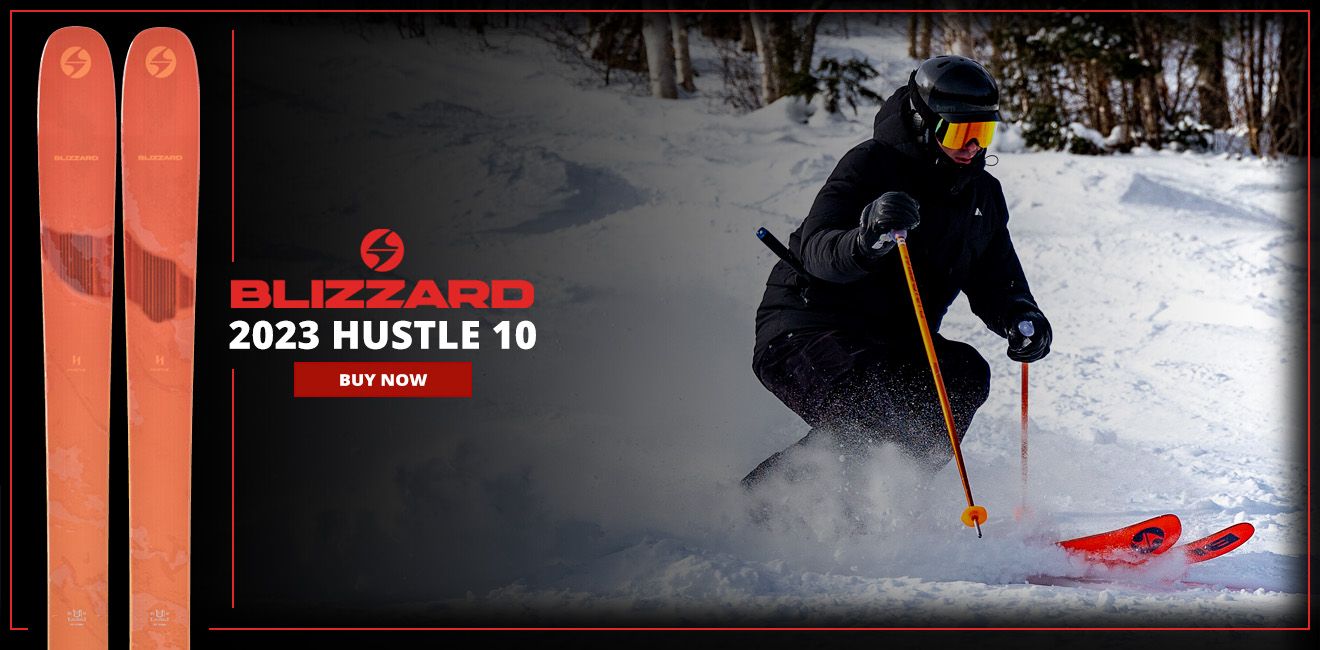
2023 BLIZZARD HUSTLE 10 SKI REVIEW
A few months ago, we shared the new 2023 Blizzard Hustle collection and our first thoughts on the skis after a handful of days on them. Since then, we’ve had more time skiing them, have had plenty of opportunities to discuss them among our staff and Ski Testers, and recently decided it would be a good time to circle back and discuss more definitive thoughts, rather than the more speculative style of our first article. In doing so, we’ll focus on one ski, which ultimately will very likely become the most popular among the three widths, the Hustle 10.
Before we get into our thoughts about performance and application, let’s touch on the ski’s construction and shape. The three new Hustle skis share the same shape with the existing Rustler line, which we’ll speak more about as we get into how it feels on snow. Shape is a good place to start here as most skiers at this point, at least most of you reading this article, should be relatively familiar with the Rustler line and what the Rustler 10 looks like. The Hustle 10 basically looks the same. It’s just a different color and you can’t see the metal laminate through the topsheet because, well, there isn’t one.
AT A GLANCE
|
|
2023 Blizzard Hustle 10 Skis |
|

AVAILABLE SIZES |
TURN RADIUS |
SIDECUT |
WEIGHT |
|---|---|---|---|
156, 164, 172, 180, 188 cm |
17.5 m @ 180 cm |
133 / 102 / 122.5 mm |
1780g @ 180 cm |
Which brings us to construction, where we start to see some significant differences between Hustle and Rustler. The wood core in the Hustle skis is different than the Rustler models and borrows proven technology we’ve already seen in skis like the Brahma 88 and Bonafide 97, TrueBlend. In the Hustle skis, we get Freeride TrueBlend, which consists of a combination of beech, poplar, and paulownia. This TrueBlend style of manufacturing the wood core uses strategically located stringers of each type of wood to create their desired flex pattern in different parts of the ski. Underfoot, it’s quite stiff, then as you reach the tips and tails of the ski, it becomes progressively softer. It’s a really cool way of controlling the flex pattern of a ski and certainly is an important element in these new skis. To achieve a lighter weight compared to Rustlers, Blizzard eliminates the metal laminate in favor of carbon stringers.
So what are these things? Are they touring skis? Are they resort skis? Are they 50/50 skis? That’s been the biggest question around here. Blizzard certainly seems like they want to call them touring skis. We’re not so sure. Yes, of course they can function as touring skis, but should they be limited to that application? We don’t think so. Let’s start by looking at some weights. I grabbed a 172 cm length of the Rustler 10, Hustle 10, and Zero G 105 and put each on our digital scale here at the SkiEssentials warehouse. The Rustler 10 came in at 1850 g, the Hustle 10 at 1720 g, and the Zero G 105 came in at 1400 g. The Zero G 105 is a dedicated touring ski. Of course, there are lighter touring skis that exist, but we think it’s fair to put the "touring" label on it and call it good. For the sake of comparison, let’s put the "resort" label on the Rustler 10. Might some skiers tour on it? Sure, but certainly not many. So, taking some liberties with how we label these skis, the Hustle 10 is closer to a resort ski than it is to a touring ski, at least it is by weight.
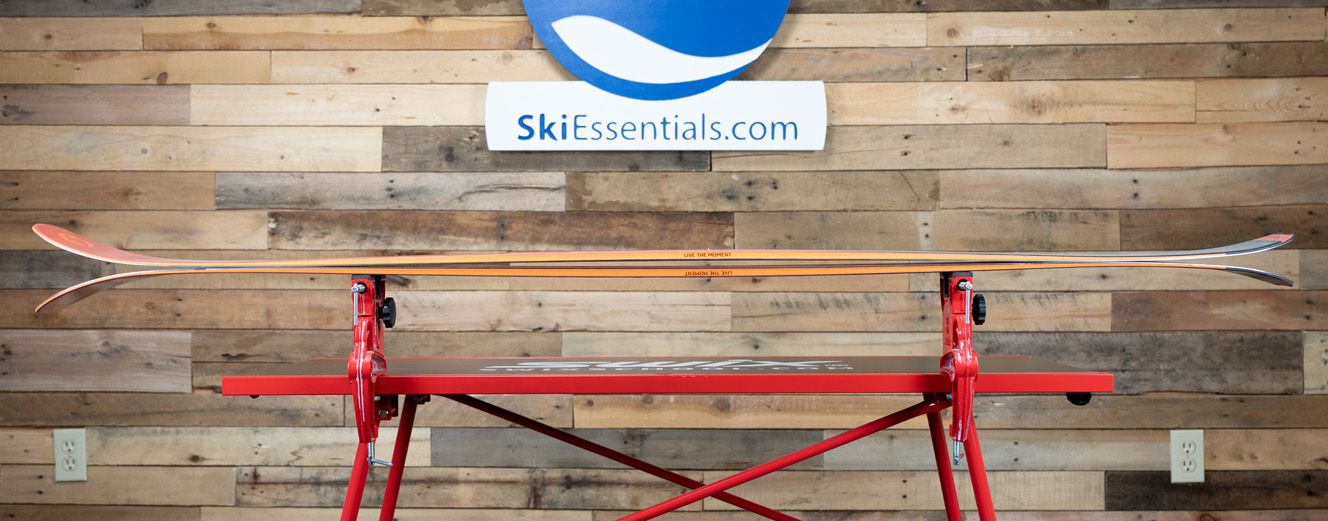
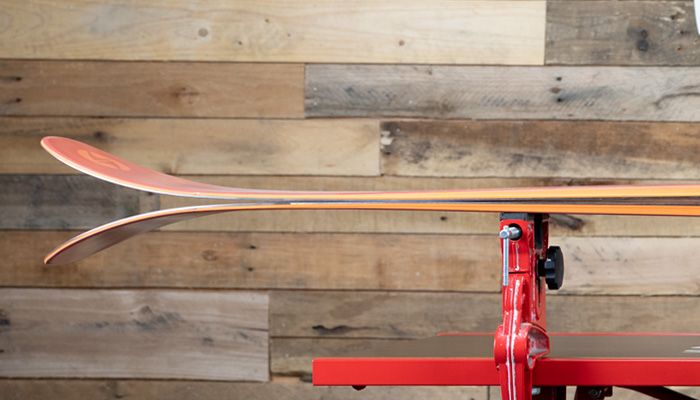
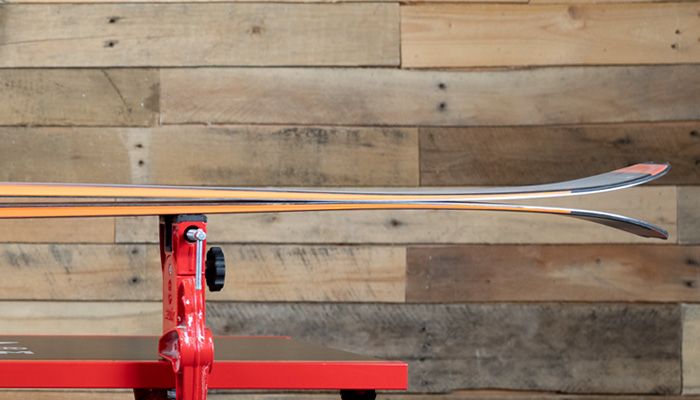
If Blizzard wants to say this is more of a touring ski than a resort ski, well, I’m just going to have to disagree with that. They might not. Time will tell. The Hustle line isn’t on their website yet and there hasn’t been a tremendous amount of public-facing content on it directly from Blizzard. In what little there has been, however, we’ve seen a lot of mention of touring and the word "backcountry" thrown around a lot. Can you take them into the backcountry? Absolutely. Can you tour on them? Of course. Can you ski them in the resort too? Well, we have, and we had a darn good time while doing so.
If anything, in our opinion, the Hustle 10 just provides a different feel compared to its brother the Rustler 10. One is light and energetic, one is heavier and has a damper, quieter feel. Perhaps the most obvious difference is that energy. Let’s just forget about the Rustler 10, Zero G 105, or any other ski for a little bit and focus on the Hustle 10. In an off-piste scenario, whether you’re in the backcountry or just off trail at the resort, it’s quick, agile, playful, springy, and a ton of fun. There’s a tremendous amount of energy in this ski and it feels like it just wants to bounce around and jump off anything in front of it. It feels light on your feet, which is extremely beneficial when you’re maneuvering it through tight terrain like bumps, trees, narrow chutes, etc. That light swing weight also come in handy when you’re slashing turns or throwing a little shifty into your airs. Not only does it love to jump off stuff, it lets you do it with your own persona style without being too fatiguing. We already know this shape floats well, and the Hustle’s weight takes that to another level. Even in pretty deep snow conditions, the tip is going to bob right back up to the surface of the snow. If you’re consistently skiing really deep snow, you can bump up to the Hustle 11, but the 10 should have plenty of float for most skiers.
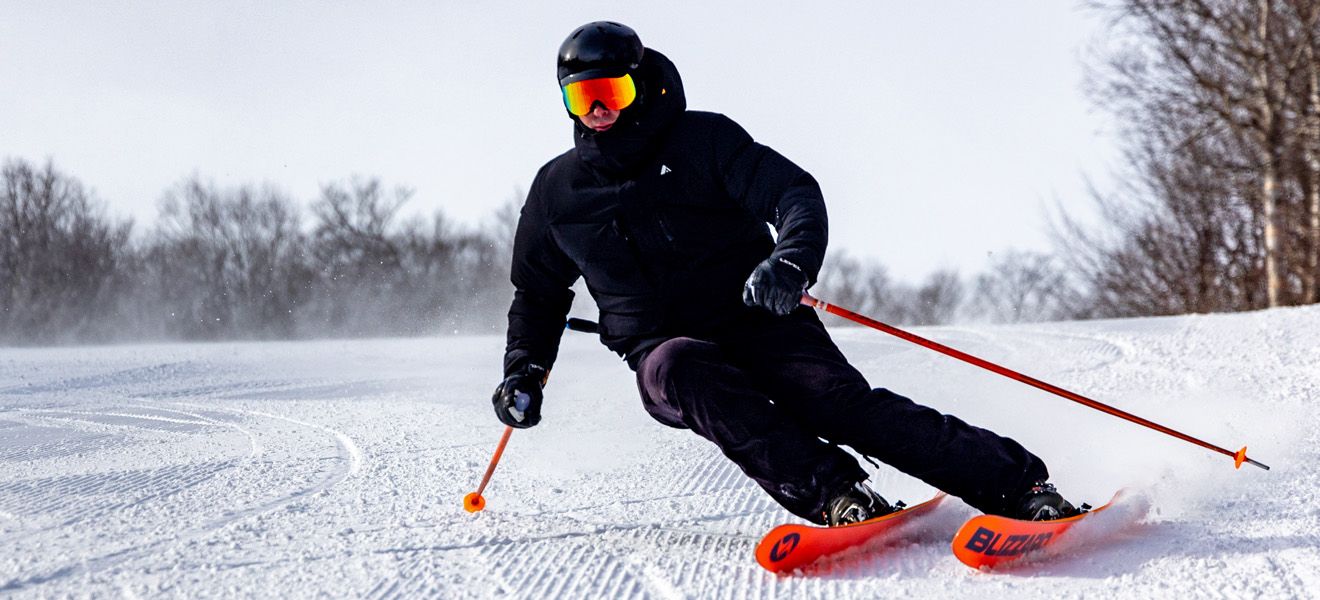
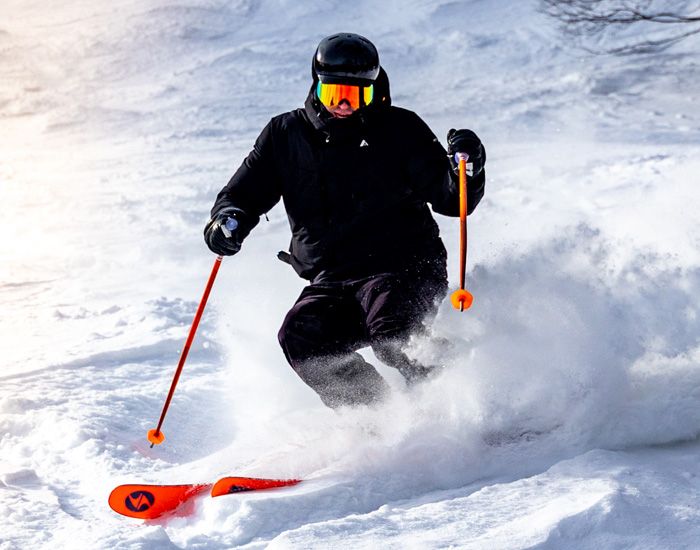
Impressively, there’s some stability to this ski too. It’s not a "set it and forget it" type of ski, basically just in the sense that you don’t want to just point it down the fall line through steep chop and let it run. It won’t track through bumpy terrain with the composure of a heavier, stiffer ski with metal. On the other hand, it’s not floppy and it gives you some nice feedback. You can push on it and it responds well; you won’t just push right through its flex when you need it to hold, which is a confidence-inspiring feature when you’re skiing gnarly lines in the backcountry or in un-groomed portions of the resort.
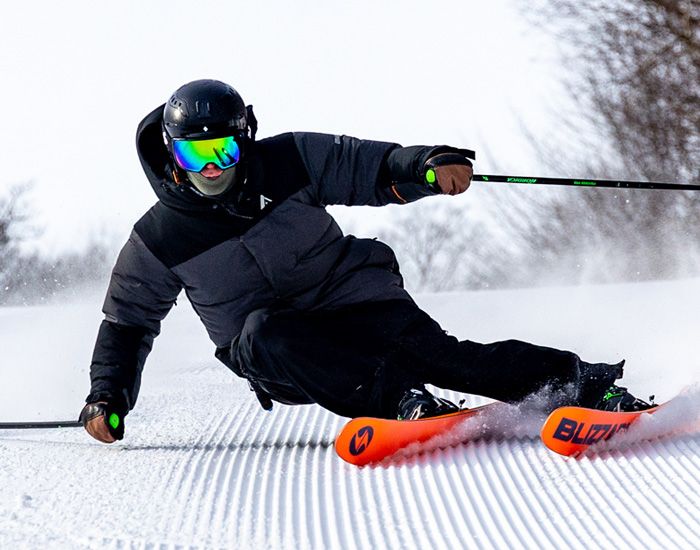
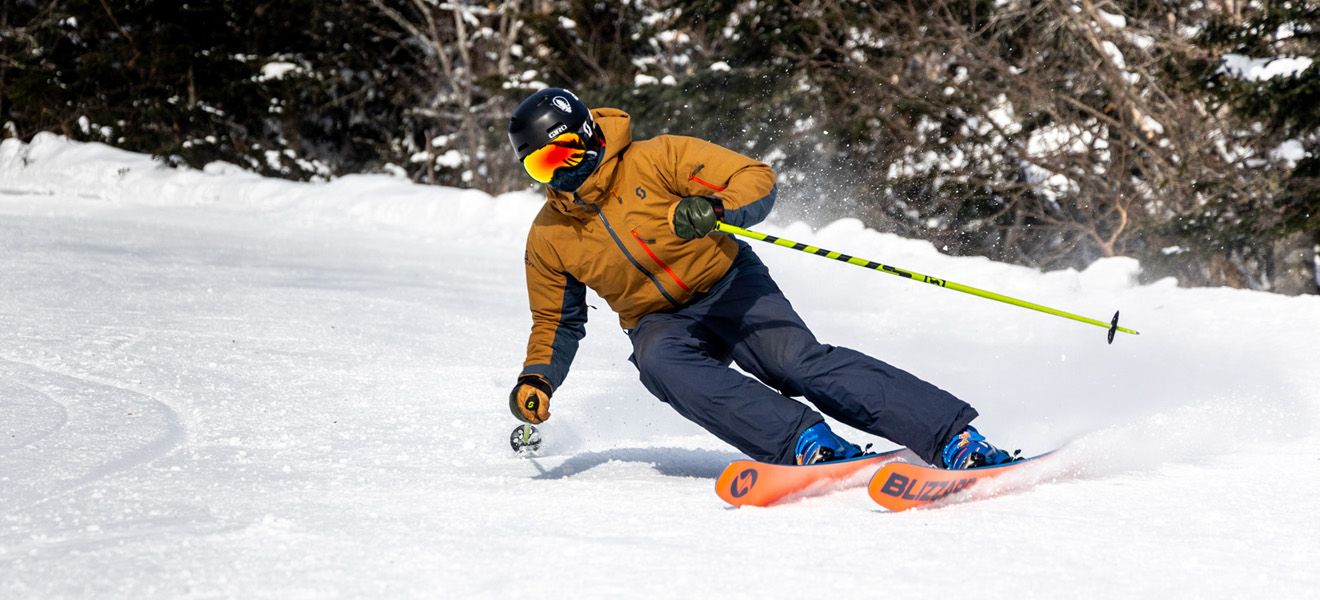
That strength comes through on firmer conditions too. I’m not going to sit here and pretend carving is the highlighting feature of this ski, but I’m also not going to sit here and just ignore the fact that it can lay over some pretty impressive turns. It doesn’t feel quiet and damp, it feels springy and energetic. Those adjectives stay with the ski regardless of where you take it. Its fun factor in off-piste terrain carries over to groomed slopes too. The way it pops you out of a turn is very rewarding. Of course, its shape utilizes quite a bit of rocker, which means edge release is quick and easy. That’s not just on firm snow, either. Even in deeper snow, the ski has relatively easy edge release. It’s not as surfy as some skis with longer tail rocker, but it allows you to throw the skis sideways when you need to, and you’re never going to feel locked into a turn.
As has become customary, let’s hear from Bob too. Before I drop in his thoughts, however, I would strongly encourage you to watch the video review for this ski. It’s an interesting conversation trying to put a label on this ski, and I think that conversation comes through better in video than written text. Anyways, here’s Bob:
The Hustle 10 is an interesting ski from a few different perspectives. From the outset, it's difficult to differentiate it from the Rustler 10 due to the similarities in shape and profile, but a closer look at the construction and application make the Hustle 10 stand apart, and in mainly a positive direction. Let's ignore the touring side of the ski for a moment and just focus on resort/in-bounds skiing. The TrueBlend Freeride wood core is very sophisticated, and since Blizzard has found success with TrueBlend in other skis in their lineup, it makes sense to use it here. It doesn't feel like a lighter Rustler 10, it feels like a totally different ski, and the wood core is mostly the cause. The Carbon laminate, in lieu of the metal of Rustler, adds considerable energy to the ski, so if you're looking for something bouncy, fun, and springy, the Hustle 10 is a better choice. In fresh snow, this ski is a total blast--floaty, smeary, and fun. At the same time, when you get this 104-mm waist ski on the groomers, it's a surprising carver as well. It doesn't have the same damping properties as Rustler 10, but for its weight and width, it punches above its level for sure.
Back to touring and the marketing of the ski, I'm still not quite sure what the benefit is here. Yes, it's a lighter ski than Rustler 10, but it's still not "touring light" (1780 grams versus 2020 per ski in the 180). It definitely falls more into the 50/50 category, and the consideration of a boot and binding plays in heavily with how you're going to use Hustle 10. Paired with a Cochise 120/130 boot and a Duke PT or Kingpin binding, you're able to use these as the marketing department intends: skinning in the morning and lift riding in the afternoon. In reality, I think that's a pretty small percentage of people who will actually use this setup in that manner, especially given the cost of the entire package. You're looking at well over $2K for the skis, boots, and bindings, and that's not including other touring gear, not to mention a ski pass, as the second part of the notion is that you'll be able to ski these in the resort as well. I think most skiers should/will gravitate towards using these mainly as lift-served, and that's fine--you can put an alpine binding on them and use an alpine boot, and they'll do great. The bottom line is that no matter where this ski fits into the marketing aspect of the catalog, I had an absolute blast skiing on these, and I didn't tour at all. Same can be said for my Nordica Enforcer 104 Unlimited--an awesome ski, whether you're riding lifts or skinning for your turns.