


Top Five Fridays: August 23, 2024
Last week, this gondola was owned by POWDR. This week, it’s been sold to the two local investors who just purchased Killington Resort. Image: Killington Resort on Facebook
#1: Breaking News: POWDR Corp Sells Killington Resort & Pico Mountain, While Putting Three Other Resorts Up for Auction:
Hello, and welcome to Top Five Fridays, the August 23, 2024 edition! This week we’ve got a dual themed double header, as we kick things off with ski resort sale and acquisition news before turning the page to focus on a pair of more competitive highlights. Getting things underway of course, is the biggest news of the week: POWDR Corp is selling off several ski resorts.
Yesterday morning, news broke that Killington Resort and Pico Mountain had been sold by POWDR Corp to a group of local investors. Immediately after that, it was also made known that the parent company will be listing Oregon’s Mt. Bachelor, Colorado’s Eldora, and British Columbia’s SilverStar Mountain for sale as well. Now, since this is a bit of a two part story, let’s take it a step at a time, starting with the Killington news.
The announcement of Killington and Pico being sold to local investors was met with both shock and excitement by locals. Since acquiring the resort back in 2007, most would agree that POWDR’s management of the resort has been favorable as they’ve overseen significant renovations and upgrades, such as the new K1 lodge, as well as the return of World Cup ski racing on an annual basis. Still, there's excitement surrounding the sale, as the acquisition by two local passholders puts Killington’s new ownership in rarefied air: it’s one of the only resorts in the industry to move from a large parent company, back into independence. While in many cases, a move like that could be perceived as a financial red flag and bring about concerns regarding the viability of the business, the situation in Killington is quite different. Not only is the resort itself not struggling, but the base area and town that support it are in the early stages of significant development. Once completed, Killington will feature a robust base village, improved infrastructure, and of course, close proximity to Boston. In other words, not only does the future look bright and relatively safe for Killington’s new investors, but many have found it downright shocking that POWDR would sell the resort at a moment like this.
Speaking of POWDR’s decision to sell, let’s get into the other half of this story. Along with the sale of Killington, POWDR also announced intentions to list three of its other resorts. Once removed, that will leave POWDR with Boreal Mountain Resort and Soda Springs ski area in California, Copper Mountain in Colorado, and Snowbird and Woodward in Park City, Utah. In other words, they’re looking to reduce their portfolio of ski resorts by about half. Such a drastic reduction naturally leads to the question, “what’s going on with POWDR?” While we certainly don’t know the ins and outs of that answer, we do know that POWDR appears to be pivoting into less snow-dependent businesses. In addition to their ski resort holdings, POWDR also owns and operates Woodward - a series of action sports camps and facilities scattered across North America, as well as Sun Country Tours, a whitewater adventure service. Perhaps most telling though, is the company’s recent forays into the world of concession operations. Back in January, POWDR picked up a contract operating the concessions at Death Valley National Park, and in May picked up the concessions contract at Zion National Park in Utah. Again, while we don’t the specifics behind these contracts, we do know that each one is guaranteed for ten years, payable by the U.S. Government. As we know in the world of ski resorts on the other hand, pretty much nothing is guaranteed for ten years - a fact which likely played a significant role in POWDR’s decision to pivot.
To learn more about the latest from the world of Killington, we recommend giving their press release a head, right here. To learn more about the latest from POWDR, check out their recent press releases here. Finally, to read about it in the format of a news report, check out the writeup over on Colorado Sun.
#2: New York’s Big Tupper Ski Center is Headed to Auction After Recent Supreme Court Decision:
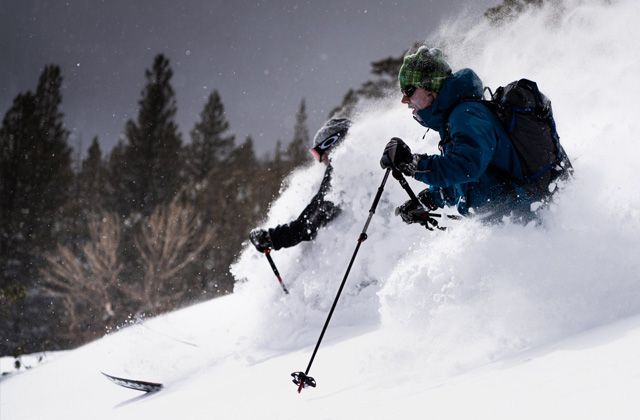
Here’s a quick fun fact to emphasize just how special of a place Big Tupper is: Robb and Scott Gaffney were born in Tupper Lake and grew up skiing at Big Tupper. Image: Ski Big Tupper on Facebook
In other “ski areas for sale” news this week, we caught an update coming from our neighbors in New York, where a Supreme Court ruling has just decided that the once bustling ski area of Big Tupper has to be put up for public auction. Prior to this week, the hope in the area was that the town itself would be able to require the shuttered resort by simply paying off its tax debts. Now, before we dive into the details of this week’s news, let’s set the scene with a quick history lesson. Uniquely located quite literally in the heart of the Adirondack Mountains, Big Tupper was an economic anchor for the town of Tupper Lake from 1960-1987. Then, from 1987 through the early 2000’s, things got a bit shaky as the ski area changed hands multiple times. Finally, in 1999 the resort shut down, with only brief moments of activity through the mid 2000’s. Still, due to both its local importance and its incredible location on the outskirts of the Adirondacks High Peaks region, many believe and have hoped over the years that the ski area could not only reopen, but transform itself into a full blown resort. That belief climaxed in 2015, when plans for the “Adirondack Club and Resort” cleared their last legislative hurdle and plans to develop 600 vacation homes and condos in the area was approved. Unfortunately, that never came to fruition as the developers ultimately ran into financial issues and the four parcels of land once owned by them went into foreclosure. This, more or less, brings us to this week’s news.
This week, it was announced that Franklin County executives will be forced to put the 240 acre parcel of land that’s home to Big Tupper up for public auction. This comes as a disappointing surprise to locals and the town’s government, who were optimistic that the area would come to be owned by the town. Unfortunately, because there are liens on the property, the Supreme Court ruled that the ski area has to be publicly auctioned off so that as much money as possible can be recouped and paid out to lien holders. As such, visions of a community owned ski resort are out the window, and what’s left is a general nervousness about what happens next.
With the auction expected to take place this fall, there are plenty of questions regarding who might acquire the resort. While town ownership was the easy answer, financial burdens and uncertainties surrounding the entire property make the answer to those questions unclear. For starters, due to how long the resort has sat idle, it’s expected that it will cost millions in upgrades before the resort could operate again. Additionally, while the development plans approved in 2015 could potentially be re-visited, 5,800 of the approximately 6,000 acres required are currently tied up in separate legal dealings and aren’t a part of this sale. In other words, what’s being offered in this auction, is the specific parcel of land being occupied by a ski resort that’s been shuttered for 25 years, and one that could be tremendously expensive to reopen. That makes the list of potential buyers relatively short. While we’re inclined to think that this could be a good opportunity for developers interested in running with the private ski resort model, à la Stagecoach, not knowing the fate of the additional 5,800 acres could put a serious wrench in that concept. As such, it’s really anyone’s guess as to who buys the ski area, and what its future will bring. For now, you can know all there is to know about this latest announcement by checking in with the Adirondack Explorer.
#3: Tech Entrepreneur Makes a Significant Investment in the U.S. Skimo Team, Launching “Project Podium”:
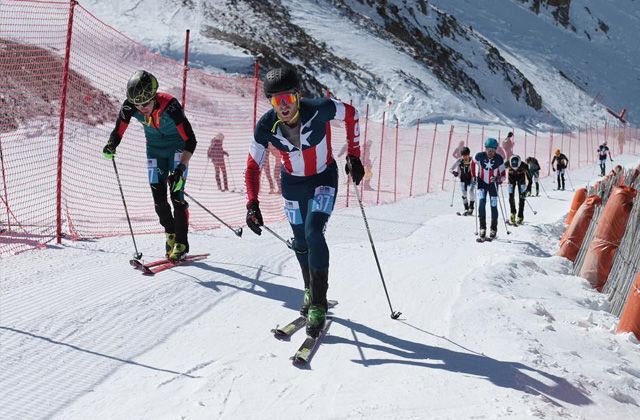
Despite ski touring being relatively popular here in America, the sport of skimo has lacked the type of support that European athletes receive. Now, ahead of the 2026 Olympic games, a new initiative is looking to change that. Image: USSMA on Facebook
Alright, enough resort talk, let’s flip the script and move onto our second theme this week: competitive skiing. Getting things started on that front is some very exciting news from the world of ski mountaineering, where the U.S. team is finally getting some much needed financial support. As you likely know, in 2021, the IOC approved the inclusion of Ski Mountaineering, or “skimo” for short, in the 2026 Olympic Games. Fast forward to the 2023/2024 season, and athletes on the United States Ski Mountaineering Association (USSMA) team - the official team of the United States - were still struggling to afford participating in the World Cup circuit in Europe. Not only that, but the USSMA itself was run entirely by volunteers, with its limited funding coming by way of membership fees and occasional donations. In other words, despite being a nation in which numerous disciplines of skiing and snowboarding are backed by strong support systems, the sport of skimo has been severely underfunded and overlooked. That is, until this week.
Making headlines this week is the announcement that tech entrepreneur Mike Paulus has made a significant donation to the USSMA, allowing it to transform its efforts by way of a program it’s calling “Project Podium”. The goal of this project is exactly what you think it is: for the U.S. skimo team to show up at the 2026 Winter Olympics, and land on as many podiums as possible. For a team that’s been lacking in funding, that concept’s been something of a longshot. Now, there’s a chance.
With Paulus’s donation, Sarah Cookler has been hired as the USSMA’s Head of Sport, the first time the organization has had a full time employee. In the newly created role, Cookler will have two tasks: earn Olympic podiums, and grow the sport at a grassroots level. For the first of those two challenges, Cookler will begin by fully funding the team’s top athletes as they travel and compete in Europe this winter. While this might seem like a given, it’s the first time U.S. skimo athletes won’t have to worry about paying for at least part of their travel expenses. Additionally, Cookler plans to hire coaches and support teams to help develop the top athletes - another first for the team. As for the second challenge? That’s a much bigger task, but one that Cookler has a jumpstart on, having founded the Silverfork Skimo team, a youth skimo team based out of Big Cottonwood Canyon, Utah. All in all, it’s an exciting time for the sport, which seems to be on the verge of an inflection point in which substantial growth is possible. Or, in the words of Mike Paulus himself, “The combination of impressive new leadership and the Olympic opportunity provide a once-in-a-generation opportunity to grow the sport both at an elite performance level and mass participation.” If that doesn’t get you fired up about Project Podium, we don’t know what will. To learn more, check out the report from Powder.
#4: New Zealand’s Winter Games, Often Called the “Mini Olympics”, Serve as the Perfect Appetizer for Winter:

Starting today, the biennial Winter Games NZ will feature up and coming pros at the FIS level competing across the alpine, freeride, and freeskiing disciplines. If you’re hungry for winter to start, consider this your appetizer! Image: Winter Games NZ on Facebook
Finally, we’re rounding things out this week with an “awareness highlight,” as we feel compelled to let you know that New Zealand’s Winter Games are set to kick off next week, running through the 8th of September. Occurring every two years and given an “olympic format” in which nations compete for medals across several categories, the Winter Games NZ are set to return for their eight iteration. Over the years the sports that have been included have evolved, with this year’s iteration mirroring what we would consider the most exciting FIS sports to watch. Kicking off the games this time around are a 2* Freeride event at Treble Cone resort from August 23-26th, and a 4* event at The Remarkables Ski Area from August 24-29th. From there, the action continues as a series of Giant Slalom and Slalom races will be held at Coronet Peak from August 27 - 31. Meanwhile, over at Cardrona Alpine Resort, Slopestyle and Halfpipe events will be held for both skiing and snowboarding, from August 26th - September 8th.
In addition to the fact that this series serves as a nice intro to winter for us in the Northern Hemisphere, it’s also a pretty cool opportunity for athletes at the lower levels of the professional circuit. Now, that’s not meant to be a knock on any of the competitors of course, but more a statement regarding the low barrier to entry, as well as high value cash prizes. Consider this, for instance: the eligibility requirement for freeski halfpipe is 10 FIS points. Now, the Winter Games NZ only accepted applications from national teams, so athletes do need to be represented by the USST or their country’s equivalent, but the point stands: compared to the World Cup level, the Winter Games NZ are much easier to get into, and as such, provide immense opportunity for up and coming athletes to prove themselves. And if they do? Well, there’s a decent amount of money up for grabs, with the cash purse for Freestyle events being approximately $36,000 per category. All in all, it’s a pretty cool event, and certainly one worth watching as temperatures slowly drop here in North America and our minds begin wandering into winter territory. To learn more about the schedule of events, visit the Winter Games NZ website.