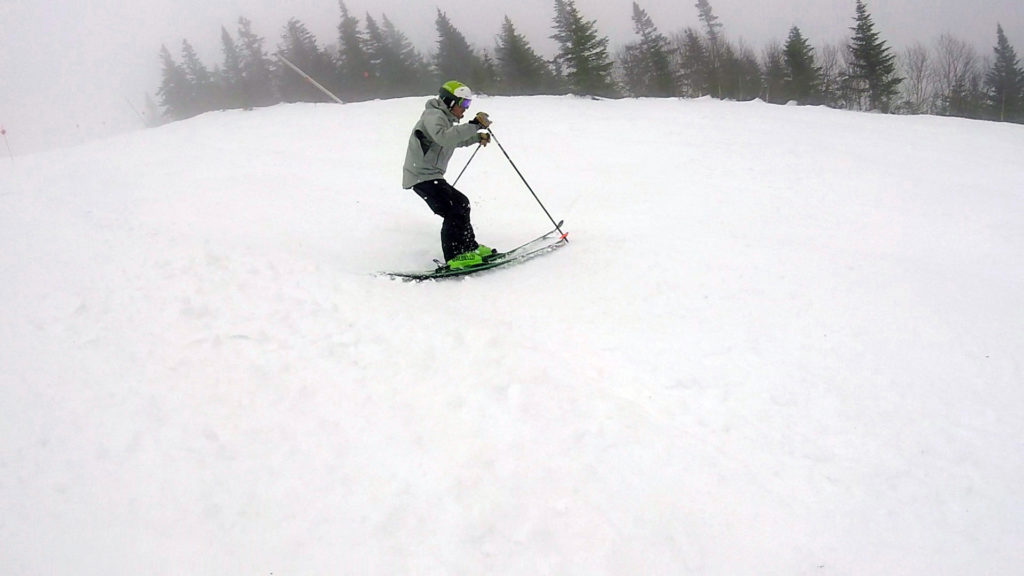


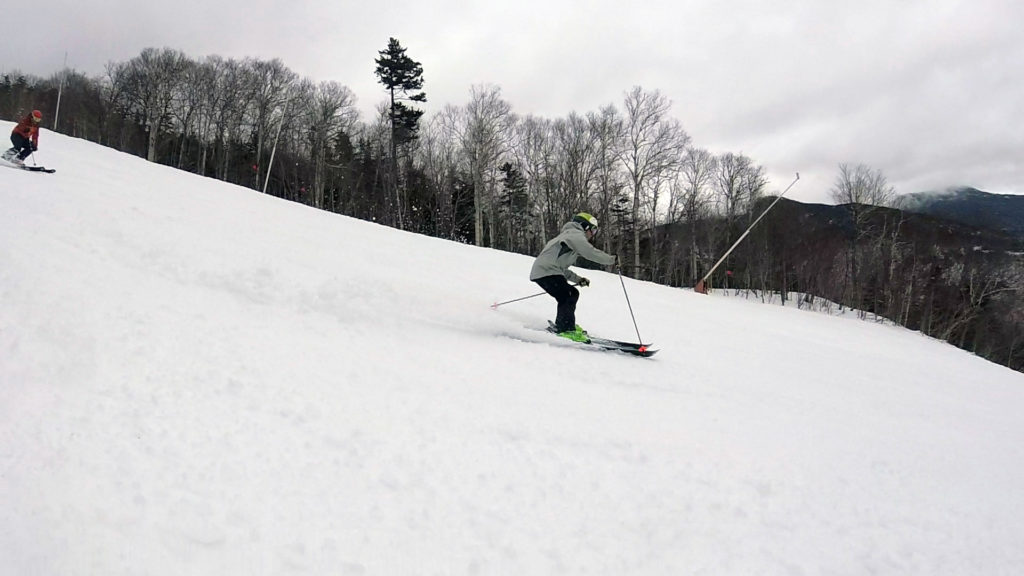
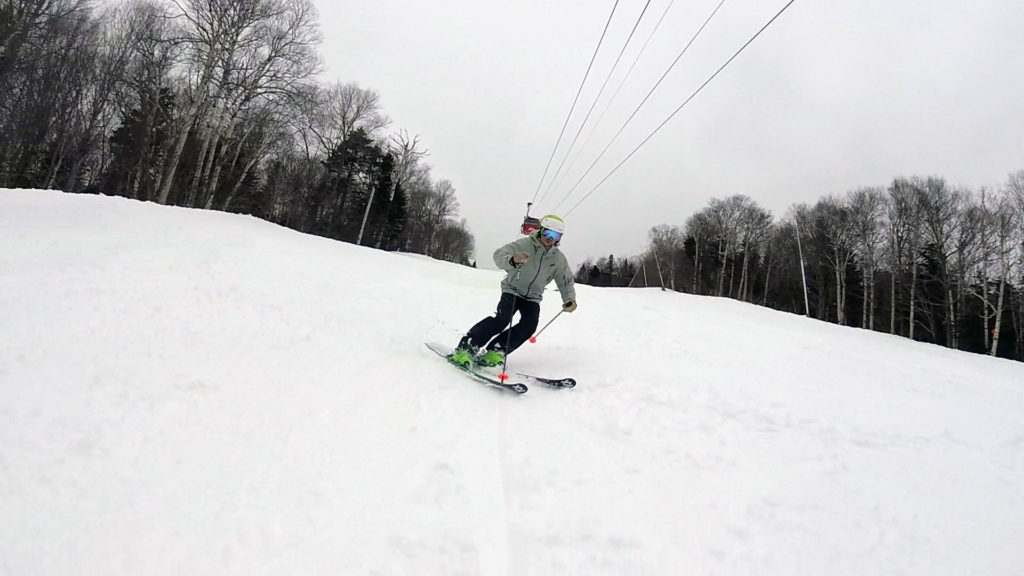

The Volkl Kanjo was introduced for the 2018 ski season and offers a lighter, narrower option compared to traditional Volkl all mountain skis. The Kanjo has an 84 mm waist width, is cambered underfoot with tip and tail rocker. It’s not high rise rocker, however, it’s relatively subtle. There is also some early taper in the tips and tails, which is more pronounced in the tip, but not drastic. It matches the subtleties of the rocker essentially. It uses Volkl’s Multi-Layer wood core and their Titanal Band construction. Instead of a full sheet of metal (or two as we see in the Kendo), there is a single strip of metal that runs through the center of the ski. This sheds almost 400 g compared to the Kendo, so it’s significantly lighter.
Dave Raybould tested the 175 cm length and admitted that he, “preferred this over the Kendo.” A lot of skiers gravitate to the most powerful, strongest ski in a certain collection, but that’s not always the right thing to do. Dave found the Kanjo was “more versatile and better in the bumps” than the Kendo. The Kanjo is definitely a fun, rewarding ski. It feels like it has a little bit more energy than the Kendo and is certainly noticeably lighter, something that Dave really seemed to enjoy. He referred to it as “less tank-like than the Kendo.” Even though it doesn’t use nearly as much metal, Dave didn’t find it to be unstable. He scored it 4 out of 5 for stability as well as torsional stiffness and edge grip. Dave also rounded out his test form with a solid 4 out of 5 for overall impression, and left us with a closing thought that the Kanjo is “just a more easy going version of the Kendo.”
David Wolfgang also tested the 175 cm Kanjo, which was really beneficial as he is quite a bit bigger than Mr. Raybould. David tips the scales at 235 lbs. As ski performance is somewhat subjective, it was really valuable to get David’s reaction to the ski. A skier David’s size is more likely to push a ski past its limits of stability, which seemed to be the case on the Kanjo. “I felt that I overpowered this ski at 235 lbs.” He also mentioned that he would’ve liked a longer length and that the 175 cm felt short to him. A 182 cm would be a more appropriate length for someone David’s size. He gave it a 4 out of 5 for playfulness, with other performance characteristics receiving 3 out of 5. That really goes to show how skier weight changes performance. A skier David’s size may be better off on a Kendo simply for the increased stability.
Jeff Neagle also tested the Kanjo in the 175 cm length and his thoughts seemed to mirror Dave Raybould’s quite closely. Jeff started his feedback by saying the Kanjo “offers a nice alternative to Volkl’s skis with more metal.” One of the best things about the Kanjo is that it offers the performance benefits of metal (vibration damping, stability, etc), but is much less demanding than skis with full sheets of metal. Jeff closed out his feedback with, “The width feels great on groomers: quick and responsive. Really fun in moguls. Doesn’t feel catchy and is pretty user-friendly for the intermediate level skier looking to improve in bumps.”
We think the Kanjo is still an excellent choice for a skier who wants an all mountain ski that performs at a high level, but isn’t overly demanding or fatiguing. It’s really quite versatile. Responsive and fun on groomers, while still being relatively powerful, but it’s also quick and maneuverable in off-piste terrain. Performance in moguls is definitely one of the highlights; the quick edge to edge feel and smooth, catch-free feel provided by the early taper will make you feel like a mogul-skiing Rockstar.