


2024 LINE BACON 108 SKI
Line has made some interesting moves with their Bacon 108 re-design. This ski follows closely on the heels of the previous Sir Francis Bacon but brings some new technology and shaping principles into the fold. The Bacon has had a loyal following over the years, not only from us, but also from fun-loving freestyle skiers who love the smeary wide-bodied twin tip that dominates the soft snow. One of the big changes, and we’re not sure how the general public will feel about this quite yet, is the removal of the convex tips and tails in favor of their new Thin Tip Technology. The convex shaping was unique in that it extended the surface area of the ski without widening it, making it smooth, smeary, and surfy in fresh snow and insanely wiggly in the trees and tighter spots. Overall, the general character and personality of the ski remains similar, but the convex shaping was one of the more interesting aspects of the outgoing ski, and again, we’re intrigued as to the public’s reception of these changes.
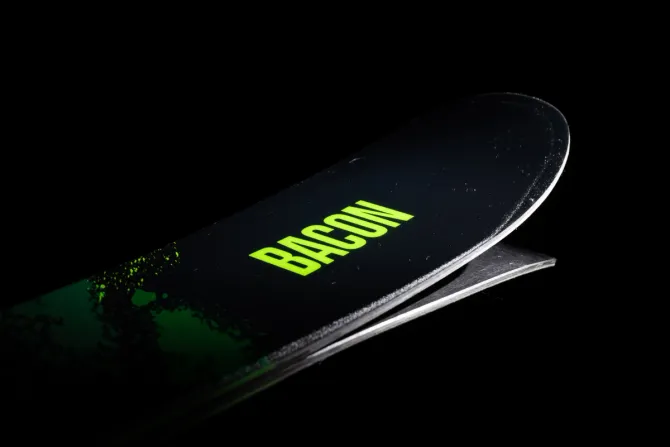
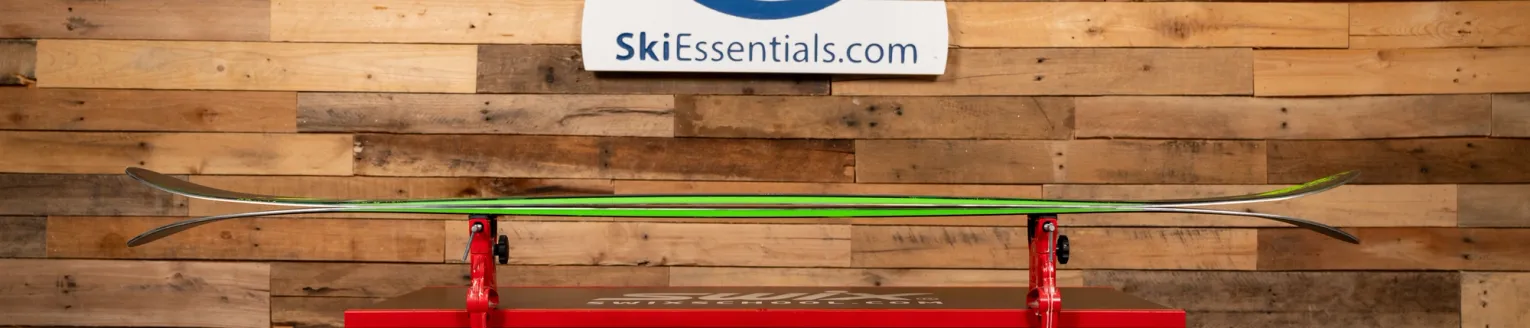
Like Line’s Blend, the Bacon is built with a maple macroblock wood core, generating an incredible amount of flex while keeping the ski’s overall poise intact. By removing the paulownia that was involved in the Partly Cloudy core from last year, it’d be fair to say they’ve moved to the more bendy side of the spectrum. That said, they’re able to adjust the thickness of the core in order to achieve the desired effect. It’s thicker underfoot, tapering to very thin ends, with the implementation of Thin Tip technology. This allows them to strategically reduce the wood core’s thickness to make it surfy in soft snow while remaining rugged enough underfoot to withstand aggressive skiing in big mountain situations and applications. It’s even so thin that in the very last centimeter or two in the tips and tails, there’s no wood at all, rather the base and the topsheet are stuck together by Line’s new Bio-Resin. The Thin Tip is the answer to the outgoing Convex shaping, and in more of an all-mountain format, we think it makes sense. These skis feel light on the feet, but on the scale they’re still on the hefty side at 2180 grams per 184 cm length.
| Length | Radius | Sidecut |
|---|---|---|
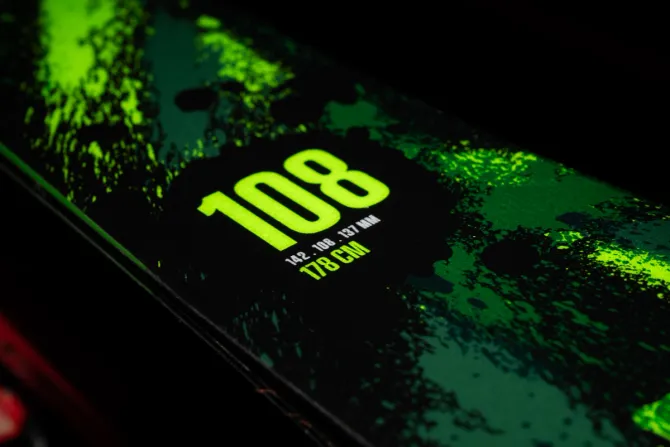
| 166, 172, 178, 184, 190 cm | 17.4 m at 184 cm | 142/108/137 mm |
| Construction |
|---|
| Maple Macroblock |
| Thin Tip |
| Thick Cut Sidewall |
| Preferred Terrain |
|---|
| Powder |
| Natural Features |
| Trees |
Shaped with a fairly dramatic rocker profile and taper shape, this is where the Bacon feels right at home. The tips and tails are pretty sharp and pointed, and in the soft snow, that assists with creating a smooth and flowy feeling in a variety of formats. It cuts right through the crud, chop, and fresh with ease and poise. The rocker profile is symmetrical, with a long and steady bend in both tips and tails. The shape is pretty darn similar as well, with 142 mm tips bookended by 137 mm tails and the 108 mm waist. This drop of 5 mm in such a wide ski isn’t a whole lot, allowing the ski to feel very well balanced and easy to drift. Overall, this ski is best suited for soft snow, and while the 17.4-meter turn radius can be used to carve a deep arc on softer groomers, the shape and the build keep it mainly planted in the soft snow spectrum.
We’ve loved Line’s commitment to having fun on skis for quite some time now, and the new updates to the Bacon reinforce those sentiments. While some of the changes may make the traditionalists wonder if it’s the right move, all we can say is that in a vacuum, the ski is awesome. If you didn’t know about the older version, and all you wanted was a playful freeride ski, this one would fit that bill with ease.