2025 Liberty Scope 94 & Scope 104 Ski Review
For 2025, no company has made bigger changes to their overall lineup of products than Liberty. We see a handful of new and re-vamped products all over the place, but by and large, skis like Blizzard Anomaly are still at least somewhat similar to their outgoing Brahma and Bonafide models. Liberty changed everything. By switching production facilities from China to Europe, everything from materials to molds is totally different. On one hand, this is a lot of fun because we get to learn about how a ski manufacturer basically starts from scratch. On the other, many of the concepts and technologies we’ve talked about for the past half decade are now gone—some of them we really liked—so it’ll be interesting to see how the market responds. For us, the move by Liberty results in the creation of two entirely new ski lines—Radian and Scope. Of these, the Radian more closely follows the character of the Evolv series while the Scope picks up where Origin left off. There are women’s versions of these two lines too, Horizon and Scope W, but they are smaller than the men’s series in terms of number of models. For a bit of carryover, Helix returns in name, but those skis get an update as well. For now, we’ll focus on the two main Scope models, the 94 and 104.
Both models share the same construction, so it’ll be easier to start there before moving into shape and performance. The first thing we took notice of is the lack of bamboo in these skis. Moving production means sourcing different raw materials. Since Liberty had previously built skis in China, bamboo was more readily available. Now that the factory is moved to Europe, Liberty acquires more locally grown wood. In the case of Scope, we get a mix of poplar and ash in the core. Ash, which is normally reserved for higher performance race skis, is an interesting choice here as it’s normally used in denser and heavier skis. Scope is neither dense nor heavy, so they must mill the stringers down to an acceptable thickness. We see this with other hyper-flexible skis like the Line Blend. Those skis use Maple, but maple is very hard, so how do they make them flex? The answer is in the thinness of the stringers or layers. In this case, the ash wood is used as a strengthening agent, but it’s not the main ingredient. The poplar does most of the work here in terms of making the ski lighter and more agile. Underfoot, Scope uses Phenolic Composite plates to stiffen the mid-section of the ski. Phenol is a stiffer plastic than the ABS material used in the sidewalls found on these skis, but it’s a good way to think about Phenol as a substance. Most race skis use Phenol as a sidewall material because it’s stiffer, but it can be harsh on normal skis, especially flexible ones like these. In a longer and thinner manner, it can also be brittle, so there aren’t many non-race skis that use Phenol sidewalls. But, in a horizontal laminate like the composite plates in Scope, a material like Phenol makes a lot of sense. It serves as both binding retention as well as increased underfoot stiffness and responsiveness. With more flexible tips and tails, it’s helpful to have a strong presence in the mid-body of the ski to keep the skier attached to the firmer snow of the mountain. In the 180, the Scope 104 sits on the scale at 1760 grams per ski—pretty light for a 104, and almost 200 grams less than the outgoing Origin 106 in the 182. There’s no more bamboo, no vertical metal struts, and no carbon in this ski. As a result, we’re seeing a considerably softer flex in Scope than we ever did in Origin.
At a Glance:
2025 Liberty Scope 94 Skis

| AVAILABLE SIZES | TURN RADIUS | SIDECUT | WEIGHT | PRICE |
|---|---|---|---|---|
| 164, 172, 180, 186 cm | 19 m @ 180 cm | 130 / 94 / 118 mm | 1,590 g @ 172 cm | $699.99 |
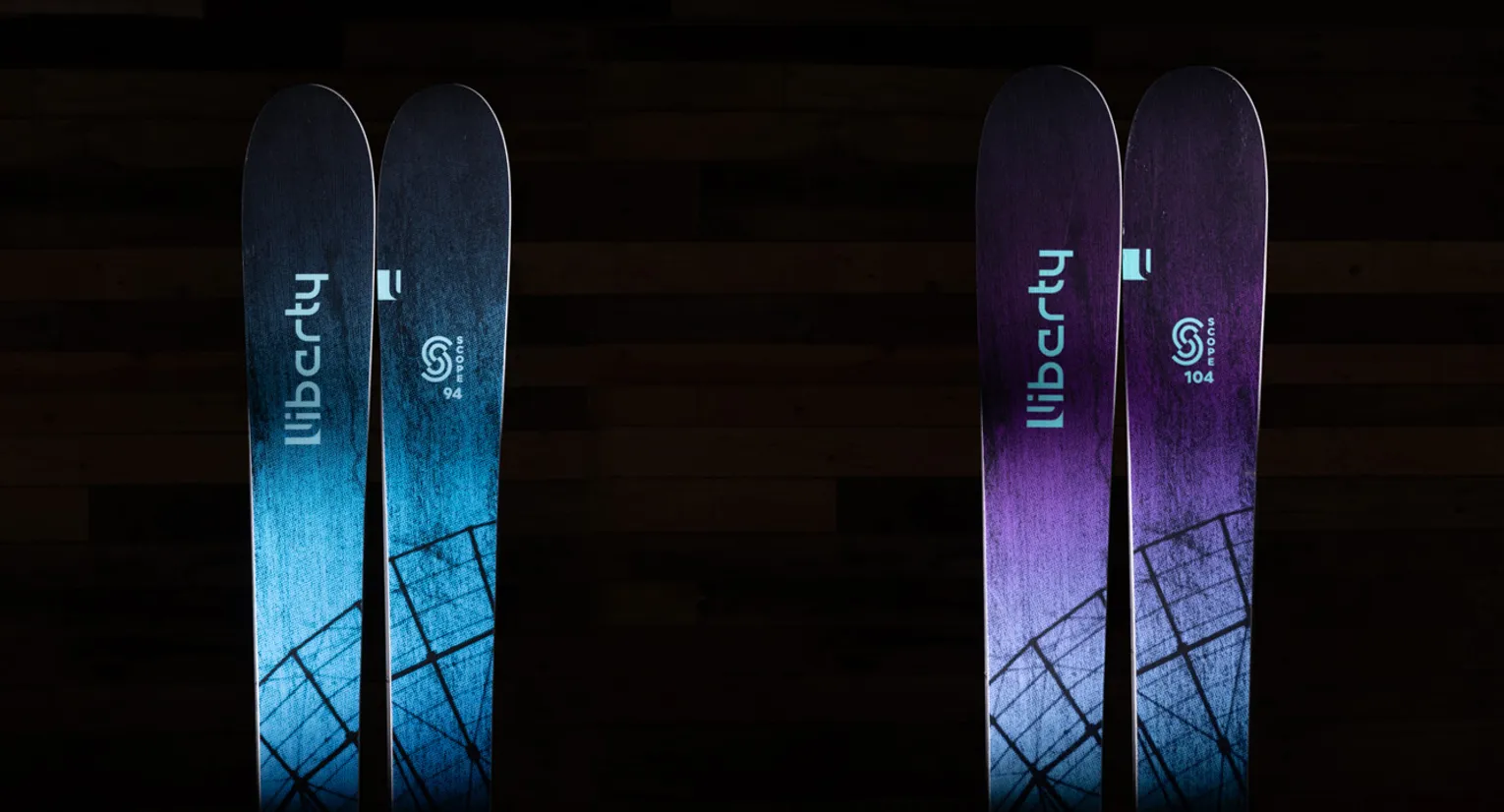
For shape, the overall ski has a lot to offer from a freestyle perspective, moving a bit closer to Helix and further from Origin. The 104 certainly has more of a powder aspect to it while the 94 fits more to the all-mountain side of the spectrum. When combined with the flex, though, Scope has a lot to offer tree, bump, and off-piste skiers in terms of versatility and accessibility. In the 104’s 180 cm length, the skis produce a 20-meter turn radius with the 188 hitting 22.5-meters. This longer arc helps skiers dictate shape, duration, and style. It’s a bigger deal in a more flexible ski as the skier has an easier time bending the ski to adhere to a certain radius. In stiffer skis, it doesn’t matter a whole lot because they’re going to want to turn regardless of what you say. With measurements of 134/104/124 mm, the 10 mm drop in tip to tail taper is enough to make it directional and smooth in crud and chop. In the 94, we get a slightly shorter turn shape of 19-meters in the 180 and an 11 mm drop in tip to tail width.
Even with the more freestyle-oriented identity, the 94 still leaves a lot of room for symmetry, of which the Helix range is happy to pick up the slack. Due to the narrower waist and overall footprint, the 94 does have an edge when it comes to carving power and grip. On the other hand, the 104 is a better floater and is happier in softer snow situations. It’s not as quick from edge to edge, but you will gain smoothness and confidence when the snow gets deep. The taper shape is one of the aspects that seems like it carries into 2025 from Origin. Round, smooth, and somewhat low in profile, this taper allows for easy transitions into and out of turns. It also makes the ski driftier and smearier when the snow gets deep. This same philosophy carries through among the widths, fitting well with these mid-widths of the 94 and 104. We always liked that about the Origin—the ski simply glided through anything soft or adverse, making it a great tool for any type of snowy day. Tip and tail splay is slightly more exaggerated than the Origin, and that’s one of the perks here—you get more of that multi-directional character and creative influence.
At a Glance:
2025 Liberty Scope 104 Skis

| AVAILABLE SIZES | TURN RADIUS | SIDECUT | WEIGHT | PRICE |
|---|---|---|---|---|
| 164, 172, 180, 188 cm | 20 m @ 180 cm | 134 / 104 / 124 mm | 1,760 g @ 180 cm | $749.99 |
This brings us to performance, and as I (Bob) skied the 104 while Jeff was on the 94, we’ll discuss these skis respectively. At first, this 104 was not a ski on my radar. Liberty had some prototype models to float to us, and we took them up on the offer. Since we had a 104 in the 188, I snatched that one up quickly, threw a gorgeous new purple Salomon Strive 16 on the thing, mounted at recommended not center, and off I went. The first few days on these skis, I used them in almost exclusively soft snow, and mainly in the trees. This was the first ski I reached for when skiing with my kids, and it worked great. The flex of the ski, especially in the tips and tails, allowed for such easy turning and maneuverability. This ski is meant to be used off-trail, so the bulk of my experience happened in that application. We have some tight trees here in Stowe, but the Scope 104 made easy work of them. This ski feels like water pouring down the mountain—it follows the contours naturally and simply. There is no resistance to anything, it just goes where you point it. Off-trail and in the woods, that’s a very fun personality trait. On-trail, this leaves something to be desired. We just finished our 2025 Nordica Enforcer 104 review before this one, and it’s an interesting comparison. Everything that the Enforcer does well, the Scope falls short. Conversely, in all arenas in which the Scope excels, Enforcer struggles. For two skis that are both in the 104 mm freeride/all-mountain realm, they could not be more different. If the snow is firm and the Scope is pushed, it simply does not have the heft and beef to maintain stability and power. It actually functions well at higher edge angles on groomers—something I was not exactly expecting, but certainly wasn’t complaining about. When you get it up on edge, you can feel the sidecut come to life and you can harness the mass and width of the ski. There’s not a ton of pop or pep out of the tail, so don’t expect massive rebound out of a carved turn. That said, I can’t think of an easier ski on which to ski the woods. While this won’t be the ski that I reach for on a firm groomer day, I can’t see myself passing it up if adventure and exploration are on the docket.
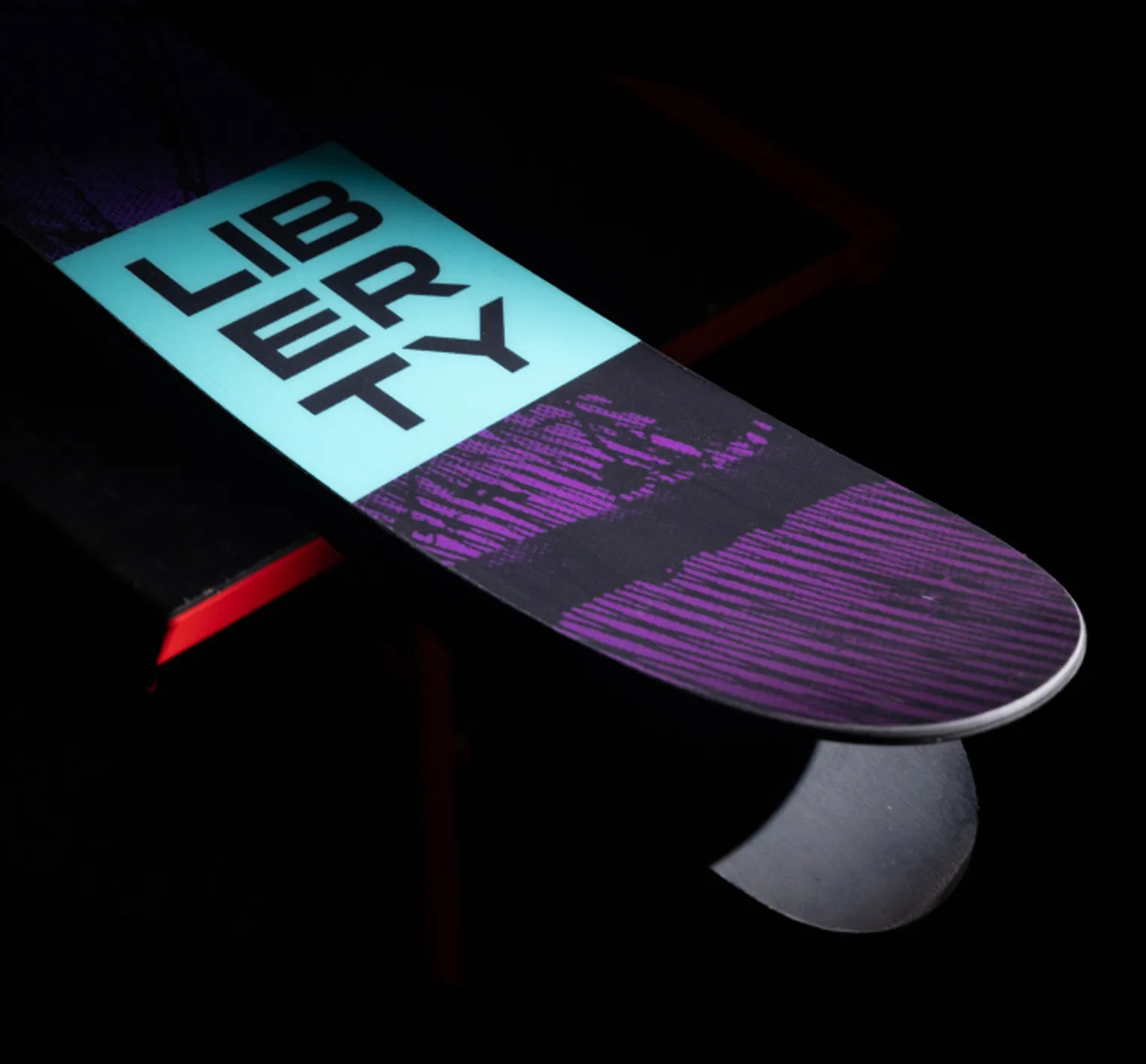
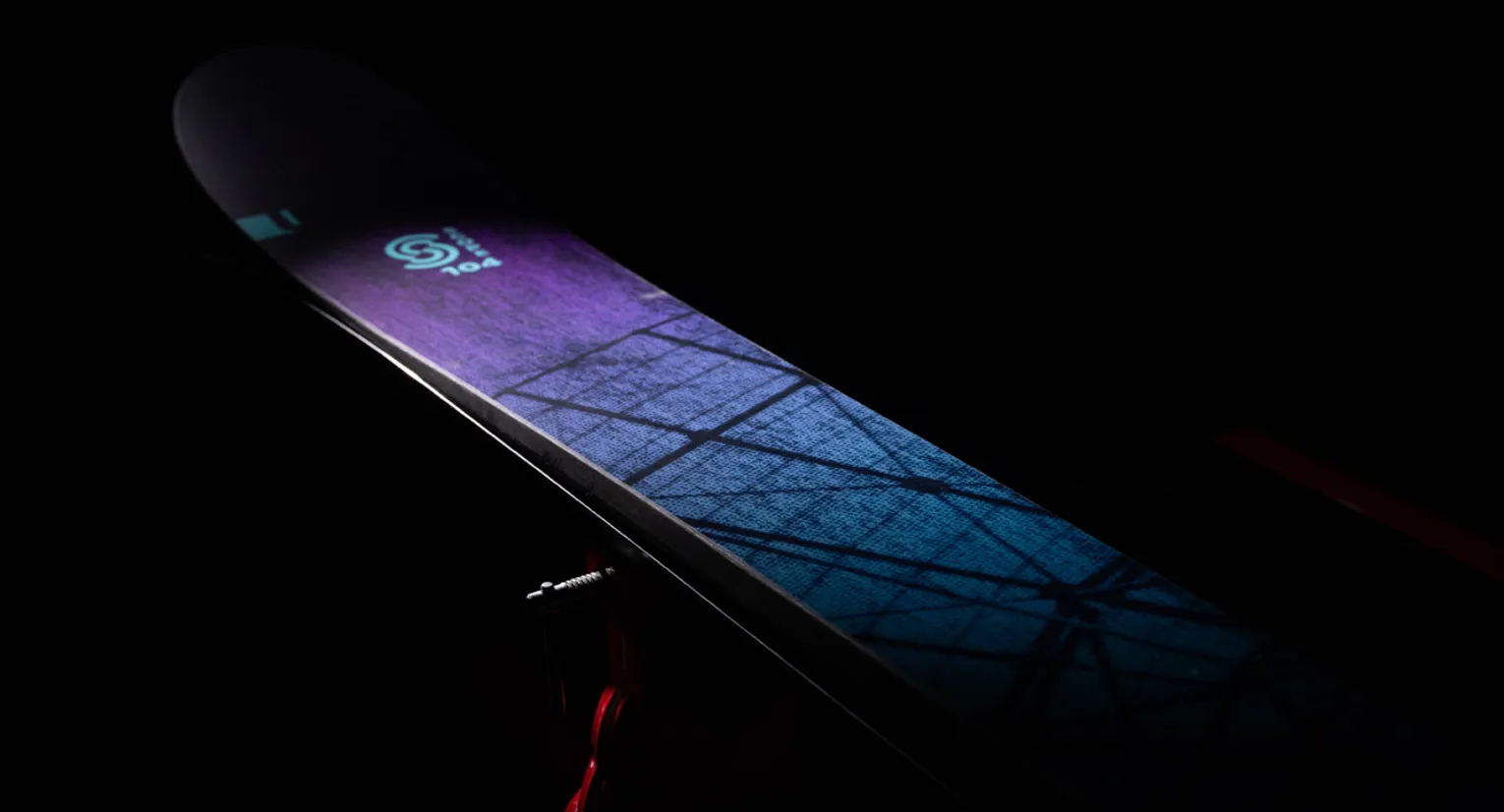
Jeff’s Experience With the Scope 94:
I (Jeff) grabbed the 180 cm Scope 94 as it felt like that width and length aligned perfectly with what I like to do on the mountain and with other skis I had been testing this year. I’ll admit I was surprised to see there was a mark for mounting true center. With the existence of the Liberty Helix line, which is more park-focused, I didn’t expect to see that on a line that’s described as “Fun Freeride.” That said, if you’re going to put a center mark on a ski, there’s a darn good chance that’s where I’m going to put my bindings, which is exactly what I did. It also got me thinking about the possibilities of a ski like this. While capable, I never thought the Origin series was particularly good in the park. Could Scope harness similar all-mountain performance that Origin did, but with increased park potential? My curiosity was piqued.
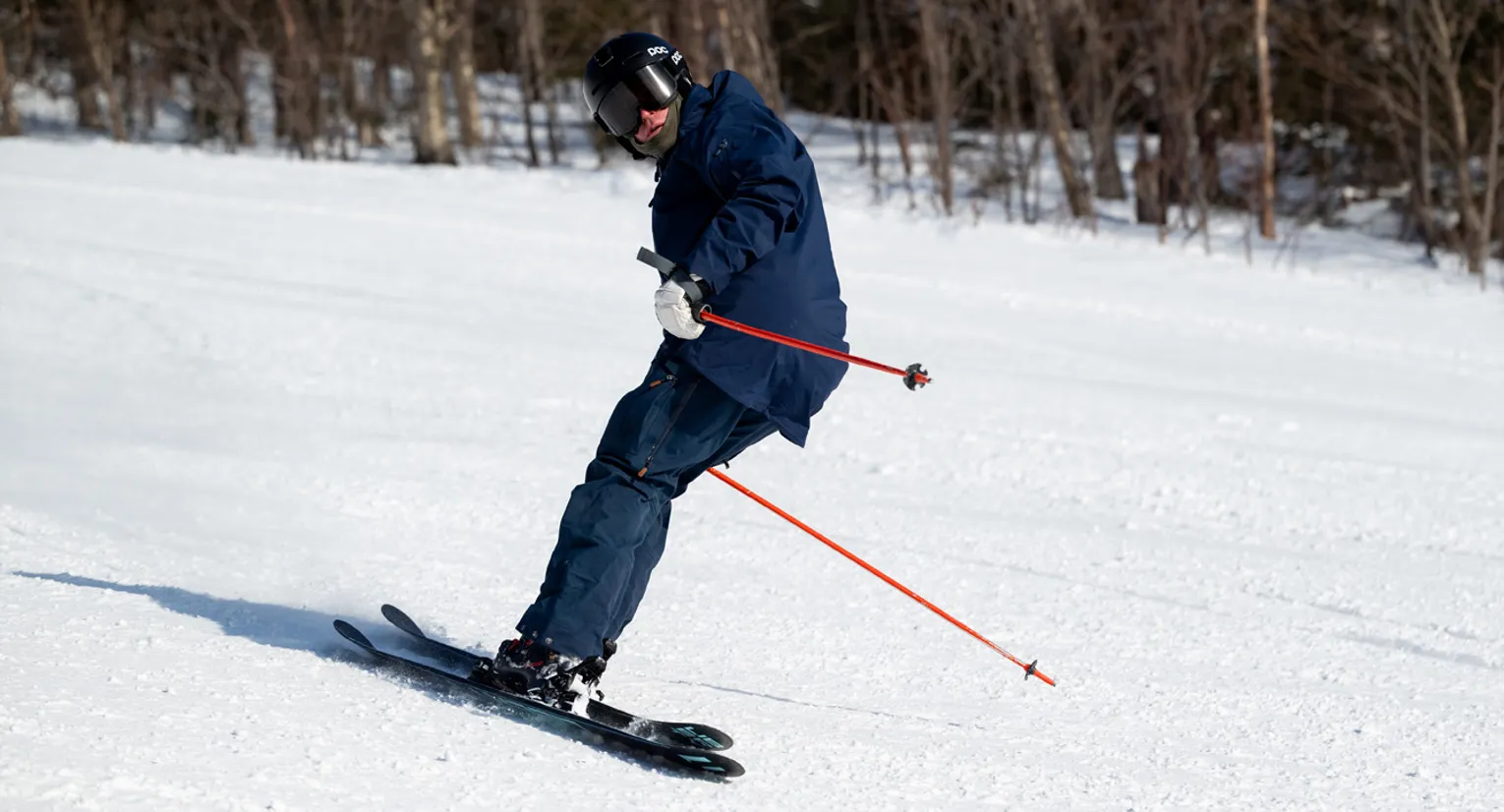
To start, the Scope 94 is exactly what I think of when I think of Liberty when it comes to how it feels on snow. It’s light, it’s quick, and it’s exceptionally maneuverable. It must be one of the loosest skis I’ve been on in this width range, which is interesting because it has a ton of camber too. There’s something about Liberty’s shapes that often achieve this. The tips and tails are pointier than some, and I think that early taper helps give it such distinct quickness. The centered mount point definitely took away some all-mountain performance, however. Turn initiation both on and off a groomer required some delicate weighting. On a groomer, the high camber height helped a ton, but it would’ve been nice to be at a more traditional mount point for railing carves. The ski can certainly do it at the center mark, but it doesn’t feel particularly intuitive. Something to keep in mind if you’re hemming and hawing about mount point and groomer performance is relatively important to you. That said, the playfulness is off the charts on groomed slopes at the center mark. 180s are super easy, the ski has a ton of pop, yet it never feels catchy either, two characteristics that are often hard to combine. If you like skiing around backwards while you make your way down the groomers, you’ll love it. If you’re a high speed charger, it might not have the stability you’re looking for, regardless of mount point. That’s actually something I thought about a lot. The Origin 96 with its vertical metal struts felt considerably stronger on a groomer, but they weren’t as agile or playful as Scope. It’s just an interesting change considering the shapes are relatively similar. If anything, the new Radian 92 and 100 are closer to Origin in regards to stability, but they have more directional shapes.
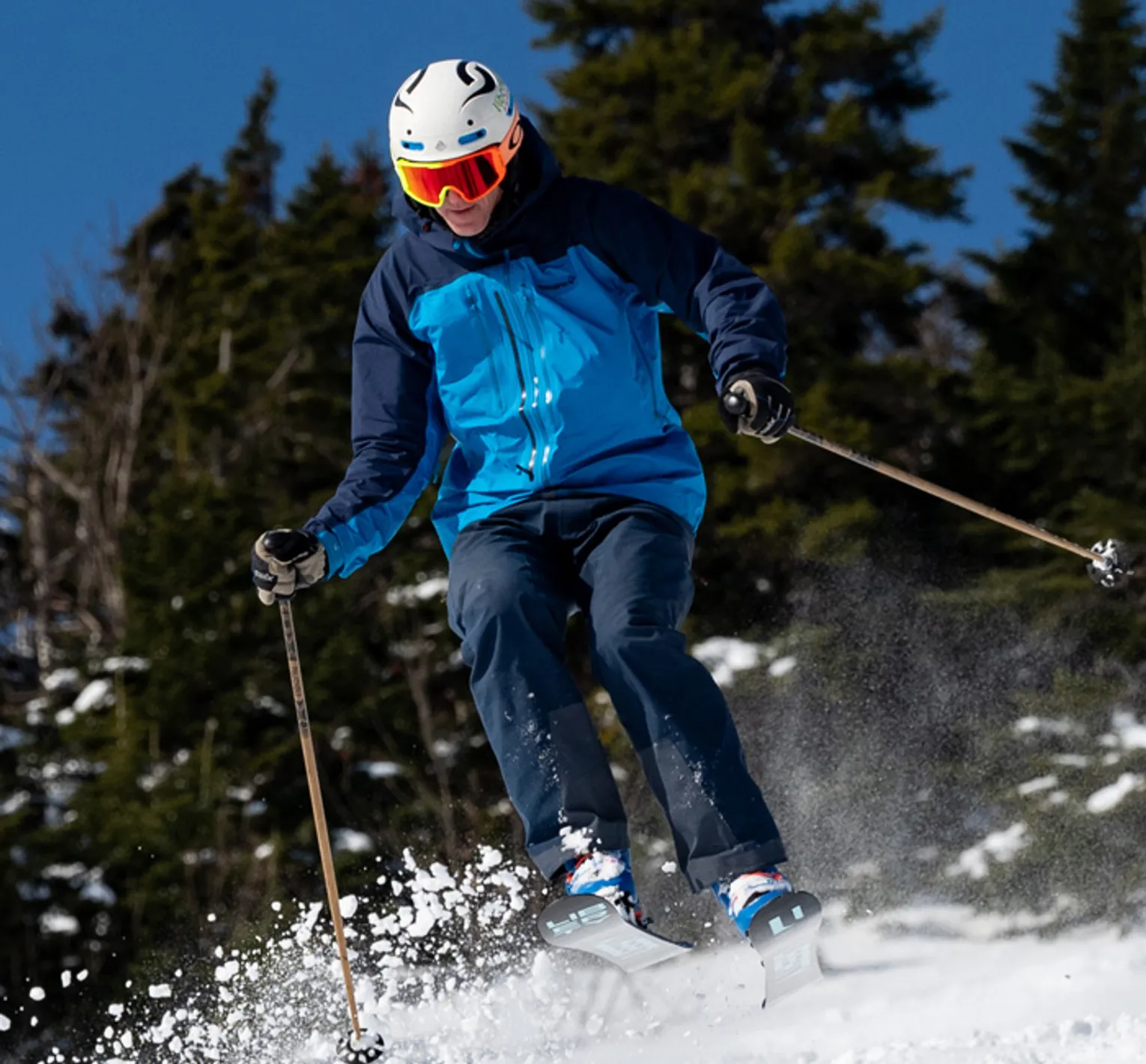
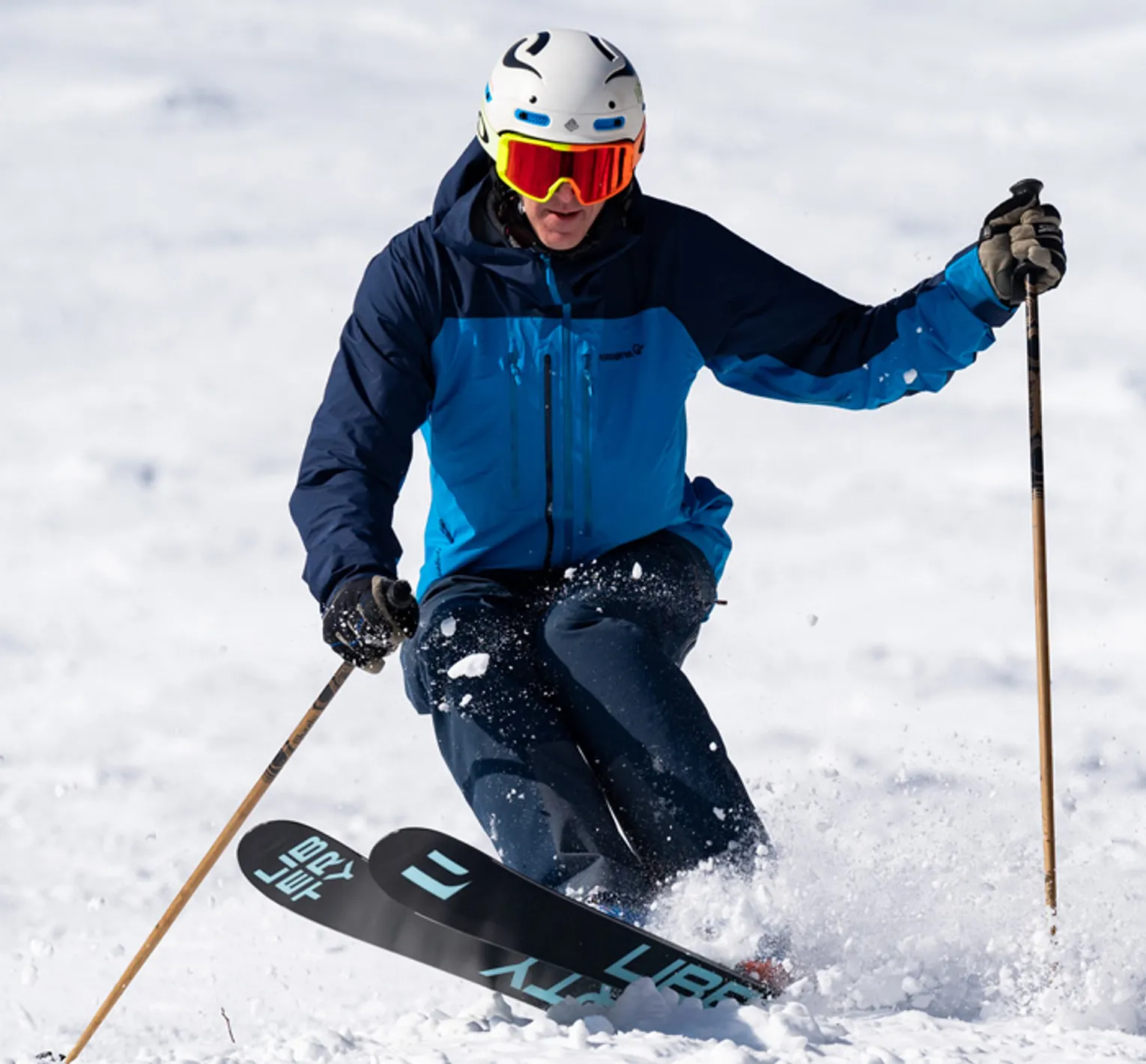
Off a groomer, the Scope 94 felt great. If I was skiing it exclusively as a tree ski, or if that was my main goal, I would go back to that more-traditional recommended mount point. You’d get a little bit more maneuverability with less ski behind you, but even at the center mark, the ski performed admirably. It has a nice mix of being loose and energetic with how Liberty combines a good amount of rocker and taper with high camber height. It actually has a pretty unique feel overall. It’s highly reactive, while also being very forgiving. It’s pretty cool. It’s sort of like you can utilize as much of the reactivity as you want with the amount of skier input you give it. If you want to be lazy, that’s cool. If you want to be super engaged and ski with purpose and precision, that’s cool too, the ski can do both quite easily. Then there’s the park performance, which is probably the most surprising thing about this new ski to me. It’s quite good in the park. The shape isn’t as symmetrical as it could be, or rather as I would ideally want it to be for a park ski, but it’s balanced enough that it works well. You also benefit from that same combination of looseness and energy, two characteristics that apply excellently to park skiing. It’s not my favorite park ski, but considering its capabilities elsewhere on the mountain, it’s very good.
Now, I don’t always like to say such profound, black-and-white statements about a ski, but I think I will here. I don’t actually think it’s best on the center mount point, even for me. I think 2 cm back would be better and you wouldn’t be giving up significant balance or park capabilities if that’s what you’re into. I measured the length of tip and tail rocker, and it’s actually pretty close to the same, but there’s about a 3-5 cm difference between tip and tail. That means at the center line, you’re slightly forward in the camber, which is never really a good thing. You can feel the amount of camber right under your heel, which can be a bit weird. I’m not 100% convinced of this opinion yet, but I’m getting pretty close. I’m not going to move my bindings yet. I’m going to ski it a little bit more this coming season at the center line and continue to feel it out and learn more about the ski, particularly in a park setting, but my instincts are for any park-focused skiers like myself, something like 1, 1.5, or 2 cm back from center is going to be the sweet spot.
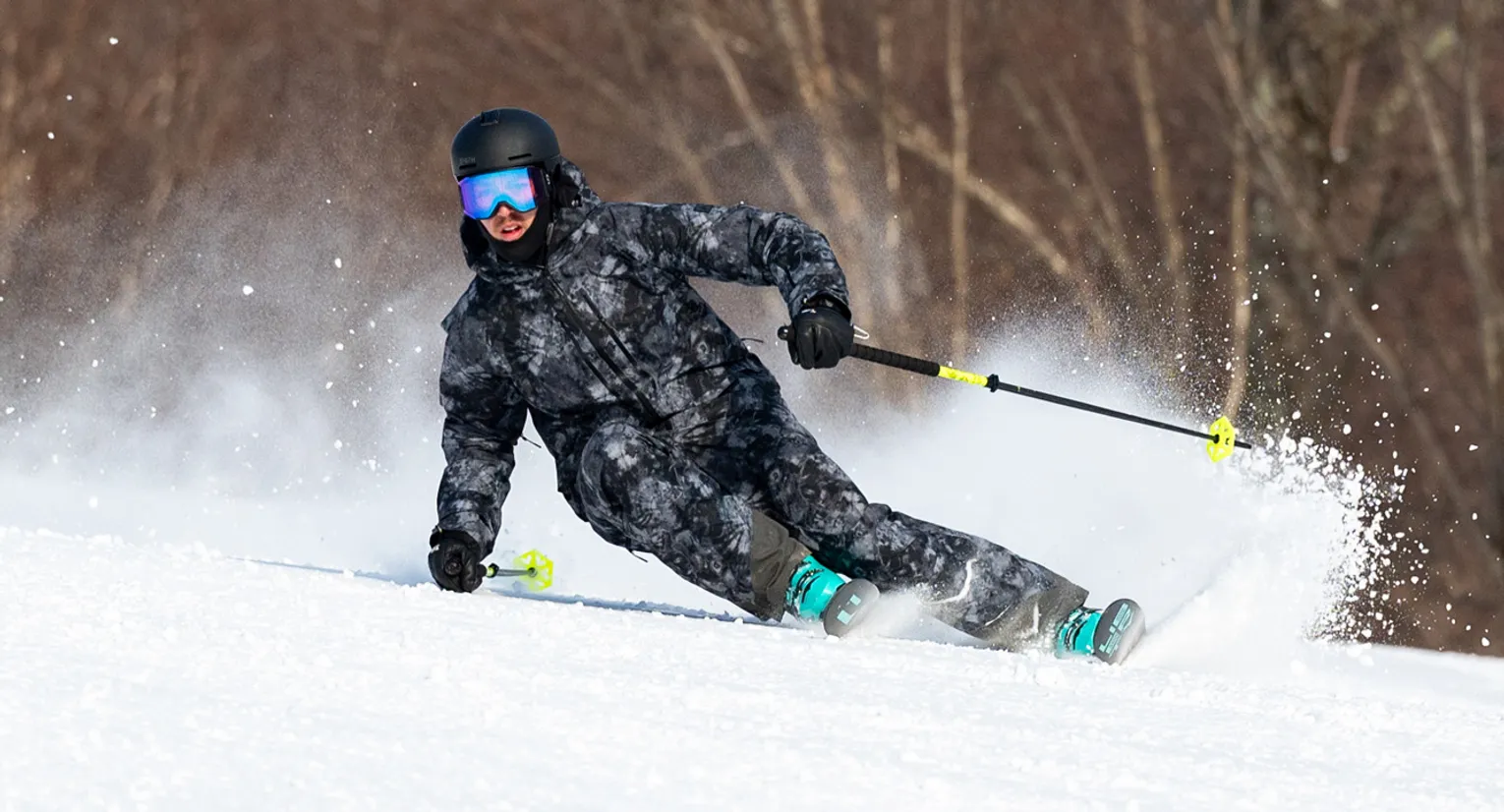
Whether by choice or force, Liberty’s move to a new factory with totally new skis is a bold one. Origin and Evolv were major parts of their business structure, and a total upheaval of those processes will be interesting to watch. By taking the existing models and all the tech and engineering that goes along with them and revamping them, Liberty is embarking on a new voyage. For Scope, at least, that journey is a move towards lighter, more flexible skis that lean a bit more to the creative and playful side of the spectrum. Whether 84, 94, 104, or 110, the Scope series of skis is here to handle soft snow, slopestyle, and any adventurous skiing you may encounter.