2027 Dynastar M-Free 94 Ski Review
For 2027 we get a new width in the M-Free line, this time featuring the same build and overall character of the wider skis in the line. While the M-Free 90 was a thing for a while, it featured a different construction and profile than the wider M-Frees, so it was never really a fair comparison. Speaking of fair, it’s also now fair to say that there’s a bit more of a park, or freestyle component to this new 94. This will add to the M-Free's totality as a lineup as it didn’t previously have a “twin tip” in a range of twin tips that was more park focused. While still directional in nature, the M-Free 94 will now certainly serve as that ski that can vacillate between realms, and function as a slopestyle option that also has all-mountain characteristics.
The construction that Dynastar uses is virtually identical to that of the wider skis in the M-Pro line, but they just take a bit off the top in terms of flex to make it more amenable to creativity and freestyle use. The M-Free 94 uses Dynastar’s Hybrid 2.0 build, which we’ve found works very well at blending smoothness and energy. For the wood portion of the core, Dynastar uses three separate laminates of poplar wood. Two of them are milled and joined together without glue, and this friction provides more energy and rebound than any adhesive would in this same situation. On the bottom of these two layers is one full horizontal poplar laminate which provides a solid foundation for the upper portions. Along the sidewalls, we get Dynastar's polyurethane frame which is the main component when discussing smoothness. Plastic like this can get a bad reputation when talking about its implementation in ski construction, but we’ve seen firsthand that it works, and now that it is used in all of Dynastar’s high-end skis, that’s a testament to its success. We’ve felt this material in person before in raw material form, and the thing that’s most surprising is how light it is. If it takes up about 20% of the core’s overall width, that means it’s an awesome weight saving method in addition to being an additive for silence and fluidity. Dynastar also uses a metal mount plate on top of the ski in order to aid in binding retention, but its full-width nature also provides damping and grip to the middle portion of the ski. In the 179 cm length, Dynastar states a weight of 1700 g/ski. With a slightly thinner core profile overall versus the wider 100, the 94’s flex pattern is more gratuitous, offering increased playfulness and a buttery feel. It’s still solid underfoot, but the tips and tails do feel more freestyle-focused.
At a Glance:
2027 Dynastar M-Free 94 Skis

| AVAILABLE SIZES | TURN RADIUS | SIDECUT | WEIGHT | PRICE |
|---|---|---|---|---|
| 156, 163, 171, 179, 188 cm | 17 m @ 179 cm | 124 / 94 / 118 mm | 1,700 g/ski @ 179 cm | $649.95 |
Looking at the skis from a shape and profile perspective, we’re seeing more of a symmetrical design here, although it’s still on the directional side versus a pure park twin. The 179 has measurements of 124/94/118 mm while the 178 in the 100 goes 130/100/122. The drop of 6 mm from tip to tail in the 94 is slightly more similar than the drop of 8 in the 100, hence the increased freestyle influence. The M-Free 94 generates a 17-meter turn radius to fuel a purely carved turn, and it does seem happy there. It’s light enough and soft enough to make all sorts of shorter turns at more moderate speeds while if you’re shooting for longer and more aggressive carves, the ski will balk slightly at that suggestion. Adding to that is a more forward mount point of –3.5 cm from center—this puts it a bit closer to the overall feel and style of the wider 112 than the 100 or 108 within the M-Free line. Certainly, if you’re really leaning into park, you can go even more forward but given its overall shape, true center would be pushing it. In terms of rocker, the 94 isn’t terribly dramatic, with shorter tail rocker than the 100, but more freestyle-oriented splay. It definitely looks more like a park ski from the side than the 100’s freeride nature. The camber is long and adds energy to the ski while the splay isn’t terribly high, giving the whole ski a relatively flat profile for a twin tip. There’s not a ton of early taper here, although it does seem like more in the tips than the tails for increased softer snow performance and all-mountain versatility.
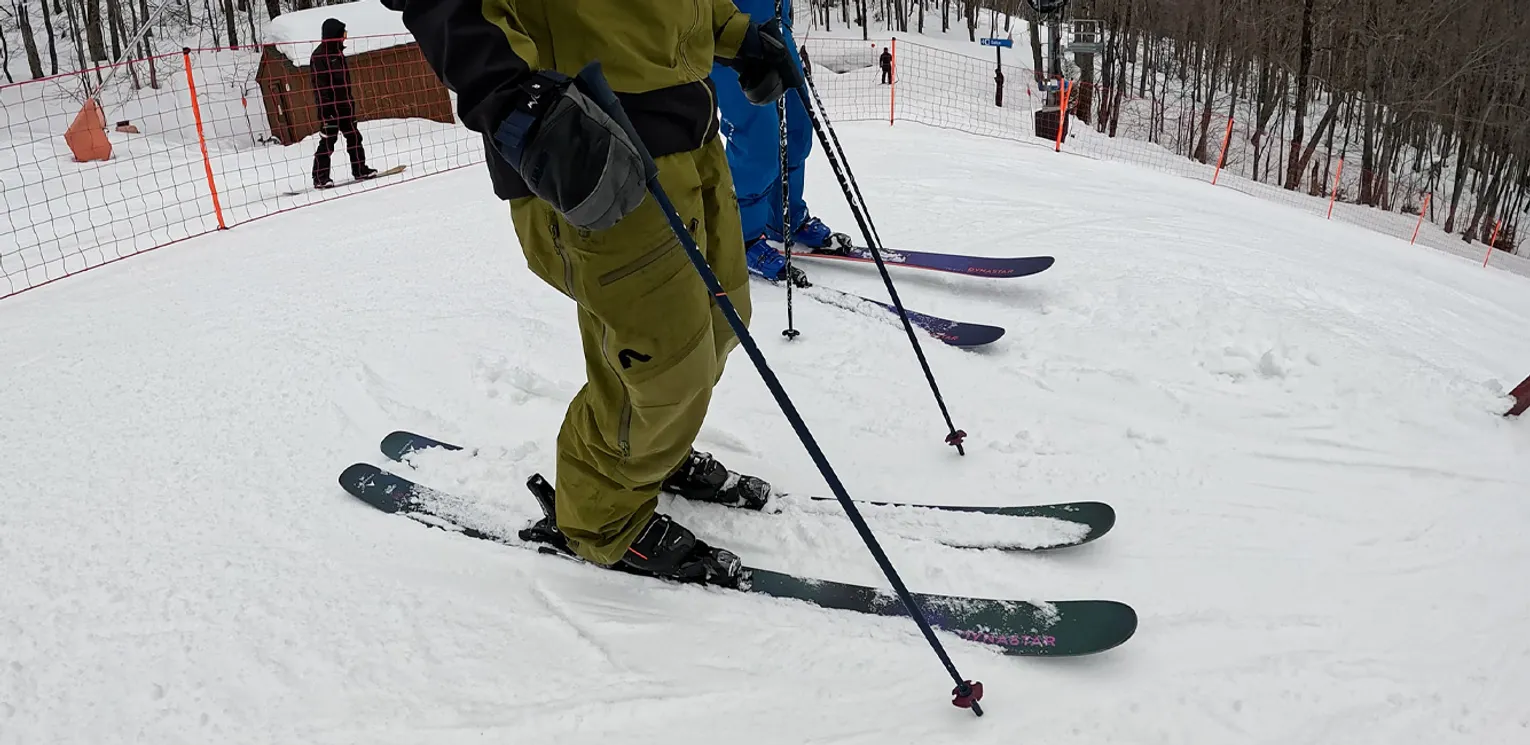
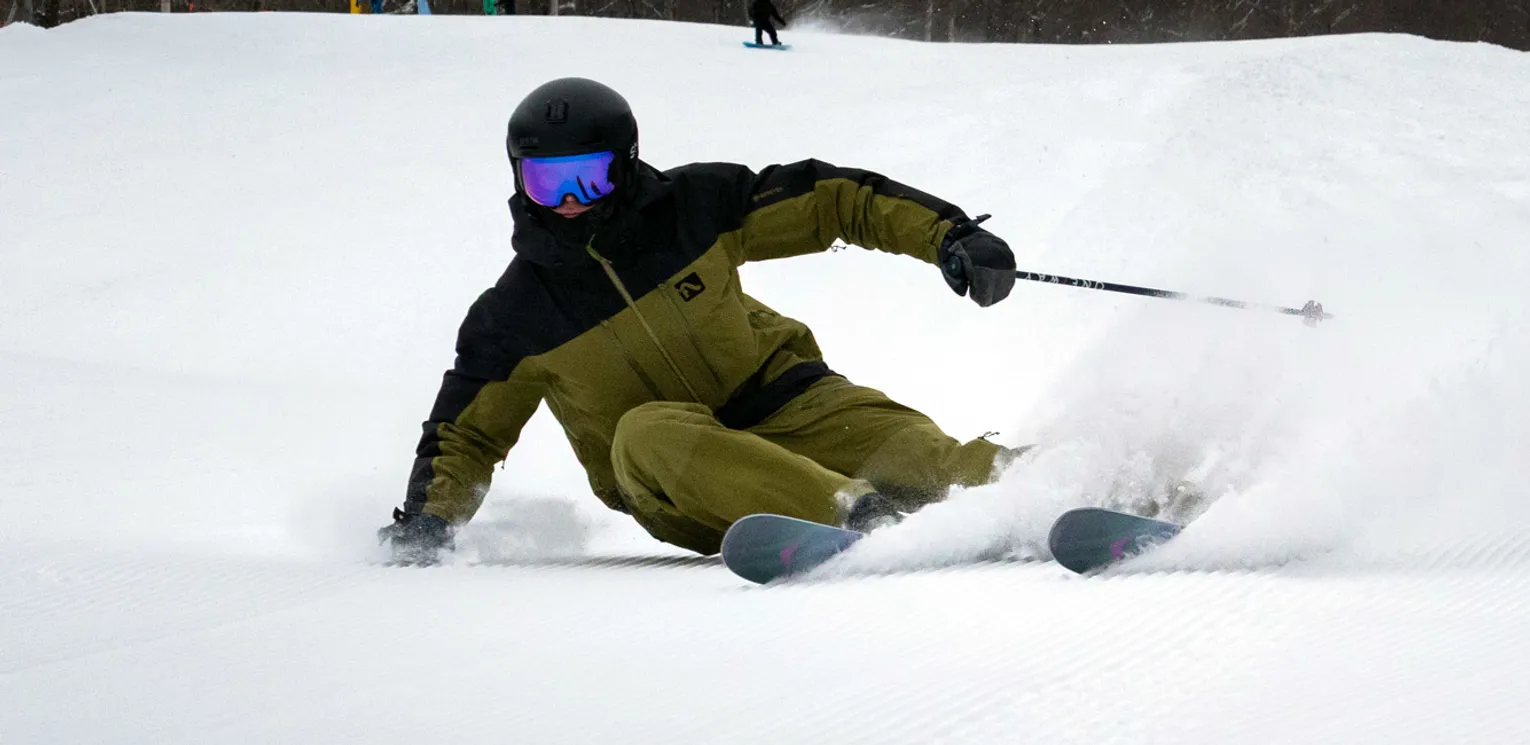
Jeff here! I’m taking over from Bob for the performance portion of this review, simply because I skied it a lot more than he did. In the video, Bob asked me some questions about it, and I’ll largely follow that order. There’s more in the video than I’ll be able to fit here, however. Starting with on-piste performance, it feels appropriate to talk about this ski at first through the lens of the M-Free 100. That ski often comes up when talking about the best carving twin tips in the 100 mm range. There are others that do quite well too, but there’s really nothing that completely outshines the M-Free 100 on a groomed slope. It’s quite good, and truthfully, quite strong. The M-Free 94 doesn’t have that same strength. It’s quite a bit softer throughout the whole ski, and especially in the middle portion of the ski where the 100 is considerably stiffer. That means it’s a lot easier to push through the shovel and forebody of the 94 if you’re really driving it into a turn. It doesn’t have the edge grip, stability, or energy out of a turn that the 100 has. That said, it’s also not bad on a groomer. You can lay it over and make some pretty turns on it, but you have to do so delicately and with exceptional balance. It also helps if you’re used to skiing a more center-mounted ski as you’re really making your turns more at the apex where you can push into the middle of the ski, rather than driving the shovel into a turn like you can on a directional ski.
Bob asked if it was an exciting ski on a groomer, which I thought was an excellent question. It is if you have the right skillset and style. If you like popping 180s, skiing switch, pressing, ollieing, slashing, and skiing groomers with a distinctly playful and creative style, you’re going to have a blast on the M-Free 94. It’s so loose and so easy to manipulate with its soft flex pattern, you really have a tremendous amount of control over the ski. If you’re skiing in a more traditional, more directional, more left-right-left-right mentality, it will likely leave you a bit unsatisfied, but I would question why a skier like that would even be considering it in the first place. Dynastar makes several skis that are much, much better for that type of skiing.
When you take it off groomers into bumps, trees, and softer snow, it certainly has more universal appeal, but the more centered mount point is a big factor. If you’re used to skiing centered skis, you’ll find it exceptionally agile when wiggling through tricky terrain. I had a lot of fun skiing it in bumps and the tight trees we have here in Vermont. It’s light and the shape makes it so easy to flick it around, it kind of makes it feel like you’re moving down the mountain more slowly because it’s so easy to make quick movements. On other skis where I would generally make 2-3 turns down a technical section, I found I was making 5-6 turns on the M-Free 94 because it’s so quick. The soft flex pattern helps in that regard too, but there is a tradeoff in off-piste stability. The M-Free 100 and M-Free 108, not to mention the 112, can both absolutely send it in open off-piste terrain. They provide so much stability at speed through choppy and variable terrain. The 94 just doesn’t have that with its softer flex pattern, but it’s also easier than its wider siblings when things get tight and technical. The tapered shape also does quite well even in relatively deep snow. It never feels like it’s grabby or catchy, which results in a lot of confidence when the going gets tough off trail.
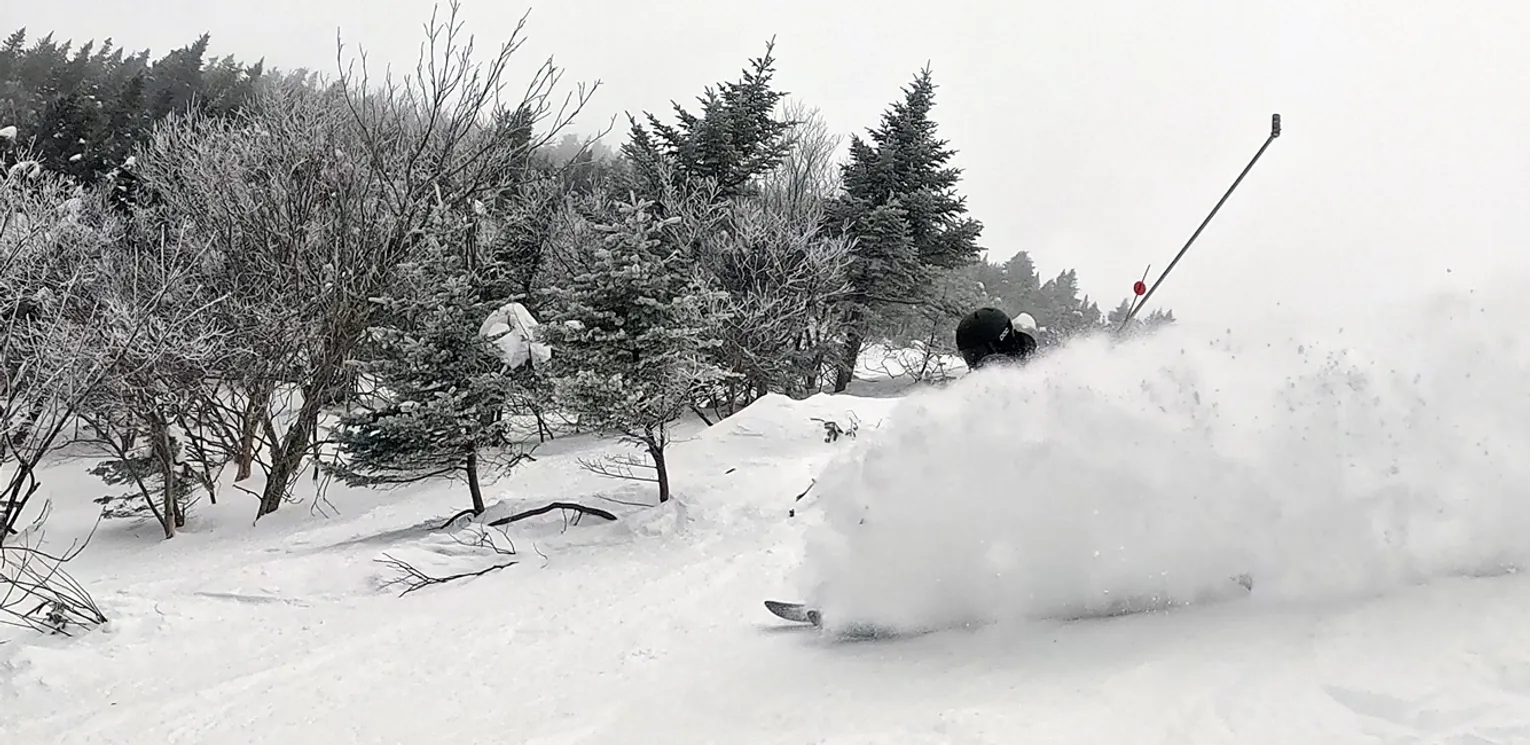
I think park skiing is the real exciting part of the story here. The pair I was able to ski this year technically belongs to SkiEssentials and we bought it from Dynastar with the intention of selling it when we were done with our testing, but yeah, that’s not going to happen. I mean, we will sell it, but SkiEssentials is going to sell it to me so I can take the demo binding off, put my own binding on it at likely a –2 mm mount point, and ski it in the park more next season. In my opinion, this ski has the ideal blend of attributes to make for an excellent park ski for a lot of skiers. It’s lightweight, but it’s not too light. It’s soft and fun, but it’s not a complete noodle. It’s going to provide a lot of quickness and eagerness in the park, but not at the cost of landing stability and overall composure. I also LOVE the shape for a park ski. I’ve talked about this a lot over the years, but the modern shape we’re seeing in a lot of park skis these days provides so much more forgiveness than we had back in the day. The way engineers are working in subtle early taper and rocker into park ski shapes provides such a nice amount of forgiveness for takeoffs and unbalanced landings. For me, the best example is always skiing switch. Especially as I get older, I can fall into some bad habits of pre-spinning a little bit when taking off switch. If you’ve ever caught your tip on the lip of a jump as you’re spinning switch, you know what I’m talking about. It might be the worse possible feeling you can have with skis on your feet and every time it happens, I feel like I’m about to die. While it can still happen, a shape like this certainly reduces the chances of it happening, which for me turns into considerably more comfort.
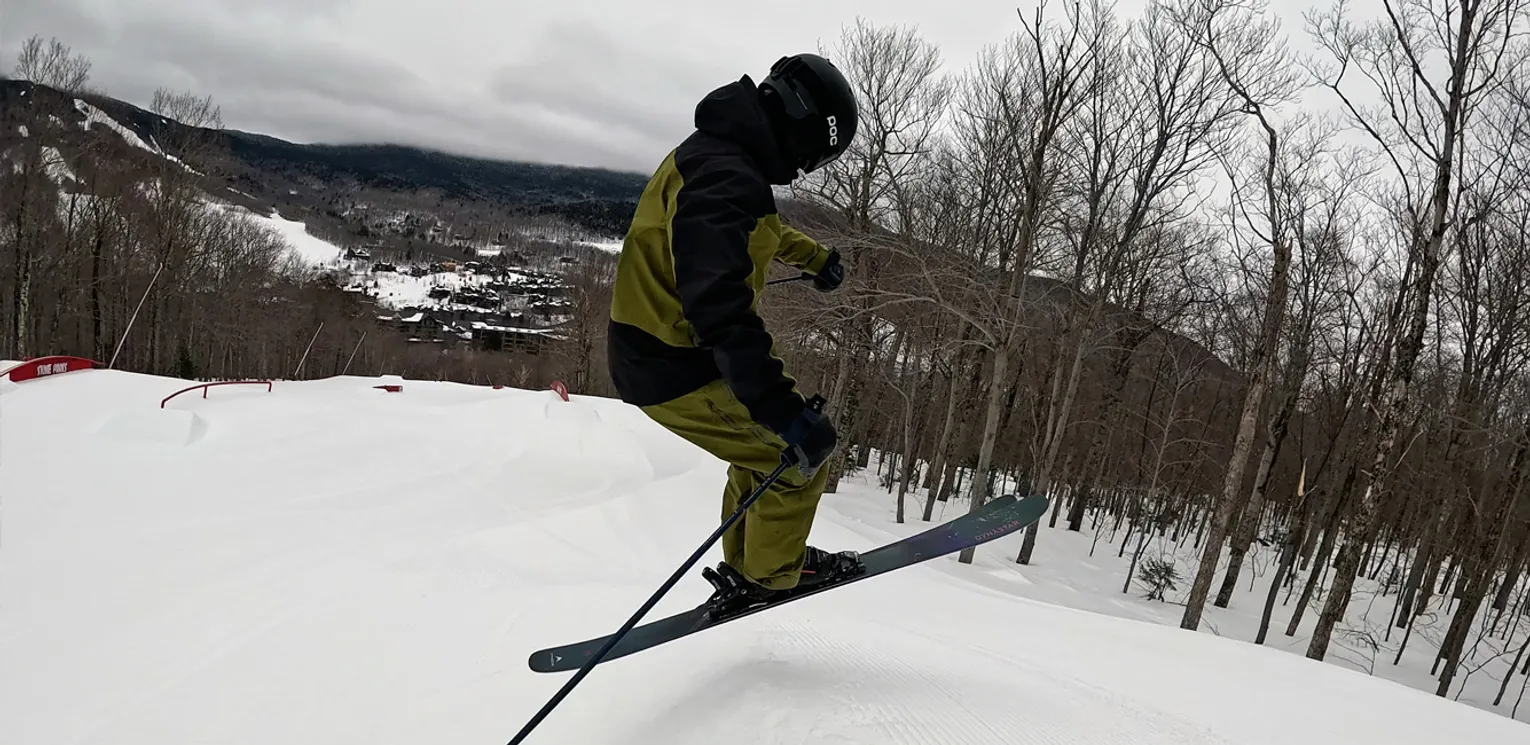
Overall, I’m quite excited about this new ski. There are a lot of great park skis out there these days and to be honest, I own a lot of great park skis. It’s not often that something comes along that I feel like I have to own... I’d survive if I ended up not owning an M-Free 94, but I really want to ski it more in the park just because it checks so many boxes for me. Will it find the popularity and universal success (from a performance perspective) of the M-Free 100? I don’t think so, but that’s not a bad thing. It just feels more specific in what it’s trying to be, and in my opinion, it’s trying to be a really, really good park ski with some all-mountain performance on the side.