

Top Five Fridays: August 18, 2023
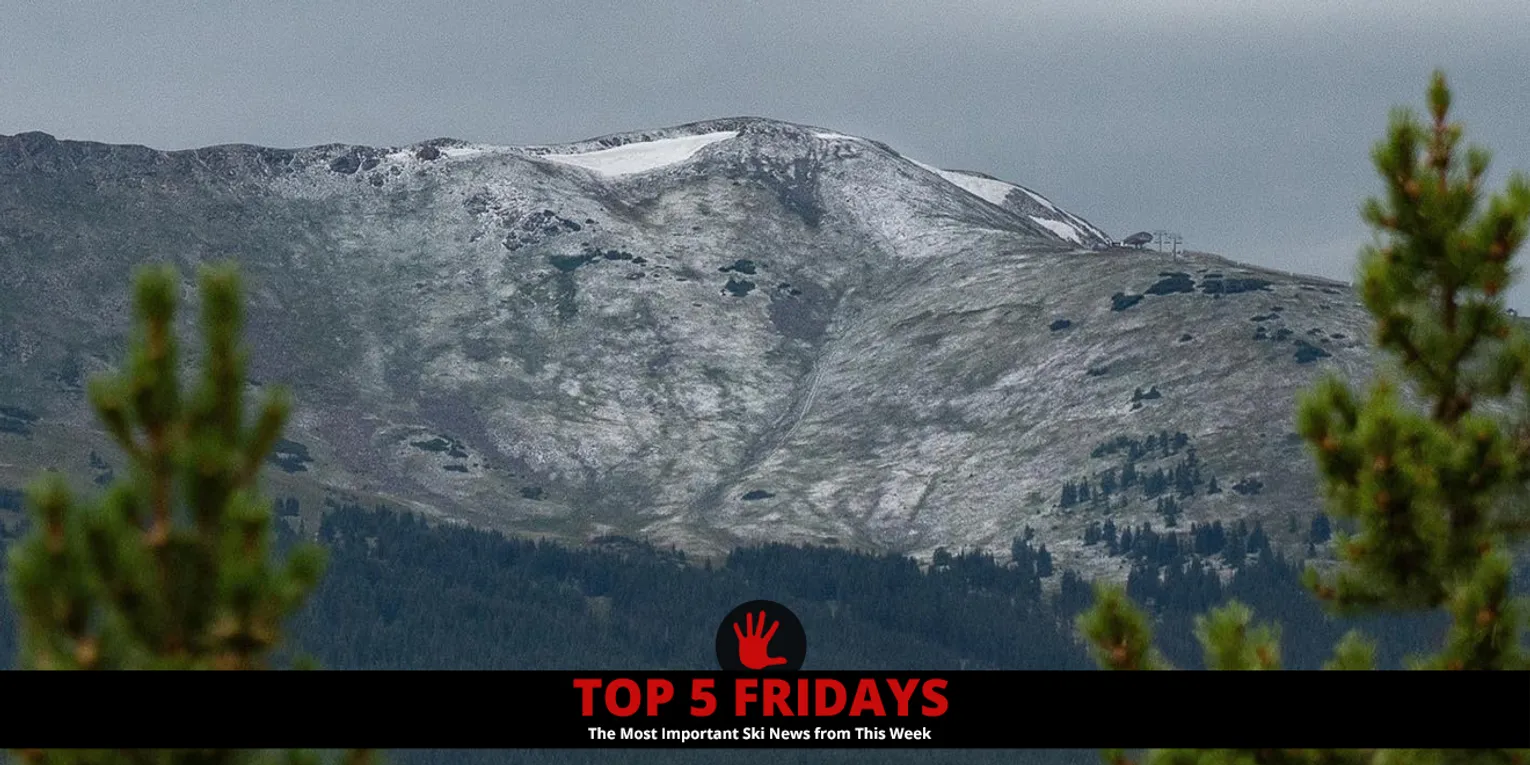
Lead Image: Is winter here yet? Not quite, but it’s getting close! In fact, Peak 6 at Breckenridge, Colorado received a dusting of frozen precipitation earlier this week. More on that below! Image: Breckenridge Ski Resort on Facebook
#1: Colorado Sees First Signs of Winter, While Resorts in Three States Announce Opening Dates:
Excited for winter? Of course you are! Keystone is too, as they shared this video alongside their opening day plans this week.
Hello, and welcome to Top Five Fridays, the August 18, 2023 edition! As we creep ever closer to the end of August, we simultaneously approach another annual tradition: the return of ski season. This week’s news cycle starts off with a reminder of that, as news from Colorado and Utah serve to remind us that winter is right around the corner. The first evidence of that? Photos documenting some form of frozen precipitation on Peak 6 at Breckenridge last Friday, August 11th. In the images, it looks like the peak received a dusting of snow, although some believe it’s just hail from a storm that rolled through. Either way, frozen precipitation on a high peak, as early as August 11th? That’s enough to get us excited for winter regardless.
In a well timed coincidence, a number of Colorado ski resorts also announced their planned opening dates this week. While this is all weather dependent obviously, resorts have become pretty used to taking advantage of tight weather windows to make early season snow, often allowing them to open at roughly the same time every year, regardless of whether or not it’s been unseasonably warm. As such, opening dates have come to depend more on operating plans rather than temperatures, enabling resorts to start marking opening day on their calendars months ahead of time. Keeping that in mind, let’s take a quick glimpse at which ski resorts have started making opening day announcements.
Leading the pack, should things go to plan, is Keystone, who hopes to open as early as possible in October. While an exact date hasn’t been provided, their opening day last year was 10/28, so the hope is that the resort will be able to open before then. From there, the next date to keep your eye on is 11/10, as both Breckenridge and Vail have it set as their opening date. Then, on November 22nd, Beaver Creek, Crested Butte, and Steamboat Springs are all expected to open as well. While these are the resorts that have officially announced opening dates, it’s worth noting that a number of other Colorado ski resorts take a more traditional “we’ll open when there’s snow” approach, which more often than not happens well ahead of 11/22. Wolf Creek Ski Area and Arapahoe Basin, for example, tend to be some of the first ski resorts to open in the country, so we’d expect their lifts to start spinning at around the same time as Keystone, if not earlier. Beyond the borders of Colorado, Park City, UT announced that they intend to open on 11/17, while Jackson Hole, WY has identified 11/24 as their targeted opening date.
All told, while we don’t actually know when the first day of the ski season in North America will be, we do know one thing for sure: it’s not far off. In a little over two months, some of us will be skiing one way or another. Until then, you can take a look at current projections in Colorado in this report from Denver News 7.
#2: Hot Tub Tax? Breckenridge and Summit County Join Growing Community of Mountain Towns Placing Fees on Buildings With High Energy Outdoor Amenities:
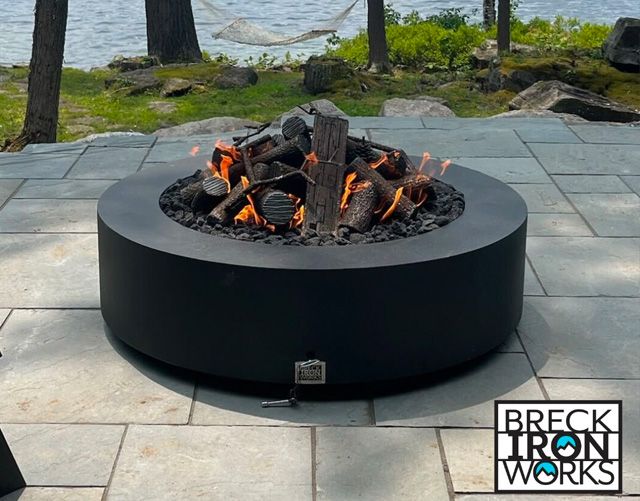
It’s not just hot tubs and heat driveways that are being impacted by REMP programs. Gas powered fireplaces, like those designed by Breck Ironworks, would also be subject to additional fees, leaving some small business owners to wonder what impact it might have on their sales. Image: Breck Ironworks on Facebook
In other Colorado ski news, we caught a pretty interesting article from the Colorado Sun this week that brings us up to speed in regards to some new legislation being passed in both Breckenridge and Summit County. As of August 10th, in Breckenridge, a new REMP policy has gone into effect for both commercial and residential buildings, with Summit County soon to follow suit. REMP programs Date back to 2000, when Aspen and Pitkin County first introduced the concept as a way for municipalities to offset emissions created by outdoor amenities at privately owned buildings. More specifically, the problem is this: in a lot of mountain communities where massive high end commercial and residential buildings exist, complete with outdoor amenities like heated driveways, hot tubs, pools, gas grills, and more, there’s a significant amount of energy being used and emissions being created to support these outdoor luxuries. How much, exactly? To put it into perspective, consider this: first, in Summit County, 62% of greenhouse gas emissions come from buildings. Now, pair it with this fact: in Aspen, “Exterior energy use was 50% of the total home energy use for some residences.” In other words, if more than half of an area’s greenhouse gas emissions are being produced by buildings, and in some cases half of the energy being used by a building is on outdoor amenities, well, you can see the issue here.
Noting this problem, it’s becoming increasingly popular for ski towns to implement REMP programs as a means of counteracting the issue. Under a typical REMP program, owners of properties with high energy outdoor amenities like heated driveways, hot tubs, pools, or outdoor heaters can choose to either power these installations using renewable energy, or pay a fee to the local municipality that will be used to offset the emissions. In some cases this means that the town will pay for power being produced by solar arrays, while in other cases the money is used to buy carbon credits or fund eco-friendly programs in the area. Now at this point, we know most of you are probably wondering the financial impact of these plans, so let’s get to it. As it turns out, in some cases, the costs of having luxuries like a heated driveway can be pretty significant. In Aspen for example, it would take approximately 17 kilowatts of solar panels to power a 1,000 square foot heated driveway. The fee for that, would be $55,000. Since initiating the program in 2000, Aspen has collected $18.3 million in REMP fees thanks to scenarios like this. Interestingly enough though, the ultimate goal of these programs isn’t to generate money for the municipality, but rather to encourage those who own high outdoor energy buildings to implement renewable energy sources themselves. While it may cost $55,000 in REMP fees to heat a 1,000 square foot driveway, if that money were spent on implementing a renewable energy system, it would be a one time cost and the system would pay itself off in a matter of years. Truth be told, it’s a pretty smart policy, and we applaud these communities for implementing such measures.
Before rounding out this highlight, we do want to mention one additional thing: there are some exceptions to these rules that make them much more palpable for us common folk. Specifically, when it comes to hot tubs and spas, the first 64 square feet are free, meaning most common hot tubs won’t incur much, if any, REMP fees. So if you’re someone who finally saved up just enough to buy that dream condo in Breckenridge, with your heart set on adding a hot tub to it, don’t worry. You’ll be fine. To learn more about this story, check out the article from the Colorado Sun, who did an excellent job covering this story in great detail.
#3: Mayflower Resort Gives Up Millions in Potential Profits as it Commits Approximately Half of its Property to Conservation:
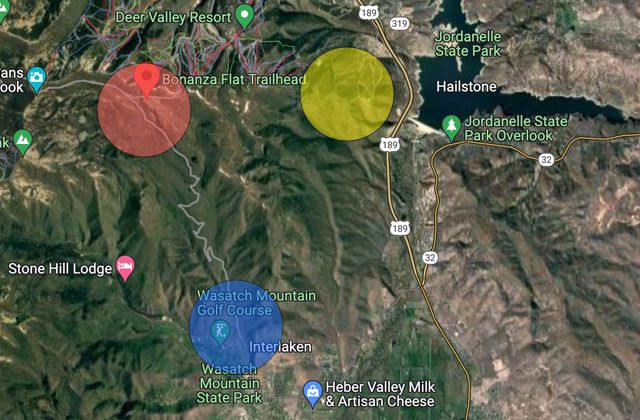
Based on the information shared with us by the Salt Lake Tribune, here is our best guess at the conserved land in question. The red circle represents the location of the Bonanza Flats, while the blue circle represents the entry point for Wasatch Mountain State Park. Approximately half the land between these two points and the yellow circle (which indicated Mayflower’s base area) is what Mayflower has contributed to conservation. If anyone has a more exact map showing the conserved land, please let us know! You can view this area on Google Maps, right here.
Moving right along to our third highlight this week, we have another story that took us by surprise: Utah’s Mayflower ski resort has just committed over half of its property to conservation. If you’ve been following the Mayflower story with us in recent years, you’re well aware that the story so far has been about the desire to connect Mayflower and Deer Valley resorts. It has had overtones of development, mega-resort, ski-exclusivity, etc, etc. This week’s update though, is quite the opposite.
In an announcement made this week, we learned that Extell Development, the developers behind Mayflower, has officially placed 3,100 acres of their future ski resort under conservation easement, to be managed by Utah Open Lands. Under this new agreement, the land will be open for public access from May 1st - September 30th every year, providing it’s free of snow and mud. During the winter months, the land will be under the ownership of Extell, which will retain the rights to use it for ski trails. The big story here though, is that by placing the land under a conservation easement, it means that Mayflower will never build on the land. Despite being previously approved for up to 700 residential units, this move eliminates that possibility. No lodges, subdivisions, or otherwise will ever be built upon it. It’s a surprisingly philanthropic move from Extell founder Gary Barnett, whose initial interest in the real estate value of the property succumbed to the beauty of the land as well as the observation of its heavy usage and the need for more open space in the area. As a result of the decision, Barnett donated property worth tens of millions of dollars, not to mention the real estate value that could’ve been realized had it been developed.
In making this charitable decision, Extell has provided an amazing opportunity for the recreational community in the area. By dedicating this land to conservation, Extell has made it possible to link the Bonanza Flats area located between Park City and Deer Valley, with the Wasatch Mountains state park in the Upper Valley. While unofficial trails have existed between the two for years, this move makes it possible to bring these trail networks above ground, enabling proper development and maintenance of them. Already, there are plans for a new mountain biking trail that would connect with an existing trail called “Spin Cycle”, which would create a loop for bikers starting in the Bonanza Flats area. In extrapolating this idea into a wider network of hiking and biking trails, the team at Utah Open Lands is thrilled about what it could mean as far as connecting the Park City and Wasatch County regions. Now, for those adventurous enough to do so, there’s a means to travel from Park City to Wasatch County that doesn’t require circumventing the range via automobile. For us on the outside looking in, it’s simply an encouraging story, where a land developer made an amazing decision to forgo significant profits in favor of conservation and public access to open lands. We applaud Mr. Barnett for making this decision. To learn more, check out the full report from the Salt Lake Tribune.
#4: Ever Hear of Sasquatch Mountain, BC? Well, After They Grow Nearly 800% You Probably Will::
A flyover style rendering of the proposed master plan for Sasquatch Resort. As you can see, the amount of skiable terrain would be immense.
Finally, we end this round of highlights with a story that’s also on the subject of ski resort development. This week, we caught wind of a story by way of fellow ski bloggers at Unofficial Networks and Snowbrains regarding a small ski area in British Columbia that has big, big dreams. Located about two hours east of Vancouver, Sasquatch Mountain currently has 37 trails spread across 205 skiable acres. After coming under new ownership back in 2006 though, visions for the resort soon became much more grandiose. In 2014, the resort published a master plan, the result of 8 years of research into possible uses for the surrounding terrain. To put it bluntly, the master planners didn’t hold back in the slightest. Following their wildest dreams, they hope to grow the ski area from 205 skiable acres to 3,104. From 37 trails to 283. From 3 chairlifts and a surface lift, to 23. No matter which way you slice it, the team at Sasquatch Mountain doesn’t want to just grow the resort a little bit, they want to blow it all the way up. As fate would have it, plans progressed in a positive direction in 2022 when the Fraser Valley Regional District approved a community plan that included the full development of Sasquatch Mountain. With full approval obtained, the development team has started executing on their $2.5 Billion, 15-20 year vision, one step at a time.
This summer, Sasquatch Mountain built a new aerial park- part of their plans to become an all season resort with a mountain style amusement park and world class mountain biking. Additionally, just this week, they released a video showing a 3D modeled flyover of what they expect the fully developed ski area to look like. When you compare it to their current trail map, the size and scale of the expansion is apparent. Of course, as is always the case with developments of this scale, much skepticism exists amongst the locals. Based purely off comments on their Facebook page, it sounds like talk of expansion has been going on for decades, and so while locals may be in favor of it, they don’t all seem to believe that it’ll actually happen. Considering the fact that it’s taken 17 years of new ownership to get to this point, we can’t blame them. But, with all of the legal hurdles cleared, it’s now down to matters of funding and execution. If the team behind the project is able to pull this off, Sasquatch will undoubtedly become one of the most significant mountain resorts in North America. To learn more about the massive expansion plans at Sasquatch Mountain, visit their official website.