

TOP FIVE FRIDAYS: AUGUST 7, 2020
#1: FIS World Cup Kickoff in Sölden, Austria Moved Forward One Week:
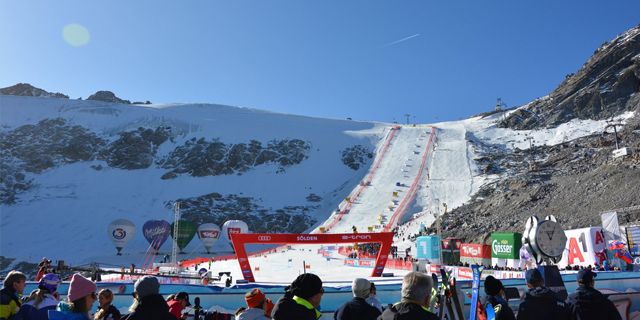
Looking up at the 2019 Sölden course. This year, the event has been moved ahead by one week in an effort to ease crowd sizes. Image: Sölden World Cup Official Event Page on Facebook
First up this week: an update from the world of FIS World Cup Ski Racing! As you know, the FIS has been actively working to put together a plan for the upcoming season, with a concerted interest in mitigating the risk of hosting a Covid-19 outbreak. As such, their focus has been primarily centered around how to modify their schedule in a manner that would reduce the amount of travel required, as well as keeping crowds to a minimum. To that end, a wide range of ideas have been floated, including the drastic measure of hosting a European athlete and venue only version of the circuit (an idea that thankfully seems to have come to pass), to only hosting speed events in North America, allowing technical racers to remain in Europe. While a decision on that front is still at least a week away, we did receive an update this week regarding the start of the season.
As per usual, the 2020-2021 FIS World Cup season will kick off in Sölden, Austria, with a men’s and women’s GS race. Unlike most years however, the event will be hosted a week earlier, on October 17th and 18th. The move has been made in an effort to reduce crowd sizes surrounding the event. By moving the races forward a week, FIS athletes, coaches, and personnel will have largely exclusive access to the Rettenbachferner glacier area, helping to alleviate the potential for disaster. One minor note that’s important for us to mention is that this news comes to us by way of Ski Austria, and not the FIS itself. That distinction means that while there’s still no news regarding the larger FIS schedule, it does indicate that progress is being made behind the scenes, at least on a per-location basis. At last check, it was estimated that the FIS would have an announcement regarding the North American schedule by mid-August, with a full schedule ready to share by the end of September. With that in mind, we’ll likely have more on the North American side of this story shortly, with a full update just over a month out.
#2: Australia's Falls Creek and Hotham Resort Lift Operations Closed for the Season:
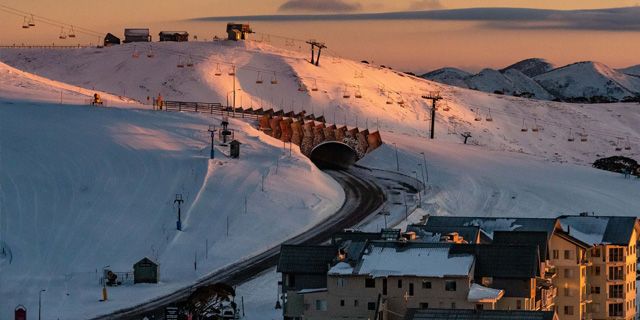
The sun sets on Australia’s Hotham Alpine Resort, both literally and figuratively as it’s just been announced that lift operations will cease for the remainder of the year due to government regulations. Image: Hotham Alpine Resort on Facebook
Next up this week is a followup to a story we first shared back on July 10th, when Vail decided to temporarily shut down lift operations at Australia’s Hotham and Falls Creek ski areas. When we reported on this story, we admittedly missed some of the nuances of the situation, which a pair of our Australian readers graciously informed us of in the comments section. (Editor’s note: we truly appreciate additional insights of this nature. If you’d ever like to add more information or context to a story we share, please don’t hesitate to use the comment section to do so. Both us as well as our readers appreciate it!). To put the ongoing situation dangerously succinctly, Vail Resorts previously made the decision to shut down all lift operations at these resorts until at least August 19th, citing the recent outbreak and lockdown of the city of Melbourne. This week, the news came that Vail would keep lift services at both resorts shut off for the remainder of the season.
Unfortunately, this week’s news also comes with further restrictions in regards to non-lift access to the resorts. In July’s announcement, resort operations other than chairlifts remained active, with sledding, touring, amenities, and even ski patrol still being offered to visitors. This time around however, due to an increase to Stage 3 restrictions, the areas are only able to be visited by area residents and services are either closed or limited. Those who’ve been visiting the area and/or arrived after the start of the restrictions in mid-July must return to their primary residences. In other words, while July’s shut down was primarily Vail taking action to stop the spinning of the lifts, this week’s news indicates that mountain operations beyond Vail’s control are also being forced to close in an effort to mitigate the impact on Covid-19 in the area. While this isn’t the outcome that anyone was hoping for, we’re inclined to believe that it’s the right move. In the comments section from our July 10th recap, one of our readers pointed out that the caseload in Melbourne is drastically lower than that of the U.S.. To that point, we have to imagine it’s abundantly cautious measures such as this one that have created that reality. For more on this, check out the official announcements from Mt. Hotham and Falls Creek.
#3: Aspen Ski Co, Raises Idea of More Frequent Blackout Dates & Targeted Incentive, Faces Immediate Backlas:
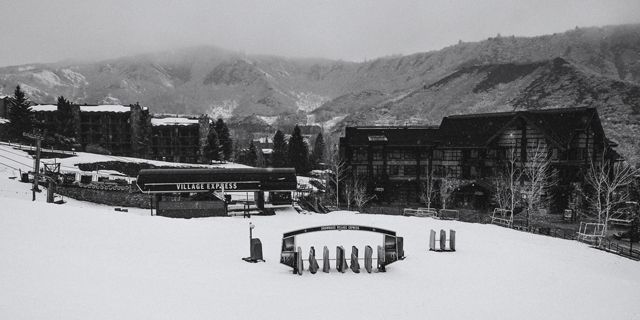
In an effort to recreate scenes not all that dissimilar from this one next winter, Aspen floated the idea of incentivizing guests to visit less popular areas at their resort, as well as additional blackout days. The reception, was not warm. Image: Aspen Snowmass on Facebook
While it’s far from our favorite topic, this week’s news was once again dominated by the wide ranging effects of Covid-19. As such, we’re compelled to report the latest. After all, we don’t make the news, we just report it. With that in mind, it’s our responsibility to share with you the news from Aspen Snowmass, where comments made by senior executive Rich Burkley caused quite the stir last week. In a video call with local health and public officials, Burkley floated a handful of considerations that were being made to help mitigate the potential spread of Covid-19 during the season. Amongst those considerations were a number of ways to help spread out the crowds of skiers, including concepts such as “pulses” of blackouts, possibly spread throughout each day, week, or month. Building on that idea was the suggestion that the Skico, "may be asking locals to ski a lot more in early December than in the holiday season, when we may have other capacity-constraint limitations in place.” Additionally, the idea of providing, “incentives for passholders to ski Buttermilk rather than Snowmass during certain times,” was suggested. In summation, the ideas and concepts put forth over the course of this particular call amount to the idea that Aspen will be using restrictions and incentives to control where and when their season pass holders can ski this upcoming season. For a sport rooted in the feeling of absolute freedom, these suggestions immediately struck a nerve, particularly amongst locals who claimed that Aspen is prioritizing the experience of its out of town guests over that of locals. In the days since this initial story broke, Burkley has since backtracked and promised that, “We’re not accommodating guests over locals. We’re not accommodating locals over guests.”
Now, it’s important to keep in mind that Burkley’s audience for this call consisted of decision makers who are more interested in public safety than skiing (which is a sentiment we should all share, quite frankly), meaning there’s a chance that the manner in which he made these statements was an attempt to appease them. Of course it’s also worth noting that the entire premise of operating a ski resort that relies on visitors from out of town to remain financially viable during a health crisis that requires capacity restrictions is an incredibly difficult task. As such, it’s no surprise that the team at Aspen is attempting to come up with creative ways to make use of all the space available to them to keep their visitors socially distanced and safe. Unfortunately, at least in regards to the concept of blackout “pulses” throughout the day, it feels safe to suggest that, as kids on Instagram would’ve said a year ago, “this ain’t it chief.” That of course begs the currently unanswerable, and unenviable question of, “if this isn’t it, then what is it, chief?” At the moment, there’s no sure answer to that question, and we can only hope that time will tell. For more on this, check out the original story from the Aspen Times here, as well as Aspen Daily News’s update in regards to Burkley’s response to the public outcry, here.
#4: The Complicated Impact of Covid-19 on Vermont’s Ski Towns:
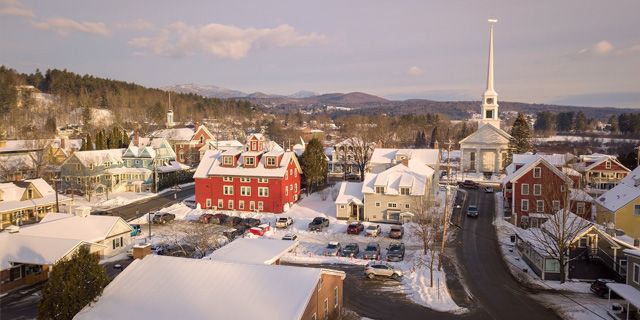
A look at the village of our hometown, Stowe, VT, one of the hardest hit areas in Vermont. For those curious, both SkiEssentials.com and our retail shop, Pinnacle Ski and Sports, have been able to weather the storm thus far, and the outlook remains positive. Our sincerest gratitude goes out to all of those who have supported our business since the world changed in mid-March. Image from Stowe Beautiful, discovered via Go Stowe
Finally, we round things out this week with a pair of stories that highlight the impact of Covid-19 on mountain towns in our home state of Vermont, focusing on the complex dynamic between mountain communities and their reliance on a tourism economy during a global health crisis. First, the not so good news: in Vermont, the five locales with the highest unemployment rates in June were all ski towns. According to an article from the Burlington Free Press, which in turn cites Vermont Department of Labor statistics, Dover, Londonderry, Ludlow, Stowe, and Fayston were the five areas with the highest unemployment rates, in that order. To give a quick glimpse into just how high unemployment rates were last month, Dover (the hometown of Mt. Snow) reported a 25.5% unemployment rate, which is nearly 5 times as high as last June’s rate of just 5.2%. The reason for this is likely obvious to anyone who’s ever visited a resort in a mountain town: the ski area is the lifeblood of the community. According to the Vermont Ski Areas Association’s director of communications, Adam White, nearly two thirds of spending done by destination resort visitors is given to off-hill businesses such as restaurants, lodges, and shops. In other words, when a ski resort is forced to close, not only are the employees of the resort impacted, but so are the businesses in the community that rely on spending from those visiting the area.
Despite the discouraging employment numbers posted by ski towns in the month of June however, there is hope. Compared to unemployment rates posted during April and May, the earliest months of the pandemic, things are actually trending in a much more positive direction thanks to the gradual reopening of ski resorts for summer activities. Dover, for example, posted high marks of 34.7% and 31.8% unemployment rates in April and May, suggesting that the town’s economy is recovering as Mt. Snow is able to slowly welcome visitors back. Finally, before turning the page on the first part of this highlight, we’d like to quickly reassure you that both Skiessentials.com and our retail location, Pinnacle Ski and Sports, have been stable throughout the pandemic, thanks in no small part to our amazing customers. Our sincerest gratitude goes out to all of those who’ve continued to support our business these last few months.
In addition to the Burlington Free Press’s story on Vermont’s ski town unemployment rates, we also caught an article from VTDigger that takes a look at a parallel topic: home sales in Vermont ski towns, and Dover in particular, are up approximately 20% this year over last. The suspected reason is obvious; residents of the city who’ve visited mountain towns in Vermont have hit a tipping point, finally deciding to make the move out of the city and into quieter surroundings. The results of this trend are likely to be a mixed bag for mountain towns like Dover as an influx of residents brings lengthy lists of both pros and cons. While we’ll refrain from sharing any of our opinions, a few stats from the VTDigger article stand out as numbers worth considering. First, the town of Dover’s elementary school is expecting enrollment to increase by nearly 25%. Paired with the general uncertainty surrounding education in the year ahead, it’ll be an interesting challenge for the school system there to navigate. Secondly, the home market has become heavily skewed towards the demand side of the supply vs. demand ratio. At the moment, average home prices are $311,000.00, up from $243,000.00 just a year ago. Additionally, of the 58 homes currently on the market in the area, 23 are under contract. Again, this is an incredibly complex situation, particularly when you begin examining its relationship with the aforementioned unemployment rates, so we won’t play the roles of economist or city planners. Instead, we’ll play the role of ski town residents and quote Bob Dylan, who once said, “The times, they are a-changin’.” For more information regarding the real estate market in Dover, check out this article from VTDigger.