


Top Five Fridays: December 19, 2025
If you thought there was a chance that Lindsey Vonn lost it, you thought wrong. Her performances last weekend in St. Moritz proved that she’s very much still the one to beat. More on that below! Image: Lindsey Vonn on Facebook
#1: FIS Results - The Women’s Speed Team Finally Gets Their Moment, and Holy Heck Did They Take Advantage:
Hello, and welcome to Top Five Fridays, the December 19, 2025 edition. This week, we have plenty of news to discuss as we once again have a ton of FIS competition results to recap from both the alpine and freeski worlds - it is that time of year, afterall. Once we bring you up to speed on all of the latest competitive action, we’ll take you on a long overdue deep dive into the myriad of ways that tariffs are impacting the ski industry, before finally rounding things out with a niche, yet contentious story coming to us out of Haines, Alaska. Truth be told, there’s a lot you’re going to want to know about his week, so let’s get started.
First things first, if you watched the video edition of Top 5 Fridays last week, you already know arguably the biggest news of the week: Lindsey Vonn is back. Not just like, back to racing, but back-back. In her first Downhill of the season, the 41 year old, once retired skier went ahead and won the race - her first time doing so in nearly seven years. Not only that, but much like Mikaela Shiffrin, Vonn did so in dominating fashion, taking home first place by a full .98 seconds. Once again, for differential comparison, the athlete who finished .98 seconds behind second place, was Switzerland’s Malorie Blanc, who took home 13th. For anyone out there who was still foolish enough to question Vonn’s abilities ahead of the season (despite taking home 2nd in her last Super G race last season), well, the proof is in the pudding as they say: Lindsey Vonn’s still got it.
Of course while that race was particularly special for Vonn, it was also very successful for the U.S. Team on the whole, as a pretty incredible seven athletes finished in the top 30, earning points. Now, we’d normally give a full list of results from each race, but honestly, there are way too many individual successes to celebrate this week, so we’ll have to let the results pages do the heavy lifting.
Case in point: the second Downhill race at St. Moritz, where Lindsey Vonn very nearly went back to back with first place finishes. In this race, she finished in second, just .24 seconds behind Germany’s Emma Aicher. Much like the first Downhill of the weekend, this race was also packed with U.S. athletes, with six athletes finishing in the top 22. Most notably, Breezy Johnson just barely missed the podium, finishing in 4th place and just .11 seconds behind Sofia Goggia.
Finally, on the third day of speed races in St. Moritz, the torrid U.S. Team cooled off ever so slightly in the Super G. This time around no podiums were had, but Lindsey Vonn came close, leading the American team with a 4th place finish, followed by four more of her teammates in the top 23. You can see the full list of results from that race here.
Now if you’ve had enough women’s alpine ski results for one week, we have some bad news for you: there’s one more race to cover. The good news though is that the results are just as impressive. While the speed team found itself in St. Moritz last weekend, the technical team traveled to Courchevel, France for a quick slalom race on Tuesday. There, the outcome was exactly what we’ve come to expect so far this season: Mikaela Shiffrin won the race, this time by 1.55 seconds. At this point, her level of skill and success is becoming downright unfair as she’s won all four of her slalom starts this season in resounding fashion. Following her lead for Team America was Paula Moltzan in fifth, who continuously remains within striking distance of the podium, but has only managed to crack it once so far this season. While her results have to be considered a massive success, we’re hoping she can manage to pick up just a few tenths of a second in future races, placing her firmly on the podium.
Looking ahead, this week presents to be a much quieter one for the women’s circuit, with the technical team off until after the holidays and just a Downhill and Super G race in Val d’Isere, France for the women’s speed team. While training run results don’t necessarily reflect the results of the actual races, it’s hard not to notice that the U.S. Team finished in 2nd, 3rd, and 4th in the first training run. With those results from training combined with what we’ve seen from this team already this season, we’ll be watching this weekend’s action with great excitement.
On the men’s side of things, it’s admittedly extremely difficult to impress following the women’s results, if possible at all. Still, they did their best and ultimately came away with some strong results from a week filled with racing. Kicking things off, the tech team was in Val d’Isere last weekend for a Giant Slalom, followed by a Slalom race. In the GS race, River Radamus led the way with a 6th place finish, while relative newcomer Ryder Sarchett finished in 10th place - his best result in his four career World Cup appearances. After finishing in 25th a week ago in Beaver Creek, Sarchett has quickly thrust himself onto our radar as an exciting up and coming athlete. The day after the GS race, a Slalom race was held. Unfortunately no American men qualified for finals in that race.
From Val d’Isere, the men’s circuit moved on to Val Gardena, Italy for a series of speed races lasting through the weekend. Yesterday, a Downhill race was held, and U.S. team member Kyle Negomir earned a career best 11th place finish - the only American athlete to finish in the points in that race. Then, earlier today, a Super G race was held. Again, Kyle Negomir led the way for Team America with a 19th place finish, followed by Bryce Bennett in 26th and Sam Morse in 30th. Looking ahead, the men have one Downhill race left in Val Gardena tomorrow before heading to Alta Badia, Italy for a Giant Slalom and Slalom race on Sunday and Monday. As always, we’ll be back next week with a full recap of the action.
#2: Freestyle Skiing FIS Updates: U.S. Men’s Team Dominant in Halfpipe Events to Start the Year:
Moving on to our freeski competitive highlights, we once again have quite a bit to cover as we had simultaneous action last weekend, with Secret Garden, China hosting halfpipe competitions while Steamboat, Colorado hosted the last Big Air events before the Olympics. There’s a lot to go over from both events, so let’s dive in.
Starting in China, it was a tale of two teams as the men’s and women’s teams had drastically different results. On the men’s side of things, while only Hunter Hess landed on the podium with a third place finish, it would be pretty easy to argue that the U.S. Team dominated the field. Afterall, of the 14 athletes that qualified for finals, nine of them were from the United States. So, while the top two spots went to New Zealanders, nine of the next twelve places went to an American athlete. Overall, an incredible sign for the team ahead of the Olympics. On the women’s side, things were very different, as no American athletes made it through to finals. Fortunately though, things are already looking up for the team as three women have qualified for finals in the Halfpipe event in Copper, CO this weekend, good for about 38% of the field. On the men’s side, the U.S. Team continues to dominate, as 11 of the 16 qualified athletes are Americans - good for about 69% of the field. You can see results from qualifiers and preview that event here.
Speaking of Colorado, we also have some action from last weekend’s Big Air event to recap, which took place at Steamboat, CO. In that event, the men’s team experienced incredible success as Troy Podmilsak took home first, followed by teammate Konnor Ralph in second. Behind them in 5th place was Keagen Supple. Most notably from this event, is the fact that Troy Podmilsak secured his Olympic bid after earning his second straight Big Air win. On the women’s side of things, Avery Krumme just missed out on the podium, finishing in 4th, while Rell Harwood took home 8th. From here, these athletes won’t see a Big Air event again until the Olympics, but we’ll see at least some of them in upcoming Slopestyle and X Games events. For more on the latest results, check in with the FIS, or coverage from Newschoolers.
#3: The Convoluted Nature of Tariffs: How and Why Ski Prices Are Expected to Rise Next Year:
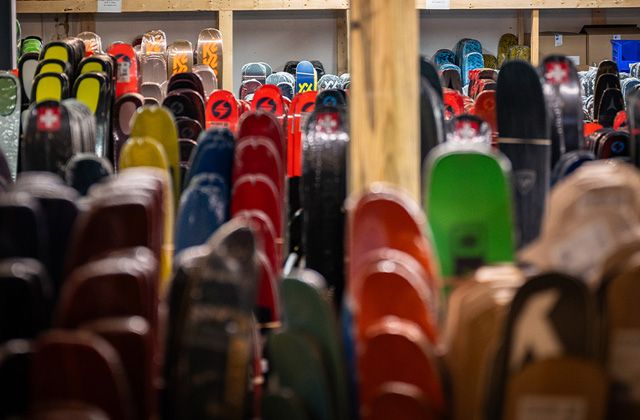
Why the vague shot? Because nearly every ski product you see in this photo will be hit by tariffs next season.
Next up this week, we’re taking a long overdue deep dive into a topic that we’re sure our U.S. readers are already well aware of: tariffs. While this subject isn’t particularly new, and you most certainly heard us talk about it quite a bit last Spring when we were running pre-tariff sales, we’ve never really done a deep dive on the subject, explaining exactly how they impact the ski industry. This week, we caught an article from Ski Mag that had recently been updated with new information, and it does an excellent job of taking you through the nuances of how the situation is impacting manufacturers, retailers, and ultimately, you - the United States based consumer.
At this point, you likely have a good understanding of the basic concept of a tariff: when a company imports a product from another country, they pay a tax on it. In this case, the rates listed in the Ski Mag article start at 15% from Europe and 30% from China, with some specific raw goods such as steel and aluminum hitting 50%. We’ll unpack what this means from a manufacturing and supply chain standpoint in just a minute, but before we do, we first want to share a little insider information about the sales cycle within the ski industry.
In our world, the buying season happens in the second half of winter and into the Spring. Flush with cash from the holiday season, ski shops across America tend to turn those profits back into inventory by late March, with manufacturers encouraging spring orders to ensure product availability the following fall. By doing this, they can get a good read on how much inventory their factories need to produce over the summer in time for deliveries ahead of next season. That’s all well and good, and normally works out just fine, but tariffs have thrown a tremendous wrench into things.
One of the most important things to know about tariffs is that they’re applied when the goods enter the United States. In other words, if the factory ships an order on July 31st when there are no tariffs in place, but the order arrives a week later when a 30% tariff has gone into effect, it means the products in that order are substantially more expensive. As such, you can imagine the race that occurred over the summer with manufacturers attempting to rush orders through their European and Chinese factories, with hopes of getting them on shore here in the U.S. ahead of the tariffs. For the most part, this went well, and we’re hitting this season largely unaffected by increased prices as new inventory arrived in time while plenty of carryover equipment still existed in warehouses here.
The challenge is next year.
With tariffs expected to be firmly in place throughout the entirety of 2026, there simply won’t be the same “tax free window” that there was this year. As a result, we expect prices of both finished equipment and raw goods to be significantly higher next season - a cost which will ultimately make its way through the supply chain until eventually it’s shouldered by the consumer.
This of course brings up the question, “if importing skis is so expensive, why don’t manufacturers just make skis in the United States?” The answer to that question is two fold. First, many materials found in skis, such as edges, are only available from factories that exist overseas, meaning that tariffs will still impact the cost of the finished product. Second, the United States simply doesn’t have the production capacity to produce that many skis. According to the Ski Mag article, Moment Skis is the largest ski manufacturer in the United States, but they don’t produce for other brands. Outside of Moment, the largest factory that does produce for other brands is Utopie Manufacturing, but there’s a catch: they’re located in Quebec. Tariffs would still apply. Furthermore, building an entirely new factory in the U.S. of a size required to meet the demand would cost a tremendous amount of money, thereby actually making it more expensive than simply paying the tariffs themselves. This solution, as it turns out, isn’t much of a solution at all.
And so as you can see, when we - or any ski brand or retailer - talks about tariffs, we aren’t simply blowing smoke. While prices remain mostly consistent this year with what we’ve seen in recent years, it’s pretty hard to imagine a world in which prices don’t increase at least a little bit next year. The only reprieve we might have from that scenario, is a scaling back of tariffs by approximately 8/1/26. Should that come to fruition, we’ll be sure to let you know. For now, give this writeup from Ski Mag a read to better understand the situation that’s at hand.
#4: Townhall Meeting Gets Heated in Haines, Alaska as Conservationists Ask Heli Skiing Operators to Share Daily GPS Data:
For reference, this is Haines, Alaska.
Finally, our last highlight this week is an interesting story coming to us out of Haines, Alaska. Despite being home to just about 2,000 people, Haines has a huge reputation in the ski world as it sits just on the edge of the Chilkat Range - some of the most massive, picturesque mountains in North America. If you’ve ever watched an Alaskan segment from filmmakers like MSP or TGR, there’s a good chance you’ve seen footage from this location. Naturally, being home to such unique terrain, there are two groups with outsized influence in the area: heli skiing operations, and conservationists. This week, they went head to head at a local assembly meeting.
On Tuesday night, the Haines Assembly gathered for what is typically a routine meeting. This time however, representatives from the four local heli skiing operations as well as representatives from Lynn Canal Conservation (LCC) were in attendance to debate regulations on heli skiing operations. Representing LCC were Thom Ely and Eric Holle, who were there trying to convince the assembly to require greater GPS tracking oversight on heli operations. The basis for their argument stems from a 54% decrease in the mountain goat population in the Takhinsha range from 2016-2019. Due to this decline, they’ve requested that the range be off limits to heli skiing operations until the population can recover. While they admit that they aren’t certain that operations are at all responsible for the decline, they cite the need for GPS data from heli skiing operations in order to better understand its impacts on local wildlife populations. Expanding upon this logic, the pair from LCC were formally asking the assembly to approve a measure that would require heli skiing outfits operating in the Chilkat Range to submit daily GPS data so that their movements could be tracked and recorded.
The heli skiing operators did not like this.
In a meeting that reportedly turned quite contentious, the operators pushed back mightily, saying that tracking and sharing their GPS coordinates would mean exposing proprietary information. Reading between the lines, what they’re essentially saying is that they don’t want their local competitors to know where they take their guests - much in the same way that locals of any resort have their “spots” that only they know about. Additionally, collecting and reporting daily GPS data would be a cumbersome task, and one that heliski operators feel like would unfairly burden their industry. As it stands, they’re currently subject to 3-5 random GPS spot checks annually, an agreement that’s been working well and has rarely turned up any out of bounds infractions. In other words, the argument from the heliskiing operators is that not only would daily GPS data collection make their proprietary information public, but it’s also burdensome, unfair, and unnecessary.
Ultimately, the heliskiing operators won the argument this week, as the assembly members voted 6-0 in favor of removing the daily GPS reporting requirement.
All in all, while it’s a pretty niche story, we thought it was a pretty interesting one to share as at the heart of it, it centers around a theme that’s a core part of being a skier: keeping your secret spots secret. For more on this, check out the report from ChilkatValleyNews.com.
#5: And Now, Your Edits of the Week: Return of the Turn is Back! This Time, the Crew’s Skiing Alta’s High Rustler:
Next Up: “Inefficient Joy” is an Artistic View into the Subtleties of Skiing:
Re-familiarize Yourself with Ross Tester as He Makes His Return to the Freeride World Tour:
*** Warning: Ross Definitely Drops at Least 1 F-Bomb to Himself While On Course ***