

TOP FIVE FRIDAYS: FEBRUARY 14, 2020
#1: FIS World Cup Ski Racing Recap: The U.S. Men's Team Scatters the Results:
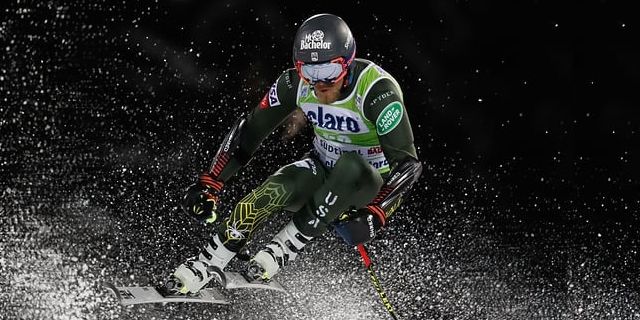
Tommy Ford en route to a career best 4th place finish in last week's Parallel Giant Slalom race. Image: Tommy Ford on Facebook
It goes without saying that our weekly World Cup Ski Racing recaps will have a decidedly different feel than what we’re used to for the foreseeable future. After the passing of Mikaela Shiffrin’s father, Jeff Shiffrin, almost two weeks ago, the most dominate athlete in the sport of ski racing, regardless of gender, has decided to take an indefinite, and very understandable, leave of absence while she grieves with her family. While we hope to see Mikaela return to competition soon, we also offer our sincerest condolences best wishes as she navigates this incredibly difficult chapter in her life. With that said, as the saying goes, the show must go on.
This week, the women’s circuit was in Garmisch Partenkirchen, Germany, to compete in a Downhill and Super G race. Between the two races, American athletes Breezy Johnson and Alice Merryweather fared the best, with each securing top 20 finishes in both events. In the Downhill race, Breezy Johnson took home 17th while Alice Merryweather earned a 19th place finish. A day later, on February 9th, their order switched as Alice Merryweather finished in 14th in the Super G, while Breezy Johnson landed in 18th. This weekend, the women’s circuit heads to Kranjska Gora, Slovenia for a Slalom and Giant Slalom race.
On the men’s side of the sport, the U.S. Ski Team actually fared quite well, despite a lack of podium finishes. To start the week, Tommy Ford earned a career-best 4th place finish in a Parallel Giant Slalom event hosted in Chamonix, France. After that event, the men’s circuit traveled to Saalbach-Hinterglemm, Austria to take on a Downhill and Super G race. In the Downhill event, Bryce Bennett led the U.S. team with a 12th place finish, followed by Travis Ganong in 15th, Steven Nyman in 21st, Jared Goldberg in 30th, and Ryan Cochran-Siegle in 32nd. A day later (earlier today, in fact), the men’s team once again scattered the standings with finishes, as Travis Ganong finished in 7th, Ryan Cochran-Siegle in 16th, and Bryce Bennett landed in 36th. While the U.S. men’s team has been unable to land a podium finish this year, this weekend’s results are a good representation of their results over the course of the year. As a team, they’ve managed to consistently earn points, hopefully laying the foundation for further growth through the end of this season and into next. Looking ahead, the men will have this week off as they travel to Niigata Yuzawa Naeba, Japan for a Slalom and Giant Slalom race on February 22nd - 23rd.
#2: 2020 Winter Dew Tour Recap:
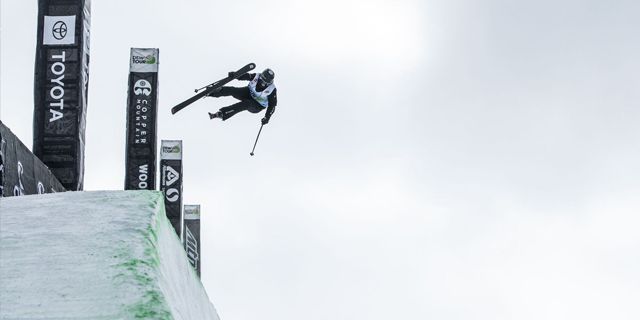
The Dew Tour's unique Modified Superpipe Competition gives athletes an opportunity to mix creativity in with their standard Superpipe runs. Image: Dew Tour on Facebook
In other competition news, we’re excited to recap the action from last weekend’s Dew Tour! To get that task underway, we’ll start with the Men’s Slopestyle competition, which went off last Saturday. Featuring a variety of rail options up top followed by three jumps of incremental size, the course itself offered plenty of opportunity for skiers to set themselves apart. The one issue, however, was variable winds which proved difficult for skiers to judge as they were forced to make split second decisions regarding speed mid-run. Ultimately though, the event went off without a hitch and it was Christian Nummedal who took home first, followed by Alex Hall and Andri Ragettli in second and third respectively. Hours after the Slopestyle event was held, the Ski Streetstyle event took place. More or less a 45 minute rail jam, the Streetstyle event offered the opportunity for a range of skiers to showoff their skills on rail features that are decidedly more approachable than those featured in the Slopestyle course. As such, the athletes were able to put down numerous impressive tricks. If you’re a fan of technical rail tricks, we highly recommend watching a replay of that event. Ultimately, that competition was won by Alex Hall (his second podium finish of the day), followed by Siver Voll in second, and Tucker Fitzimons in third. The event also had a Best Trick award, which went to Colby Stevenson. Finally, to round out the weekend, the men’s division competed in the Modified Superpipe event. Unique to the Dew Tour, the Modified Superpipe splits a standard halfpipe into sections, allowing athletes the opportunity to mix airs into and out of the pipe along with their classic halfpipe run. Ultimately, it makes for a much more entertaining, diverse event. Despite having a minor amount of snow accumulation to deal with, the event was still held without issue, ultimately resulting in a gold medal for Noah Bowman, a silver for Gus Kenworthy, and a bronze for Nico Porteous.
Before diving into the details of the women’s side of the event, we feel compelled to mention that Kelly Sildaru opted out of all events due to a bruised knee. Having just taken home two gold medals in the X-Games Superpipe and Slopestyle events, Sildaru’s absence was notable and left the door wide open for the rest of the field. On Saturday morning, Cassie Sharpe, Rachael Karker, and Zoe Atkin took advantage of that opportunity as they placed 1st, 2nd, and 3rd respectively in the Modified Superpipe event. Later that day, Johanne Killi, Mathilde Gremaud, and Taylor Lundquist also capitalized by taking home 1st - 3rd in the Streetstyle event. In addition to winning the gold medal, Johanne Killi also earned the Best Trick award. Finally, to round out the weekend, the women’s circuit took on the Slopestyle course on Sunday afternoon, where Mathilde Gremaud took home first, followed by Johanne Killi in second, and Maggie Voisin in third. All told, the entirety of this year’s Dew Tour was exciting to witness, and we’d recommend heading over to their YouTube channel to watch replays of your favorite events. To check out more results and recaps, you can also head over to the official Dew Tour website.
#3: 2020 Freeride World Tour Stop #2 Recap - Kicking Horse, Canada:
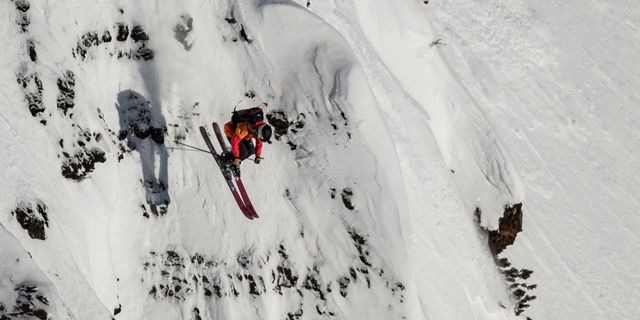
A skier takes advantage of one of the many cliff drop opportunities available at the Kicking Horse stop of the Freeride World Tour. Image: Freeride World Tour on Facebook
Next up this week, is even more competition news! If you’re a fan of the competitive side of the sport, you’re welcome. If you’re not, we apologize, but also assure you that next week’s news will only feature two competition based recaps (FIS ski racing and the Kings and Queens of Corbet’s competition which was held this week, but winners have yet to be determined for). Regardless of where you stand, we’re super excited to recap the second stop of the Freeride World Tour! As was the case last season, the second stop of this year’s tour was held in Kicking Horse, Canada. Much like the Hakuba stop, the Kicking Horse venue offers ample opportunity for tricks, although the run itself is much shorter. As such, athletes are asked to balance technicality and tricks in a concise amount of time. Presented with that challenge, it’s always interesting to see how athletes approach their runs at Kicking Horse. This year, on one side of the spectrum was Tanner Hall, who opted for a fast paced run that featured two massive hits. On the other side was numerous athletes who took a less direct route down the face and instead made an effort to squeeze in as many hits as possible. In addition to these two mentalities, there is also a risk variable to consider, which unfortunately took down a number of skiers. Whether it was a result of miscalculating lines or snow conditions, there were a number of brutal crashes in the men’s field. While certainly not the most painful crash of the afternoon, Tim Durtschi’s run may take the award for the biggest missed opportunity as his line combined an impressive big mountain style drop in, a flat 3 off a sizable cliff drop, and an attempt at a cork 7 off an even larger cliff. Unfortunately for Durtschi, his cork 7 effort was unsuccessful, putting a damper on what could’ve been a first place finish. Ultimately though, it was Kristofer Turdell coming in first, followed by Carl Regnér Eriksson in second and Andrew Pollard in third.
On the women’s side of things, the action was equally impressive, and much less destructive. Having the advantage of being the second group to drop (women’s snowboarding went first), the women’s ski division was able to take advantage of plentiful natural snow. As a result, the athletes were able to put down numerous impressive runs featuring massive drops, high speed turns, and tons of technicality. When all was said and done, Jessica Hotter took home first, with Arianna Tricomi grabbing second, and Elisabeth Gerritzen in third. Looking ahead, the Freeride World Tour heads to Ordino Arcalís, Andorra, where athletes will take the course sometime between February 28-March 4th, depending on the weather. To see a full list of results, check out the official Freeride World Tour website.
#4: Powder Panic Creates Jaw Droppingly Long Lift Lines at Vail:
*** Warning: One Instance of Adult Language ***
Finally, we close this week’s news recap with a story that you most likely caught wind of. Last weekend, Vail experienced a perfect storm of factors that resulted in what could quite possibly be the longest lift lines ever at a ski resort. As you can see in the video above, hundreds, if not thousands, of eager skiers found themselves stuck waiting for Vail’s Chair 5, the only way out of the Sun Down and Sun Up bowls. The catastrophic situation occurred as the result of a few compounding factors. First, as we all know, multi passes have lead to increased congestion at included resorts in recent years, providing a platform to enable this type of crowd. Second, approximately 38” of snow fell on the resort over the course of 48 hours, resulting in a classic “powder panic” scenario. Finally, with these first two factors in place, the straw that broke the proverbial camel’s back was insufficient on-hill communication with guests warning of the growing congestion in an area in which there was only one lift out. As a result of these three factors, guests found themselves stuck waiting in a line that lasted for up to two hours, providing ample opportunity for the scene to be captured and disseminated across social media. Ultimately, it was most likely the virality of the scene that caused Vail COO Beth Howard to author an apology and acknowledge that changes will have to be made moving forward to avoid recreating a similar situation.
Before we close the book on this story, we want to briefly zoom out and consider what this means from a wider perspective. When ski resort consolidation was at its peak, many skiers bemoaned the loss of ski culture as they feared it would be gobbled up along with localized ownership. While that subjective argument could be debated endlessly, what few people saw coming was not the consolidation of resorts, but the consolidation of skiers. While the scene last weekend at Vail is the most jaw dropping example of crowding at ski resorts that we’ve seen yet, numerous other ski areas have also experienced issues with crowd sizes in recent years. That’s most likely the most detrimental outcome of ski resort consolidation. On the other hand though, it’s also a key element in the evolution of our sport, and one that could ultimately create new opportunities for smaller resorts to experience new life. In the world of physics, it’s well known that every action has an equal and opposite reaction. In the world of skiing, the very same concept could be true. Between the recent improvements in alpine touring equipment and new concepts such as Bluebird Backcountry (the first 100% human powered ski area) or Bolton Valley’s BC Pass, it’s reasonable to wonder how the concept of a ski area might adapt to a new landscape in which crowd sizes are counter balanced with a growing interest in, and ease of access to, remote backcountry zones. While it’s too soon to make any definitive claims, it’s safe to say that these next few years will be interesting to observe as the sport of skiing continues to evolve.
#4.5: Bonus Highlight: February is K2 Month in SkiEssentials.com's 2020 Ski Happy Contest!
