

Top Five Fridays: February 20, 2026
At the sixth iteration of the Backcountry Invitational at Nendaz, event organizers steered the course design a bit more towards a slopestyle run, resulting in more freeski style tricks than ever. Image: Nendaz on Facebook
Hello, and welcome to Top Five Fridays, the February 20, 2026 edition! This week, we once again have plenty of Olympic coverage to recap as the U.S. Team keeps providing, while the debut of Skimo has seemingly baffled the entire world. We’ll bring you up to speed there, before diving into further coverage with stories like how Lindsey Vonn’s crash might be the catalyst needed to revolutionize ski bindings, as well as updates from the world of Freeride. Unfortunately though, we do wrap up the week with some incredibly somber news as the past 7 days have been amongst the deadliest ever in avalanche history. We’ll tell you what you need to know there, before rounding things out with the best ski edits from this week. Let’s get started.
#1: Olympic Recap: Medal Updates from Team USA & the Hilarious Reaction to the Debut of Skimo:
First things first this week, we have a ton of Olympic highlights to bring you as a multitude of ski events were held. For the sake of consistency, we’ll start with alpine ski racing, where a total of four races were held this past week as the discipline wrapped up its event calendar. Unfortunately, across all of the men’s and women’s Giant Slalom and Slalom races, we only have one podium to discuss. On the men’s side of things, the top result for Team America came in the GS race, where River Radamus earned a 17th place finish. In the women’s version of that event, no podiums were had, although Mikaela Shiffrin did put up a very respectable 11th place finish. Additionally, Paula Moltzan took 15th and Nina O’Brien took 20th. Indisputably though, the real result of the week came in the women’s Slalom race.
Women’s Slalom:
Ahead of this race, all eyes were on Mikaela Shiffrin. And we do mean all. While those of us who follow the sport had high hopes for Shiffrin given her absolute dominance in the discipline this season, mainstream media seemed hooked on the narrative that Shiffrin hadn’t medaled in Slalom in the past two Olympic games. According to mainstream sports pundits, this race was somehow a make or break moment for Shiffrin’s career. Fortunately for us, them, and Shiffrin, Mikaela did exactly what she’s been doing all season long: she absolutely smoked the competition. If you’ve been reading along with us this season, you know that we’ve been focusing on Shiffrin’s margin of victory in slalom events as she hasn’t just been winning, but winning them by historic measures. This week, at the Olympics, that storyline continued as Shiffrin won the race by a full 1.5 seconds. To put that in perspective, the Team USA Instagram account shared this eye-popping stat: over the previous 7 Winter Olympics, the combined winning margin in women’s Slalom races was 1.51 seconds. Shiffrin’s margin in this single race was 1.5 seconds. In addition to that stat, Shiffrin also earned another impressive feat: she is now both the youngest and the oldest U.S. woman to win an Olympic Gold Slalom medal, having won her first at 18 and this year’s at 30. With an Olympic gold in the bag and the Crystal Globe secured, it’s safe to say that this will go down as a hallmark season in Shiffrin’s career.
Men’s XC Team Sprint:
In other incredibly impressive Team USA news, we direct your attention to the Men’s XC Team Sprint event. In that race, a team of Gus Schumacher and Ben Ogden (a local legend for us here in Vermont) teamed up to take on several incredible teams, including the Norwegian team - one half of which was Johannes Klaebo, who had won every event so far this Olympics. To say the U.S. Team was a darkhorse candidate in this race would be an understatement. And then, the race happened. At the start of the 5th out of 6 laps, Ben Ogden was tagged in, starting the lap in 12th place. By the end of the 5th lap, Team USA had moved all the way up to 2nd place. From there, the final lap consisted of Gus Schumacher heroically chasing Klaebo in a display that fully exhibited Schumacher’s sheer willpower as he worked to keep up with the fastest man in the sport. While he was ultimately unable to catch him, Team USA did secure a silver medal, and did so in incredibly dramatic fashion. If you’ve never caught a XC race before, we highly recommend giving this one a watch, as the excitement from the race permeates through the screen. With that medal, Ogden became the first U.S. XC athlete to win two Olympic medals, let alone at the same Olympic games. If there’s a more meaningful silver medal in history, we’re currently unaware of it.
Men’s Ski Big Air:
Moving right along, there was a third event this week that not only produced a strong result for Team USA, but also provided an incredible watching experience: the Men’s Ski Big Air. Now, we’ve touched on this event a couple of times this year, and along with that has been some commentary on how the sport has moved back away from creativity and has returned to a spin to win mentality. That more or less remained true for the Olympics, however it was impossible not to be impressed by the display of athleticism regardless.
On a venue in which a considerable amount of ongoing snowfall couldn’t prevent the riders from airing well into the depths of the landing, the ski men treated us all to a dizzying display of rotations and never been dones. Without getting into each and every trick, just know this: there was no shortage of tail butters, nose butters, or rotations exceeding 1980. When all was said and done though, it was Tormod Forstad from Norway whose combination of a tailbutter double bio 1620, and nosebutter double bio 1620 impressed the judges with their technicality and landings enough to secure the gold medal, earning scores of 97 and 98.5 respectively. Coming in second place for Team USA was Mac Forehand, who went absolutely massive on his first hit, with a switch triple cork 2160 mute, followed by a nosebutter triple cork 2160 safety grab - a trick he’d never even attempted before, but which he stomped. Ultimately though, despite a score of 98.25 on his second jump, he came up just short of the gold. Still, for anyone who follows the sport and watched the event, it’s hard not to feel like that was arguably the best Big Air event ever. For a full recap, check out the article from Newschoolers.
Women’s Dual Moguls:
We’re going to keep this one pretty brief as we still have the debut of skimo to cover, but we want to very quickly acknowledge U.S. athletes Jaelin Kauf and Elizabeth Lemley who secured the silver and bronze medals respectively in this year’s Dual Moguls event. As you’ll recall, we highlighted these two athletes last week as well as they’d placed first and second in the solo event. Hats off to these two for putting down the best combined team results in the mogul discipline!
The Debut of Ski Mountaineering:
Finally, we absolutely have to include some coverage of the general population’s reaction to the debut of Ski Mountaineering. As skiers, you’ve known this event was coming for a while now, but it appears to have caught the public completely off guard. As a quick recap, this event is a race in which skiers begin by ascending a hill using skins, have to portage over some stairs, resume ascending, and then transition into downhill mode for a race to the bottom. All told, the sprint event takes roughly 3 minutes to complete. For those of us familiar with uphill skiing, it’s an entertaining, but not at all bewildering event. The same cannot be said for mainstream audiences.
This week, we were amused to see headlines come in such as this one from Yahoo!: “Ski mountaineering makes no sense ... and it's sort of awesome.” That general sentiment is pretty prevalent across the internet right now, where people are confused by the concept of uphill skiing. For those not involved in the sport, the idea that someone would race up a hill with skis on when there’s a perfectly good chairlift right there is downright preposterous.
Despite the bewilderment though, people seem to love the event. It’s somewhat reminiscent of XC ski racing, with an added element of chaos as skiers are tasked with taking off skis, putting them on a backpack, putting them back on their feet, climbing, taking off the skins, packing them, and finally descending. At an instinctual level, it’s wildly entertaining. Unfortunately, being such a new sport, the American Team didn’t notch any podium finishes, but both the men’s and women’s races saw an athlete make the cut to semi-finals. So, all in all, a solid introduction for the sport, and we look forward to its inclusion in future Olympics. To read the full Yahoo! reaction, click here.
#2: Vonn’s Crash Could Usher in a New Era of “Smart” Ski Bindings:
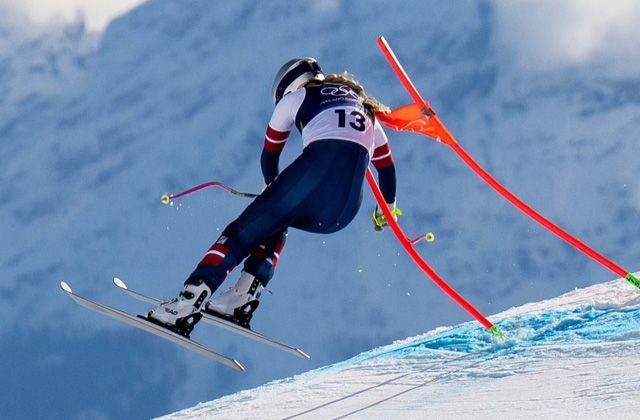
While some question the bindings, others question the gates themselves, and whether they should breakaway. That’s a conversation for another day though. Image: Lindsey Vonn on Facebook
Next up in somewhat Olympic news, we have a pretty intriguing story that’s starting to spread as a result of Lindsey Vonn’s crash. If you’ve seen footage of her crash, you might have noticed something beyond the fact that it was horrific: her skis didn’t come off. As a skier, you’re surely aware of the fact that our bindings have what’s called a DIN setting, which is a spring-loaded system that’s meant to ensure that your skis stay on when they’re supposed to, and come off when they’re supposed to. For the vast majority of skiers, this system works quite well. There is however, a disconnect amongst professional athletes who are exerting incredible force on their bindings, and for whom a pre-release at well over 70 MPH would be an absolute disaster. As a result, most professional ski racers crank their DINs way past what most of our consumer bindings even max out at. That helps their skis stay on when they’re supposed to, but it also means that they don’t come off when they should - just like Lindsey Vonn recently showed us.
In light of Vonn’s crash, we’re beginning to learn that efforts have already been underway to create what industry insiders are calling a “smart” binding. Regular readers of Top 5 Friday might recall our coverage back on November 14, 2024, when the FIS mandated the use of smart airbags amongst Downhill and Super G competitors. Those airbags are skintight accessories worn by athletes that contain a small device that’s capable of reading an athlete's movements, measuring things like g-force, speed, and rotation. In the event that a crash happens, this device triggers a personal airbag to go off, protecting the athlete. As we found out this week, work has been happening behind the scenes to bring this same technology to bindings for ski racers.
As it stands, the inventor of this technology, Dainese, has shared its proprietary algorithm with bindings manufacturers like Look, Tyrolia, Salomon, Atomic, and Marker. While that’s a significant step forward, the reality of the situation is that there’s still quite a bit of work to do before this technology is ready for use. As this article from Oregon Live points out, measuring forces upon a body and deploying an airbag is relatively simple compared to what’s being asked of binding manufacturers. While the premature deployment of an airbag might cost an athlete a race, it doesn’t risk additional injury. In the world of bindings though, if a smart binding decides to release, it had better be absolutely certain that it was supposed to. Put in different terms, this new smart technology is essentially being asked to take over the job of DIN settings, but to do it even better. Currently, DINs are being cranked to prevent prereleases as those are generally considered catastrophic. If these new smart bindings aren’t able to prevent a prerelease while also improving necessary releases, they ultimately won’t be an improvement. As you can imagine, it’s absolutely crucial for binding manufacturers to get that algorithm exactly right.
At the moment, the smart binding is in early development. While the binding companies have the algorithm to work with, and FIS insiders are advocating for their development, the reality is that it’s going to take quite a bit of time and money to pull this off. We suspect a future of smart bindings is inevitable, but it’ll take several years before they’re here, and even then, they’ll likely be reserved for the best athletes in the world. For the rest of us, the DIN system seems to be working just fine. To learn more about this project, check out the report from Oregon Live.
#3: Freeride Skiing Recap: Results from Kings & Queens, a Nendaz Backcountry Invitational Recap, and Two Freeride World Tour Updates:
Moving right along, we're going to take a moment to dip back into the world of competitive sports, this time catching up with some freeride updates. With multiple events to touch on, this might feel like a bit of a lightning round, but don’t worry - we’ll be sure to link to additional resources so you can explore more. That said, let’s start by recapping this year’s Kings and Queens of Corbet’s event.
First things first, if you haven’t spent any time watching highlights from this event, we highly recommend doing so as it was arguably the best iteration of it yet. While most versions of this event have featured far more crashes than successes on the entrance air, this year’s conditions resulted in a perfect landing pad, leading to an exceptional number of stomped landings. From Alex Hackel’s perfectly executed cork 7, to Wyatt Gentry’s massive 3, and Kelly Hilleke’s absolutely dialed double backflip, the beauty of this year’s event was that not only were athletes sending it into the couloir, but they were completing runs as well. While the meat of the course remained consistent with past years, with most athletes getting 1-2 hits in before the park jump at the bottom, two men unlocked an impressive new feature. Towards the bottom of the venue, to the looker’s left, there lies a roughly 30’ cliff, just above the park jump. This year, Wyatt Gentry and Tristian Lilly both made their way over to it, and absolutely stomped the landing. Ultimately, it was Lilly’s run that consisted of an ultra relaxed frontflip into the couloir, followed by a windlip backflip, the aforementioned cliff, and a misty 7 off the park booter that impressed his fellow competitors the most, giving him the win. On the women’s side Piper Kunst was the first female to drop, and she made quite the impression with a perfectly executed backflip into the couloir. That effort alone was enough to award her the Queen’s crown for the second time, having won the event back in 2022 as well. For more coverage on this event, check out the recap from Freeskier.
In other freeride news, we want to quickly let you know that the 2026 iteration of the Nendaz Backcountry Invitational was recently held, with their Live Show being shared on Sunday of this past week. Just to jog your memory, the Backcountry Invitational has been an annual event held in Nendaz, Switzerland for the past 6 years. Historically a well regarded venue for the Freeride World Tour Qualifier series, Nendaz began hosting an additional event 6 years ago that takes cues from traditional freeride events, but gives them a freeski twist by adding rail features and manmade jumps to natural terrain. The result has been an event that allows a wide range of riders to showcase a wide range of skills. This past summer, the event blossomed into the “Backcountry Invitational”, as organizers expanded it beyond just Nendaz, with events in Argentina and New Zealand. With those additions made, this was the first iteration of the Nendaz event under the new trajectory.
With that in mind, this year’s event underwent some small changes as it adjusts to its new format. First up on that list is a change in the viewing experience. In past years, the event was livestreamed. This year, the event followed the NST’s playbook and released an event replay after it had concluded. All told, it was a favorable adjustment as it allowed for the final product to be more refined than the livestream had been in year’s past. In addition to the adjustment in coverage, it appeared as though the course build took another step in the terrain park direction. Whereas in years past, this event has included a number of natural features in combination with built features, this year’s venue had more of a slopestyle course feel, built on natural terrain. How you feel about that direction is up to you, but at the very least it serves as further differentiation from traditional freeride events. Between the adjustments made to the presentation and the course, it feels as though this year’s iteration of the event is a step towards a more finished product and we remain excited to see what the BCI brings next. From here, we’ll hold off on the spoilers, but we'll turn you over to the Backcountry Invitational website, where you can easily cue up runs you want to watch.
Finally, before rounding out our freeride highlights, we want to share just a couple of quick updates from the Freeride World Tour. Initially our plan was to use this slot to let you know that the next FWT stop is planned for Georgia this coming week, but unfortunately it was announced earlier today that that event has been cancelled due to an unstable snowpack. While the announcement regarding the cancellations suggests that they’ll attempt to reschedule it for the Fieberbrunn weather window (March 5 - 10th), the reality is that squeezing two separate events into a 5 day window doesn’t seem particularly feasible. Regardless, that window will serve as the next FWT event, whether it’s in Georgia or Fieberbrunn.
Lastly, before rounding this update out, we also want to share the news that Kelly Hilleke has been ruled out for the remainder of the year after tearing his ACL and meniscus. Despite a brutal year in which he’s broken his neck, fallen in both FWT events, and lost a ski before even starting his FIS World Championship run, Hilleke has quickly become a fan favorite as the glimpses of his potential that he’s shown has everyone eager to see him put down a complete run. Unfortunately, that will likely have to wait until next year. To learn more, check out the FWT announcement on Instagram.
#4: Widespread Avalanche Fatalities Serve as a Stern Reminder of the Importance of Backcountry Knowledge, Decision Making, & Risk Assessment:
Unfortunately, we have to end this week on a pretty severe down note, as a spate of avalanche deaths across the world have forced our hand into writing the type of highlight that we dread writing every year. As you’ve likely heard by now, there was a horrific avalanche this past week in the Tahoe region, off of Castle Peak, just north of Boreal and Sugar Bowl ski areas. That incident resulted in the loss of 9 lives, including 3 experienced backcountry ski guides and 6 lifelong friends and mothers who were also experienced in backcountry skiing and had hired a guiding company to take them on a 3 day trip. Despite the wealth of experience amongst the group, heavy snowfall and high winds led to extreme avalanche conditions and the group of 15 was hit as they attempted to exit the backcountry area that they were in. Ultimately, it became the deadliest avalanche in California’s history. We won’t dive too deeply into the details here, as there is a ton of coverage available already. If you’d like to learn more details about this group and their ties to their communities, give this article from the New York Times a read. If you’d like to learn more about the avalanche itself, check this one out. For even more, just Google “tahoe avalanche.”
While we hate to spend such little time on such a tragic story, the harsh reality is that the Tahoe avalanche wasn’t the only one this week, and this highlight (lowlight) is unfortunately about a wider theme. In Utah, multiple fatal avalanches have occurred within just the last 48 hours. On Wednesday of this week, a father who was snowmobiling with his son in the Wasatch mountains was caught in an avalanche and died. While his son was able to find and unbury him, he was unfortunately too late. Then, just yesterday, a young girl was skiing in the sidecountry of Brighton Resort where an avalanche was triggered. Unfortunately she was caught in it and also passed away.
The terrible news this week wasn’t limited to U.S. borders though. Overseas in Europe, multiple avalanches resulted in even more deaths. Last Friday, there was an avalanche in the French Alps that killed three. Then, on Tuesday, two separate avalanches left a total of four more dead, also in the French Alps.
In total, that’s 18 avalanche deaths this week.
If that number scares you, it should. While we know that avalanches are a part of our sport, we also know that they aren’t random. In addition to carrying reactive equipment like beacons, shovels, probes, and airbags, it’s absolutely imperative that you also carry preventative knowledge. While factors like climate change result in more quickly escalating severe weather, and snow droughts lead to an unquenchable thirst for powder, the number one skill that has the potential to usurp these factors is decision making. If you’re someone who ventures into the backcountry, we fully support you. That said, please, please do so with not just the right equipment, but with the right knowledge and conservative decision making skills required to survive the mountains as well. By making the right calls, you can survive anything, but one wrong decision is all it takes for tragedy to strike. Keep this in mind as you enjoy each and every powder day.
Now, onto our edits.
#5: And Now, Your Edits of the Week: Meet Dillon Flinders, Winner of TGR’s Dream Factory Film Festival Doug Coombs Award for Best Male Action:
Part Ski Flick, Part Travel Doc, Part Memoir, Giray Dadali’s “Of the Black Sea” is a Fantastic Watch:
Hank Stowers POV Edits Are Unintentionally Educational. Watch and Learn:
Finally, Enjoy About 15 Minutes of Skiing with GoPro Athlete Parkin Costain, Including One of the Most Jaw-Dropping Pillow Line Crashes We’ve Seen in a While:
*** Warning: Contains moments of strong, but justified language ***