

Top Five Fridays: January 31, 2025
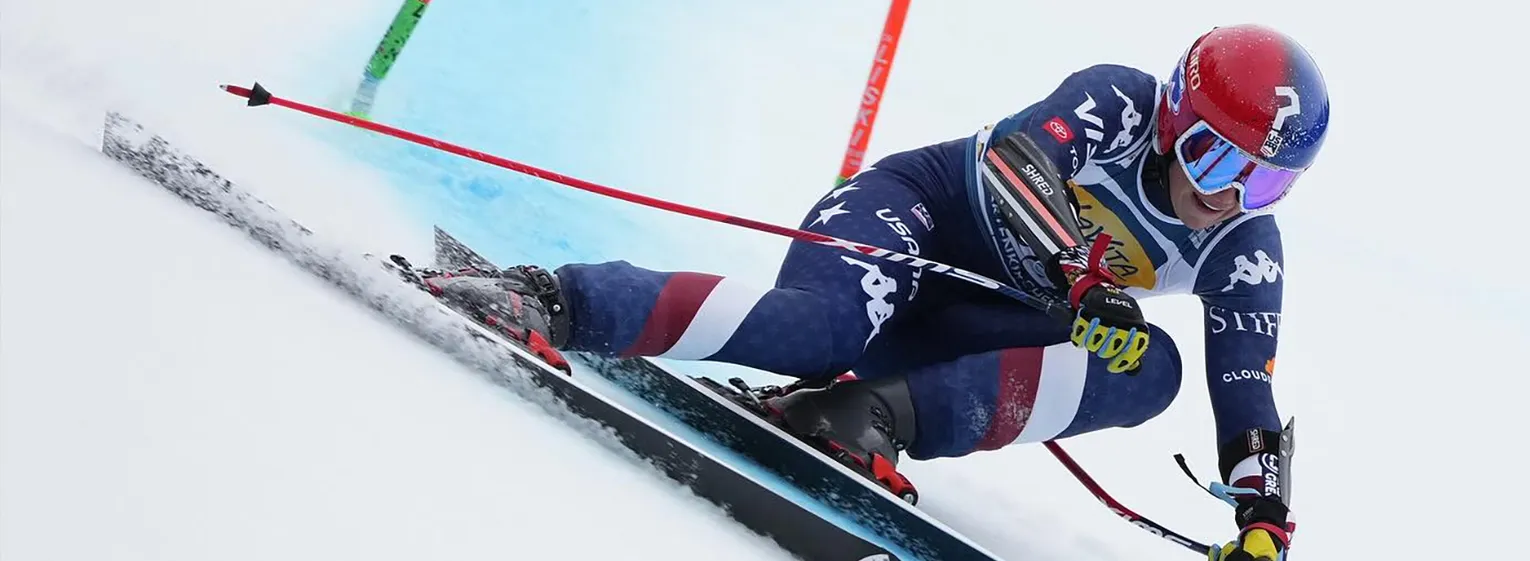
Lauren Macuga’s debut as the TFF is long overdue. This week, after yet another impressive round of results, she’s earned it. Image: U.S. Ski and Snowboard Team on Facebook
#1: FIS Alpine Recap: U.S. Women’s Team Adds a Podium Threat While Shiffrin Returns to Racing:
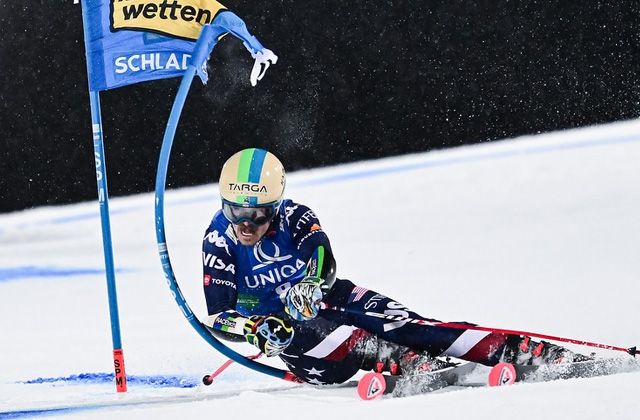
If this image of River Radamus ripping a gate doesn’t get your blood flowing, do you even have blood? Image: U.S. Ski and Snowboard Team on Facebook
Hello, and welcome to Top Five Fridays, the January 31, 2025 edition! This week, our highlight reel is a lot like last week’s, as the same three competitions and drama-laden company once again dominated the newscycle. Seeing as my esteemed colleagues Jeff, Bob, and Matt weren’t able to put out a video covering these topics last Friday, it seemed wise to run it all back and give them another shot at satisfying our visual learners this week. So, with that said, let’s get this thing underway!
If you read along with us last week, you might recall a declaration in which we stated that the U.S. Women’s Alpine team has, “conservatively six athletes that are serious podium threats.” After this week’s results, we not only feel even more strongly about that statement, but we’d actually like to increase that number to seven. You’ll see why in just a moment.
Kicking things off for the ladies last week was a Downhill and a Super G race in Garmisch, Germany. In the Downhill race, one of the aforementioned podium threats, Breezy Johnson, finished in 4th place, just .06 seconds behind 3rd and .25 seconds behind first. Moments behind Johnson was Lauren Macuga with yet another fantastic result, finishing 6th. Finally, rounding out what was already a strong showing from the Americans, was Jacqueline Wiles, coming in 11th. A day after that race, in Sunday’s Super G, Keely Cashman let us know that she took exception to being left out of our list last week, deciding to finish in 6th place, showing us that she deserves the title of “podium threat” as well. Joining her in the points in that race was Lauren Macuga, yet again, with a 12th place finish. Finally, Lindsey Vonn and Breezy Johnson rounded out the festivities with 13th and 20th place finishes respectively. While the team on the whole missed the podium last weekend, it’s hard not to see it as a successful stop as numerous athletes earned significant FIS points.
From Garmisch, the women’s circuit moved onto Courchevel, France, where a Slalom race took place just yesterday. While that race wasn’t able to live up to the previous two on the schedule, it was significant for one other reason: Mikaela Shiffrin made her official return to racing. After being sidelined for a full 60 days, Shiffrin finally retook the starting gate, racing to a 10th place finish. While that’s not the typical high level result we’re used to seeing, it’s very important to note that yesterday’s race wasn’t about chasing a podium for Shiffrin. Rather, she saw it as part of her recovery: simply getting back to the starting gate, completing two runs, seeing how she felt, and seeing how she measured up to the competition in her current state. Ultimately, Shiffrin’s stated goal is to be fully competitive in time for this year’s World Championships, starting next week. For now, we’re just happy to see her back in action.
On the men’s side of things, this week’s schedule brought about a ridiculous five races. Starting things off was a series of three races last weekend in Kitzbuehel, Austria: a Super G, Downhill, and Slalom. In the Downhill, Byrce Bennett paved the way for Team America, finishing in 19th, while Jared Goldberg earned 22nd, and Wiley Maple took 29th. In the Downhill event a day later, it was Ryan Cochran-Siegle’s turn to lead the team, with a 19th place finish, followed by Jared Goldberg in 25th, and Bryce Bennett in 29th. Finally, capping off the weekend was a Slalom race, in which Ben Ritchie held it down for Team USA, earning a 21st place finish.
From Kitzbuehel, the men traveled to Schladming, Austria, for back to back night races: a Giant Slalom and a Slalom. In the nighttime GS race, River Radamus was the only American earning points, finishing tied for 12th, while Ben Ritchie once again held it down for the U.S. in the slalom race, earning 9th place points.
Looking ahead, it’s a bit of a light week for both circuits as the women have the weekend off, while the men have just one race scheduled: a Downhill in Garmisch. Then, the World Championships in Saalbach officially gets underway on Tuesday, February 4th with a Team Parallel event, followed by a Women’s Super G race on Thursday. We’ll cover all of those events next week, as well as preview the rest of the World Championships calendar. Until then, you can get your eyes on the full schedule here.
#2: FWT Recap: Val Thorens Provided a Powder Paradise. Whether That’s a Good Thing Depends on Which Competitors You Ask:
It’s not the winning run, but it could have been. To watch a full replay and skip around to see your favorite skiers, click here.
Moving right along, our next topic this week is just the same as our second topic last week: recapping the latest Freeride World Tour stop. Much like last week, our coverage this time around comes with the surprise news that the tour had to move from its preferred venue, to its Plan B venue. Set to take place at Val Thorens, France, and marking the first time the tour had been to France since 2017, the venue for the event ultimately had to be moved to the Lac Noir - the first time the face had ever been used as a Freeride World Tour venue.
And what a venue it was.
Featuring three unique drop in points, this venue was opposite from last week’s stop in Baqueira Beret in that it must have been a nightmare for judges. While the Baqueira Beret venue offered one definitive entry point, making it easy to compare each rider’s line, the Val Thorens stop’s three drop ins offered unlimited possibilities for riders.
While the face itself was quite impressive, arguably the real storyline to this week’s competition were the incredible powder conditions that blanketed the venue. That of course made for some incredible visuals as riders blew up snow with every landing and turn. Or, in the case of the Swede Carl Regnér Eriksson, triggering minor avalanches while lily-padding over doubles. For spectators, the event was incredible viewing as the conditions offered movie-quality shots. For the riders however, it was a mixed blessing as the deep snow also led to quite a few ejections as skis got caught under deep snow or knocked away by the gratuitous slough.
Still, despite the tricky and uncertain conditions, one man rose above the rest, claiming his first FWT victory. That man was 20 year old Martin Bender. In a run that featured an elite mixture of calculation, risk, technicality, and stomped landings, Bender rolled the dice multiple times and got away with it. Right out of the gate, he expertly aired a cliff that set him on top of a second, much larger feature, from which he lofted a beautifully carved 360. From there, he traversed through knee deep powder to get to the lower zone, where he threw another massive left-side 360, immediately carved back right, where he threw another, massive 360. From there, he pinned it off large air which he smoothly shiftied before lily-padding off a final small air that he encountered in the landing. When all was said and done, Bender had put down a heater of a run. Throughout the rest of the field, several athletes also put down some incredible antics . Some, like Marcus Goguen who finished third, were successful and earned strong results after completing their runs. Others, like Weitien Ho, whose run was amazing in the most literal sense of the word, nearly put down a podium worthy run before ultimately double ejecting the moment he put his landing gear down on a massive backflip. Runs like Weitan’s really highlight the thin line between success and failure on the Freeride World Tour.
On the women’s side, having witnessed the do or die results from the men���s field, it felt like a number of competitors opted to play things a bit safer, ensuring that they went home with points from the event. While you might be inclined as a viewer to feel underwhelmed by that approach, the fact of the matter is that it’s a smart strategy in terms of trying to secure enough points to make the cut for finals. That said, not everyone played it safe. Astrid Cheylus, for one didn’t hold back, as an XL backflip up top, big airs, and controlled maneuvers throughout the venue ultimately led to a first place finish.
Looking ahead, competitors have this week off as they travel to Kicking Horse, BC for the third stop of the tour, with a weather window running from 2/7 - 2/13. In total, athletes have three more stops in which to earn points, with their top three scores of their first five events counting. If they make the cut and compete in the sixth and final stop of the tour in Verbier, then their top four scores out of all six stops will count towards their final score. To watch a full replay of last week’s action, click here. To preview the upcoming event in Kicking Horse, click here.
#3: More Big Air Records Broken as the Final One-Off X Games Comes to a Close:
Bear witness, to one of the spinniest and flippiest Big Airs of all time.
Next up this week is, you guessed it, X Games coverage! When we said this week is going to feel a lot like last week, we weren’t kidding. For those of you who are growing a bit tired with full competition breakdowns though, you are in a bit of luck, as the X Games simply had way too many events last weekend for us to possibly give full coverage to. Keeping that in mind, we’ll just recap a few of the top storylines while encouraging you to visit the X Games website for more.
On that note, it’s likely that no storyline is bigger than the fact that records were broken once again at X Games. Specifically, in both the ski and snowboard Big Air contests, a new rotation was discovered: the 2340 (aka, six and a half 360’s). In snowboarding, the feat was accomplished by Ogiwara Hiroto who combined it with a mute grab, while Miro Tabanelli combo’d it with a blunt grab for the skiers. Regardless of grab or equipment, one thing was the same for both athletes: they were each approximately 1 RPM away from legitimately taking flight and soaring off into the distance.
The other most notable piece of news coming out of the X Games is a bit more somber. After appearing immortal for years on end, Eileen Gu finally showed us that she is human, and sometimes incurs the type of injury and fatigue that force you to pull out of competitions. Unfortunately, Gu crashed during the Street Style event, badly bruising her hip, and leading to her opting out of both Superpipe and Big Air. While the injury itself doesn’t seem to be anything too significant, it came at a time when Gu was already at the edge of her limits. After battling an intense illness in the days leading up to the events, combined with skiing multiple 12 hour days, Gu’s body simply crashed as a result of her crash. In her words, “To be completely honest, my mental and physical tanks hit zero yesterday.” It was an unfortunate turn of events for the competitor who is always a favorite to win, however it was ultimately a decision that seemingly had to be made.
And with that, the 2025 X Games are a wrap, as is the era of one off annual events. This summer, we expect to learn much more about plans surrounding the rollout of the X Games League, which is set to debut next winter. As we learn more, you can be sure that we’ll share the knowledge. For now, head on over to XGames.com to relive this year’s events.
#4: Vail’s Terrible, Horrible, No Good, Very Bad Season Continues:
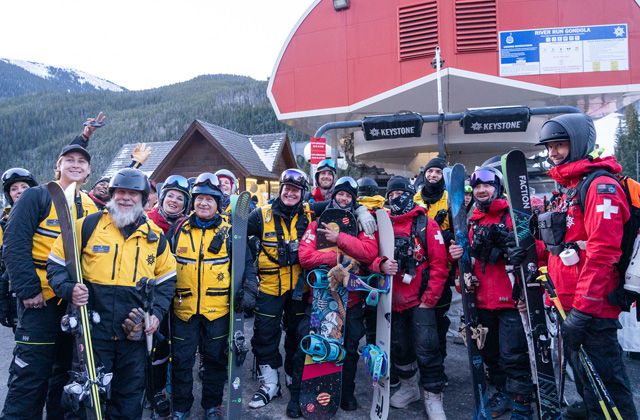
There’s beef in the water, as unionized patrollers and upper management at Keystone are in the midst of a back and forth regarding comments made between the two at a contract negotiation session last week. Image: Keystone Ski Resort on Facebook
Finally, we round out this week once again with more drama from the world of Vail Resorts. This week, two separate stories came across our desk that continue to elaborate on the same story: people aren’t stoked on Vail.
The first of those two stories is seemingly really bad, as it comes to us by way of Colorado based investment group Late Apex, whose largest position is an investment in Vail Resorts. This week, the investment group sent a letter to Vail, telling the company that its performance over the past five years has been “unacceptable.” From there, it outlines four specific problems surrounding the current business, including the fact that the ski community currently sees them as “the evil empire.” Rather than continue to belittle the business though, Late Apex’s letter goes on to request a number of changes in order for the company to earn their confidence and continued support. Sounds positive, right? Here’s the thing: the suggestions are severe.
Topping Late Apex’s requests and recommendations are the firing of CEO Kristin Lynch and CFO Angela Korch, as well as Rob Katz’s resignation from the roll of Executive Chairman. For those who recall the pre-Lynch days, Katz was the longtime CEO of Vail, and one of the founding fathers of consolidation. In other words, the Late Apex’s demands would be a complete overhaul of the company’s upper management. While it’s unlikely that Vail will swiftly meet Late Apex’s demands, the message is clear: all of this bad publicity is starting to make the shareholders nervous, and for Vail, a publicly traded company, their shareholders are everything.
In tangentially related news, we also caught a report this week from Powder that highlights Vail’s ongoing struggles with ski patrol unions at their mountains. This time around, it’s news from Keystone, where the Keystone Ski Patrol Union (KSPU), the resort’s Vice President and General Manager Shannon Buhler, and Vail Resorts are finding themselves in a bit of a “he said, she said” routine. It all stems from a meeting that took place last Wednesday as the three parties attempted to make progress on an updated contract for the union. That meeting, did not go well. In the words of KSPU, Vail Resorts, “signaled to the union that they do not want their patrollers to prioritize medical care for injured guests, and instead simply transport them off the mountain.” Additionally, the KSPU statement suggested that Vail was planning on reducing wages for their most highly skilled staff. That statement ultimately triggered a response from Buhler, who sent an email to employees on Sunday, stating that this claim was not true while also addressing other claims made by the KSPU. The KSPU then responded with a rebuttal to the rebuttal on Monday, and, well, to put it in other terms: this thing is spiraling.
We’ll stop there before we get too deep into the nitty gritty of the KSPU situation as our intended takeaway from this highlight is a bit higher level. That takeaway is this: it’s been a tough, tough season for Vail, and regardless of what the financial reports suggest, it feels as though perception of the business is changing. For years, skiers have been saying, “all that matters to Vail are the shareholders,” and now that the shareholders are mad too, it’s not hard to imagine a scenario in which change quickly becomes afoot. We’ll leave you there for now, but we also encourage you to read more about the Late Apex letter as well as the Keystone Ski Patrol Union debacle here.