

Top Five Fridays: June 2, 2023
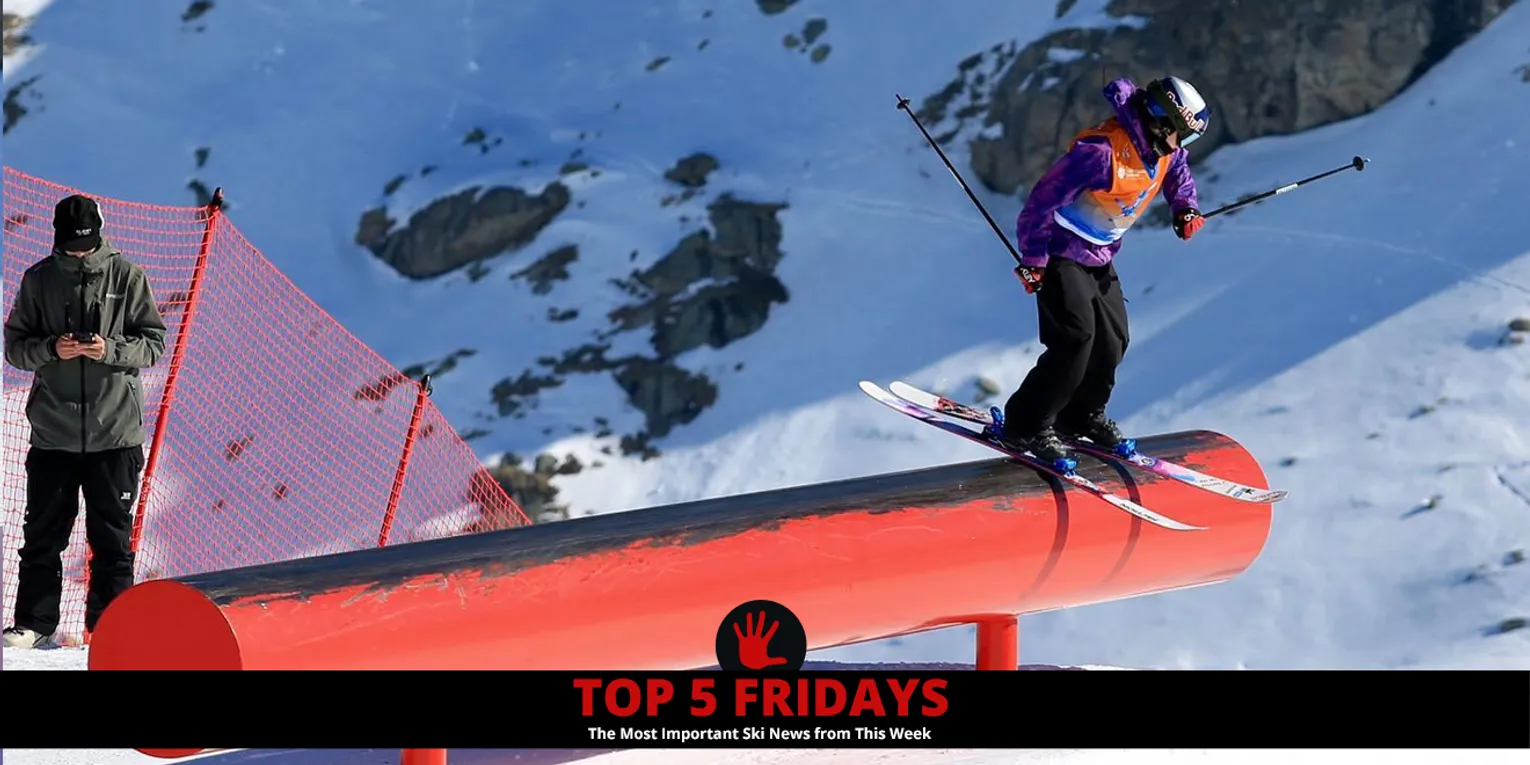
Lead Image: This week, the FIS released a five year master plan for the first time ever. Amongst the plethora of goals for the next five years are a number of initiatives aimed at growing exposure for winter sports and their athletes. Image: FIS Freestyle Skiing on Facebook
#1: The FIS Has Just Released Their First Ever Five Year Plan, and if it All Works Out, We’re in For Quite a Show:
In its first ever official five year plan, the FIS lays out a roadmap for fulfilling its vision of creating a globally visible winter sports league. Image: FIS Official Website
Hello, and welcome to Top Five Fridays, the June 2, 2023 edition! We’ve got a surprisingly solid round of ski news to discuss this week, with a big development coming from the FIS, another contentious update from the Little Cottonwood Canyon gondola saga, jaw dropping news from our own backyard, and an excellent highlight of Mikaela Shiffrin’s new head coach. Somehow, on this Friday in June, we have an incredible batch of ski news to share. Let’s get started.
Topping our list of updates this week is the announcement of a new five year plan from the FIS. For the first time in its history, the FIS has publicly released what it’s calling a rolling five year plan, which means that each year they’ll produce a document that’s essentially a roadmap for the next half decade. One year in the making, this initial document lays out the groundwork that the FIS has already put down following Johan Eliasch’s election as president, and previews the next four years. To be fair, it’s a comprehensive document with a ton of great content that was released just two days ago. As such, we’ve only had a chance to skim through it, but from what we’ve read, the plan is impressive.
Perhaps the biggest highlights of this document is the heightened focus on broadcasting and increasing global visibility. This angle has always been one of Eliasch’s driving principles, so it shouldn’t come as much of a surprise, but the plans and developments laid out in this document are very exciting. First, let’s touch on broadcasting rights. As you might recall from last Summer, the FIS was in the midst of ending contractual obligations with third party organizations in an effort to bring broadcasting management under the FIS umbrella, into a group now called FIS Media & Marketing (FIS M&M). By centralizing the broadcasting and media rights, and no longer allowing a third party to manage them, the FIS is back in full control over their media. What this ultimately means for us is that the complex international broadcasting rights agreements which made it difficult to view content taking place in other countries are now a thing of the past. If all goes to plan, this should mean for example, that those of us in the U.S. should have no issue streaming races and events taking place in say, Italy, for example. Now that the FIS controls who can broadcast events, the idea is that they’ll be able to ensure their content is easily accessible regardless of region. Ultimately their goal is for there to be “no excuse to miss any special “live sporting moment”.
Taking this concept a step further, the FIS also has plans to “modernize” their approach to media. For example, there are plans to enhance the viewing experience in an effort to make the content more accessible for those who aren’t ingrained in the sport. For example, there’s a section of the document that lists concepts such as, “Live comparison of the actual competitor with the leading athlete (ghost)”, or, “Virtual 3D graphics – line, rotations, position in field, comparisons etc.,” and even, “Athlete biometrics and more detailed information for the audience: heart rate, speed, G-Force, jumps length and height, difficulty and terrain steepness.” Mix in additional focuses on POV footage and more audio sound bites, and you can tell that the FIS is hyper focused on developing their visual product, beyond simply making it more accessible.
Further building on their own product, the FIS also wants to encourage the creation of athlete driven content across a number of platforms. While the document doesn’t delve into details, it’s laden with phrases such as “development of channels across social media, YouTube, gaming and digital platforms”. In another line, it states a goal to create, “Content access for athletes and brands to become their own content creators and sport influencers.” What this means, essentially, is that the FIS wants to aid in the creation of winter sports superstars. In other words, the FIS is envisioning a world in which winter sports stars like Mikaela Shiffrin or Eileen Gu are seen in the same light as athletes like the F1’s Lewis Hamilton or the PGA’s Jordan Spieth. While lofty, this is certainly a goal we can get behind.
Finally, before rounding out this highlight, we want to touch on one last aspect of the document that we were particularly interested to read more about: the FIS’s plans for the Freeride World Tour. As it turns out, this portion of the document was interesting, but not for the reasons we expected. On page 34, we’re treated to a quick 3 paragraphs of the FIS’s plans for the FWT. This space, as it turns out, is chock full of the FIS saying more or less what fans of Freeride might hope for: acknowledgement of Freeride skiing’s strong existing infrastructure and a respect for the sport itself, as it is. In this writeup, there are two sentences that stick out. First, “. The FWT is well organized with a strong structure, robust safety, digital platform, modern marketing and visibility, and importantly, a sizable younger audience.” And second, “Integration into the FIS Discipline and Event framework will be undertaken thoughtfully and respectfully, having regard to the existing commercial model and the history and culture of the Freeride community.” Within the Freeride skiing community, the news that the FIS had acquired the FWT has been met with immediate and significant apprehension, and with good reason. The FIS has a history of adding criteria to a sport that can take away its heart and soul. While the verdict is still out on what happens in regards to scoring and judging formats, it should be at least somewhat relieving to see that the FIS recognizes the strong foundation they’ve purchased, and seems focused on integrating the sport under their umbrella in the best way possible. Which ultimately leads us to our final thought on this subject: the most important part of this section of the five year plan are all of the things it doesn’t say. By far the most brief portion of the plan, it’s clear that the FIS doesn’t actually know what they’re going to do differently with the FWT. That should, at least for now, bring some peace to mind for those of us in the community who’ve feared the worst. For more on this, and to read the entire 5 year plan, simply click this link.
#2: The Little Cottonwood Canyon Saga Continues as Regional Transportation Plan Gives Stamp of Approval Despite Heavy Backlash from Locals:
We’ve shared it before, but here it is again: the promotional video from Gondola Works, touting the benefits of the gondola plan.
Moving right along, our next highlight this week is a story you must know quite well at this point: the ongoing saga of the Little Cottonwood Canyon gondola. This week, plans for the ultra controversial gondola took another step forward as the Wasatch Front Regional Council (WFRC) approved a Regional Transportation Plan (RTP) that includes the LCC gondola alongside over 1,000 other considerations. To provide some additional context here, the WFRC is an organization that’s tasked with organizing and planning transportation measures in the greater Salt Lake area, including the two Cottonwood Canyons. Now that the Regional Transportation Plan has been approved, it’s being shipped off to the state government for additional considerations.
The approval of this plan is fraught with tension, as it feels like everyone in the entire United States, besides Ski Utah, Snowbird, Alta, and the Utah Department of Transportation are adamantly against this plan. In the public hearing in which the RTP was approved, there was significant public resistance to the approval of the plan. In one comment, Carl Fisher, the Executive Director of Save Our Canyons, stated that their organization had received comments opposing the gondola from residents of each of the 50 states. Unfortunately, he also said, “our elected officials are being told it's illegal to listen to that.” Despite numerous other objections, Wasatch Front Regional Council members told the audience that they ultimately had no choice, and have to include the gondola proposal in their plan as it had already been backed by the Utah Department of Transportation. In other words, this was never a point in time in which the gondola proposal could’ve been removed from this particular plan. It was always going to clear this hurdle, thanks to approval from a higher authority. The concerning aspect of this development was well stated by Utah Senator Nate Blouin, who said, “My concern is that that is going to really allow the legislature to look at this as if it's gotten this ‘gold star’ from our planning organizations, and I don't think it's quite had the due diligence that it deserves yet.” In other words, when this RTP lands on the desk of the legislature, it’ll appear as though it’s a development that the region is in favor of, when the reality couldn’t be further from the truth.
Interestingly enough, the final moments of news coverage from Fox 13 Now mention a timeline that makes the gondola project seem almost impossibly improbable when combined with the sheer volume of opposition. In their closing comments, Fox 13 says that ground wouldn’t break on the gondola project until at least 2043. With the sheer amount of local opposition, and efforts such as tolling and increased public transportation starting as soon as next year, it’s incredibly difficult to see how this proposal will go on for the next 20 years without ever being pronounced dead. But, apparently this is the story that never ends, and for as long as it continues to live, we’ll be here to cover it. Even if it takes us 20 more years. For more on this, check out the reporting from Fox 13 Now.
#3: After Years of Secret Discussions, Plans for a Stowe to Smuggs Gondola Have Been Made Public:
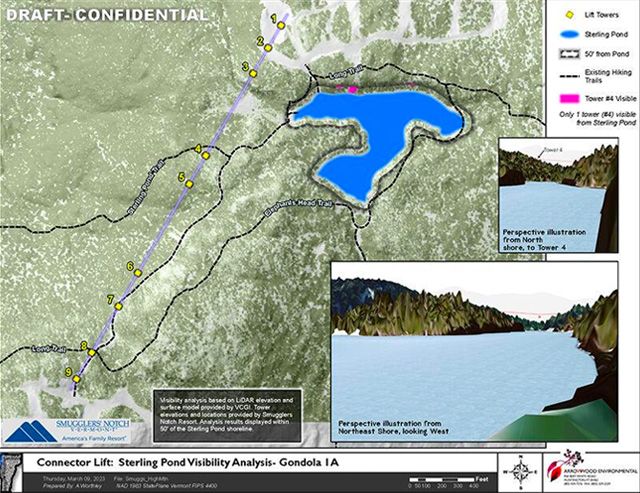
A map showing the proposed pathway of the new gondola, as it relates to both peaks, Sterling Pond, and hiking trails in the area. To see a larger version, click here.
In other gondola news this week, we’ve got a major announcement to share with those in our region: Stowe Mountain and Smuggler’s Notch have been in secret discussions for years regarding the development of a gondola to connect the two resorts. For those who aren’t in our area, let us quickly set the scene for why this is such jaw dropping news. Let’s start with the lay of the land: the main mountain at Stowe is Mt. Mansfield. That’s where we host our annual ski test, shoot a majority of our ski review content, and can access above treeline skiing. Across the street is Spruce Peak, which is home to some excellent beginner terrain, race terrain, and lesser known backcountry zones. If you were to ski about a half mile off the backside of Spruce, in the correct direction, you’d find yourself at the top of Smuggler’s Notch Ski Resort. In fact, in the summertime, there’s a popular hiking trail that people often use to check out both summits on the same hike. In other words, the resorts are direct neighbors. The catch here is that despite the proximity of the resorts, the notch road that connects the two ski areas is closed in the winter, meaning it’s about a 40 minute drive from one base area to the other. This also means that Stowe is about a full hour closer to more populated areas to the south of us, such as the greater Boston area.
In addition to the proximity of our resorts, the second fact to take note of are the distinct differences in style and approaches to mountain management. Here at Stowe, the Vail influence is real, complete with high speed lifts and ongoing base area renovations. At Smuggs, the vibe is different. There, the highest capacity lifts are double chairs and the base lodge feels more “rustic” than “upscale.” For those who ski at Smuggs, this is exactly what they prefer. In fact, every time the concept of Vail acquiring Smuggs to make a mega resort, much like they did with Canyons and Park City, most Smuggs loyalists will be quick to tell you how much they hate the idea with every ounce of their being. To be fair, we get it. Now, it’s with all of this in mind that we finally share this week’s news.
Just yesterday, two months to the day after April Fool’s day, news broke that Smuggs and Stowe have been secretly having conversations regarding the concept of connecting the resorts via gondola for over six years, dating back to a time when Vail had just purchased Stowe. There’s a lot to be said about this as it relates to Smugg’s management’s public claims that they’ll never sell out to Vail, but we’ll leave that for another day. For now, let’s check out some of the facts with this gondola concept. If it were to come to fruition, the idea is that a short, 2,600’ gondola would be installed, running from the top of Smugg’s Sterling Lift to Stowe’s Sensation Quad. There’s been no additional conversation regarding additional cost to ride the lift, or even an eventual merging of the two resorts, but it’s tough to see a reality in which the resorts don’t merge if this lift is completed. Of course that “if” is still a pretty big if. “If” the proposal clears all environmental and visual disruption hurdles, then we can begin to have those bigger conversations. Currently, the plan has a number of environmental and natural integration reviews to clear and boxes to check before this concept becomes a reality. Still, for us in the region, this is earth shattering news, and something that many might have never expected to hear. To learn more, check out the article that broke the news from Morrisville’s News and Citizen.
#4: This Season, Mikaela Shiffrin Hired a New Head Coach: The Legendary Karin Harjo. This Week, Ski Racing Media Shares Her Story:
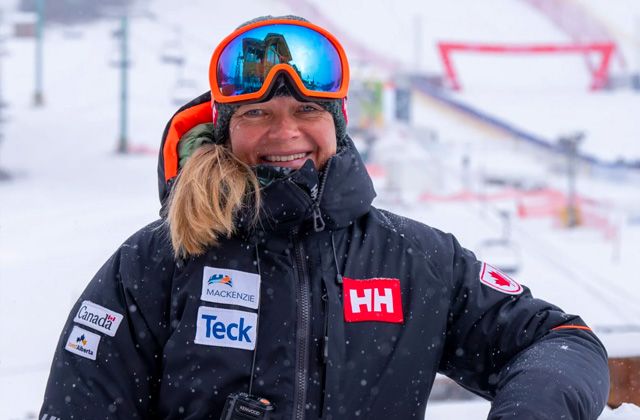
A photo of Karin Harjo, a trailblazer for female coaches at an elite level. Image compliments of the official Olympics website.
Finally, we want to close out the week with a story that’s not so much news as much as it is a really interesting highlight piece on an under-sung hero in ski racing: Karin Harjo. As you likely know, last year was a wild one for Mikaela Shiffrin, with news coverage being dominated by her dominance on the World Cup circuit, and her constant quest to take down long standing records. Amongst all of that commotion, something else happened with Shiffrin: she lost her head coach at the end of February, during the World Championships. To be fair, Shiffrin already had plans to move on, so when she told her former coach Mike Day the news, he simply decided to depart immediately and take action on following his own path forward. Ultimately this left Shiffrin without a head coach for the final stretch of her season, at a moment when she’d accumulated 85 victories and was on the cusp of making history. So, who was Shiffrin’s unofficial head coach in waiting, who prompted such a dramatic turn of events? Karin Harjo.
If you’re familiar with some of the deeper layers of ski racing, the name isn’t unfamiliar. Karin Harjo has a long history of coaching, having worked her way to the top over the course of 25 years. Starting from the lowest levels of competitive ski racing, Harjo eventually became a vital part of the U.S. Team’s coaching staff. From 2015-2017, Harjo was the assistant coach for the women’s technical team, before becoming the assistant coach for the women’s speed team from 2018-2022. Over the course of these years, Harjo worked with both Lindsey Vonn and Mikaeala Shiffrin, as well as numerous other athletes. Then, ahead of the 2022-2023 season, Harjo got the opportunity of a lifetime: becoming the head coach of the Canadian ski team. In taking that role, Harjo became just the second ever female head coach of a World Cup national team. Even more impressive than this claim is the fact that not only did Harjo take on an impressive role, but she thrived in it. This past season Team Canada had one of its best World Cup seasons to date, one of the highlights being Laurence St-Germain’s gold medal in the slalom at the World Championships. With that win, St-Germain earned the country’s first slalom gold medal since 1960. Interestingly enough, this race occurred just three days after Shiffrin and Mike Day departed ways. While we don’t know whether or not Harjo and Shiffrin had discussed their future plans at this point, it could be the reason why Shiffrin seemed almost excited by St-Germain’s victory in that race, rather than being disappointed by her own silver medal.
In addition to discussing recent history, the SkiRacing.com article also takes deeper dives into both Harjo’s upbringing and approach as a coach - both of which are highly interesting. For instance, Harjo is a Norwegian, who was born in Japan to two Norwegian missionaries. As such, she grew up with a mix of Norwegian and Japanese influences, becoming fluent in both languages while also being raised on skis from an early age. As for her mentality as a coach, the article is rich with insights into Harjo’s athlete-led approach in which she sees herself as more of a guiding influence than an authority figure. In reading the story, it becomes clear that Harjo wasn’t hired by Shiffrin purely because of her results, but also because of the way she partners with athletes. At this point in her career, Shiffrin doesn’t need someone to tell her how to ski, she needs someone with experience that she can trust to bounce ideas off of. Despite the length of this highlight, we promise that there is a ton of additional information in this piece from SkiRacing.com, and we highly encourage you to give it a read!