

Top Five Fridays: March 1, 2024
Lead Image: Last week, Minneapolis, Minnesota hosted the first World Cup XC races on U.S. soil in over two decades. Both the American fans and athletes rose to the occasion. More on that below! Image: U.S. Ski and Snowwboard Team on Facebook
#1: FIS World Cup Alpine Update - Women’s Races Canceled, Shiffrin Eyes Return, & River Radamus Earns Career Best:
Hello, and welcome to Top Five Fridays, the March 1, 2024 edition! This week we’ve got back to back competitive highlights, followed by a reality check brought to you by climate change, as well as a final highlight that gives some insights into the ski scene in the remote country of Georgia. Whether you’re a fan of ski racing, freeskiing, political activism, or travel, we truly have something for everyone this week, so let’s dive right in!
First things first, let’s just get this part out of the way: the only women’s races scheduled for last week were a pair of super gs in Val di Fassa, Italy. When we checked the results this week, one of the scheduled races went mysteriously missing from the calendar, while the other was canceled. Either way the outcome is the same: the women did not take the course this week, and so there are no results to report. That said, we do have a small amount of Shiffrin news to share as we learned that she’s reportedly eyeing a return to racing for the season’s final weekend in Are, Sweden. While the chances are slim, and there’s a lot on the line with this weekend’s two super g races in Kvitfjell, Shiffrin does still have a mathematical chance to claim the overall title, sitting just 205 points behind Lara Gut-Behrami who currently holds first place.We’ll have to see how Gut-Behrami does this weekend of course, but for the moment, there’s still hope for Shiffrin.
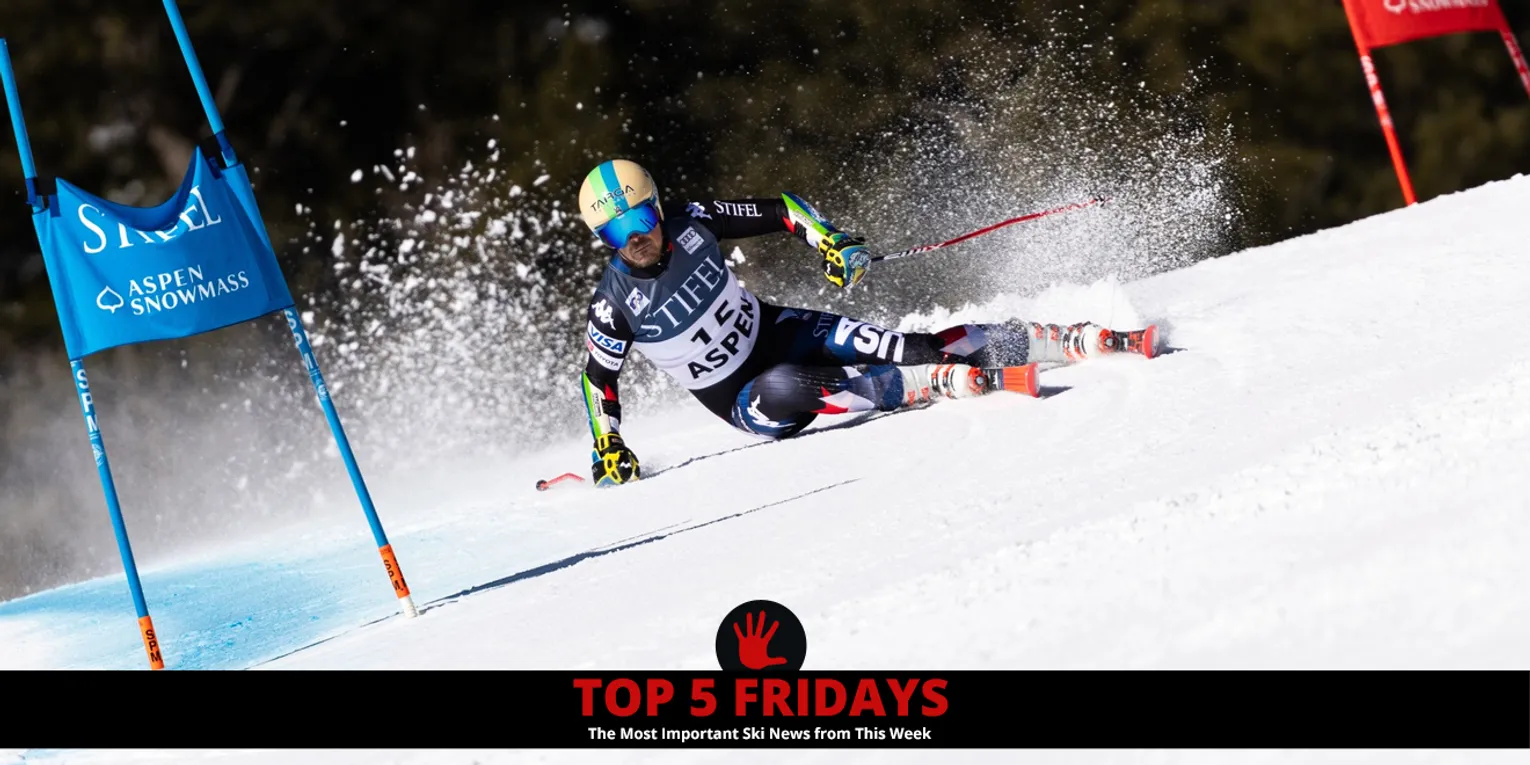
On the men’s side of the sport, we not only have some results to share, but some exciting ones at that. All year we’ve been talking about consistent results, despite only a few podium finishes. This week, we’re excited to share that the men’s team has added another podium to the resume as River Radamus finished in a career best 3rd place in the giant slalom race at Palisades Tahoe this past week. Also earning points in that race were Tommy Ford in 20th and Patrick Kenney in 24th. A day later, in a slalom race, Jett Seymour held it down for the Americans with a 15th place finish. Looking ahead, the men are currently in Aspen, CO for a pair of giant slaloms and a slalom race before heading back to Europe to wrap up the season. You can preview the schedule and results for the Aspen events, right here!
#2: 2024 Freeride World Tour Stop #3 Recap - The First Ever Stop in Georgia Proves to be Wildly Successful:
At this week's FWT Stop #3, Marcus Goguen put down not only the best run of the day, but of the entire season thus far. Just watch for yourself.
Next up in competitive ski news this week is the highlight we’re admittedly the most excited to share: results from the third stop of the 2024 Freeride World Tour. This week, for the first time ever, the FWT found itself skiing in the remote mountains of Georgia, and the venue didn’t disappoint in the slightest. In fact, of the three events that have been held so far this year, the Georgia venue offered arguably the best terrain as well as undeniably the best conditions. If you somehow still haven’t watched any Freeride World Tour events yet, this is the one to start with. With excellent snow conditions and qualification for the final two events on the line, both the men’s and women’s fields left it all out there, resulting in jaw dropping displays of talent. If you’re wanting to watch the action live, without spoilers, we recommend scrolling down to our edits of the week, or heading over to the Freeride World Tour to watch the full replay. For the rest of you who have either seen the event or are interested in our breakdown, keep reading.
As per usual, we’ll start with the women’s side of things, as their field has been raising the bar all season long. In something of a testament to that fact, it’s with mixed feelings that we share the news that 6 of the 10 female competitors at the Georgia event fell. While you might be quick to assume that that indicates a lack of ability, the fact of the matter is actually the opposite. In reality, the 6 women who crashed all did so because they were absolutely pushing the limits of what was possible on the venue. Case in point: Molly Armanino, who was putting together an incredibly spicy line, but unfortunately got caught up in a mix of slough and rocks before tumbling over (and exposing) a rocky cliff band. Another excellent example would be Manon Loschi, who became the first female competitor to put two rotations into a FWT run in Kicking Horse, and whose run featured a 360 into a massive, beautiful backflip. Unfortunately the size of that backflip put her in the unfortunate situation of having to straight line over a cliff, a predicament in which gravity ultimately won out, causing Manon to take a tumble. Ultimately, at the end of the day, it was Sybille Blanjean, Hedvig Wessel, and Lily Bradley who took first, second, and third respectively. In each of their runs, these athletes opted out of tricks, and instead stuck to runs that featured high line scores and a variety of airs that they could land with confidence. For the women, the Georgia event came down to who was the best at calculating their own individual risk factors.
While a majority of the women’s field crashed out, the opposite was true for the men, who finally put together an event in which numerous athletes put together jaw dropping runs. Again, we want to reiterate here, if you haven’t watched the FWT and are wondering what the fuss is all about - you absolutely must watch the men’s field at Georgia. To quickly put it into perspective, consider this: seven athletes in Georgia scored a 90.00 or higher. At the last stop, in Kicking Horse, only the top three did. Another fun stat? The 6th place run in Georgia would’ve been the third place run in Kicking Horse. In other words, this stop of the tour was ultra competitive, a nightmare for judges, and incredibly fun to watch as a spectator. While we’re not going to be able to do all of the athletes and individual feats justice here, we’ll do our best to call out some highlights.
First up on the highlight reel absolutely has to be Marcus Goguen. A competitor who's shown what he’s capable over the past two seasons, but had yet to win an event, finally put it all together in what will surely be one of the most memorable runs from the season. Right out of the gate, Goguen lofted a massive, floaty 360 off the top hit which saw plenty of action throughout the day, into a backflip that utilized a completely different takeoff than had been hit up until that point, into a ridiculous cork 7 that Goguen had to really pull himself out of, before improvising an absolutely massive launch off a subtle windlip that previous competitors had only taken a handful of feet. It was the type of run that had jaws dropped throughout, and that the judges rewarded with an incredible 98.00. As just the third athlete in the men’s field, the bar was set incredibly high, and the rest of the competitors followed his lead. Throughout the other 19 runs, we saw just about everything. Absolutely massive windlip backflips from athletes like Maxime Chabloz, Kristofer Trudell, Martin Bender, and many more. There were also huge 360’s, with arguably none bigger than Max Hitzig’s second hit. Martin Bender also snuck in a cork 720. WeiTian Ho put down maybe the most technical, highest risk run of the day. Japanese rookie Tenra Katsuno packed multiple creative hits and tricks into his run. The list truly goes on and on, in what was one of the most impressive FWT events we’ve seen in years.
At the conclusion of the day’s events, both the men’s and women’s fields were trimmed as the list of athletes who made finals had been determined. Reviewing the list of athletes who qualified for the final two events this year, the fine line between success and failure in the sport is revealed. Amongst those who didn’t make the cut are names like Andrew Pollard (who finished third overall last year), Max Palm, and Blake Marshall. Even more dramatically, on the women’s side of the event, none of last year’s top four finishers (Justine Dufour-Lapointe, Molly Armanino, Megane Betend, and Addison Rafford) made the cut for finals this year. For us, this makes each event even more anxiety inducing, as truly anything can happen, to any athlete, on any run. From here, we’ll turn our attention to the fourth stop of the tour: the Fieberbrunn Pro in Austria, where athletes will benefit from a best of two run format. To see who made the cut, and who we can expect to see in action sometime between March 12-18th, click here.
#3: New Study Finds That Climate Change Has Already Cost Ski Resorts Billions of Dollars, With Expectations of a $1 Billion Annual Impact in 25 Years:
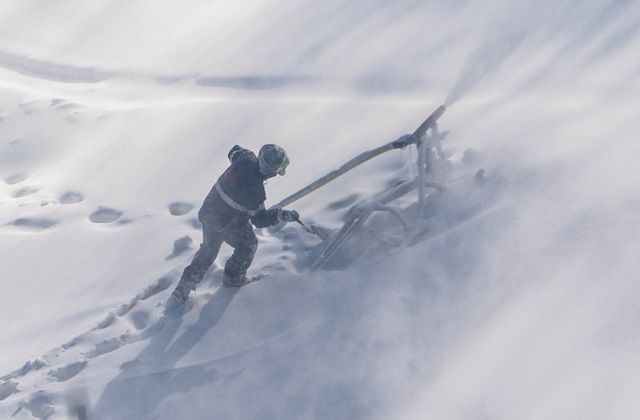
While increased snowmaking capacities have helped ski resorts stay open in the face of warming weather, it’s a double edged sword. Not only is snowmaking a resource intensive process which in many cases ultimately contributes to global warming, but it’s expensive as well, furthering the economic impact of climate change. Image: Stowe Mountain Resort on Facebook
In other ski news this week, we have a not-so-fun, but nevertheless important highlight to bring you regarding the financial impacts of climate change, specifically on U.S. ski resorts. This week, the Associated Press published an article that shared the results of a study that looked at the economic losses that ski areas already have faced due to climate change, as well as the outlook for decades to come. First, let’s start by sharing this little tidbit: between 2000 - 2019, the study estimates that U.S. ski areas lost a combined $5 billion due to climate change. To achieve this figure, researchers compared the length of ski seasons in the Northeast, Midwest, Rocky Mountain and Pacific West from 2000-2019, to the length of ski seasons in the same regions between 1960 to 1979. While not foolproof, the thought process here is that 1960-1979 represents a sample of an average period of time before the effects of climate change were being felt, while 2000-2019 represents the same period of time, starting at our earliest awareness of climate change. In their comparison, researchers found that, despite an increased use of snowmaking, ski seasons from 2000 - 2019 were an average of 5.5 - 7.1 days shorter. From there, they calculated the financial value of those lost days. While we don’t know the exact formula, our guess is that their math was something along the lines of: average lost days per year x number of ski areas x average value of a ski day, for each of the 20 years. Even without running the numbers, it’s easy to see how the financial value adds up.
The second part of this study of course is the outlook. If you were to ask an average Vermonter, especially this year, if winters have become less snowy since 2000, you can almost guarantee that the answer would be an adamant yes. It’s no secret that things have gotten pretty warm here in recent years, and what used to be consistent snowpack each year can now vary widely on a weekly basis. Yes, it’s true that this year’s El Niño weather patterns factor into this season’s low tide, but it should also be noted that the previous three years have been La Niña weather patterns, and the early guess is that next year will be as well. In other words, what used to be weather patterns that would occur once every few years, have now become the norm, due in large part to more volatile weather patterns in general.
With all of that in mind, the report doesn’t paint a pretty picture moving forward. Whereas the 20 year span from 2000 - 2019 saw a total loss of $5 billion, the study expects that by the 2050s, the average ski season could be reduced by 14-33 days, even under the most optimistic scenarios. If that were to happen, total losses would be an estimated $1 billion per year. That, of course, also assumes that the sports of skiing and snowboarding remain as popular, which seems unlikely if conditions at ski resorts continue to deteriorate. As we’re reminded each year with the release of annual ski visitation numbers, participation in skiing and snowboarding are heavily reliant on snowy weather, and with less snow there will undoubtedly be less interest in the sport.
To be clear, the purpose of this highlight isn’t to bring about a doom and gloom mindset. Rather, our hope is that it will motivate at least some of you to take steps towards fighting climate change, whether that’s simply taking measures within your own life to reduce your personal impact, or by becoming involved in advocacy movements to push policy in a cleaner direction. As we’ve seen in recent years, climate change is having an undeniable, direct impact on the quality of our sport, and we encourage you, as a passionate skier or snowboarder, to get involved. To get started, browse this selection of tools to measure your own carbon footprint, or check out some of the resources available through Protect Our Winters.
#4: Wondering What the Ski Scene is Like in Georgia? Don’t Worry, Nat Geo’s Got Your Answers:
In our efforts to find media to accompany this highlight, we stumbled across this video on the Georgia Travel Facebook page, and honestly, it does a pretty great job of putting both the country’s mountains and culture on display.
Finally, for our fourth highlight this week, we wanted to conclude with a cool article we caught from National Geographic that ties in perfectly with our coverage of the Freeride World Tour. As we mentioned in that highlight, it was the first year that the tour had traveled to Georgia, and by all accounts it was an amazing decision. While it sounds like the travel required some serious planning, comments made during the broadcast spoke highly of the venue, the culture, the food, and really the entire experience in a part of the world that isn’t exactly in the forefront of ski culture. Throughout the broadcast, we found ourselves pondering the Georgia ski scene in the back of our minds, wondering what exactly ski culture is like in the remote country.
Fortunately, Nat Geo has our backs, as they coincidentally published a piece just yesterday that looks into exactly that. Focusing on the village of Ushguli, which is located just under 30 miles and 1 hour 20 minutes by car from Mestia, where the tour took place, the Nat Geo piece tells the story of a medieval mountain village that offers the type of ski experience that diehards would die for. As you might suspect, there isn’t an aprés scene in Ushguli. There aren’t lux mountain lodges, or pizza joints, or any of the other amenities you’d expect from a typical American ski destination. Instead, there are sheep, stone towers, and UNESCO heritage sites. In lieu of snowmobiles, local guides use horses to bring them to remote terrain. And then, of course, are the mountains. If you watched the Freeride World Tour winning run accompanying the above highlight, then you’ve already caught a glimpse of what Georgia’s Gvalda Range has to offer. Ushguli itself is located at about 7,000 feet above sea level, and most tours in the area will ascend another 2,900 - 4,900 feet. In other words, it should be noted that a ski vacation to this particular destination is not for the faint of heart - this is big mountain territory. In Ushguli, there are no chairlifts, only high elevation ski touring to access some of the best snow and terrain in Europe.
In reading through the report from Nat Geo, it’s hard not to feel excited about the idea of Georgia. It comes off as a hidden jewel, offering respite from the impacts of climate change being felt across the rest of the world. While the experience in Ushguli is entirely human powered, there are two ski areas in the region, as well as seven total in the country. With that in mind, it seems like Georgia should be on the list of “destinations to watch,” as it feels like an increase in exposure could have a direct correlation to an increase in ski tourism to the area. While that has positive implications for the region’s economy, it would also have an undeniable impact on its unique culture and way of life. Seeing as we’re not locals there, it’s hard for us to say whether that will be a net positive or negative, but for now it’s all just conceptual anyways. To learn more about skiing in Georgia, and to possibly decide to book a trip before it’s the next hottest destination in skiing, check out the report from National Geographic.