

Top Five Fridays: May 29, 2026
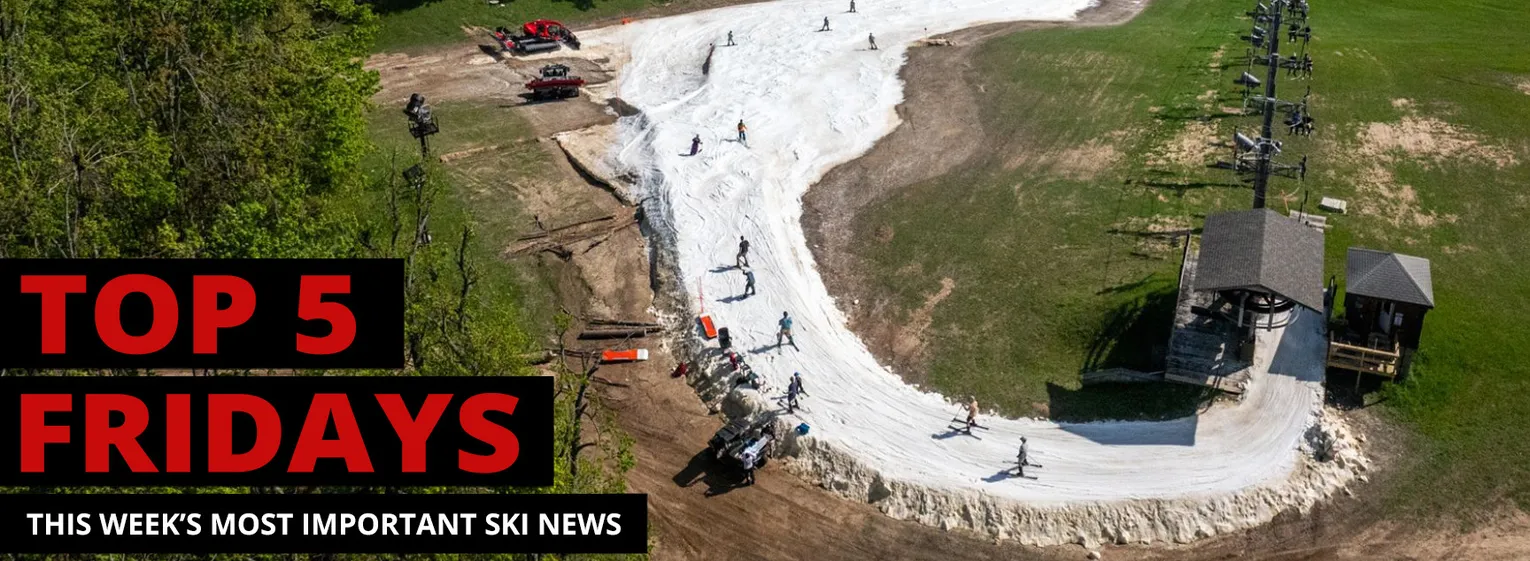
This week starts with a quick shout out to the staff and employees at Michigan’s Boyne Mountain Resort, who pushed their snow to the limit this season and stayed up until Memorial Day, a new record for the ski area. Image: Boyne Ski Resort on Facebook.
Hello, and welcome to Top Five Fridays, the May 29, 2026 edition! This week we’re completely themeless, with four stories touching on very different aspects of the ski world. From Beartooth Basin firing up its lift for the first time this season, to growth within FIS sports, real estate in Colorado, and skier safety in Whistler, this week’s ski news is coming to us from far and wide. Still, these are all topics you’ll want to know about, and our edits this week feature some deep cuts from athletes with modest followings. For those of you who stick with us in the summer for our more niche storylines, we think you’ll thoroughly enjoy what you’re about to read. Let’s get started.
#1: Beartooth Basin is Open, Mammoth Mountain Extends Season, and Boyne Breaks a Record. Here’s Your Summer Ski Report:
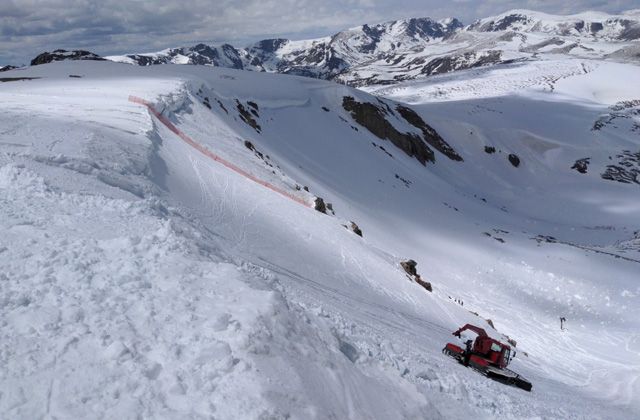
A look at Beartooth Basin on opening day, May 25, 2026. Image: Beartooth Basin Official Website
Kicking things off this week, we have some big news for skiers in North America: despite being the final days of May, one ski area has just started spinning its bullwheel, signaling the start of their season. Having just read that statement, now feels like a good time to point out that there are three types of people in this world: those who are aware of Wyoming’s Beartooth Basin, those who aren’t, and those who are about to find out.
For those in the last category, Beartooth Basin is North America’s only summer-only ski area. Located at the peak of the Beartooth Highway, a seasonal road, Beartooth Basin is only accessible during the summer months once the snow has melted enough to reopen it. Even then, there are seasons when the ski area is unable to open due to a variety of conditions related reasons, and when it does open, it’s typically only open for a few weeks. In other words, not only is Beartooth Basin the only summer-only ski area in North America, but it’s also one of the rarest and most fleeting. With that all in mind, it’s with great excitement that we share the news that Beartooth Basin is officially open for the season!
On Monday, May 25th, the ski area announced that it was opening for the first day of summer skiing. At present, you’re able to buy a $50 day ticket on their website for any day up until June 14th, indicating that they’re expecting an approximately 3 week season on this go around. As short lived as the season may be, the ski area provides an incredibly unique experience, and judging by the videos posted by Freeskier Magazine, both the conditions and the vibes appear to be all time. If you’re in the area and still itching to ski, we highly recommend checking them out.
If you’re not in the Montana / Wyoming region, but you are in the Mammoth Mountain, California region, don’t worry, we have good news for you too: thanks to a modest amount of recent snowfall yesterday, as well as prolonged cooler weather, the resort has once again extended its season. This week, Mammoth announced that it’s pushed its last day back to June 7th, adding another week to its operations. While that very well could be the closing date, it’s worth noting that OnTheSnow.com is reporting a 34” base at mid mountain, and an astounding 97” base at the summit. So, while we have a new end date, we also wouldn’t be surprised to see it get pushed back again. To keep tabs on that, check out Mammoth Mountain on Instagram.
Finally, before rounding out this highlight, we want to give a quick shout out to Michigan’s Boyne Mountain. While the ski area has officially closed for the season, they kept the vibe alive for as long as they possibly could, extending their season all the way until this past Monday, marking the conclusion of the longest operating season in its history. Big shout out to the team over there for making it happen.
#2: The FIS is Reporting Substantial Growth in its Development Pipelines:
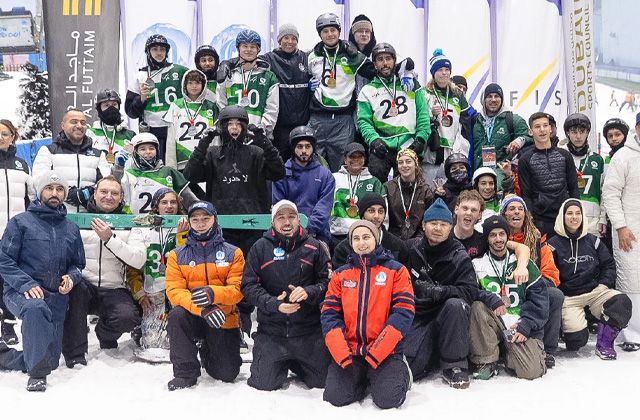
A group photo from a Park & Pipe FIS Camp in Dubai, where coaches and athletes alike learn the ins and outs of competing in FIS events. Thanks to expansion efforts like this, the FIS is reporting significant growth in its development funnels. Image: FIS
Moving onto other news this week, we have a story coming to us from the FIS, just under two weeks before their much anticipated presidential election. If you’ve been following that story, then you know that the upcoming election is set to be the most contested one in at least 5 years, if not ever. The reason being, current President Johan Eliasch’s push to centralize media rights in an effort to make the entire FIS a more globally visible sports league. While that push has upset some of the foundational members, it’s inarguable that Eliasch has, in fact, effectively grown the league on a global scale. For proof of that claim, look no further than a report shared this week from the FIS itself that highlights the significant growth of its development programs over the last 4 years.
While there are a number of metrics that could be used to gauge whether or not the FIS is growing as a league across all disciplines, perhaps one of the best indicators is what’s happening at the youth and development levels as that’s where the future of winter sports lies. As it turns out, that’s exactly what this latest report focuses on.
According to their numbers, the FIS has seen a 141% increase between 2022-2026 in participation in the development camps hosted by the FIS. In addition to participation, there have also been more camps themselves, with opportunities increasing 208%, thanks to 97 camps being hosted between 2022-2026. Notably, this past season there were 37 camps. A quick run of the numbers suggests that that indicates a healthy growth in the development pipeline during Eliasch’s tenure, with this past year being the strongest yet. The trend is up and to the right.
Beyond these two highlight statistics, the report goes on to cite a number of additional, more niche figures. Taking a broader perspective though, there are two big things that jump off the page for us. First, a significant portion of this growth is coming from non-traditional winter countries, such as Azerbaijan and Saudi Arabia, who both became full members of the FIS during the last 4 years. Additionally, Benin, Bhutan, and Indonesia all became associate members. Of course as we also know, growth continues to be strong in Asia, where the FIS has signed agreements for another 800 ski days (aka camp days) in the coming years. While media rights remain a heated point of contention within the FIS, it feels safe to say that each member nation also wants to see the league grow in prominence, and would welcome the opportunities that come with increased global exposure. To Eliasch’s credit, the sport certainly is showing considerable growth on the global scale.
Finally, the last thing we took away from this article is a bit more subtle, and hits a bit closer to home: in the report from the FIS, it says in regards to the 2025-2026 season, “37 program-specific activities were either delivered or supported by FIS across Europe, South America, and Asia, attended by almost 800 athletes and coaches.” Notably absent from that list? North America. Considering the fact that this applies not just to alpine racing, but to all disciplines, from cross country, to ski jumping, to freeskiing, the lack of any official FIS camps in North America seems like a missed opportunity. Of course, there may be a legitimate reason for this that we’re not aware of. If there is, and you are aware of it, feel free to let us know in the comments! Otherwise, we’ll pass you off to the FIS to read the report in full.
#3: In Colorado, Mountains Towns Are Beginning to See a Cooling Off of the Real Estate Market:
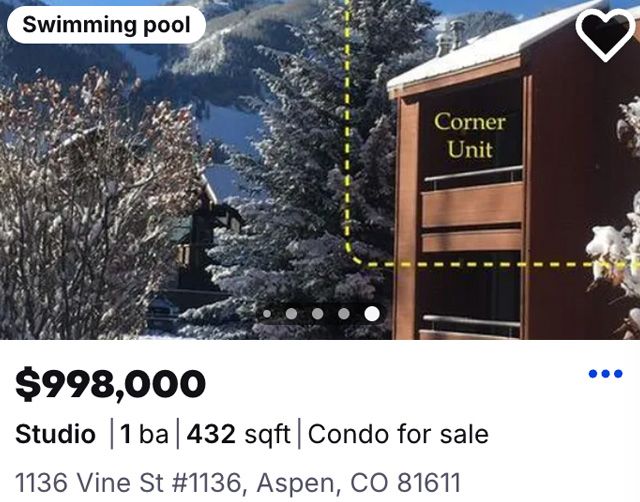
For added context in regards to just how high prices are in a place like Aspen, feast your eyes on the cheapest property currently available in downtown Aspen: a 432 square foot studio condo, currently listed at $998,000. Image: Zillow
For our third highlight this week, we want to share a story coming to us from Colorado that, while regional in nature, is a decent signal for a trend that’s applicable across the entire industry: the cost of real estate in mountain towns.
It’s no secret that when Covid hit back in the spring of 2020, mountain towns across North America saw an influx of homebuyers. As a result, prices shot way up, home ownership became more exclusive, and longtime locals suddenly found themselves more priced out than ever before. While mountain towns everywhere regardless of region encountered this issue, one of the states that was hit most dramatically was Colorado, where median home prices in Eagle, Routt, and Pitkin Counties rose 111%, 98%, and 80% respectively between 2020-2025. To put that in monetary terms, the average price for a home in Pitkin County’s Aspen last year was $17 million. And while yes, Aspen is Aspen, the fact remains: the mountain and supporting town are run by locals, and locals need a place to live.
With all of that in consideration, a report from the Colorado Sun brought us just a glimmer of hope this week as it shares the news that the ultra hot mountain town real estate market is starting to cool off. In the article, author Jason Blevins shares with us the news that both the number of homes being purchased, as well as the total dollar amount of those deals, are both down to start 2026. While the average asking price for a home hasn't dropped yet, the fact that overall demand for these high end homes is decreasing brings hope that a leveling off is on the horizon and that average home prices might even start to come down.
Now, again, it’s important to note that this report is coming to us out of Colorado, where high end resorts like Vail, Aspen, and Steamboat have an outsized impact on local real estate. That said, countless ski towns across America, including our hometown of Stowe, VT, saw similar patterns as a result of the pandemic. As such, while this report is specific to Colorado, our hope is that it’s reflective of a wider pattern that ultimately suggests that ski town real estate everywhere may be on the verge of becoming more accessible. At the moment, we don’t have enough sources to confirm that notion, but once we do, we’ll be sure to let you know. For now, you can learn all about the latest news from Colorado, right here.
#4: Is Skiing Getting Too Chaotic? In Whistler, Locals Are Asking Vail to Police the Slopes a Little Bit Tighter:
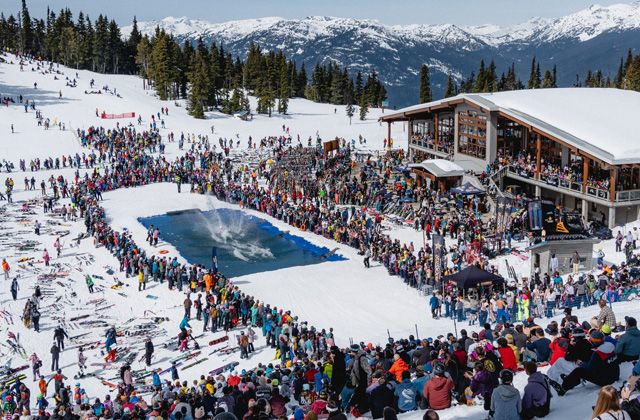
Yes, this is a pond skim event. That said, it doesn’t take a stretch of the imagination to see how a crowd and an atmosphere like this could lead to chaos on the slopes. Image: Whistler Blackcomb on Facebook
Finally, we’re wrapping up this week with a story that’s sure to get a reaction out of just about any skier: in Whistler, local pass holder Dr. Christina Williams has launched a Change.org petition calling on Vail to make the mountain safer. Citing anecdotal evidence and her own experiences on the mountain, Williams argues that Vail has dropped the ball on enforcing its Alpine Responsibility Code, leading to a dangerous environment on the slopes. In order to fix this issue, Williams has presented 5 solutions that she’d like to see implemented:
1. Increase safety staff.
2. Enforce the Alpine Responsibility Code, meaning adding repercussions such as pulling passes for violations.
3. Instruct children instructors, meaning provide younger ski instructors more guidance so that their groups are skiing in control.
4. Create speed traps by using fencing to force skiers to slow down when entering a slow zone.
5. Publishing accident data.
Now, before determining your reaction to this petition, it’s worth knowing a little more about where Williams is coming from. Over the course of this past season, she was run into on three different occasions, with the third instance resulting in a broken leg and ankle. Based on the comments on the Change.org petition, she isn’t alone in her experience as a number of other Whistler locals have shared similar accident or near-miss stories.
Of course, on the other hand, this concept strikes the heart of any skier who uses the mountains as a means to escape the rigidity of everyday life. For them, the idea of over policing a ski area seems to go against everything that makes skiing the unique sport that it is. On skis, you’re free to move however you’d like, go wherever you want, and at whatever pace you desire. Being in the mountains, it’s one of the most “free” sports that exists. It feels safe to say that a scenario in which the ski slopes feel more like a highway, where you feel pressured to follow strict rules and are weary of being “caught”, goes against everything that makes the sport so special. That’s not to say that ski slopes should be lawless, but the idea of overpolicing them is equally as unsettling to many.
With all of that said, we think it’s a worthwhile conversation to have this offseason: where should that fine line between safety and freedom be drawn on the slopes? Do you feel like your mountain has found the right balance? We’re sure you have opinions, so feel free to share them in the comments! To learn more about this story, check out the writeup from PiqueNewsMagazine.com, or check out the Change.org petition yourself.