

Top Five Fridays: October 16, 2026
Winter weather got underway at several ski areas this week, including Alta, Utah, where well over a foot of snow landed at elevation. Image: Alta Ski Area on Facebook
Hello, and welcome to Top Five Fridays, the October 16, 2026 edition! This week, we’ve got an even split, with two topics covering our favorite thing in the world (snow) and two topics covering potentially controversial stories. On the snow side of life, we kick things off this week with news of serious accumulations across North America, while rounding things out with coverage of progress in the world of snow farming. Sandwiched between those two stories, we have news from Alta, where a new parking reservation no-show policy will likely delight and infuriate the masses in equal numbers, as well as a passionate article written by Breezy Johnson who feels targeted by a new FIS rule that limits the weight of skis. To be fair, she may have a point. Whether you’re a fan of snow or a fan of controversy, we’re sure to have something that tickles your fancy in this week’s news, so we encourage you to forge ahead!
#1: The Lifts May Not Be Spinning, But People are Certainly Skinning Thanks to Significant Snowfall Across the Rockies:
How much snow fell at Alta, exactly? Well, enough to hit Highboy apparently.
First up in ski news is by far the most exciting update of the week: real snow fell across several Western regions this past week, with locales in multiple locations receiving far more than just a dusting. As you’ll recall, it was just over a month ago when we reported on trace amounts of snow that showed up in the Pacific Northwest and interior British Columbia. At that time, we were excited because any snow in the first week of September is worth getting worked up about. This week though, we’re fired up because the snow that fell wasn’t just a dusting, but a foot or more in many places.
Kicking things off, the first real signs of winter landed in the northern portion of the U.S. Rockies, with ski areas in Wyoming and Montana reporting significant snowfall over the late hours of the weekend and into the early hours of Monday. While we don’t have unfettered access to snow totals across all the resorts in the region, this map on OpenSnow.com suggests that areas like the Yellowstone Club and Bridger Bowl received around a foot of snow from the weekend storm. Elsewhere, in Jackson Hole, while we haven’t been able to dig up any specific numbers, posts from their Instagram show considerable accumulation in scenes reminiscent of mid-winter powder days. But, that’s not where the fun stops.
Joining the party in the Central Rocky Mountains, were several ski areas in Utah and Colorado. Again, while we don’t have very many specific measurements available to us on account of resorts not being open & actively monitoring snowfall, we do have anecdotal information from a number of locations. In Colorado, images from Silverton seem to suggest that the ski area received a foot of snow or more. A bit further to the North, mountains like Aspen, Vail, Copper, Winterpark, and more have all received several inches of snow as of the time of this writing. In Utah, Alta reported receiving 16” by Wednesday morning, while neighboring Snowbird received 18”. One canyon over, Brighton Resort reported 14” by Wednesday morning. We could go on, but we think you get this point: this week, Winter officially made its intentions known.
As for us in New England and Eastern Canada? Well, no snow yet, but fear not: Ullr seems to be cooking something up for us too as forecasts are beginning to suspect that we may be in for a solid inch or two at higher elevations over the weekend. Regardless of how you might feel about this winter’s super El Niño, we currently know one thing that’s for sure: it’s starting to snow just about everywhere.
#2: Bail on Your Alta Parking Reservation? That’ll Be $100 Please:
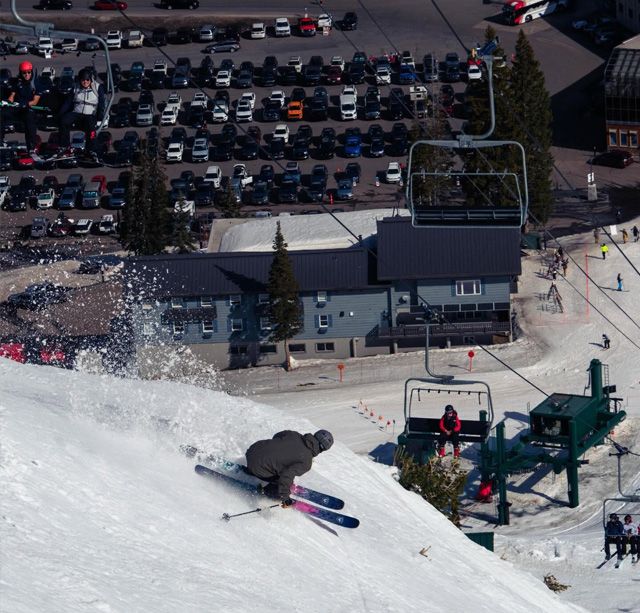
A spring skier at Alta squeezes in one last turn before arriving back at the lift. In the background, a parking lot full of reservations. Image: Alta Ski Area on Facebook
Speaking of Alta, snow, and winter, here’s a headline that we’re sure will get a debate going: this winter, the ski area has announced that it will be issuing fines for no-show reservations. Now, to make sense of this headline, let’s just make sure we’ve got our bearings straight. While it’s a somewhat new practice that originated post-pandemic, Alta is one of countless ski areas that have implemented a permanent parking reservation system for peak days. While the roots of that system were in crowd management during an era of social distancing, many ski areas have kept the practice around as it’s proven to be a decent way to manage traffic and capacity at resorts. Begrudgingly or not, reservations have come to be accepted at a number of popular ski areas.
One thing that has not been accepted though, is the phenomenon in which skiers preemptively make reservations and then don’t show up. As you can imagine, should that practice become rampant, it would result in partially filled parking lots as well as many skiers sitting at home, wishing they’d been able to get a reservation that day. The resort also doesn’t love the practice, as it leads to less foot traffic and therefore less patronage at the ski area’s shops and services.
All of this is to say, Alta has had enough. This week, the ski area updated their parking policy, and while by and large most of it is run of the mill information, one new policy looms large: “Missed a parking reservation? Your first no-show is a warning. After that, a $100 fee applies for each no-show.”
Yep, you read that right: reservation no shows at Alta are now subject to a $100 fee. As for enforcement? Well, the reservation system already uses license plating scanning technology to determine whether or not a given vehicle has a reservation for that day. While it’s not explicitly stated in the policy, it’s our assumption that that same technology will be used not only to verify that a car has a reservation, but at the end of the day it can cross reference the list of reservations and see which vehicles didn’t show up. From there, warnings and fees can be submitted appropriately.
In a perfect world this all makes perfect sense. That said, the real world is home to Murphy’s Law, meaning that there are plenty of ways for this to go wrong. For instance, what happens if it’s snowing too hard and a license plate can’t be read? Or, the skier with a reservation has an emergency pop up? What if their car doesn’t start so they hitch a ride with a friend? Ultimately the what-if scenarios are endless, and when all is said and done next summer, they may prove to be few and far between. Either way, it’s an interesting development in the ongoing saga of traffic in the lives of skiers. To see the new parking policy yourself, click here.
#3: The Self Proclaimed “Largest Female Ski Racer on the World Cup Tour”, Breezy Johnson, Takes Issue With the FIS’s New Weight Restrictions on Skis:
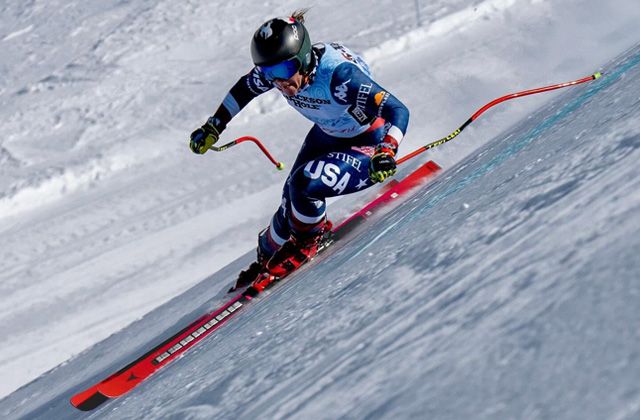
Breezy Johnson ripping a downhill turn on skis that presumably exceed the FIS’s new weight limits. Image: Breezy Johnson on Facebok
Next up this week in controversial ski news, we have a story coming directly from Breezy Johnson, who has taken issue with a new FIS rule that’s been implemented ahead of the 2026-2027 season.
In an self-authored post published on Substack this week, Breezy Johnson more or less directly attacks the FIS for the way they’ve implemented a new rule that limits the weight of skis for both men and women. Under this new rule, women’s downhill skis - including the ski, plate, and binding - must weigh 5.2 kilogram or less, and men’s are limited to 5.3 kilograms. While nearly all skis fall under this weight limit, and Johnson herself only has a handful of pairs that fall above it, it’s actually the exclusivity of these above-weight skis that Johnson takes issue with. And honestly, she might have a point.
According to her Substack post, Johnson claims that this is how the new rule came to be: over the course of the summer, at one of the FIS’s meetings, a chart was presented that highlighted the top downhill results over the course of the season, along with the weight of that skier’s equipment. On that chart was one outlier: Breezy Johnson, whose heavier skis allegedly gave her a competitive advantage. At some point, that discussion became centered around skier safety, with questions regarding whether or not these heavier skis were a risk to athletes. When it came time to vote, a decision to cap the weight of downhill skis was narrowly made. For Johnson, this decision felt intentional. In her mind, the vote itself was dubious as she was the only athlete set to be impacted. As such, it was a no-brainer for many nations to vote in favor of the rule, knowing that it would curb her competitive advantage while not impacting their athletes in the slightest.
Of course, there’s more to the story, and this is where Johnson really takes issue. As she states in her Substack post, Johnson is 5’8” and 180 lbs. As you might guess, that puts her firmly at the upper end of the weight class on the women’s FIS circuit. Now, extrapolating her size, which is comparable to many men on the circuit, and pairing it with the discipline of downhill racing, you can pretty quickly see why Johnson might prefer a more substantial ski than her competitors. In the article, she gives a full breakdown of what she believes to be the physics involved as they pertain to momentum and chatter. Ultimately, she ends her speculative scientific claims with a statement that’s equally amusing and powerful, saying, “I don’t have a multi-million dollar scientific study proving that top-level athletes over 80 kg are safer on a heavier ski. But FIS doesn’t have a study saying the opposite, either.”
Ultimately, that’s the core of Breezy’s issue here. In her eyes, the FIS has made a rule in the name of safety that’s not backed by any research, and that impacts just one skier. Whether or not that was actually intentional, we might not ever know. But, the outcome is the same regardless: Breezy will be the only athlete on the circuit this year being forced to ski on equipment that she’s less comfortable with.
Moving forward, Johnson admits that there’s not much that she can do. The decision making process at the FIS is pretty insular, with NGBs voting on the behalf of athletes, and athletes being forced to follow the approved rules. Still, she asks those who feel for her to share her story in hopes that public pressure will grow alongside awareness. To read this story in full, check out her Substack writeup.
#4: Snow Farming Continues Maturity Arc as it Trends Towards More Widespread Usage:
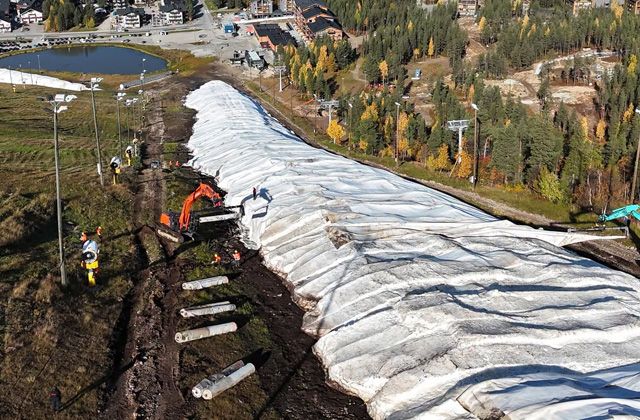
In Levi, where snow farming operations have been an annual occurrence for the last decade, operations have scaled up far beyond preseason snowparks. Now, entire trails are preserved over the summer. Image: Levi Ski Resort on Facebook
Finally, our last highlight this week is one that honestly feels a bit overdue. In years’ past, we’ve found ourselves discussing snow farming on multiple occasions, dating all the way back to 2018. Over time however, we’ve somewhat lost the thread as most instances of North American snow farming have resulted in out of season rail jams, either before or after winter. While that is pretty cool, it felt repetitive to update you all every time a ski area saved snow in order to host a rail jam. The takeaway from those stories is definitely cool, but they also have a ceiling. For our part, we’ve always wanted this story to become something more impactful. This week, we’re seeing glimpses of that.
Ironically, our coverage of this topic this week does, in fact, start with a rail jam. This time, the story takes place at Aspen Snowmass, where a limited version of their Makaha Terrain Park was opened to the public on October 3rd & 4th. This event was made possible by, you guessed it, snow farming.
What makes this story feel a bit different from those we’ve opted out of in the past though, is that this temporary terrain park was never the end goal of the snow farm. Instead, it marks the successful conclusion of what Aspen Snowmass is referring to as a pilot program. In other words, their goal over the summer was simple: buy some Snow Secure blankets, put them to use, and see what happens. As it turns out, Aspen is viewing the experiment as a wild success.
According to their calculations, Aspen estimates that the snow blankets retained approximately 85% of the snow they covered. In terms of water usage, Aspen estimates that their original pile was the equivalent of 3.5 million gallons of water. Taking that a step further, our math is showing that that means the mountain preserved roughly 2.975 million gallons worth of water in the form of snow. For an industry in which reducing water usage is critical from both an environmental and economical standpoint, as well as one which is often at odds with early season temperatures, the ability to retain that much snow year to year is an absolute game changer.
That’s what brings us to the meat of this story: Aspen Snowmass has already purchased more snow blankets for next season. In their minds, the power of snow farming isn’t in the fact that it can create a fun community event in the off season, but in that they can use it to get a massive jump start on early season operations. In the words of Aspen One’s senior vice president of sustainability, community and advocacy, Chris Miller, “At scale, this technology can support less early-season snowmaking which should mean less water consumption and energy use to get a jumpstart on the season, and that’s the real win here.”
Carrying this story a step further, while the resort didn’t grab any headlines this week, we feel compelled to include a quick update from Levi, Finland, one of the first ski resorts to fully embrace snow farming. Starting back in 2016, after a series of early season FIS race cancellations, Levi began leaning on snow farming as a way to ensure the viability of their race each year. What started with a modest effort has grown substantially over the years, with Levi now covering what’s essentially an entire trail with Snow Secure blankets. To wrap your head around what this means, it’s easiest to see for yourself. To do so, check out their recent images on Facebook.
All told, this week’s highlight feels like a good chance to update our perspective on snow farming. What started as a novel idea, turned into offseason marketing events, and is now on track to becoming a potentially transformative technology. While it may be a while before we circle back on this one, we suspect that when we do, it will be because some resort somewhere in the world blew our minds with the amount of snow they preserved and what it meant for their operations. Until that happens, check out the latest from Aspen Snowmass, by way of the Colorado Sun.