


Top Five Fridays: October 20, 2023
Lead Image: Leo Landrø executes a picture perfect mute grab during a practice run at this year’s Big Air Chur event. More on that below! Image: FIS Freestyle on Facebook
#1: The 100th FIS Season is Officially Underway, as the Big Air Chur Freeskiing Event is in the Books:
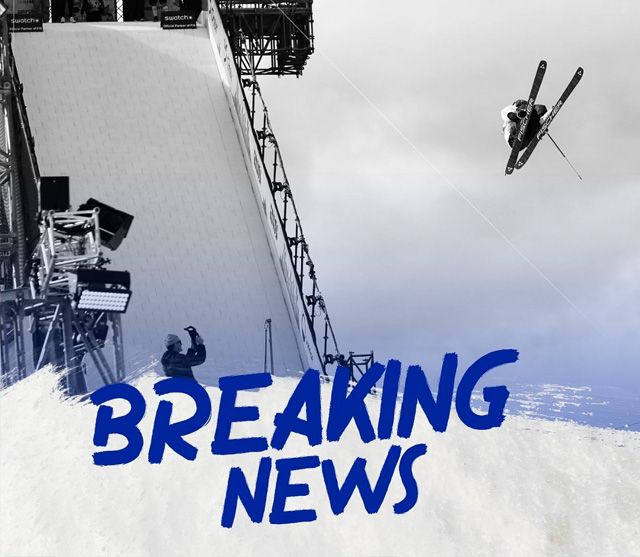
Athlete Mathilde Gremaud spin-flipping her way to victory in yesterday’s Big Air Chur qualifying rounds - which ultimately became the final results. Image: FIS Freestyle on Facebook
Hello, and welcome to Top Five Fridays, the October 20, 2023 edition! This week is somewhat of a big week as it marks the official kickoff of the FIS’s 100th season! Now, just to satisfy our ski history buffs, we should probably clarify that the roots of the organization actually go back 113 years, to 1910 when 10 founding countries formed the International Skiing Commission in Christiania (NOR). Still, it wasn’t until 1924, during the first ever winter olympics, that the group added 4 additional members and became known as the International Ski Federation. Since those early days, the FIS has added a number of sports and disciplines, with the addition of big air freeskiing and snowboarding being two of the most recent events to join the World Cup league. Interestingly enough, it’s those two events that have kicked off the organization’s 100th season.
Yesterday, in Switzerland, the FIS season officially got underway with the freeski big air qualifying events at Big Air Chur. Now, you might be a little surprised to hear that an on snow event is happening already, being that it’s still October. But, if you’ve watched a big air event before, there’s a strong chance that you’ve already witnessed the impressive scaffolding work that can make these events possible with very little snow. By constructing a tower of metal rather than relying entirely on natural snow, big air events can be held with a relatively modest amount of snow. Plus, at this year’s Big Air Chur, a majority of the drop in has been constructed using a dry slope material, with the transition to snow happening just before the compression into the jump. This move further reduces the reliance on snow, helping make the event even more weather-proof. That said, it should be noted that the contest isn’t totally weather-proof. In fact, as it turns out, weather has already had an impact on the 100th FIS season.
While Big Air Chur was originally scheduled to get underway today, October 20th, a rainy forecast forced event organizers to move the ski qualifiers up to October 19th, with the hopes of using a brief weather window this evening to hold finals. Unfortunately, as we were writing this preview, news broke that finals have been canceled on account of the weather, forcing event organizers to use qualifying scores to determine the final results. It’s a bit of a tough break for Troy Podmilsak, the only U.S. athlete who traveled to the event, as he sat in 4th place entering finals, with just one point separating 2nd, 3rd, and 4th. Still, for Troy, earning 4th place and 587.3 FIS points isn’t a bad way to start the season. From here, Big Air Chur continues, with hopes of hosting the snowboard big air event tomorrow, on 10/21. To check out a full list of the men’s ski results click here, and for the women’s results, click here.
#2: In Other FIS News, the Alpine Racing Season is Set to Start Next Weekend as Solden Has Been Given the Greenlight!
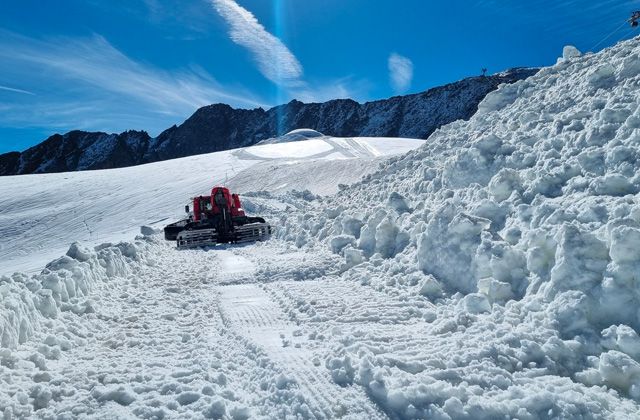
Things are looking good over in Solden, Austria, where the venue has just been given the greenlight to host the first race of the season next weekend. Image: Skiweltcup Sölden on Facebook
In other FIS news this week, we bring you a brief but important update from the world of alpine ski racing, where the first event of the season is scheduled to take place in just over a week in Solden, Austria. As you’ll recall, last year’s FIS alpine race season got off to a bumpy start as a number of races were canceled due to weather. While Solden was able to host the men’s race at the start of last season, the women’s race was canceled, as were the next three stops on the schedule. This year, the FIS is looking to avoid the same scenario through a variety of techniques, some of which are not being looked at favorably.
We’ll circle back to the darkside of this update in just a second, but first, the good news: the FIS has given Solden the greenlight, meaning that next weekend should mark the start of ski racing season. Should the weather hold, unlike in Chur this weekend, the women’s and men’s circuits will kick things off with a giant slalom race, scheduled for 10/28 and 10/29 respectively. Making this news even sweeter, it was also announced this week that Peacock will be streaming full coverage of the Solden races, as well as all of the Austrian races this winter. While we haven’t heard anything else in terms of coverage of future races, we do know that expanded media availability has been a huge goal of the FIS in recent years, with a fresh agreement with longtime media partner Infront Media having been signed this past summer. Now, with the first race of the season being easily viewable, early returns on that agreement are looking promising.
There is, unfortunately, some questionable, if not downright “bad” news coming from the FIS this week. As we just mentioned, last year the FIS struggled to host its first races of the season due to poor weather conditions - largely attributed to climate change. Noting the effect that climate change has on their organization, the FIS has been vocal about their support and commitment to eco-friendly practices. It’s with that in mind that images began circulating this week showing event organizers in Zermatt digging into the glacier in an effort to prepare for the races there on November 8-10th. This exciting new venue, which would start in Switzerland and end in Italy, was set to make its debut last winter before being a part of the early season cancellations. This year, the FIS moved the race back a week hoping for better weather conditions. As such, you can imagine that event organizers are willing to do whatever it takes to pull off the event in its second year. Unfortunately, that apparently means tearing into the glacier with heavy machinery in order to prep the course. Now, to be totally fair, we don’t know exactly what the purpose of the operations that are currently underway are hoping to achieve. The assumption is that they’re grabbing snow to use on the course, but the reality could be any number of things. And even if they are relocating snow, we’re not absolutely positive that this is detrimental to the glacier at all. But, one thing that’s certainly true is that the optics aren’t great and there’s growing uproar within the ski community. To be sure, we’d need more information about this story before coming to any final conclusions, but it certainly seems bad. To learn more about this story, check out the writeup from Newschoolers.
#3: Plot Twist: New Hampshire’s Black Mountain Will NOT Be Closing, as the Indy Pass Comes to the Rescue:
The image shared by Black Rock Mountain, accompanying their announcement on Facebook this week. Image: Black Mountain on Facebook
Next up this week is a really, really cool story about the Indy Pass and Black Mountain, NH, coming to us by way of StormSkiing.com. Within this report from StormSkiing, we’re treated to not only a wealth of information regarding the story unfolding at Black Mountain, but also a significant amount of subtle insights into the inner workings and ideologies of the people running the Indy Pass. Before we get too far ahead of ourselves, let’s start with a headline that made significant waves last week: New Hampshire’s Black Mountain, the 9th oldest ski resort in America, suddenly announced that it would not be reopening for the 2023-2024 season. In a post to their Facebook page, the mountain cited a confluence of factors ranging from weather to staffing issues as the reason for the closure. As a beloved ski area with deep roots in its community, the general sense was that this closure hurt quite a bit more than most.
Then, in the middle of this week, something amazing happened: news broke that the Indy Pass had committed the necessary resources to ensure that Black Mountain can open again this season. While a number of news outlets covered this story, none did it better than Storm Skiing, who seemed to have a bit of an inside scoop. In their article, we learn quite a bit about how this new agreement is set to work. First things first, the Indy Pass did not buy Black Mountain. While the idea was briefly explored as one of many options, Indy Pass owner Erik Mogensen quickly concluded that it wasn’t in the best interest of either the Indy Pass, or his ski technology company Entabeni Systems to own the ski area. Instead, Mogensen had another idea: dedicate the resources necessary to help Black Mountain operate for the 2023-2024 season, while putting in the effort to find a new owner for the resort for the 2024-2025 season. In the report from Storm Skiing, Mogensen makes it very clear that this isn’t a long term solution for the resort, and that the plan isn’t to keep the ski area on life support for the next 5 years. Rather, his hope is that by supporting the resort through this season, it will buy them enough time to help the resort’s current owner find a buyer rather than simply shuttering it.
That in and off itself is a thoroughly interesting story for us, and one that we looked forward to covering, with an interest in highlighting how the Indy Pass had gone above and beyond to rescue one of its longtime partners. While that’s still very much the case, what we weren’t expecting from this article from Storm Skiing was the incredible amount of background information on Erik Mogensen, the history of his relationship with the Indy Pass, the history of Black Mountain, and even the background of Andy Shepard, the man tasked with saving the ski area. While the purpose of this article is to tell the story of Indy Pass coming to the rescue of Black Mountain, the level of depth that it goes into provides us with so much more. If you’re someone who can’t get enough of the inner workings of the ski industry, we highly recommend giving this article a read.
#4: Tracking the Multi-Pass Landscape, with StormSkiing.com:
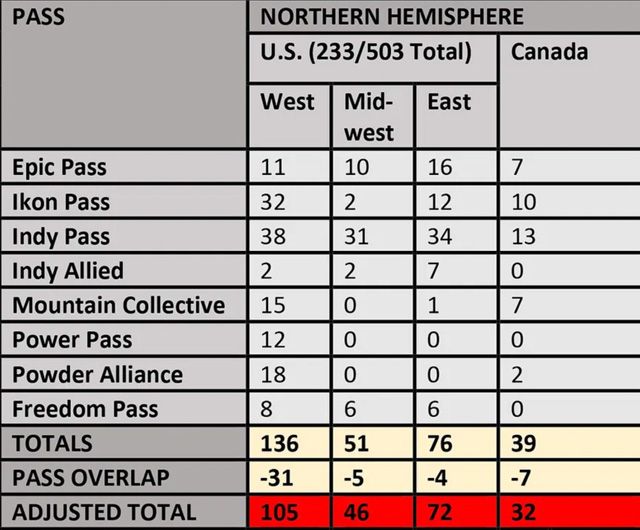
A very small sampling of the Storm Skiing U.S. Based Mega Pass Inventory chart. We highly recommend viewing it in full over on their website. Image: StormSkiing.com Article with Multi Pass Chart
Finally, as luck would have it, rounding out this week’s news cycle is a second ultra-thorough report from StormSkiing.com. This time, the article in question is a comprehensive breakdown of the ski resort landscape as it pertains to U.S. owned multi-passses. In this report, Storm Skiing owner Stuart Winchester shares the results of his deep research into the American ski resort landscape, in which he researched all 504 ski areas currently operating in the U.S., taking note of whether or not they are a part of a multi-pass, or if they aren’t, whether or not they have a chairlift. The value in this research is two-fold: it generates interesting statistics that paint a picture of the current state of the ski resort industry, and it also helps buyers make sense of which pass makes the most sense for them. Since we’re kind of dorky, let’s start by sharing some of the statistics generated by this research.
In his statistical analysis of the data he gathered, Winchester broke his findings into three categories: the Mega Pass Overview, U.S. America, and International. Within the first category, the Mega Pass Overview, Winchester highlights the overwhelming presence of the seven U.S. based multi-pass options (Epic, Ikon, Indy, Mountain Collective, Power, Freedom, and Powder Alliance). Between these seven passes, a total of 303 ski areas have signed agreements with at least one of them, with 233 of the ski areas being in the U.S. In other words, out of the 504 active ski areas in the U.S., 233 have multi-pass agreements - good for 46.2%. Another highlight from this category is the observation that 50 of these resorts are on multiple multipasses. For us though, the most intriguing and telling statistics actually come in the next category: U.S. America. Within this category, Winchester highlights the regional presence of each multi-pass, sharing facts such as the Ikon Pass having almost three times as many resorts in the West as the Epic Pass, or the Indy Pass having nearly 67% of the midwest’s multi-pass resorts. Above all else though, the stat that really caught our attention is this one: 60% of U.S. Ski Resorts that have a chairlift (in other words, are not exclusively surface lifts) are on one of the multi-passes. 60%. For a concept that’s relatively new to skiing, in the sense that it’s only emerged in the last 10-15 years, that’s what we’d call in the business “incredible market penetration”.
In addition to the statistical analysis of his findings, Winchester also created two charts that pass buyers might find particularly helpful. First, he provides a chart that shows the number of resorts on each multi-pass, broken down by both U.S. regions, as well as international countries. This makes it really easy to see which passes are most prevalent where, as well as which passes have international offerings. The second chart included in this article is a massive list of every ski area that’s on a multi-pass, broken down by either state, or country & region, as well as which pass(es) they’re on. For instance, if you’re like us and live in Vermont, scrolling to the Vermont section makes it easy to see which resorts are on Ikon, Epic, or Indy, giving you a birds eye view of your multi-pass options. Overall, whether you’re in it for the stats or the decision making, we found this article to be very informative. You can give it a full read here.