


TOP FIVE FRIDAYS: OCTOBER 28, 2022
Lead Image: Eventual Big Air Chur winner Birk Ruud warming up in qualifiers at last weekend��s event. In finals, he landed a first of its kind trick, easily securing first place. More on that below! Image: Big Air Chur on Facebook
#1: The Weekly FIS Report: Soelden GS & Big Air Chur Results Recap, Plus Cancellation Updates:
In the Big Air Chur Men’s Event, athlete Birk Ruud took home the top spot, landing this mind boggler of a move. You’ll want to watch this one a few times.
Hello, and welcome to Top Five Fridays, the October 28, 2022 edition! As we promised you last Friday, we’re kicking things off this week with the first FIS results of the year! Before we get into that though, we do have to share some bad news: the season hasn’t gotten underway quite like we hoped it would. In last week’s update, we shared the news that, thanks to the addition of the Zermatt-Cervinia races, this year’s FIS schedule offered up non-stop action from now through March. Well, unfortunately that won’t be the case as both the men’s and women’s Zermatt-Cervinia downhill races have been canceled due to a lack of snow. This means we’ll have to wait until the weekend of November 12-13th for the return of World Cup Alpine ski racing, when both the men’s and women’s circuits will convene in Lech / Zuers, Austria for a parallel slalom race each. Making matters worse for the women’s circuit is the fact that their race in Soelden last weekend was also canceled on account of weather conditions, meaning the start of their season will be a parallel slalom event in mid-November.
Now, as much as we dislike all of this cancellation news, it’s not all bad this week as we still have two events to recap from last weekend: the men’s giant slalom race in Soelden, and the Big Air event in Chur, Switzerland. For the alpine men’s team, it was a mixed bag of results as some athletes left the venue undoubtedly disappointed, while others were likely pleased with their performances. Amongst those in the disappointed group was likely Ryan Cochran-Siegle, who finished in 45th in run number one, eliminating him from the chance to participate in finals. On the other side of the spectrum though, were River Radamus and Tommy Ford, who came in 26th and 6th place respectively. For Ford in particular, this result is worth celebrating as a 6th place finish in the first race of the season bodes quite well for the season ahead. To see a full list of results from this race, click here.
In other competitive news, we also want to highlight the results of the FIS Big Air event in Chur last weekend. When we left off last week, U.S. Rookie Team member Troy Podmilsak had qualified for finals in first place. While we assumed this was in part due to some of the heavy hitters in the event not giving it their all in qualifiers, we remained hopeful that Podmilsak would find success in finals as his qualifying score of 94.00 was remarkable regardless of what the competition was doing. As it turns out, Podmilsak continued to prove himself in finals as a rightside triple in his second run earned a score of 94.75, putting him solidly in contention for first place. In his third run, Podmilsak landed a switch rightside double 1620 mute grab, resulting in a score of 85.00. Combined, these two scores resulted in a third place finish for Podmilsak in his first FIS event, losing to second place finisher Noah Porter Maclennan by just .25 points. While we’re here to celebrate the success of this rising U.S. Ski Team star, we’d be remiss not to mention first place finisher Birk Rudd’s second run, which featured what’s being called a “switch left double 900 mute to bring back.” In other words, whilst upside down, Birk Rudd vetoed physics and decided to spin 360 degrees in the opposite direction. If that’s confusing to you, you’re not alone, as we’ve watched the clip countless times at this point and still don’t really understand what happened. It’s as if the whole Matrix glitched, perhaps proving simulation theory is real once and for all. To see a full list of results, check in with the FIS. To read a breakdown of the action round by round, trick by trick, check out this great recap from Newschoolers.com.
#2: Reuters Shares U.S. Ski & Snowboard Team President Sophie Goldschmidt’s Plans to Grow Interest in World Cup Ski Racing:
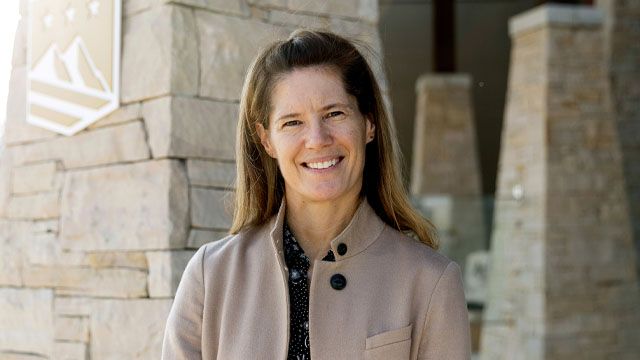
U.S. Ski and Snowboard President and CEO Sophie Goldschmidt outside of the organization's headquarters. Image: U.S. Ski and Snowboard Team
Next up in ski news this week, is another highlight on the subject of the U.S. Ski Team and FIS Alpine Racing. In recent months, there’s been a consistent uptick in discussion regarding ways to generate more interest in FIS sports. On the international level, FIS President Johan Eliasch has talked about things like media rights and following the lead of other international sports leagues like FIFA and Formula 1. This week, Reuters published an article that highlights parallel thinking from the U.S. Ski Team’s President Sophie Goldschmidt. Much like Eliasch, Goldschmidt also has expressed interest in generating more attention for FIS sports, with her particular focus on engaging the U.S. fan base. With this in mind, Goldschmidt shared two key insights in the Reuters article this week in regards to some of the ways she hopes to make that happen.
As we now know, the United States will be hosting more World Cup events on its soil in the upcoming season than it has in any season prior. On the calendar are four racing venues: Killington, Beaver Creek, Palisades Tahoe, and Aspen. In order to make the most of these events and generate the most hype around them, Goldschmidt has tasked her team with trying to learn from the Formula 1 playbook, as the event they held in Miami over the summer resulted in massive interest in the region. In other words, the first thing we learned from this week’s article is that Goldschmidt is looking to capitalize on the opportunity to host multiple World Cup Events on U.S., ideally paralaying those events into an increase of domestic interest in FIS sports. To do so, she’ll look to mimic Formula 1’s proven playbook.
Takeaway #2 from this week’s article builds on the first takeaway and results in a specific, highly intriguing anecdote: Goldschmidt seems very keen on producing a behind-the-scenes type reality show that follows U.S. Alpine athletes throughout the course of the season. Again citing Formula 1, Goldschmidt points out the success of the Netflix series, “Drive to Survive,” which has generated a ton of interest in the sport. Expanding on these thoughts further, Goldschmidt points out a number of factors which, for better or worse, suggest that a behind the scenes reality show for FIS athletes would do well in the American market. For example, Goldschmidt accurately points out that FIS Alpine Racing produces the same high speed, high risk adrenaline that F1 sports do, along with the same athletic challenges and courage that make for compelling storylines. Pair that with the glamourous locations of ski races and a colorful cast of characters, and her argument in support of creating a show like this is hard to poke holes in. At the moment, there isn’t any actual plan to produce this show that we’re aware of, but it’s exciting to hear the idea being floated by the President of the USST nonetheless. If it happens to progress at all, we’ll be sure to keep you updated. For now, check out the latest in this article from Reuters.
#3: Central NY Ski Resort Kingpin Under Fire from State’s Attorney General, Alleging Violations of Antitrust Laws:
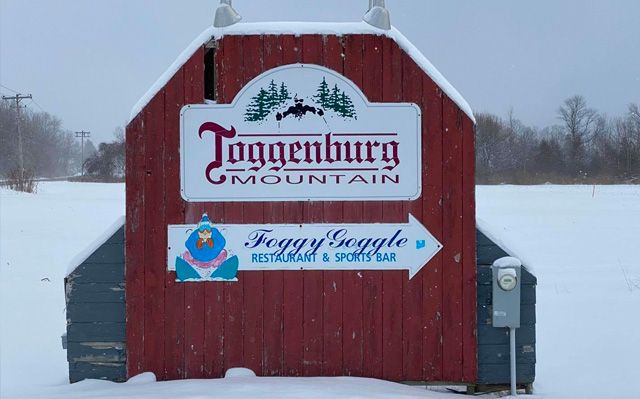
For our third highlight this week, we’re going to take a look at a story coming out of Central New York, where there’s been a development in a story that began just over a year ago, when a man named Peter Harris purchased a competing ski hill and shut it down immediately.
Now, to fully understand this week’s story, you need to know a little bit about the lay of the land in Central New York. To the south of Syracuse, the largest city in the area, there are three ski resorts, each approximately 30 minutes away. From West to East, they are: Song Mountain (where this writer happened to learn how to ski), Labrador Mountain, and Toggenburg (where this writer skied throughout his highschool years). For all intents and purposes, these three resorts are comparable, offering similar vertical, terrain, and snow quality (although locals will assuredly argue otherwise). In addition to these three resorts, there’s a fourth resort in the region that’s 45 minutes south of Syracuse and offers more vertical as well as terrain: Greek Peak.
Back in 2014, the owner of Song Mountain, Peter Harris, purchased Labrador Mountain. Five years later, in 2019, the owners of Greek Peak, the Meier family, purchased Toggenburg from the Hickey family. In other words, what used to be four resorts operating independently in the area had come under the ownership of two owners: Peter Harris and the Meier family. Then, just over a year ago, in August of 2021, the Meier family sold Toggenburg Mountain to Peter Harris, meaning his parent company, Intermountain Management, now owned all three of the resorts most accessible to the city of Syracuse. If the story ended there, this week’s news likely wouldn’t have happened, but instead Mr. Harris’s next move infuriated the local community as upon purchasing Toggenburg, he announced that he would be closing it indefinitely, citing the need to consolidate resources in a market that is too small to support three ski areas. Even still, if Harris had stopped there, he likely wouldn’t be facing legal trouble this week. Instead, Harris’s final move was to add a restriction to the deed of the mountain, barring any future owners from operating it as a ski resort. Ultimately, it was this final step that resulted in Harris being sued by the Attorney General of New York.
In a lawsuit that was filed this week by Attorney General Letitia James, Peter Harris and Intermountain Management are accused of violating antitrust laws, alleging that Harris bought Toggenburg Mountain for the sole purpose of eliminating his only competition in the area. In a news release regarding the lawsuit, James said, “Intermountain tried to freeze out competitors to increase its profits and dominate the region’s ski market.” For Harris’s part, he suggests that the region simply doesn’t have the capacity to support three separate ski hills, and that by purchasing Toggenburg, he was able to consolidate resources and create superior experiences for skiers in the area at both Song Mountain and Labrador. This logic might have held up, had it not been for the attempt to restrict the use of Toggenburg as a ski resort in perpetuity, or an illegal contract in which Peter Harris paid the Meier family an additional $195,000 to sign an agreement in which they couldn’t hire any of Intermountain’s employees for five years from the date of the sale. These two acts seem to have pushed this situation from a story about a schemey businessman, to one who has potentially violated antitrust laws. As a result of the transgression, James is asking Intermountain to sell one of its three resorts, once again equalizing the competitive landscape of ski resorts in Central New York. To learn more about this story, check out this writeup on Syracuse.com.
#4: Saddleback Mountain Signs Memorandum of Understanding With ReNewSnow, Allowing Them to Prototype Revolutionary Snow Making Device:
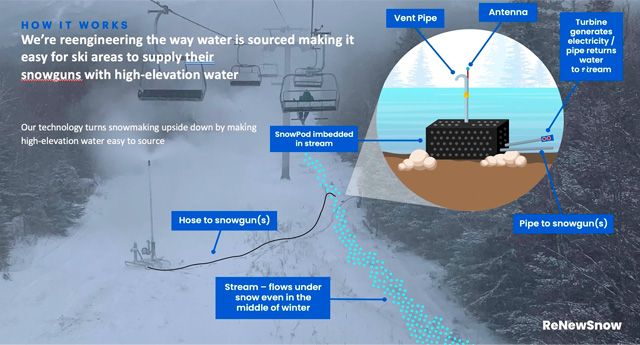
A quick diagram showing how the ReNewSnow SnowPod is designed to work. Click here to view it at full size. Image: ReNewSnow Official Website
Finally, we end this week with a cool story from the recently revived Saddleback Mountain ski resort in Maine, where the resort has just signed a Memorandum of Understanding (MOU) with an interesting startup called ReNewSnow. As you know, ski areas have found themselves in a bit of a pickle in recent years as climate change has resulted in less predictable, often more mild, weather. As a result, ski resorts feel both the need to play their role in slowing climate change, while also needing to produce man made snow in order to operate. Making snow, as it turns out, is a resource intensive process, requiring both incredible amounts of water and energy. This dynamic puts ski resorts in the awkward position of being advocates for the environment while also participating in activities that many would argue aren’t exactly eco-friendly. It also creates significant market opportunity for companies to find a way to remedy this situation by enabling ski areas to produce snow more sustainably.
Enter: ReNewSnow. This week, the startup announced that it has signed an MOU with Saddleback Mountain which will allow them to install a prototype of their potentially revolutionary new snowmaking infrastructure device. Before we attempt to explain the ReNewSnow SnowPod System, let’s quickly review how most ski resorts currently make snow. At most resorts, there’s a water reservoir at the base of the mountain where runoff is collected, connected to an extensive network of piping that brings water to snow guns all over the resort. In order to get the water to these guns, it needs to be pumped uphill, a process that requires a significant amount of energy.
Now, we’re not scientists here, nor do we pretend to be on days other than Halloween, so apologies in advance if we get the details of this system wrong. That said, to the best of our understanding, the ReNewSnow SnowPod System looks to solve this issue in a somewhat ingeniously simple way: by capturing the water supply at elevation rather than allowing it to flow all the way to the base before being pumped back uphill. The basics are this: SnowPods will be installed in streams and water sources around the mountain, where they will be able to capture water on its way down the mountain and either divert it directly to snow guns at elevation, or allow it to pass through, churning a turbine capable of producing small amounts of energy as the water flows through it. With this system, the idea is that water can be pumped to snow guns from a closer proximity and at a similar elevation, while each SnowPod also produces electricity to help power this process. In doing so, resorts can reduce the amount of electricity needed to pump water from the reservoir at the base of the hill, back up the mountain to make snow. In doing so, ReNewSnow suggests that it could reduce resort expenses by up to 30% and decrease their carbon footprint by potentially up to 80%, citing the fact that pumping water can sometimes account for up to 67% of a resort’s energy usage.
All told, the ReNewSnow SnowPods system is a pretty cool idea. While it’s yet to be seen if the numbers above hold true, this week’s news is a big first step for the company as they’ll be able to finally work with a resort to further develop their prototypes while also capturing real data in regards to energy and cost savings. To learn more about this week’s news, check out SnowJournal.com. To learn more about ReNewSnow, check out their website.