

TOP FIVE FRIDAYS: OCTOBER 7, 2022
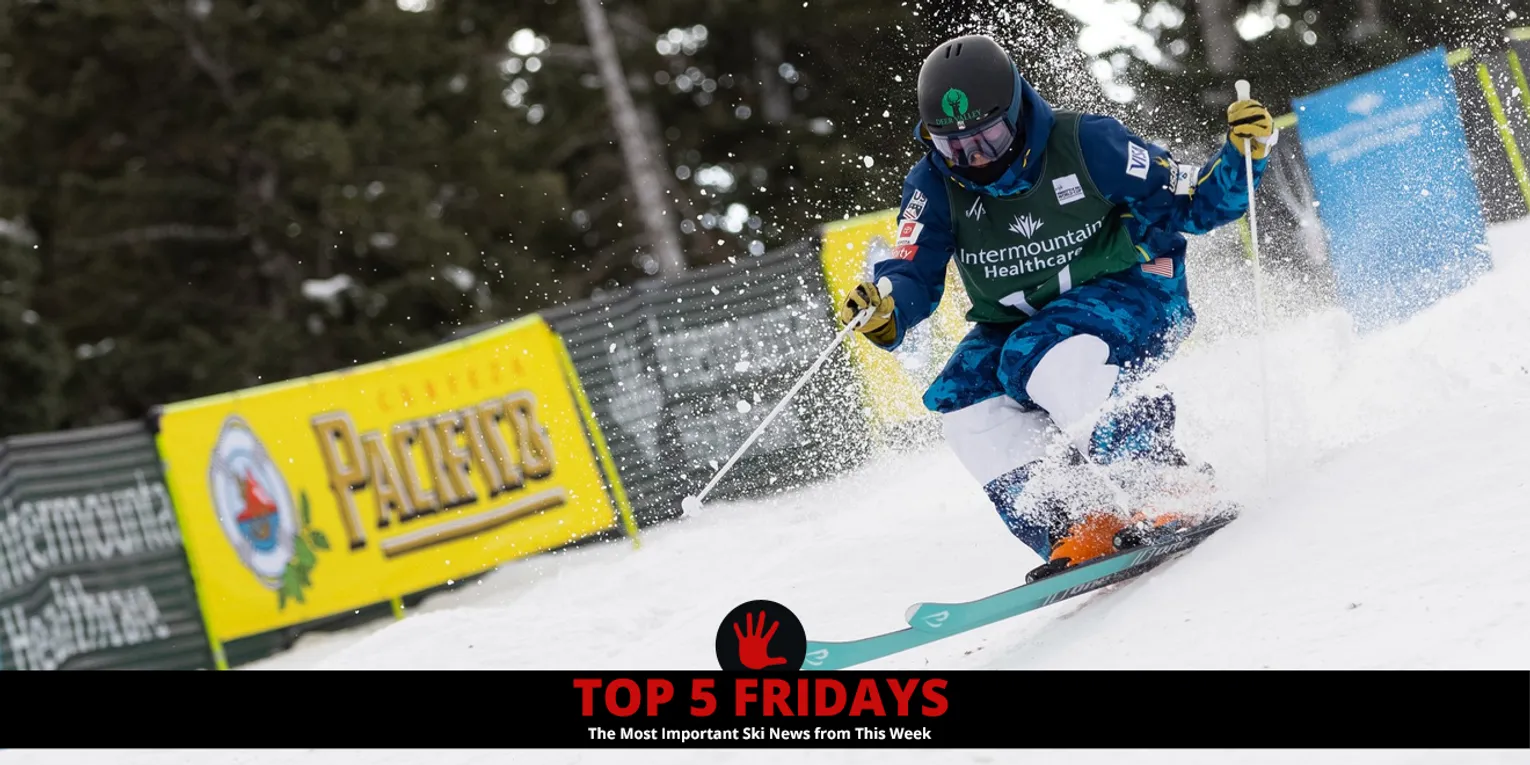
Lead Image: In the season ahead, the U.S. is scheduled to host 10 FIS World Cup events, the most ever in a year. On that list is the return of the annual men’s and women’s, moguls and aerials events in Deer Valley, UT. Image: U.S. Ski Team on Facebook
#1: It’s Official: The United States Will Host More FIS World Cup Events in 2022-2023 Then it Ever Has Before:
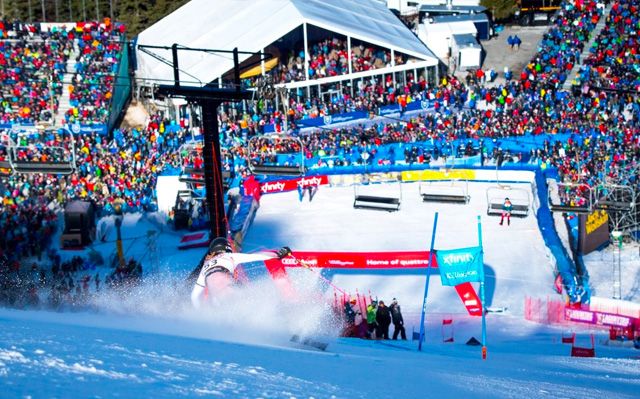
Amongst the four American mountains hosting FIS World Cup events this season is Killington, where the women’s slalom and giant slalom races over Thanksgiving weekend have become a highly anticipated tradition in recent years. Image: Killington Resort on Facebook
Hello, and welcome to Top Five Fridays, the October 7, 2022 edition! This week we thankfully have a much lighter round of news compared to last week, as we start with an update from the world of FIS sports. As you know if you follow our weekly writings, the United States has been planning on hosting an increased number of FIS races in the season ahead, with events being added in both Tahoe and Aspen. This week, following the FIS’s Fall Congress, the 2022-2023 calendar has been set in stone, making these much discussed plans official. In addition to finalizing dates for FIS alpine racing, this week’s meeting also finalized dates for events across all of its sports, including freestyle skiing, freeskiing, and snowboarding. Along with the finalization of the calendar comes a pretty exciting anecdote: the U.S. is set to host the most FIS World Cup events in the 2022-2023 season that it ever has. On that note, let’s take a look at the details.
Things kick off for the U.S. FIS alpine season on Thanksgiving weekend (11/26-11/27) with a women’s slalom and giant slalom coming to Killington, VT. A week later, the men’s circuit visits the U.S., with Beaver Creek, CO hosting a men’s super-g and a pair of downhill races from December 2nd through the 4th. From there, U.S. fans of FIS alpine racing will have to wait nearly two months for its return on February 25th and 26th, when the men’s circuit will compete in a slalom and giant slalom race at Palisades Tahoe. From there, the men will head to Aspen from March 3rd-5th for a super-g and the return of one of the historically most popular downhill venues on the circuit. All told, that makes for 10 planned races across 4 venues in the season ahead- a huge win for ski racing in America.
As for the other disciplines we mentioned earlier, we’ve got full details on those events, dates, and locations as well. For freestyle skiers, the FIS will be returning to the aerials and moguls venues at Deer Valley for the weekend of 2/2-2/4 for events for both men and women. For freeskiers and snowboarders, the highlight of the schedule is undoubtedly the weekend of December 16th-17th as Copper Mountain, CO is set to play host to men’s and women’s halfpipe and big air contests. Then, about a month and a half later, Mammoth Mountain, CA will host men’s and women’s halfpipe and slopestyle events. With a full slate of FIS competitions coming to America in the year ahead, it’s looking like the U.S. will be one of the biggest benefactors of Johan Eliasch’s goals of spreading the global FIS brand. To learn more about these recent decisions, check out the recap from the U.S. Ski and Snowboard Team.
#2: Crans-Montana Cancels Annual Nighttime Slalom Race Due to Energy Saving Measures:
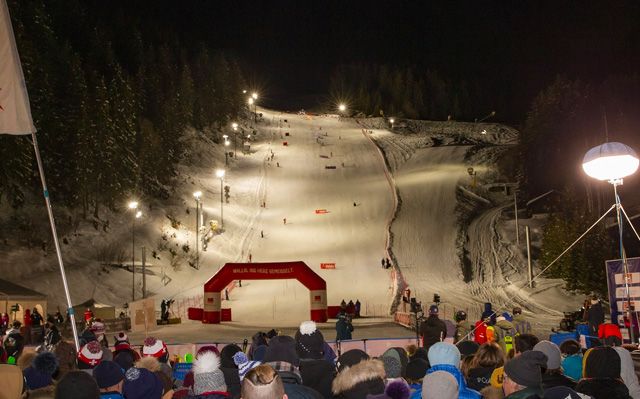
In recent years, Crans-Montana has held an exhibition nighttime slalom race ahead of the Wengen World Cup event. This year, due to energy shortage concerns, the organizing committee has called it off. Image: Crans-Montana World Cup Page on Facebook
Next up in ski racing news, we have a quick highlight here that builds on a story we briefly covered back in the middle of August: in light of available energy concerns in Switzerland and Austria, there’s a chance ski resorts will have to cut back on operations this year. While we haven’t caught word of any actual abbreviations of operations, we did come across a story this week that’s uncomfortably close. In a typical FIS season, the Swiss resort of Crans-Montana will invite a selection of world class slalom skiers to participate in a nighttime exhibition race between the Adelboden and Wengen stops of the FIS tour, the latter of which features one of the most notable slalom races on the calendar. As such, the Crans-Montana nighttime exhibition race has become something of an annual tradition to look forward to for World Cup skiers who get a chance to compete in a fun exhibition race ahead of the Wengen slalom. This year however, they won’t have that chance as the organizing committee has canceled the race, saying, “The current and expected power shortage with the required restrictions at all levels has prompted Crans-Montana to cancel the men’s night slalom on January 11, 2023.” The committee goes on to say that while the decision wasn’t easy, it shows, “the sensitivity of the organizing committee when it comes to environmental issues.” There are hopes to bring the event back next season, but for now the cancellation serves as a reminder of the very real effects of climate change, particularly on skiing. To learn more about this, check out the announcement from Crans-Montana.
#3: Stories From the Front Lines: Stowe Announces Paid Parking Details, and Locals Are Unimpressed:
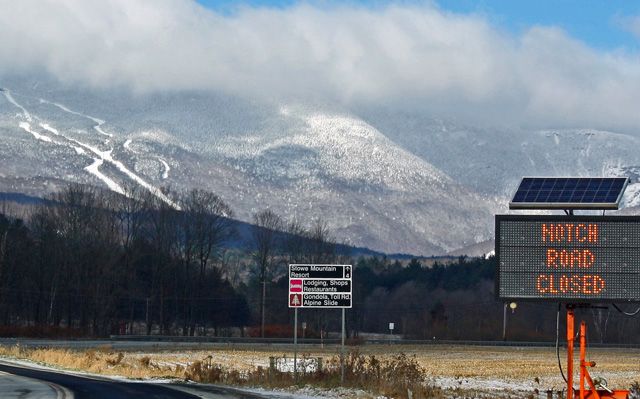
This week, Stowe Mountain announced some of the finer details regarding their paid parking program for the upcoming season. Reactions were swift and dissatisfied. Image: Post from Stowe Mountain on Instagram
And now we enter the more controversial half of this week’s news as we discuss a pretty juicy story that we expect to hear a lot of opinions about: Stowe has just announced details regarding its $450 season parking pass. Before we dive into this week’s update, let’s do a quick recap on where this story stood prior to this week. At the end of last April, shortly after shutting down their lifts for the season, Stowe announced that it would be implementing paid parking on weekends (Friday - Sunday) and holidays in the year ahead. While many decried it as a money grab, Stowe’s reasoning for the move was an attempt to reduce the amount of traffic on the mountain road leading to the resort- a very real problem. With this new policy in place, guests will have four parking options this year: park in town and take a shuttle for free, carpool with at least four people and receive free parking, pay $30/day to park, or buy a $450 season parking pass. With those details outlined, we entered the week.
Then, last Saturday, Stowe shared more details regarding their parking program on Instagram and Facebook, and to say it went poorly would be a massive understatement. In the post, which focused on details around buying a season parking pass, Stowe wrote, “While these passes do not guarantee a parking spot, they do provide value for our resort regulars who visit throughout the season.” With that one line, the comments section exploded, with well over a thousand commenters expressing everything from outrage, to perplexment, and even doubt over whether or not it was legal to offer a product that doesn’t actually guarantee anything. In addition to backlash regarding a season parking pass that doesn’t guarantee free parking, another potentially major issue was exposed in the comments section: for those carpooling, it will be their responsibility to find a parking attendant to prove to them that they came with four people in order to receive a coupon code that they can enter on the app in exchange for free parking. To us, this seems like a plan that’s riddled with potential issues, ranging from skiers faking their carpool numbers, to being unable to find a parking attendant, or even inconveniencing those with special circumstances such as needing to drop off kids at race programs at Spruce or handicap skiers at lodge entrances. All told, the current plan to ask those who carpool to Stowe to track down a parking lot attendant on their own is messy.
That’s the bad side of this week’s news. The eternal optimist in us however has hope that the season ahead won’t be nearly as bad as it currently seems. At the root of all of this is the fact that traffic has been a legitimate issue in recent years, and if carpooling and shuttling are taken advantage of, there’s a chance that the issue at hand could be solved. As for some of the more detailed concerns, such as season parking pass holders not being able to park or difficulties tracking down a lift attendant, we have to think Stowe will find ways to address these issues throughout the year. For example, they could simply have a lift attendant stationed at the entrances to Spruce and Masnfield for those carpooling, making it easy to obtain a code. All told, this year does feel like a bit of an experiment though, no matter how you slice it. As such, you can bet that we’ll report back from the frontlines with updates throughout the season as necessary. For now, we’ll turn you over to ParkStowe.com, where you can read all of the details regarding this winter’s parking policy.
#4: Futuristic and Non-Existent Ski Resort “Trojena” Chosen For the Site of the 2029 Asian Winter Games. Significant Environmental Concerns Ensue:
Behold: Trojena.
Finally, we end this week with what’s hands down one of the most bizarre stories we’ve covered in our years here. To do it proper justice, let’s recap the story of Trojena, a futuristic mountain community in the city of Neom, which itself is a 10,000 square mile city being built in Saudi Arabia. While the entire plan for Neom presents itself as something straight out of a sci-fi movie, this week’s news focuses on Trojena, where developers are planning to develop a mountain community with year round skiing in the country’s high peaks. To be honest, it’s hard to do this portion of the story justice here, so we’d highly recommend checking out our full coverage of the story that we ironically covered in our Top Five post on April 1st.
With the stage loosely set, it’s time for this week’s news: Neom has just been selected to host the 2029 Asian Winter Games at Trojena. Starting simply with the facts, it feels a bit surreal that this announcement has been made as the vision for the development is so massive in scale that many have doubts that it will ever be completed at all. Now, there’s a massive event scheduled to be held there, well before the venue is complete. It’s not just this announcement that made headlines this week though, but the backlash to it too.
In the wake of the announcement, swift rebukes came from multiple parties, denouncing the decision for its environmental implications. For example, in France, a number of parties invested in ski culture, including the French Ski Federation, multiple ski resort operators, the mayors of several ski towns, and ski instructors themselves, have all signed a joint statement stating in part that, “we can only denounce this aberrant project, which is totally opposite to what is desirable for the planet.” The global organization Greenpeace also issued a statement condemning the decision, with more specific citations of the issues at hand, mostly centered around how excessive and unnecessary the project seems, while also being at odds with sustainable practices. The massive man-made lake planned for Trojena, for example, will need to be constantly fed with desalinated water, a massive and unnecessary use of resources, even if the energy comes from renewable sources. In other words, what the counter argument against the decision to host the 2029 Asian Winter Games at Trojena amounts to is that it’s an irresponsible decision where an organization that should be invested in environmental best practices is instead promoting the exact opposite by encouraging the development of this futuristic city. All told, the entire story is equally problematic, bizarre, and interesting. With skiing currently planned to start at Trojena in 2026, we’ll be sure to keep you updated as this project develops. For now, read more about the latest announcement from Business Insider.