

Top Five Fridays: September 29, 2023
Lead Image: As a ski area built specifically with backcountry access in mind, Silverton Mountain might offer you the best chances at finding powder on any given day. This week, it was sold to new owners who promise to keep the experience the same. Image: Silverton Mountain on Facebook
#1: Silverton Mountain Has Been Sold to the Owners of an Adventure Travel Company:
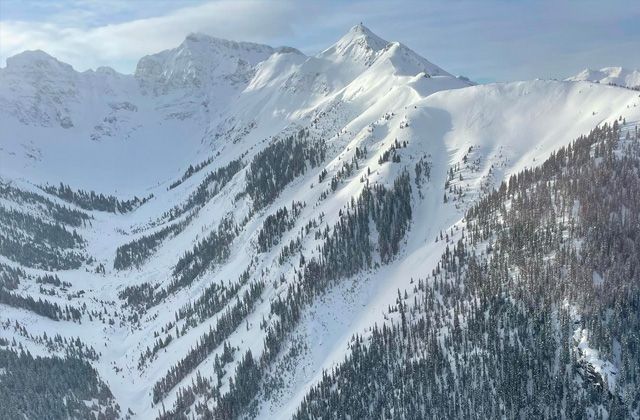
Looking out at the vast terrain accessible via the single chairlift at Silverton Mountain. Image: Silverton Mountain on Facebook
Hello, and welcome to Top Five Fridays, the September 29, 2023 edition! We’ve got a thought provoking round up of ski news this week as a trio of headlines were made that’ve left us with more questions than answers. First up on that list is news that Silverton Mountain, the Colorado ski area renowned for its extreme terrain, has just been sold. In order to really appreciate this story, as well as the perspective of those involved, we have to start by making sure there’s a clear understanding of what Silverton Mountain is. This unique ski area’s origin story starts like this: in 1999, a man named Aaron Brill was armed with some family money, the dream of creating an exclusively backcountry ski resort accessible via a singular chairlift, and a whole lot of drive. As Brill was exploring possible terrain for his resort, he pulled up to land that would become Silverton Mountain in a retired UPS van. After exploring the former mining land on foot, he quickly fell in love and began purchasing old mining claims. Since this was more or less abandoned land, the cost was exceptionally cheap. Eventually he acquired 200 acres worth of property, sourced an old double chair from Mammoth Mountain, and began the daunting task of applying for permits and approvals. Five years, millions of dollars, and countless persuasive arguments later, Brill was finally given the green light to move forward. Since then, Silverton has become one of the most iconic destinations in skiing, and has completely revitalized the local economy, all without succumbing to the allure of development.
Things were going well for the resort until the pandemic hit. In 2022, Aaron and his wife Jenny, who have also owned a heliskiing operation in Alaska since the mid-2000’s, began feeling the same economic pressures as the rest of the ski industry. They began searching for an investor in Silverton, but ultimately ended up looking for a buyer for the mountain. But, the Brill’s weren’t interested in just any buyer. For them, it was crucial that this new buyer respected the foundation they built, would honor their dream of only meaningful development, and most importantly, promised to keep the entirety of the 50 person staff on board. Given the climate of the ski industry, this strict list of demands resulted in several refused offers. Finally, this week, the Brills finally said yes to one of their suitors.
Enter Andy Culp and Brock Strasbourger, co-owners of Heli Adventures Inc., a company that specializes in curating adventures for travelers. Originally launched as a liaison for those looking for backcountry skiing experiences, Heli Adventures has since grown to offer a multitude of experiences, ranging from yoga retreats, to safaris, fly fishing expeditions, diving trips, and a plethora of other adventure based vacations. As the company continued to grow its offering and network of vendors, they came to realize that it might be beneficial to begin owning the operations themselves, and not just middle-manning the experiences. So, last December, they acquired a heli-skiing operation in Alaska, and it went surprisingly well. Now, just under a year later, they’re making their second foray into vertical integration through their ownership of Silverton, where they’ll undoubtedly offer curated backcountry experiences.
While we haven’t had a chance to witness local reactions yet as this news is hot off the presses, the general vibe from both the Brill’s and the mountain’s new owners is that this transition leaves the resort in good hands. While there will always be some skepticism that comes with new ownership, one interesting distinction to note with this new agreement is that Heli Adventure’s business interests aren’t the same as most ski resort owners. While an organization like Vail or Alterra might focus on maximizing the profit of the property itself by developing it and increasing visitation, Heli Adventures sees the mountain as a destination in its portfolio. That means that for them, keeping Silverton as a unique experience has significant value. They don’t pride themselves in offering vacations to Aspen; they pride themselves in creating unique experiences for guests. With that in mind, it provides some reassurance that things likely won’t change all that much at Silverton under its new owners. It does, however, leave us wondering whether or not plans for a second chairlift will still move forward. We’ll let time tell that story, but for now, we recommend giving this article from the Colorado Sun a read to learn more about the Brill’s perspective on the sale, as well as this article from Aspen Daily News that highlights the perspectives of the new owners.
#2: As Locals Continue to Push for Increased Public Transportation, Utah Transport Authority Announces Reduced Ski Bus Service This Winter Due to Staffing Shortages:
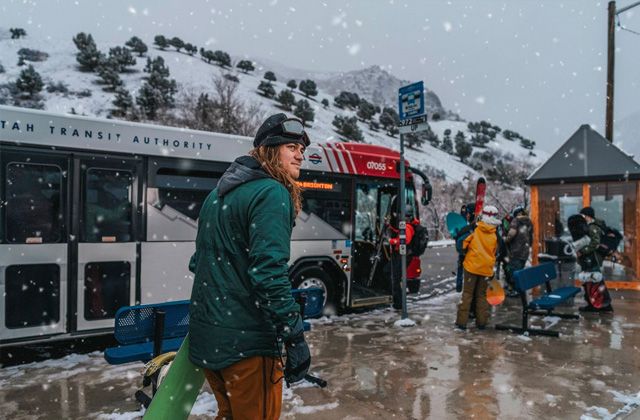
Despite significant public demand, the Utah Transportation Agency announced this week that they will be offering a reduced ski bus schedule for the second year in a row due to staffing shortages. Images: Utah Transport Authority on Facebook
In other ski news this week, we have yet another update from the neverending saga that is canyon road transportation in Utah. It would be kind of crazy if you weren’t already aware of the story that’s been unfolding in Salt Lake’s Little Cottonwood Canyon in recent years, but it’s a backdrop that bears repeating to give this story proper context. There, despite much local opposition, the department of transportation continues to make progress on its plans to build a gondola that would transport guests from the base of the canyon up to Alta and Solitude resorts. It’s a plan that’s meant to mitigate the unbearable traffic congestion that regularly occurs on the canyon road, but also one which is expected to cost over $1 billion dollars and wouldn’t begin construction until approximately 2043. In other words, it’s an expensive solution that could take literal decades to come to fruition. For obvious reasons, locals who work and recreate at the resort aren’t thrilled with the plan. To many in the community, there’s a much easier solution: better public transportation. Unfortunately, this week’s news is not that.
This week, the Salt Lake Tribune shared an article announcing that for the second straight year, the Utah Transport Authority’s (UTA) ski buses will operate on a reduced schedule. Specifically, the buses that run up and down both Big and Little Cottonwood Canyons will run every half hour rather than every 15 minutes. While an additional 15 minute wait may not sound significant, what this really means is that public transportation’s capacity potential has been cut in half. Here’s the kicker though: the reason for the reduction in service isn’t because the department of transportation doesn’t want to operate a full schedule. Rather, it’s because for the second straight year, they simply can’t find enough drivers to run the routes. Currently, UTA has 101 open driver positions, out of a total of 864 positions. Without the ability to fully staff their services, UTA is behaving just like any other business experiencing staffing shortages: they’re scaling back their capacity. This of course just adds another layer to the complexity of the issues facing Utah’s Cottonwood Canyon. On one hand, a Gondola will be extremely expensive and is still roughly 25 years away from completion, and nobody is happy about this. On the other hand, there simply aren’t enough bus drivers to operate the expected ski bus schedule, let alone an expanded one. Even if UTA wanted to increase their services, it’s simply not possible at the moment. To be sure, we don’t envy anyone tasked with solving this issue. To learn more about this week’s news, as well as plenty of other interesting information about the situation, check out the report from the Salt Lake Tribune.
#3: Big Sky Reveals Updated Trail Map Including New Double Blue Square Ratings, Leaving Us to Wonder, “Does The Trail Rating System Need Reimagining?”:
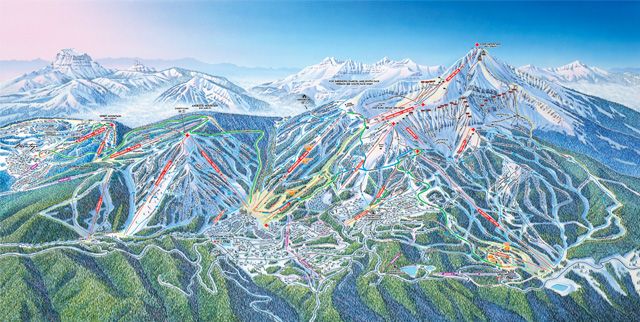
A very small version of Big Sky’s new trail map, featuring its new double blue trail rating. To see the full version, click here.
Third up this week is a bit of a double highlight as we came across two articles that made us stop and ponder the validity of our classic, “Green, Blue, Black, Double Black” trail rating system. Going in chronological order of our discoveries, we first came across this article from Powder Magazine, sharing the news that Big Sky has just released their updated trail map, featuring the new Lone Peak tram, as well as a pretty interesting adjustment to some trail ratings: the introduction of double blue square trails. Intuitively, it’s pretty easy to understand what this new rating represents: a trail that’s more difficult than most intermediate runs, but isn’t exactly an “expert” trail either. What’s interesting though, is how the resort came to the conclusion that this new “advanced intermediate” designation was necessary. According to a recent blog post announcing the changes, the move actually started with their beginner terrain, when they realized that some of their green circles featured headwalls that were really too steep to be considered beginner friendly. As such, those got upgraded to blue squares, which in turn made the blue square ratings inconsistent as these new trails were overall much easier than the existing blue squares. Rather than bumping the more advanced blue squares to black diamonds, which would only continue to allow the issue to cascade, the resort created the double blue square system. Interestingly enough, Big Sky is neither the only nor the first resort to feature double blue squares. While we don’t know for certain all of the resorts that currently feature this trail rating, we can say with certainty that Deer Valley, Canyons, and Jackson Hole have all currently or previously used the double blue square rating. This brings us to the second article we caught on the subject.
In a surprisingly thorough investigation posted to SnowBrains this week, author Gregg Frantz highlights the discrepancies that exist amongst trail ratings across different resorts, ultimately arguing that these inconsistencies are dangerous. While we’re not sure we share his level of concern, we certainly see his point, noting that not all blue squares are alike, and it’s a phenomenon that is only exacerbated as trails become more difficult. For example, is Black Hole at Smugglers' Notch really a triple black diamond, when compared to terrain out West? What makes Frantz’s article particularly interesting to us though, is that he offers a solution for the issue. Rather than allowing resorts to label trails at their own discretion, he argues that there should be a universal system that takes into account things like slope angle and slope angle length that can be applied to all resorts. In theory, this would create a consistent rating system at all ski areas.
Ultimately for us, we just love the conversation that this starts. It brings up questions like, “Would we be better off with a universal trail rating system? Or are the discrepancies part of the character of each mountain?” Other questions could be: what is the best trail rating system? Do we stick with the green through black scale, or would something numerical be better? If we went with numbers, what would the best scale be to keep the rating system simple, yet diverse enough to include all trail difficulties? While we’re inclined to keep things exactly how they are, it’s an interesting discussion to have, and we’d love to hear your thoughts about it in the comments!
#4: Skiing Has Lost a Legend: Dr. Robb Gaffney Has Passed Away:
There’s perhaps no better clip to sum up the dichotomy of Robb Gaffney than this clip from the end of G.N.A.R., where he sits in his office, backdropped by his diplomas, explaining the value of the absurdity of the film. This is the stuff of legends.
Finally, it’s with heavy hearts that we share our final highlight this week. Last Friday, on September 22, 2023, Dr. Robb Gaffney passed away after a multi-year battle with acute myeloid leukemia. For those of you who don’t know the name, Robb Gaffney was an absolute legend in the world of skiing. After moving to Palisades Tahoe (known as Squaw at the time) in the 1990’s, Robb and his brother Scott teamed up to produce a number of big mountain ski films both independently and for Matchstick Productions, including 1999, Immersion, Walls of Freedom, and several others. During this time, Robb was also extremely close with fellow legend Shane McConkey, with the two of them both embracing and promoting a brand of ski culture that emphasized pure elation and humor, often bordering on the absurd. If you were in the ski scene from the late ‘90s - mid 2000’s, you know exactly what we mean. It’s the brand of ski culture that birthed McConkey’s legendary “saucer boy” character, as well as influenced Gaffney’s iconic “Squallywood” book, which he published as an off-humor guide to big mountain skiing at Squaw Valley. It’s also the brand of humor that ultimately culminated in cult ski film G.N.A.R. (Gaffney’s Numerical Assessment of Radness) - a ski movie that inspired countless skiers to take life a little less seriously, and whose many point-earning metrics are continuously referenced to this day. Point in case: the story of Chuck Mumford, who was a skier in the film, and who carried the lifestyle it embodied along with him as he started a little sunglass company called Pit Viper. As a skier, Gaffney’s influence is, ironically, immeasurable.
What ultimately solidifies Gaffney’s legend though, is that he was so much more than just another extremely talented, hilarious, antics obsessed skier. He was also an incredibly intelligent, thoughtful person with deep convictions and ties to his community. Between the years of 1995-1999, just before moving to Squaw, Gaffney earned his MD in Psychiatry. While he didn’t practice immediately, he turned to this degree as his professional ski career began to wane, and became a practicing psychiatrist in the Squaw area. Given his background, Gaffney became something of an expert in the psychological benefits of big mountain skiing, specializing in risk assessment in youth as it pertains to action sports. In 2017, he gave an incredible TED talk on the subject. As a member of his community, Robb also played a pivotal role in the Keep Squaw True / Tahoe Truckee True movement, which has been one of the key players in the push to prevent the development of the Olympic Valley. As it turns out, Gaffney was one of the first to push back against Squaw’s desire to develop the valley, first leaving his role with the resort back in 2014 and launching an IndieGoGo campaign to raise funds to support the resistance effort.
While it’s impossible to share the news of his passing without heavy hearts, it’s equally impossible not to look at Robb’s life as one that truly exemplifies a life that’s well lived. From earning his medical degree in psychiatry in his college years, to demonstrating how to live a life filled with joy in his post-college years, Gaffney managed to hit both sides of the spectrum. He was serious, thoughtful, and intelligent when the moment called for it. Yet his legacy as a skier was anything but. He taught us all that life shouldn’t be taken too seriously, and that one of the greatest gifts of life is simply living. In the moment, enjoying every second. So while the news of Robb’s passing is inherently sad, let’s all do our best to carry his lessons with us as we move forward. Life is about living. While it’s ok and necessary to be serious sometimes, it’s equally as important to just let life happen. Let it be absurd, let it be hilarious. Let it be what it is, for as long as you’re alive. Rest in Peace Robb, your impact on our lives as both humans and skiers will be felt forever.