


Top Five Fridays: September 8, 2023
Lead Image: Feast your eyes, on the 2024 SkiEssentials.com Ski Test.
#1: The 2024 SkiEssentials.com Ski Test is Officially Live!

It’s finally here, the day we’ve all been waiting for: the launch of our 2024 Ski Test.
Hello, and welcome to Top Five Fridays, the September 8, 2023 edition! This week represents one of our favorite weeks of the year as it’s the one in which we get to announce the release of our annual ski test! In honor of its 7th year, we decided to take things a step further and give you the ultimate access into the minds of our ski testers. If you’ve checked out the test in previous years, you know that our written content has essentially been a few paragraphs about the ski, providing foundational facts alongside quotes from those who tested it. This year, we’re separating the two, giving you a full writeup about the ski that’s a deep dive into its construction and purpose, as well as full access to every ski tester’s test card.
Moving towards the tester cards format was a big step for us. In every iteration of the ski test, we’ve made it a point to emphasize that this is not meant to be a numerical ranking of skis. We very purposely avoid overall scores and “best in class” type awards. Instead, our goal is to tell you how specific skiers feel about the skis they tested. That way, if you find yourself aligning with one of our ski testers, you can follow their thoughts and feelings across an array of skis, ideally helping you find the perfect choice for yourself. Keeping all of that in mind, we hope that you’ll use these tester cards as an additional reference, but not as the ultimate source of truth. Just because “Kevin”, an avid front side skier, didn’t love the K2 Reckoner 112, that doesn’t mean you won’t. Chances are, if you’re more like “Corey”, a freeride influenced skier who loved it, then it means that you just might love it too.
In addition to the inclusion of our tester cards, we’re also excited to once again bring you “more”. More skis, more brands, more words about each ski, more images, and more video content- more everything. In fact, we want to bring you “more” so badly that this isn’t even the final version of the test. We’ll be continuing to add more skis over the course of the next few weeks, and as we’re able to get back on snow, we’ll allow our testers to continue submitting test cards for new skis as they try them. As such, if there’s a ski you’re considering buying in a month or two, it probably makes sense to bookmark the page now and revisit it when you’re ready to buy. Chances are there’ll be additional content to consider by that point.
While we do hope you’ll continue reading the rest of this week’s Top 5 Fridays, we completely understand if the allure of checking out over 425 skis from 20 (soon to be 21) brands is too much to resist. Whether you decide to check it out now or later, you can do so right here.
#2: Netflix Co-Founder & CEO is the New Majority Owner of Powder Mountain:
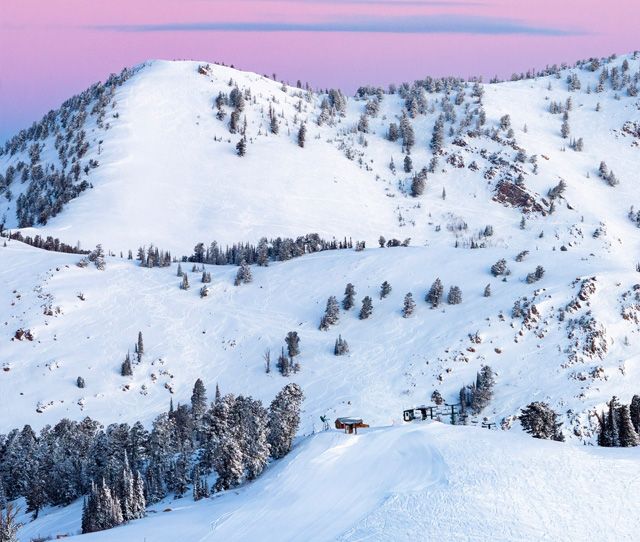
After falling in love with Powder Mountain, Netflix CEO Reed Hastings has become the majority owner after a $100 million investment. His dream? Increase access for all abilities. Image: Powder Mountain on Facebook
For our second highlight this week, we’d like to start by apologizing to Netflix Co-Founder and CEO Reed Hastings. Despite spending $100 million this week in an attempt to dominate ski news headlines, this highlight still didn’t supersede our Ski Test for the top highlight, relegating him to second place. For that, we apologize.
With that out of the way, here’s the story: This week, Netflix Co-Founder and CEO Reed Hastings invested $100 million into Utah’s Powder Mountain, becoming the resort’s majority owner. Now, from that sentence alone, you might feel a ping of concern, as the idea of a tech giant becoming a majority owner in a ski resort might lead you to the conclusion that their goal is to develop the area as much as possible. In reading through this article from the Deseret News however, it sounds like Hastings’s interest in the resort is potentially quite pure. In the writeup, he’s quoted as saying things like, “This is an investment in what we consider to be the ultimate skier experience,” or, “we love the untracked powder several days after a storm cycle, we love the vastness of the terrain, and we love the community,” and even, “We’re looking to accentuate what has always made it special.” While we don’t want to put additional words in Hasting’s mouth, it sounds like what he’s saying is that he’s something of a Powder Mountain local who has fallen in love with the resort, but sees potential for growth. Given that he has the means to fund that growth, he’s bought in in a big way.
Alongside this investment news, we also get a handful of tangible improvements that Hastings is looking to implement. In a word, Hastings’s goal can be summarized in just a word: “access.” As avid skiers, by far the most exciting part of his access goal is the opening of 500 acres of ultra steep terrain that will require a guide. That concept, of on-resort, guide-accessed terrain, is something that’s both new and exciting to us, and suggests that this new terrain will be an incredible addition for expert level skiers. In addition to this new on-resort terrain, Hastings is also looking to add a “trails and activity” center, including a yurt, which will act as a gateway to the backcountry, where guest can wander a network of trails via snowshoes, XC skis, snowmobiles, and even moonbikes. In addition to this exciting expansion of services for those of us who are already winter sports enthusiasts, Hastings is also interested in providing access for those just getting started. Back at the resort, he’s looking to make a number of improvements to the beginner terrain, while also introducing a $19 night skiing lift ticket that he hopes gives anyone who’s interested in learning how to ski or snowboard the opportunity to do so. All in all, this seems like a positive development for the ski resort, and we’re excited to see what Hastings’s leadership brings about. For now, you can learn more about this story from Utah’s Deseret News.
#3: Salomon Releases Findings of Life-Cycle Assessment Study, Providing Breakdown of Each Product’s Environmental Impact:
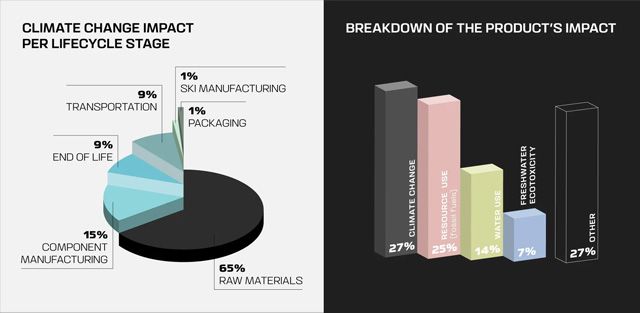
The Life-Cycle Assessment results for Salomon’s MTN Touring Skis. Click here to view a full size image and the complete assessment.
In other ski news this week, Salomon has just released an overwhelming amount of information regarding the results of a recent Life-Cycle Assessment (LCA) study that was performed across a wide number of their winter sports products. In this study, Salomon scientifically recorded both the “climate change impact per lifecycle”, as well as the “breakdown of the product’s impact,” for a number of products. Because these titles aren’t ultra clear without context, it helps to think of them like this: the “climate change impact per lifecycle” is a reflection of how much each part of the product’s life contributes to its overall impact, while the “breakdown of the product’s impact” speaks to the volume of impact across several environmental concerns. To make this easier to understand, let’s take a look at the MTN Touring Ski. As you can see on the accompanying chart, the raw materials account for 65% of the ski’s environmental footprint, while component manufacturing accounts for 15%, end of life is 9%, and transportation is another 9%. Packaging and actual manufacturing are just 1% a piece. In terms of how this ski’s footprint impacts the environment, that’s where the “breakdown of the product’s impact” chart comes into play. There, we can see that climate change and resource use are the top two categories at 27% and 25% respectively, followed by water use, freshwater ecotoxicity, and “other”. One figure that we do wish was present on these charts is a metric reflecting the overall environmental footprint of the ski, but we assume that’s information that Salomon has, and also isn’t strictly relevant to the purpose of the study.
Speaking of which, let’s talk about the goals of the study itself. Typically, environmental impact studies produce the kind of figure we just requested: the overall impact of a product. This study however, breaks things down even further, into the how and the what of the impact: how the product earns that footprint, and what parts of the environment are being affected the most. By obtaining this knowledge, Salomon can now focus their efforts on the areas in which they can have the most impact in terms of reducing the footprint, and/or the areas in which the product affects the environment. Sticking with the MTN Touring skis, it’s easy to see that raw materials are the biggest contributor to the ski’s footprint. While the ski itself currently contains 40% sustainable materials, the fact is that if that number could be increased, then the raw materials would be less of a contributing factor. In terms of how the ski impacts the environment, we see that the ski’s life-cycle contributes most to climate change and resource use. If Salomon were able to focus on reducing the amount of resources and emissions required to produce the ski, it would also have less of an environmental impact.
Ultimately the importance of this research extends well beyond Salomon’s own operations. As a part of this study, Salomon has committed to being transparent with their results so that not only can they learn from them, but other equipment manufacturers can as well. At the end of the day, ski (and helmet, goggle, boot, binding, pole, etc) manufacturers produce their goods in a similar enough manner that there’s at least some carry over in these results. As such, Salomon is producing something of a roadmap for other manufacturers to use as they also look to reduce their own environmental impact. All in all, it’s a pretty cool study, and the nerd in us loves diving into the different charts across different product lines. To do so yourself, head on over to the Salomon website.
#4: Behind Every Great World Cup Ski Racer is an Equally Great Ski Technician. Here’s a Glimpse into Their Life:
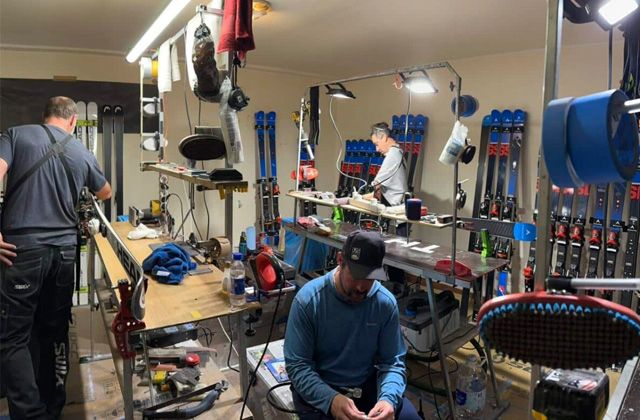
U.S. Ski Team technicians Jake Dippy, Marco Skube, and Daniel Andesilic, gathered in the ski room at this year’s team camp in Argentina. Image: SkiRacing.com
Finally, we end this week with a highlight from SkiRacing.com that puts the importance of World Cup ski technicians front and center. In the article, Argentinian writer Ruggero Preto takes us behind the scenes as he spends time with a trio of U.S. Ski Team technicians: Jake Dippy, Marco Skube, and Daniel Andesilic. While the article starts by calling to attention the importance that ski technicians have, and how mere seconds can determine dozens of places at any given race, it was the anecdotes about the job requirements that truly fascinated us. Take for instance a typical day at training camp. On a typical day, the crew is up at 6:30 AM, to have the team’s equipment loaded by 7:50 AM so they can hit the mountain bright and early. They’ll take a quick on-mountain lunch break in the early afternoon before breaking down and heading back to the shop around 1:30 PM. From there, they’ll start preparing skis for the next day. Depending on what needs to be done, each technician will tune between 4-5 skis for their assigned athlete, as well as any other skis they might need to prepare for the coming days. Sometimes, that can mean working until as late as 2 AM. In other words, while the athletes work hard on training runs at the hill and in the gym, there’s a team of technicians working just as tirelessly to ensure that their equipment is absolutely perfect when it’s in use.
As you might imagine, this amount of effort requires a lot of equipment and skis. Elsewhere in the article, Andesilic says that he brought “63 gear bags from Europe, and Dippy added another 72 from the US, totaling 135 bags,” to the U.S. Ski Team’s month long camp in Argentina. While this may sound like an insane amount of gear to travel across the world with, the team of technicians insists that it’s necessary so that they know they’ll have everything they need to dial in each athlete's skis. For them, this is a training camp too, as they use the month in Argentina to get intimately acquainted with each ski and athlete so that when the season starts, they can quickly tune each athlete’s skis. When that time comes, each technician will reduce their luggage to just 3-4 boxes packed with tools, skis, boots, bindings, poles, and the rest of their athlete’s gear. As they travel, they’ll have just 2-4 days at each location to unpack, set up, tune equipment, and break down before being on the road again. Just like their athletic counterparts, speed is everything.
For us, that’s the interesting part of this article. It really brings to light the amount of hard work and expertise required to be a World Cup technician. Being “good” at ski tuning doesn’t cut it. You have to be world-class. With the bright lights on the athletes themselves, it can be hard to remember sometimes that behind every athlete is an equally important piece to the puzzle. To learn more about the life of a U.S. Ski Team technician, we highly recommend giving the article from SkiRacing.com a full read.