

Top Five Fridays: August 2, 2024
Think skiing’s too expensive? Think again - there’s plenty of mountains offering affordable passes. Take Sierra-at-Tahoe for example, who offered a $267 FOMO pass this past spring. Image: Sierra-at-Tahoe on Facebook
#1: New FIS Wild Card Rule Provides Immediate Path for Hirscher’s Return to the World Cup:
With the new FIS Wild Card rules, only the most prolific athletes are able to return. Qualifications include Overall Globes, Event Globes, Olympic golds, and World Championship golds. Fortunately for Hirscher, he’s got credentials in spades. Here he is winning two Olympic golds, and a silver for good measure.
Hello, and welcome to Top Five Fridays, the August 2, 2024 edition! We’ve got yet another fun one this week as each of our four highlights is vastly different from the next, covering a wide variety of industry topics. From arguments that skiing is just as affordable as ever, to exciting new avalanche risk mitigation technology, this week’s got tons of exciting headlines to cover. We’ll get into those topics soon enough, but first, let’s start with an update to some news we shared last week regarding the return of Marcel Hirscher.
Last week, as you’ll recall, we shared coverage of recent comments made by Marcel Hirscher ahead of his return to ski racing. At that time, Hirscher once again shared plans to head to New Zealand in the coming weeks in an effort to earn enough FIS points to be able to join the World Cup. As it turns out, that won’t be necessary, as the FIS approved a new Wild Card rule at this summer’s Congress, back at the start of June. According to this new rule, athletes are immediately eligible to return to the World Cup if they meet the following criteria:
- They retired between 2 - 10 years ago
- They have won a World Cup Overall Globe
- Or they have won a singular event globe, including 5 individual race victories
- Or they have won a World Championship gold medal
- Or they have won an Olympic gold medal
For athletes who have won an overall globe, they’re immediately eligible to race in all events. For those who’ve won a gold medal or globe in a singular event, they’re eligible to compete in that specific event. For Hirscher, who has won eight overall titles, it means that he’s immediately eligible to compete in any World Cup race.
What’s particularly interesting about this rule is that it almost feels like it was made specifically for Hirscher’s return, despite him being unaware of it until this week. In addition to the qualifications for the Wild Card, all of which Hirscher meets, the sequence of events is also curious. According to our own reporting, Hirscher announced his plans to return to competition back at the end of April. A couple of weeks later, at the FIS’s Spring conference during the days of May 5th-9th, FIS athlete spokespersons Verena Stauffer and Daniel Yule reportedly pitched the idea of a Wild Card to president Johan Eliasch, who’s said to have immediately loved the idea. It’s easy to imagine why, if Hirscher’s name was mentioned. From there, the rule was quickly approved at the FIS’s Annual Congress at the start of June. Of course this could be a coincidence, but from our perspective, it certainly feels like excitement regarding Hirscher’s return led to the development of the Wild Card rule, or what we might begin calling, the Hirscher Card. Regardless, it’s an exciting update as we now know, without a doubt, that Hirscher will be back on the World Cup circuit this coming season. For more on this announcement, check out the report from SkiRacing.com.
#2: The Outdoor Industry Association and Outdoor Retailer Trade Show End Their Long Standing Partnership, Signifying the End of an Era:

In its heyday, the Snow Show was the event of the year. While the OR show continues the tradition, this week’s announcement was undeniably a blow to its business model. Image: Outdoor Retailer on Facebook
In other ski news this week, we caught an interesting article from the Colorado Sun that shares the announcement that the Outdoor Industry Association and Emerald Expositions - the parent organization for the Outdoor Retailer show - have ended their partnership agreement. What’s interesting to us about this headline is that for as clean and concise as it is, the story behind it is far more complicated. At a high level, it goes like this: throughout the early 2000’s, the SnowSports Industries America’s (SIA) Snow Show was the event of the year when it came to unveiling the following year’s product lines. At this show, retailers from all over the country would travel to Salt Lake City to meet with brands, learn about product updates, and place purchase orders. As consumers, we would all eagerly await image leaks on internet message boards, hoping to find out what exciting new gear was coming the following season. Then, in 2017, the SIA sold their Snow Show to Emerald Expositions for $16.7 million. The following year, Emerald Expositions moved what was then called the Outdoor Retailer show from its longtime home in Salt Lake City, to Denver, Colorado. At first, the transition went relatively smoothly as the new OR show proved to be just as impactful as the SIA’s version. Then, in 2020, the pandemic hit.
As we all know all too well, Covid-19 changed the way we do business. In 2021, an event that brought guests from every nook and cranny of the hills and mountains of North America simply wasn’t feasible nor medically responsible. As such, the OR show attempted to host an online version, but ultimately brands and retailers realized that such a show was no longer as necessary as it once was. In subsequent years, instead of putting together expensive exhibitions, brands began channeling more of their sales efforts through regional reps or via online communications. The obvious result was a decline in both participation and excitement.
As all of this was happening, the value of the partnership between the Outdoor Industry Association and Emerald Expositions was also beginning to decline. According to the article from the Colorado Sun, royalties from the annual tradeshow made up about 70% of the OIA’s income for nearly a decade, peaking at between $4.1 million and $5.2 million a year. After the pandemic though, that amount dropped to just $642,000 in 2021, before bouncing back to $1.69 million in 2022. For the OIA, it quickly became obvious that the organization would need to pivot if it wanted to stay in existence. Upon that realization, the organization was able to do just that, by shifting its focus to providing industry research and educational efforts for its members, as well as a new focus on political action. Now, the OIA thrives on membership dues and is posting all time high revenues, with $3.1 million of the organization's $8.59 million earned in 2022 coming from memberships.
For the Emerald Expositions part, while we know their share price has dropped from $20 to $5, we also know that their revenue has rebounded from pandemic lows to pre-pandemic levels of roughly $380 million. In a rare occurrence, the Colorado Sun piece doesn’t expand on how Emerald Expositions has rebounded, but we imagine that they too have adjusted their business model to fit the post-pandemic world. All in all, we found this article interesting as it comes off as something of a bookend for an era in which the annual SIA tradeshow in January was one of the most exciting times of the year. Now that those days are behind us, we’re in an era where brands are cutting out the middlemen and delays, and are instead offering annual mid-season releases. In our minds, that’s even better. For more on this, check out the report from the Colorado Sun.
#3: So, is Skiing Really Too Expensive? Not According to This StormSkiing.com Article:
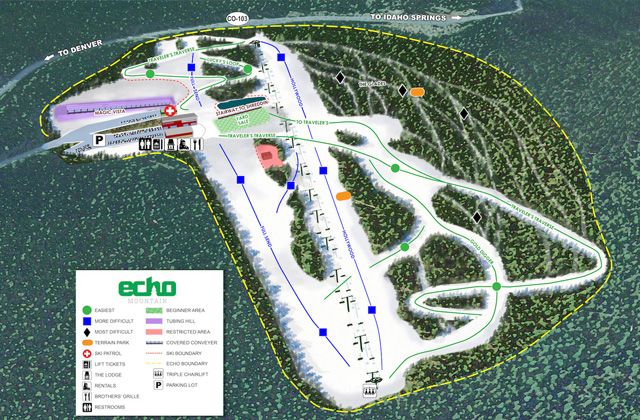
Want to take your kid skiing for the first time? Don’t waste the money on a trip to Breckenridge, take them to a local ski area like Echo Mountain instead. Image: Echo Mountain
Next up this week is an article that was published on March 1st, 2024. We know, we know - that puts this article way out of our typical 7 day scope, but here’s the thing: it’s August 2nd. The world isn’t exactly brimming with ski news, and so rather than share stories about how Eileen Gu is running a marathon in Paris or how Aspen is making expected progress on a new chairlift, we thought it would be more fun to share an article that we overlooked this winter, and one that could stimulate an interesting discussion. That piece is called, “Is Skiing Too Expensive, Or Are You Just Bad at Shopping?”, and it does a pretty excellent job of debunking the myth that skiing is simply too expensive for anyone to try for the first time. Let’s dive in.
In recent years, as Epic and Ikon resorts have used expensive lift tickets to sell more affordable season passes, there’s been a growing narrative that the cost of skiing is discouraging potential new participants from trying it. While there’s certainly some validity to that sentiment, as acknowledged by Alterra CEO Jared Smith back in June, we’re going to set that perspective aside this week as we explore the counterargument, by way of Stuart Winchester’s piece on StormSkiing.com. In that article, as the title suggests, Winchester argues that skiing isn’t expensive. At all, really. Instead, consumers are just bad at shopping for the best prices and opportunities. About midway through his piece, Winchester draws a comparison to car shopping. In his analogy, he suggests that someone who shows up to the ticket window at Breckenridge and balks at the cost of a lift ticket and/or rentals is equivalent to someone going to a Mercedes dealership and balking at the price of the car, asking themselves, “how can people afford cars?”, while completely ignoring all of the more affordable automobile options. To be fair, it’s a good point. The argument that skiing has become too expensive is often based on “worst possible pricing,” in the sense that it’s a scenario in which someone goes to the most expensive resorts there are, and chooses the most expensive options.
To counter this perspective, Winchester breaks down eight different examples where access to the mountains in popular regions like Denver and Tahoe can be had for much, much cheaper than the popular narrative would suggest. While he touches on a variety of examples, the most powerful one is arguably his counterpoint to a scenario presented in a Slate article from back in December 2023. In that article, the author draws up a scenario in which a Denver based Dad wants to take his kid skiing at Breckenridge for the first time. According to the Slate author’s math, that day of skiing - the kid’s first time on skis mind you - would cost about $800. To Winchester, this isn’t a reflection of skiing being too expensive, but of this hypothetical Dad’s abysmal financial decision making skills. Rather than take a kid skiing for the first time at the Mercedes dealership of ski resorts, Winchester presents a clean alternative: take them to Echo Mountain. There, night tickets run $35 for an adult, and $20 for a kid. Rentals are $45 and $35 respectively. For lessons, he points out that Echo has a unique offering in that they employ Mountain Ambassadors to hang out in the beginner zones and give out tips for free. Instead of introducing his kid to skiing for the very first time by spending $800 and driving to Breckenridge, Winchester suggests a $135 alternative.
Ultimately that’s what we loved about this piece. Instead of simply countering by saying, “ok, then don’t go to Breckenridge,” it reframes the argument as a consumer based financial education problem. Regardless of where you live in North America, it’s all but guaranteed that there are local ski areas that are far more affordable than the mega resorts, meaning that anywhere you can ski expensively, you can also ski affordably. Again, while we do think there is merit to the concept that skiing is becoming too expensive to entice new participants, we also have to acknowledge Winchester’s perspective that in addition to that perception, there’s also a consumer education problem. From here we’ll turn you over to his piece on StormSkiing.com, although we must warn you - it gets a little rowdy at times and Winchester’s not afraid to drop some powerful four letter words.
#4: Propagation Labs’s New Smart Snow Probe Hopes to Make Snow Pits a Thing of the Past:
More of a visual learner? Check out this demo video from Propagation Labs, highlighting their Snow Scope Probe and app.
Finally, rounding out this week, we caught wind of a new product that really caught our attention: the Snow Scope Probe from Propagation Labs. Coming to us by way of an article on Powder.com, we were excited to learn about this new avalanche mitigation tool that looks to bring classic avalanche risk assessment techniques into the modern era. Put simply, the Snow Scope Probe is a smart probe that’s capable of quickly translating snowpack density and layers into realtime, computerized, objective data. In the article from Powder, the benefits of the Snow Scope Probe are made obvious when paired against the traditional method of snow pit digging. Utilizing that method, even the most seasoned pit-diggers would spend multiple minutes digging a pit before subjectively analyzing the layers, using terms like “weak” or “dense” to describe their findings. The Snow Scope Probe looks to replace that method via the use of a common probe design that’s outfitted with sensors. Using this tool, skiers can simply stick the probe into the snow and the sensors will gather data as it moves through the snowpack. From there, the raw data is sent to an app on your phone where you can analyze it further.
Building on the tool’s ease and speed of use, the team behind Propagation Labs hopes that the Snow Scope Probe will produce prolific amounts of data in an effort to keep users safe. Noting that snowpack can vary widely within a short amount of distance due to factors such as wind, sunlight, and slope direction, it’s easy to imagine risky scenarios in which backcountry skiers rely on the data from their previous snow pit rather than spending the time to dig a new one. With the Snow Scope Probe though, the process of checking the snowpack can happen in a matter of seconds while expending almost no energy. As a result, the hope is that users will be able to check snowpack dozens of times throughout the day rather than just the handful of times they might if they were relying on pit tests. Here’s the real kicker though: every time a user checks the snowpack with their Snow Scope Probe, the data is uploaded to the cloud and other users of the app are able to view the data from the test. In other words, those exploring popular backcountry zones won’t have to rely on a handful of pit tests to determine their safety. Instead, they could have access to countless readings from the area, both from that very day, as well as historically.
At the moment, Propagation Labs is primarily targeting avalanche forecasters, ski patrollers, and guide services as initial customers as they look to continue development of their product. Presently, the price of the tool reflects that as it’s available on their website for $1,500. You can, however, download their app and view reports for free. While the technology and the brand are still young, we’re excited by the concept of bringing classic avalanche mitigation techniques into the future through the development of smart tools like this probe. To learn more about the team behind Propagation Labs, check out the writeup over on Powder.com or visit their official website.