

Top Five Fridays: June 21, 2024
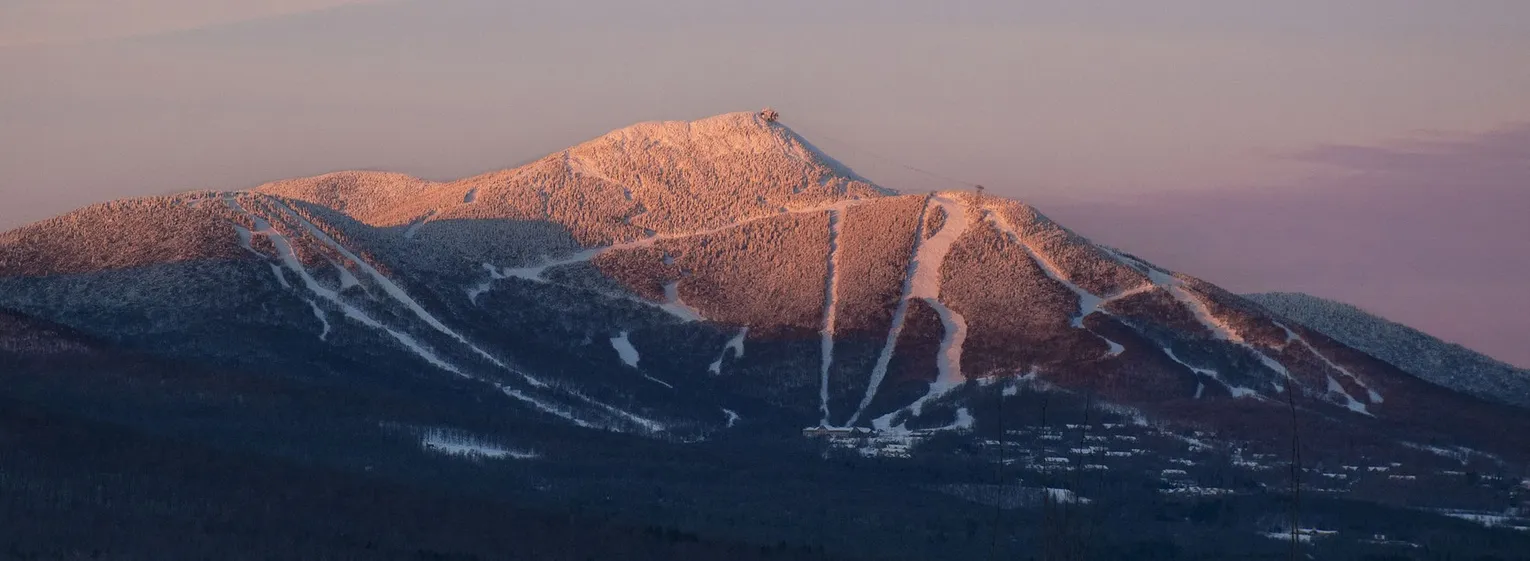
Lead Image: Looking out at Jay Peak’s iconic peak. There, the General Manager has announced a price freeze and reduction across the resort’s offerings as a means of easing the pains of inflation amongst its guests. Image: Jay Peak on Facebook
#1: One Week After the Big X Games League Announcement, Shaun White Introduces a League of His Own, With “Snow League”:
With all the league talk over the past couple of weeks, there’s a ton to unpack, and plenty of opinions going around. This week, Snowboard Magazine shared an hour long conversation with Todd Richards that dives headfirst into the Snow League, XGL, and future of the sports. Two quick disclaimers here: we haven’t had a chance to watch this all the way through, and there’s sure to be some adult language mixed in.
Hello, and welcome to Top Five Fridays, the June 21, 2024 edition! This week, the ski news gods bring us a quadruple header of business related topics, as each of our highlights delve into the money making side of the industry. If you’re someone who loves business strategy or the world of finance, this one’s for you. If you’re not, well, stick around anyways - you might just learn something! With expectations set, let’s jump right in.
The most attention grabbing headline we caught this week is without a doubt the news that Shaun White has announced a league of his own, the “Snow League.” This new league, which is set to debut in March 2025, will initially be a five stop league comprised specifically of snowboarding halfpipe events. After a few initial stops, the league will move on to add freeskiing sometime before the conclusion of its inaugural season. Looking ahead, White has voiced his intention to eventually grow the Snow League beyond halfpipe, into a multi-disciplinary league, with up to 15 events per year. As for the actual format of the league, the plan is to invite the top 20 men and 16 women to compete at each stop. For qualifiers, they’ll be broken up into 4 heats, with the top two riders from each heat advancing. Then, the 8 athletes in finals will compete head to head in a bracket format until there’s just one athlete remaining. For those that perform well at Snow League events, there’s a substantial cash purse to be had. That, as it turns out, is the motivating factor behind the creation of the Snow League: the opportunity for winter action sports athletes to earn significant money for their abilities.
What makes this announcement so interesting to us isn’t necessarily the league itself, but the way it combines with last week’s news that the X Games plans to transform into the X Games League (XGL). In case you missed that announcement, the long and short of it is that just last week, the X Games announced that they will also be launching a league in 2026 that they hope will create significant revenue opportunities for action sport athletes. Besides that shared core value though, the X Games League and the Snow League are taking very different approaches to solving the issue. Whereas the Snow League will initially be exclusive to snowboarding halfpipe events before expanding into freeskiing halfpipe, and will invite athletes based on rankings from the World Snowboard Points List, the XGL is taking a much more imaginative approach by introducing the concept of teams and drafts to the world of action sports. The XGL is also far more expansive right off the bat, with numerous disciplines spanning both winter and summer sports.
Ultimately, what the addition of the Snow League creates, is a third “league” option for winter sport athletes, immediate competition for the XGL, and another opportunity for athletes to find a path towards financial opportunity. Suddenly, in the span of just two weeks, halfpipe athletes in particular find themselves with three options rather than just one if they want to compete. Now, they’re faced with the decision of whether they should participate in the XGL, the Snow League, or the FIS, where they can earn points for the Olympics. Of course with the number of uncertainties regarding each of the two new leagues, it’s currently unknown whether or not athletes will be able to compete in more than one of these leagues simultaneously, or if there will be either contractual or scheduling conflicts that restrict them to just one of the options. It also creates countless questions, such as whether or not either of the two new leagues will work alongside the FIS to enable athletes to earn points, as well as just how lucrative these new leagues might be for athletes, whether or not athletes will suddenly find themselves needing agents in the same way that other professional athletes do, or any other number of yet to be revealed considerations. For us in the ski news world though, it’s an exciting announcement as there will surely be all kinds of drama and developments to unpack in the months and years ahead. For now, learn what there is to know about the Snow League by checking out this article from Outside Online or Teton Gravity Research.
#2: Are We Seeing the Early Signs of Late Stage Ski Resort Consolidation-ism? Exhibit A: Vail’s Ticket Sales & Stock Prices Are Down:
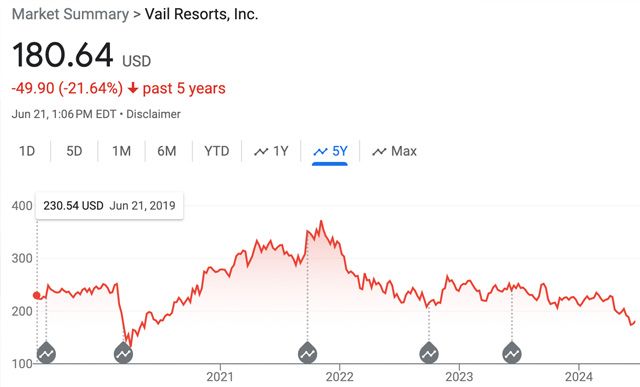
A look at Vail’s stock prices over the course of the past 5 years. Honestly? It could be a great time to buy (although just to be clear, we are not at all investment experts and don’t claim to be). Vail's Stock Price Tracker via Google
Next up this week is the first of two headlines that play into a theme we’ve found ourselves discussing a bit this Spring: the cost of lift tickets. As you’ll recall, we shared headlines coming to us by way of Alterra back in late April, when CEO Jared Smith gave some fascinating insights into the delicate balance between the price of daily lift tickets vs. season passes, as well as the risk of deterring new skiers and snowboarders from trying the sport due to exorbitant prices. This week, we caught news that ties into that topic by way of Vail Resorts, who’s experiencing some financial concerns as a result of a down season.
Before we dive into a dissection of the news, let’s start with the headline: Vail’s revenue is on track to fall short of predictions for a third time this year, resulting in a significant decrease in stock value. Now, as straightforward as that statement is, there’s a ton to unpack here as far as the causes behind the news, as well as Vail’s current financial standing. First things first, let’s just clarify one thing: financially speaking, Vail is doing just fine. While they’re underperforming projections for a third time this year, it’s important to note what those numbers specifically are. In December, Vail CEO Kristin Lynch told investors that they could expect between $912m - $948m in net revenue this fiscal year. That number was reduced a third time last Thursday, with Lynch now telling investors that $825m - $843m is a more realistic expectation. Now, there’s two ways to digest that reduction. The first is through percentages, which show that current projections are about 10% lower than initial expectations. In other words, Vail is underperforming by a pretty significant amount. The second viewpoint though, is that Vail is still earning $825 million or more this year. Regardless of who you are or what business you’re in, making that kind of money in a year is pretty darn good.
Despite the significant earnings though, there are some troubling trends for Vail. Being a publicly traded company, Vail’s primary obligation is to keep its stockholders happy. At the moment, they are not happy, as evidenced by the fact that Vail’s stock tumbled down to just $165 a share immediately following the news, marking a four year low. For reference, Vail’s stock hit $222 a share just six months ago, in mid January. Circling back to percentages, that marks an approximate 25% drop in the span of just 6 months. Regardless of who you are or what business you’re in, that’s pretty darn bad. Making matters worse for Vail, it was also announced that season pass sales for the 2024-2025 season are down approximately 5% as compared to this time last year, although revenue is up 1% thanks to an 8% increase in pricing. If that previous sentence was even a little bit confusing to you, congratulations, you now understand the complexities of ticket pricing.
Making things even more complex, is the fact that Lynch is citing a decrease in lift ticket sales as the primary reason for a decrease in season pass sales for next season. In her words, “The single biggest impact on our spring pass sales is new pass holders and that is driven by lift ticket guests… And the size of that audience is down significantly, which is impacting, then, our ability to convert them into new pass holders.” While you might assume that strategy is based on the idea that if a guest visits a Vail resort, they’ll love it so much that they’ll buy a season pass, it’s actually a bit more manipulative than that. Instead, the strategy is that guests who visit in the Spring will see the high cost of a daily lift ticket, as well as the option to buy an entire season pass for the remainder of the season and the next season for what seems like a reasonable amount more. In other words, the theory here is that a guest would rather spend something like $900 on a season pass vs. $200 on a day ticket. There is, of course, one problem here that circles back to thoughts shared by Jared Smith back in April, and one which we’ll be revisiting in the next highlight: if would-be skiers and snowboarders are aware of how much a lift ticket is, they’ll be dissuaded from making it to the ticket window in the first place.
Ultimately, that’s the story behind the story here. At the moment, Vail Resorts is still the Goliath of the industry - having pioneered consolidation and the multi-pass model, while still netting nearly $1 billion in annual revenue. But, due to a cocktail of factors and an incredibly complex pricing structure, there are some pretty significant cracks in the foundation that are starting to show. The question now is, will Vail be able to fix them while appeasing stock holders? Or is this story about to delve into an entirely new chapter? One way or another, we’ll be here to keep you updated. For now, check out the report from the Sierra Sun.
#3: Exhibit B: Jay Peak Announces Plans for Rate Freezes & Reductions:

Jay Peak's recent price freeze and reductions announcement wasn't just limited to lift tickets - it was a resort wide announcement covering everything from lodging, movie theater tickets, and rounds of golf. Image: Jay Peak on Facebook
If that last highlight left you feeling flummoxed and frustrated, don’t worry, we’ve got some good news coming out of Jay Peak, who gave us what felt like a much needed breath of fresh air. While the general trend across the industry are price increases that reflect inflation, Jay Peak has announced resort wide price freezes or reductions for the 2024-2025 season. We’ll get into some specifics in just a second, but before we do, we want to share the mindset behind the announcement as we think it’s an excellent counter to our previous article. In a press release from the resort, they shared that the decision was, “a direct response to the inflationary environment across the US economy over the past several years, which has affected guests and the resort alike, as everyone tries to navigate a challenging economy while still engaging with the sports and brands they love.” In other words, Jay Peak is making the decision to focus less on their profit margins and bottom lines and more on their relationship with its customer base, realizing that its guests are living through challenging economic times. For Jay Peak, it’s important that skiing remains a reprieve from these challenges, and not yet another stressor.
Diving a little bit deeper into this story, we were interested to learn about the specific actions being taken by Jay Peak to turn this proclamation into a reality. In an article from Ski Area Management, Jay Peak’s General Manager Steve Wright explained that, “we simply reviewed each product, compared it against the costs within our comp set, looked at when they last received increases, and asked ourselves if we could live with slightly worse margins; in just about every instance, we said yes.” As a result of that extensive process, countless offerings have either been price locked or reduced. For example, some lodging packages will see a 25% reduction in cost. The cost for a ticket at the resort’s movie theater was cut in half to just $5. Rounds of golf have decreased by $10. Pizza from the cafeteria is now $1 cheaper. Most importantly, on the ski side of life, the resort’s Mission Affordable 4-Pack of lift tickets has been decreased by $10, while lift tickets themselves will either be price locked or reduced ahead of next season.
At the end of the day, saving $1 on a slice of pizza may not seem like a huge deal, but when you contrast this highlight with our previous one, it’s easy to see a world of difference in the approaches between Vail and Jay Peak. To be clear, we’re in no way intending to disparage Vail in our report this week, and we continue to believe that there’s great value in the Epic Pass, which provides an immense amount of access for its price. Rather, we bring up both of these issues, as well as our previous coverage from Alterra, to help tell the story of what’s happening at the resort level of the ski industry as the U.S. economy navigates a period of inflation. For businesses like Vail who’ve gone public, incredibly complex financial factors exist as they attempt to appease stockholders while also asking guests to pay more at a time during which they’re experiencing financial stress. For Jay Peak, who belongs to a much smaller parent company called Pacific Group Resorts that focuses on independent stewardship of their mountains, it presents an opportunity to build trust with its guests as they’re able to cap or reduce the price of its services so as to preserve skiing as something of a getaway for those experiencing the pressures of life. All told, it’s a particularly complex time to own a ski resort. For more on the latest from Jay Peak, check out the report from Ski Area Management.
#4: The Ski Resort Consolidation Ripple Effect: Delta Bets on Ski Tourism By Announcing More Ski Destinations:

Seeing opportunity in domestic ski tourism, Delta Airlines has announced a 10% increase in flights to ski-destinations ahead of next winter. Image: Delta Airlines on Facebook
Finally, we’re rounding things out this week with a fourth story from the world of ski business, although one that’s out of our normal scope of coverage. Here’s the headline: Delta Airlines has announced plans to expand flights to ski destinations next winter. Specific details of this announcement are wide ranging, with Los Angeles’s LAX seeing the largest increase of flights. There, Delta is increasing ski-destination flight capacity by 25%, adding daily flights to Vail and Bozeman, as well as Saturday flights to Sun Valley. In Minneapolis and Atlanta, Delta is continuing to offer pre-existing flights to destinations like Jackson Hole, Steamboat Springs, Vail, Aspen, and Telluride. Additionally, the airline will be adding Bozeman flights to its Atlanta hub. Ultimately, the announcement reflects an increase of 10% in ski-destination based flights for the airlines.
Alright, so an airline is offering flights to ski destinations, what’s the big deal? Well, to be honest this news has simply opened our eyes to a crucial part of the ski industry that we’d never given much thought to: the role of airlines. We talk a lot about how an important metric for the industry is the number of new participants, and how current pricing can often deter potential first time skiers, but we don’t often consider the importance of travel logistics - how skiers even get to the mountains in the first place. That’s what makes this news interesting to us: it highlights the importance of airlines in the ski industry, while also giving us another piece of the puzzle to keep an eye on. Think of it like this: in order for the ski industry to be thriving, it needs to be able to pull in guests from well beyond the mountain towns it exists in. To do that, it needs to pique the interest of airlines who recognize the value of ski destinations, thereby committing the resources to offering flights there. At the moment, Delta sees the value of the ski industry and has committed to increasing flight availability, therefore making it easier for guests to travel to these destinations. On the flip side though, should dynamics such as ticket pricing begin to deter guests, it could lead to less flights being booked, and therefore less flights being offered. That’s the dynamic that interests us here: the codependent relationship between lift ticket prices and flight schedules, and how it could be an undervalued factor in the health of the ski industry. For us, that’s the takeaway here: in an incredibly complex industry filled with cause and effect relationships, we now have yet another factor to keep our eye on. To learn more about the latest news from Delta, check out the announcement via their official website.