

Top Five Fridays: August 21, 2026
Just a friendly reminder that our 2027 Ski Test is now live! Click here to check it out.
Hello, and welcome to Top Five Fridays, the August 21, 2026 edition! This week, we’ve got another classic grab bag as each topic is quite different from the next. To kick things off, we’ll share what we know about the upcoming Super El Niño season, which comes with a healthy mix of certainty and uncertainty. From there, we’ll share a story from the Colorado Sun that should give you some optimism about the future of mountain towns, before moving onto new information regarding the four Winter X Games League teams, and ultimately rounding things out with a ski adventure through Uganda. Finally, as always, we’ll send you into the weekend with a few of the best ski edits that we saw this week. Without further ado, here’s this week’s news!
#1: It’s Time to Discuss the Elephant in the Room: Super El Niño:
While this video comes to us from July 8th, no one breaks down the weather quite like Chris Tomer. To get an idea of how all of this works, as well as some historical context, give this one a watch.
Getting things underway this week, we’re starting with a topic that at this point is absolutely demanding some acknowledgement from us. All summer long, we’ve been seeing headlines popping up regarding the potential for a “Super El Niño” event this coming winter. If you’re someone who’s been following TFF for multiple years now, you probably already know that winter forecasts are one of our most reluctant topics. Afterall, while early forecasts can typically give us some indication of what to expect, weather patterns are ultimately the result of the nuanced interactions between numerous variables. For that reason, weather is notoriously hard to predict, which is also why your local news typically only extends its forecast to about 7 days. Anything beyond that is a bit too blurry to predict with any certainty. With that in mind, we always take these long range predictions with a grain of salt, and never let them interfere with our hopes and dreams for the winter ahead. That said, this year feels at least a little bit different as the likelihood of a Super El Niño seemingly increases by the week.
Before diving into some of the weather forecasts for this winter, let’s start with a really quick refresher on what El Niño means, and how it differs from both La Niña and neutral weather patterns. In short, these three weather events simply tell us where we can expect the jet stream to flow over North America, based on the water temperature in the Pacific Ocean. If you want to learn more details about how that all works, check out this writeup from NOAA. For our purposes today though, just know that during La Niña years, the jetstream enters North America from the north, coming in from Alaska and British Columbia before swooping down across the Pacific Northwest. In El Niño years, the jetstream enters much further south, cutting through Southern California, Mexico, and Texas. In neutral years, the jetstream enters somewhere in the middle.
This summer, weather outlets have been keeping an eye on the potential for a “Super El Niño” event. Essentially, what this means is that the waters in the Pacific have been well above their average temperature for multiple months now. Specifically, El Niño is declared when the surface waters of the Pacific remain 0.5°C above average for “five consecutive overlapping three-month periods”. Our brains hurt trying to decipher what that amount of time actually means, but fortunately other news outlets have already done the math for us: as it stands, our average temperature reading as of August 12th was +2.7°C. According to figures provided by Columbia Climate School, temperatures between 1.5 - 2.0°C are indicators of a “strong” El Niño”, while 2.0°C+ is “very strong.” With .5°C celsius ranges between ratings, +2.7°C puts us quite literally off the charts and potentially into unprecedented territory.
All of this is to say, one thing is all but guaranteed: we’re in for an El Niño winter. The interesting part though, is that despite the certainty, there’s still plenty of uncertainty as to what that specifically means for some regions. With that in mind, let’s take a look at some forecasts.
According to NOAA, the most likely benefactors of this weather pattern are the Rocky Mountain and Wasatch Mountain ranges of Colorado and Utah. For those areas, NOAA - who is overall the most conservative to provide prediction - gives equal chances of above and below precipitation, as well as temperature. In other words, the NOAA forecast indicates that these regions will return to their normal, gloriously snowy conditions. For just about every other skiable region, from the Pacific Northwest, to the Upper Rockies, the Midwest, and the Northeast, there is some unfavorable mix of either cold weather and less precipitation, or warmer weather and more precipitation. Out of all of the forecasts we’ve looked at, NOAA has the most widespread warmth and least precipitation predicted.
Outside of NOAA, things get pretty interesting as other forecasters offer an array of predictions. By and large, the one common theme is that Utah and Colorado are in the crosshairs of a big season, with the Sierras joining them in many forecasts. Likewise, the Pacific Northwest is largely considered to be at risk of an underwhelming season, with most predictions suggesting below average snowfall due to a combination of above average temps and below average precipitation. Here in the Northeast, we’re once again the least predictable region as we’re the furthest away from the origin of the jetstreams. Ultimately for us, what it really comes down to is how far south the polar winds drop this winter. Should the polar jetstream make it to us, we have a shot at our above average precipitation meshing with cold arctic air and becoming snow. On the flip side, if the jetstream keeps the polar air North, then precipitation will come down as rain, sleet, or ice.
Ultimately what makes this year’s long range forecast so interesting to us is that despite being one of the most informed, strongest El Niño signals we’ve quite literally ever had, we still don’t exactly know how the winter will play out in most regions. If you’re in Utah and Colorado, chances are you’re in great shape. For the rest of us though, it seems to be the same coin-flip odds we have most years. With that in mind, we’ll defer our East Coast friends to the Direct Weather winter forecast on YouTube for a favorable forecast, while our West Coast friends should check out the On The Snow Forecast for an optimistic outlook.
#2: Colorado Mountain Towns See Slight Decrease in Sales Tax Revenue From the Low Snow Year, But Resiliency is the Real Story:
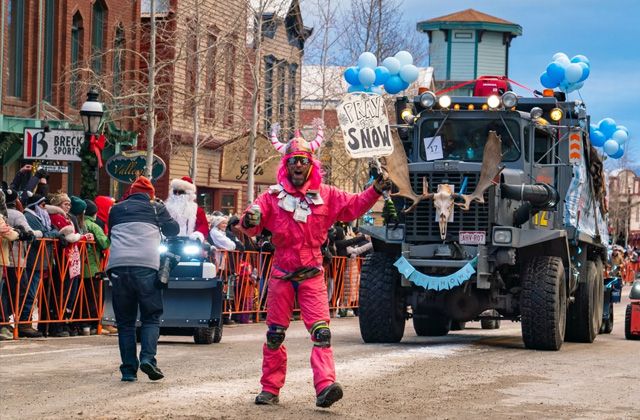
Despite a 24% decrease in skier visits across Colorado last winter, cumulative sales tax revenue is down just 4% across 18 mountain towns, signaling a strong economy that extends beyond the ski resorts. Image: GoBreck on Facebook
On a somewhat similar note, our second story this week is also on the subject of snowfall, although this one’s not about what’s to come, but about the results of what’s already happened. As you absolutely know by now, last year featured historically low snowfall, particularly in Colorado. As such, ski tourism plummeted. While these are facts that you are already well aware of, the Colorado Sun published an article this week that examines the ripple effect that that’s had on municipal budgets in mountain towns. What’s intriguing to us about this story isn’t the expected result of a downturn in tourism, but the unexpected upside of the story. Let’s dive in.
First things first, let’s address the obvious: as a result of last year’s low-snow fueled decrease in tourism, municipal budgets in mountain towns across Colorado are down. In fact, it’s the second straight year in which sales tax revenue across 18 Colorado mountain communities has decreased. Looking back, the high-mark of tax revenue came after the 2023-2024 season, in which the Colorado Sun says the 18 communities generated $5.1 billion between November and April. A year later, that figure dropped slightly to $5 billion. This past winter, it dropped again to $4.8 billion - a roughly 4% decrease.
But here’s the thing: skier visits in Colorado were down 24% last season. Had sales tax revenue followed that trend, these 18 communities would be looking at just $3.8 billion in revenue - a figure that would represent a devastating hit. That didn’t happen though. Instead, while municipalities are still tightening their belts as a result of the decrease, an all out catastrophe has been completely avoided. The reasons for that are where this story inspires some hope.
There are two primary drivers of this resiliency: an increase in full time remote workers living in these areas, and a diversification of the local economies to be more than just ski communities.
The first factor is one that can often be somewhat contentious, as the pandemic fueled population increases in mountain towns resulted in a dramatic increase in housing prices. This of course, makes it harder for locals to find a decent place to live, whether that’s through ownership or renting. While that’s indisputably a negative impact of this migration, this week’s news puts a win in the “positive” column as well, as these mountain town migrants are clearly showing their economic impact by way of helping to stabilize the economy during a downyear.
The second factor at play, and one that we admittedly wish the article explored further, is a diversification of their economies. Keeping in mind that the numbers we’re working with here are specific to the winter months, we take this claim to mean that mountain towns and resorts are finding more ways to attract and entertain locals and tourists alike, through things like indoor climbing facilities, ice skating rinks, retail experiences, and more.
Taken in totality, what this article tells us is that at a time when each winter is seemingly less certain than the last, mountain towns are already finding ways to diversify their economies, giving us hope that even if the ski season should shorten someday, the glorious mountain towns that we know and love will find a way to carry on. For more on this, check out the report from the Colorado Sun.
#3: With the Inaugural Winter XGL Draft Just Over 3 Weeks Away, the Teams & Managers Have Been Announced:

Here you have it: the four inaugural Winter XGL teams and their General Managers. Image derived from the X Games Website.
Alright, after a couple of dense topics, let’s relax with some more fun-oriented, light hearted news. As you know, we’re on the precipice of a new era of the X Games: the X Games League (XGL). First announced back in June 2024, the last couple of years have been full of intrigue, with new information slowly becoming available every few months. Now, with the first ever XGL Winter Draft slated for September 16th, we finally have one of the last pieces of missing information: the four teams that will make up the inaugural season.
Late last week, the X Games finally announced not only who the first four Winter X Games teams will be, but also their managers. While we speculated, and even assumed, that these teams would be global, we’ve come to learn that they are in fact all North American based. In alphabetical order, the teams are: Golden State, New York, Park City, and Whistler. Let’s take a closer look at each one.
Starting with Golden State, this team is meant to represent Northern California, regionally including Lake Tahoe and the Bay Area. Helming the team is none other than Johnny Moseley, whose legendary “Dinner Roll” at the 1998 Winter Olympics brought the concept of new school skiing to mainstream audiences. While his career may have been made in the world of moguls, Moseley is without a doubt one of the founding fathers of freeskiing, making this team immediately one to watch.
Next up is New York, which is the only team to compete in both the Winter and Summer games. For the winter side of things, the team is managed by Dave Sypniewski whose career has been built by strengthening ties between snowboard athletes, fans, and brands by working with companies like Thrasher, Boost Mobile, and Burton to create partnerships and events. In other words, if Moseley’s strength is athletic prowess and experience, Sypniewki’s strength is a wealth of experience in the world of action sports business.
Moving along, we get into a couple of winter-centric locations, starting with Park City. There, Sharalee “Haze” Hazen is taking on the role of GM, making her the only GM with XGL experience after helming Los Angeles for the first iteration of the Summer games. Hazen’s background is deeply rooted in athlete advocacy, having launched multiple initiatives in an effort to create new opportunities for upcoming athletes.
Finally, the fourth team is Whistler, which may have the most grassroots GM of them all. There, snowboarder Ryan Stutt will lead the team, bringing with him an exceptionally strong bond with athletes themselves. In Whistler, Stutt is known as the founder of ski blog “Forecast Ski”, snowboard blog “King Snow”, and the director of award winning documentary “Our Kind of Chaos”, which chronicles the history of snowboarding in Whistler. In other words, Stutt’s strength as a manager is having his finger directly on the pulse of the industry.
All in all, it’s at the very least an intriguing time to be a winter action sports fan, as the grand experiment that is the XGL is set to get under way in just over 3 weeks with the first official draft happening on 9/16. Being a Wednesday, we likely won’t cover that the week before, but you can either watch it live or check back here for a recap on the 18th! For now, learn more about this week’s news straight from the X Games.
#4: Skiing Uganda’s High Mountain Glaciers May Be One of the Rarest Ski Experiences on Earth, But Time is Ticking:
While the Ski Mag article has an excellent video attached, it also has embeds disabled. That being the case, check out this video to get a read on the region.
Finally, rounding out this week’s news is a fascinating story for those of you who are interested in tales of adventure, travel, and/or ski mountaineering. Coming to us by way of Ski Mag, we learned this week that there is, in fact, skiing in Uganda.
Despite being located just about directly on the equator, the high peaks of the Rwenzori Mountains are home to a handful of glaciers. Given its equatorial climate, the valleys and ravines of the mountain range consist of dense jungle, remote villages, and occasional farmland. That geography sets up quite the juxtaposition between the rugged, snowcapped highpeaks, the tallest of which tops out at 16,762 ft. All of this, of course, makes the terrain ripe for ski exploration.
In the piece from Ski Mag, we’re treated to not only a story about the way of life in this unlikely ski destination, but also the uniqueness of the land, some of the challenges that locals face, and of course, the experience of summiting and skiing these remote glaciers. Over the course of the tale, we learn about Ski Club Uganda, who organizes the guided trips to the glacier, and meet characters like Edison Kule, who is an indigenous Ugandan and one of the first locals to ski the high peaks. We also, unfortunately learn one piece of terminal information: it’s expected that the glaciers high up in the Rwenzori Mountains will be fully melted out by 2030.
All told, we simply found this story to be an excellent read as it contains far more storylines than those we’ve shared here. If you’re looking for a unique tale of adventure skiing in an unexpected place, head over to SkiMag.com to give it a read.