


Top Five Fridays: August 25, 2023
Lead Image: Is winter here yet? Not quite, but it’s getting close! In fact, Peak 6 at Breckenridge, Colorado received a dusting of frozen precipitation earlier this week. More on that below! Image: Breckenridge Ski Resort on Facebook
#1: Breaking News: Deer Valley Announces Massive Expansion, Taking Over the Terrain for the Formerly Proposed Mayflower Ski Resort:
A chart showing the expected reduction in ski season for each resort in North America by 2050. It should come as no surprise that elevation plays a significant role here. To see the ful size version, Alterra's Official Press Release.
Hello, and welcome to Top Five Fridays, the August 25, 2023 edition! If you’re tapped into the world of skiing on social media in any way at all, then you probably already know what our first story is this week: Deer Valley has just announced plans for a massive, massive expansion. Now if you’re a regular reader of Top Five Fridays, then you’re a step ahead of your peers, because it means you already know that this story isn’t as simple as the headline reads. Let’s dive in
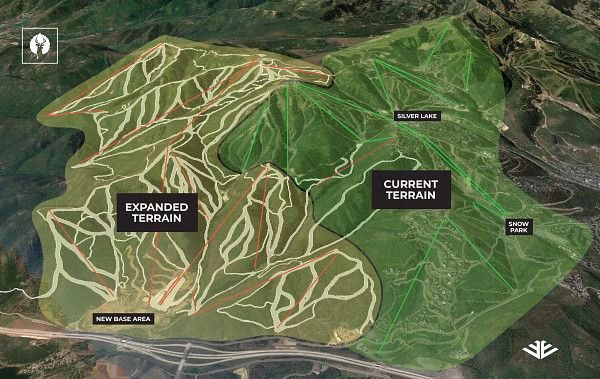
If you were with us last week, then you caught the news that Mayflower ski resort developer, Gary Barnett, donated approximately half of the resort’s acreage to Utah Open Lands. In doing so, it was put into conservation, preventing it from ever being developed despite being previously cleared for up to 700 residential units. It was a wildly philanthropic gesture, and one that undoubtedly cost Barnett millions of dollars. Then, this week, huge news broke by way of the back door, as Alterra announced that Deer Valley will be adding 3,700 acres to its resort over the course of the next three years, bringing its current footprint of 2,025 acres to 5,726. In other words, this isn’t just a small increase in size- it’s huge. With this expansion, the new Deer Valley will be over 2.8x its current size. In addition to the land expansion, the resort will be adding 16 new lifts, as well as a 10 passenger gondola. All of this is expected to be developed over the course of the next three years, “with a significant portion of the new lifts and trails set to open as early as the 25/26 winter season.”
While the news of Deer Valley’s sudden, massive expansion has been the dominating headline this week, as followers of the Mayflower story, we’re finding ourselves asking, “what just happened?” Going back in time a bit, it was just at the end of March when we reported that talks between Mayflower and Deer Valley were continuing to go well, and that some form of operating agreement between the two seemed likely. At that time, we even mentioned the idea of Deer Valley running the ski operation, although we still assumed the resorts would remain separate entities. Then, last week, Barnett put half of the resort’s property under conservation to prevent development. A week later, this news has broken, where we now know that the terrain that was once being considered Mayflower Resort will now officially become part of Deer Valley. As part of this new agreement, Extell (the developers of Mayflower Resort) will continue to develop and operate the base area that serves the new Deer Valley terrain. Ultimately, this feels like the right fit for both parties as Deer Valley will become a massive ski resort with two access points, enabling them to compete with neighboring Park City. For Extell’s part, they’ll be able to focus on the business model that they have more experience with, while also benefiting from a consistent customer base, provided by Deer Valley’s operations.
Still, our inquisitive nature can’t help but continue to wonder about what went on behind the scenes. Clearly Deer Valley knew of Barnett’s hopes to put the land under conservation, but was there more to that move than meets the eye? Maybe it was a savvy move by Barnett to look good for the media, already knowing his next move, and realizing that he would never develop the land anyways. Or how about the money (or lack thereof) that exchanged hands alongside this announcement? There hasn’t been a purchase price shared in any of these announcements, leading us to wonder if Extell simply gave the land to Deer Valley, recognizing that it was actually a better business decision to let the ski resort pay for the development in order to ensure a consistent flow of customers to their hotel and base area amenities. All told, there’s certainly more to this story than meets the eye, and we really hope there’s a publication out there that’s actively working to get to the bottom of it. If they are, we’ll be sure to share the story in full as soon as it comes out. Until then, check in with Alterra for the official announcement.
#2: The Associated Press Covers the Role of Ski Resorts in Promoting Climate Change:

A chart showing the expected reduction in ski season for each resort in North America by 2050. It should come as no surprise that elevation plays a significant role here. To see the ful size version, click here and scroll down.
In other ski news this week, we caught an excellent article from the Associated Press that takes a look at how ski resorts are leading the fight against climate change. Now, to be fair, this isn’t exactly news to any of us. As deeply embedded members of the ski community, efforts to combat climate change are constantly at the forefront of our minds. Still, we always enjoy when mainstream media picks up on a story that’s so important to us, particularly when they go above and beyond to tell it. Such was the case in this week’s piece from the Associated Press, where the myriad of ways that ski resorts are fighting climate change was shared with the wider public in an engaging, interactive article format.
In the writing itself, we’re first presented with the stories we’re familiar with: ski resorts converting to eco-friendly buildings and renewable energy, purchasing carbon offsets, providing electrical vehicle charging stations, etc. etc. As we scroll further though, we’re treated to a slightly new angle: the idea that ski resorts are also pushing for political change- both themselves and by working to educate and motivate their guests. One great example of this is at Aspen’s Limelight Hotel, where a kiosk in the lobby recently asked guests to write a quick note and sign a prepaid postcard, addressed to the area’s senator, asking for their support of a climate bill that had been in congress. Another example comes from across the country, in West Virginia, where Snowshoe Mountain CEO Patti Duncan penned a letter to her senator, Joe Manchin, who had been outspoken in his defense of the state’s coal industry. In her letter, Duncan pointed out that while the climate change bill might negatively impact the state’s coal industry, it would greatly benefit the state’s growing outdoor recreation industry. While it’s unknown how much of an impact Duncan’s letter had, Manchin ultimately voted in favor of the bill. These two anecdotes, as well as others shared in the article, underscore the political influence that the ski industry has, despite being an industry with a reasonably small environmental footprint.
What’s perhaps even more interesting about this article though, are the infographics that show the impact of climate change across the ski industry. In addition to showing which ski areas currently contribute the most to climate change, there are also a number of visuals that show which ski areas stand to lose the most. Of these graphics, the most eye opening one might be the visual in which every ski resort in the U.S. is placed on a chart, indicating how much shorter their ski season is likely to be by the year 2050 if we stay on the same climate change trajectory. As you can see, lower elevation ski resorts stand to lose the most. All in all, the article is a solid read, full of visuals that are worth looking at, even if you don’t have the attention span for all the words. You can check it out right here.
#3: Speaking of Ski Resorts Combating Climate Change, Copper Mountain is in the Midst of Year Two of an Interesting Experiment:
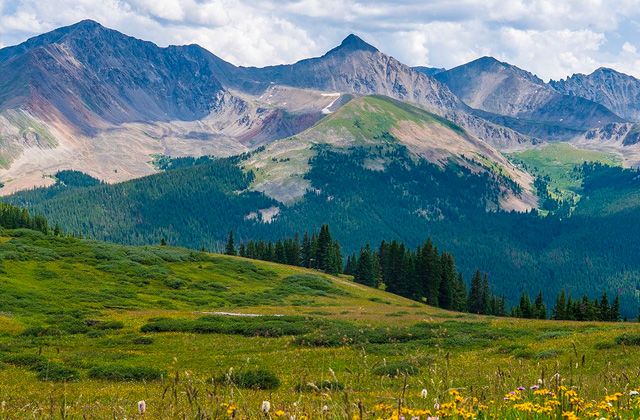
Looking out over Copper Mountain. Researchers are currently exploring the potential for planting vegetation that could hold onto carbon rather than letting it leak back into the atmosphere. Image: Copper Mountain on Facebook
Speaking of ski resorts fighting climate change, we came across another cool article this week that talks about some unique efforts being undertaken by Copper Mountain to combat climate change. Within the article from the Colorado Sun two stories are told. First, the resort recently hosted their second annual conservation summit, in which ski resort leaders gathered to tell stories of their own climate protection efforts. For example, representatives from Arapahoe Basin shared a presentation in which they detailed their efforts to preserve topsoil and replant vegetation while installing new lift towers. While it may seem like a small effort, the goal of this event is to share tricks and stories of what’s working at different resorts, in an effort to help all ski resorts become as environmentally friendly as possible. The second story told in this piece from the Colorado Sun was also the highlight of the event: Copper Mountain’s own efforts to increase natural carbon-storing efforts across the mountain.
In the second year of a ten year experiment, teams of researchers have been testing ways to add carbon-storing plants and grasses to the resort’s landscape. To accomplish this, they’ve been taking soil samples and planting specific forms of vegetation that are known to store more carbon. The goal, of course, is to intentionally replace simple grasses with more biodiverse, native plants and grasses that are more capable of storing carbon. In doing so, the hope is that ski resorts can utilize these eco-friendly techniques to capture carbon produced by the resort, retaining it naturally rather than allowing it to become part of the atmosphere. While the program is still quite young, being just the second year of a ten year project, the dream for project leader Jeff Grasser is that they’ll come up with a solution that can be rolled out at any ski resort. In his mind, the dream would be for all ski resorts to re-evaluate their landscapes, and opt to plant carbon-storing vegetation across the resort, rather than treating open land as a lawn, in which no consideration is given to the amount of carbon being retained. All told, it’s a cool story, and yet another example of how ski resorts are leading the way in the fight against climate change - not only politically, but by experimenting with innovative approaches as well. You can read the story in full, right here.
#4: If the Little Cottonwood Canyon Gondola is Going to Happen, Alta and Snowbird Are Going to Have to Help Pay For it:
Finally, rounding out this week’s news we want to take a second to discuss a trickle of an update coming out of the Little Cottonwood Canyon gondola saga. As you know, the project was officially recommended by the Utah Department of Transportation (UDOT) back in the middle of July. With that approval, the project was essentially given the greenlight to move forward, meaning the team behind the project can take the first steps towards putting the plan in motion. Specifically, that means phase one will kick off this year, in which the state has been approved to spend $150 million to implement more bussing up the canyon, toll booths, and parking restrictions. From there, phase two will involve widening Wasatch Boulevard, adding snowsheds to the canyon road, and increasing trailhead parking. Finally, phase 3 will be the actual building and development of the gondola itself. When all is said and done, the combined total of these projects is expected to be just over $1 billion, with skeptics expecting the project to balloon well beyond that. This of course has led to one of the biggest questions regarding the project: who is responsible for footing the bill?
We remind you of all of this background information to preface this week’s news: earlier this week Utah governor Spencer Cox, when discussing funding for the project during his monthly conference, said that, “I don’t think the state should do it alone… those conversations will be ongoing — How much private participation can we get in building the gondola.” In other words, in reading between the lines, it’s his expectation that private organizations who will benefit the most from the gondola project will have to contribute to the funding of it. While Alta and Snowbird are the two obvious beneficiaries, a number of other organizations would also benefit, as revealed by those who support the “Gondola Works” coalition. On the list are groups like Ski Utah, Utah Clean Cities, POWDR, and more. What will be interesting to see here, and what could mean the difference between whether or not this project happens, is how much of a financial contribution private organizations are willing to make. In addition to this comment by Spencer Cox, we also caught a second nugget in this week’s report from Deseret News that confirmed a concept we’d been pondering. In their report, Deseret shared the information that UDOT project manager Josh Van Jura had told them that, “it’s possible that the first two phases could be so successful that it will negate the need for a gondola.” This half sentence, buried towards the bottom of the report, is possibly the most sensible insight we’ve heard from UDOT since the project was approved. Afterall, why spend over a billion dollars if the first <$500 million solve the problem? To learn more about this week’s updates, check in with the Deseret News.