

Top Five Fridays: August 8, 2025
It's finally here: our 9th Annual Ski Test. We encourage you to read the Top Five Fridays this week, but if you can't wait and feel like you need to check out the ski test immediately, you can do so here.
#1: The 9th Annual SkiEssentials Ski Test is Officially LIVE!
It’s finally here: our 2026 Ski Test. If you can’t stand the excitement and need to head over there immediately, we understand. Here’s the link.
Hello, and welcome to Top Five Fridays, the August 8th, 2026 edition! This week is a HUGE week for us here, as today’s the day that we’re launching our 9th annual ski test! Of course we’ll still cover some other news this week, including an excellent story from The Athletic that gives a behind the scenes look at Mikaela’s injury and recovery last season, as well as an update from Central New York, where a shady businessman is being forced to sell a ski resort he shuttered. We’ll get to those stories and more in just a minute, but before we do, we have to share the latest news regarding our ski test - we’re far too excited about it not to.
This year, in its 9th year, our test is yet again back and better than ever. Building on last year’s redesign, this year we’ve really dialed things in with even more content per ski, more comprehensive tester feedback, and more accompanying media. In the years since we’ve started, our ski test has become one of the most reliable sources of information for anyone exploring a ski purchase. The reason is simple: this isn’t your typical ski test. Rather than sum up an entire ski with a singular grade, we ask our testers to share their thoughts on each ski in a variety of criteria. The result is that you’ll find honest truths about each ski from multiple testers. In some cases, that means a ski might receive glowing praise. In others, maybe the praise isn’t quite as glowing. Most interesting to us though, are the skis with polarizing personalities, where skiers of a certain ilk may love it and those of a different ilk may hate it. For us, split reviews like this only reinforce our belief that there really aren’t any bad skis, only skis that better meet the needs of certain people, depending on their skiing personality.
With that nuance in mind, we encourage you to not only browse our test by brands, categories, and specific skis, but also by tester. Across our roster of testers, we have nearly every type of skier - from former racers, to park skiers, to freeride enthusiasts, and even skiers who prefer to keep the speedometer somewhat conservative. As such, it’s very likely that you can find a tester or two that you relate to, at which point you can see a list of all the skis they tried. From there, click a ski, read its test results, and get an idea of how your counterpart felt about it. To us, it’s truly one of the best ways to get the feel of a ski without actually skiing it.
Of course, if you’re reading this, it’s likely not your first Ski Test rodeo. You know the drill. So with that in mind, we’ll simply say, “go check out the ski test.” Well, after you read the rest of the news of course. Then, once you’re done, clear the rest of your schedule and click this link!
#2: We Knew it Was Bad, but Now We Know Just How Insane Mikaela Shiffrin’s Recovery Was:

Shiffrin, having just won a gold medal in Slalom at the finals in Sun Valley, Idaho. Image: Mikaela Shiffrin on Facebook
Alright, now that we’ve got what’s inarguably the most important news of the week out of the way, let’s move onto some other topics. First up, an incredible read from The Athletic, detailing Mikaela Shiffrin’s return to racing after her crash in Killington last season. Before we dive into the story itself, allow us to quickly set the scene as the weeks leading up to last November’s Killington races make this story even more dramatic.
As you’ll recall, Shiffrin came into last season with 97 World Cup wins. With just three races before the Killington double-header, it meant there was a chance that Mikaela could earn her historic 100th win in front of a home crowd in Vermont. While it was somewhat improbable - especially after finishing 5th in the first race of the season - it certainly wasn’t impossible. Until Shiffrin greatly improved her odds anyways. In the second and third races of the season, Shiffrin took home gold medals, giving her 99 wins coming into the Killington weekend. There, Shiffrin would need to win just one of two races to secure her 100th victory in a place that felt like home.
With that in mind, it makes perfect sense that Shiffrin laid it all on the line in the Giant Slalom race at Killington. Unfortunately, we also all know the outcome of that approach, as Shiffrin lost hold of an edge as she attempted to carve around one of the final gates on the course. That resulted in a serious fall and a puncture wound which would ultimately leave her on the sidelines for most of the season. Throughout her recovery, it was never quite clear what her timeline for returning looked like as the injury itself was pretty unique in the world of skiing. Eventually though, she did return to snow after just two months. Ultimately, Shiffrin rounded out the season in successful fashion, winning two races, podiuming a third, and contributing to a gold medal in the team combined event at the World Championships. Still, throughout the season and the successes, details regarding Shiffrin’s injury and rehab have been somewhat mysterious. That is, until this week.
Just two days ago, the New York Times’s “The Athletic” published a story that gives us our first indepth look at all aspects of Shiffrin’s recovery, from the injury itself, to the mental and physical rehabilitation, to the incredible efforts of the team she’s built around her. We’ll get to all of that, but let’s start with the injury itself: a stab wound.
As the story reports, to this day no one is entirely sure how Mikaela got stabbed. Regardless of how many times you watch the replay, it’s impossible to tell whether it was the gate, her own pole, part of the safety net, or something else that punctured her abdomen. Ultimately though, it doesn’t matter what the cause was as the outcome was the same: Shiffrin was left with a nearly 3” deep stab wound. While this part has been known to us, what we’re learning from this Athletic article is just how significant this wound was. In addition to penetrating all three layers of her core muscle group, it also missed her colon by mere millimeters. Had the puncture hit her colon, there’s a chance it could have been fatal.
From here, the story takes us through the initial rehab process, from potential infections and surgery scares to overlooked tears. While the two week stretch following the initial crash was a rollercoaster, the medical team around Shiffrin ultimately managed to put her in position to begin healing in a reasonably short amount of time. From there, it was time for her longtime physical therapist, Regan Dewhirst, to take over.
One of the more interesting aspects about Shiffrin’s recovery story is the fact that her injury type was unprecedented in the world of ski racing. Typically injuries for ski racers are muscle or ligament tears, for which there are recovery playbooks. For an Olympic level ski racer with a deeply punctured abdomen though, there was nothing. As such, Dewhirst was in uncharted territory. Not to be deterred by the daunting task ahead of her, Dewhirst immediately began researching the rehabilitation of torn muscle and ultimately discovered a similar sport where this type of injury has occurred: ice hockey. Armed with that knowledge, Dewhirst was able to collaborate with PT’s from the world of hockey, such as Chad Drummond of the Edmonton Oilers. With their input and her own experience, Dewhirst put together a rehab plan for Shiffrin. That plan, combined with the perfect balance of patience and drive, is what enabled Mikaela to return to snow last season, ultimately earning her 100th win. More importantly for Mikaela though, getting back on snow and onto a podium last season means she’ll be able to start the upcoming Olympic season from a position of strength, both mentally and physically. Had she postponed her return, she may have had some mental demons to fend off at the start of the year.
Truthfully, there are a ton of additional details in this story that are well worth reading. From details regarding the PTSD Shiffrin faced, to the decision to risk her ranking in Giant Slalom by returning before the season ended, this story is a fascinating look at how much a ski racer’s world can change when just one edge slips one inch, one time. If you have an Athletic subscription, you can give it a read here. If you don’t they do offer a 7 day free trial, so consider signing up and cancelling once you’ve given it a read.
#3: The Sale of Central New York’s Toggenburg Mountain is Imminent, With Plans to Reopen as a Ski Area:
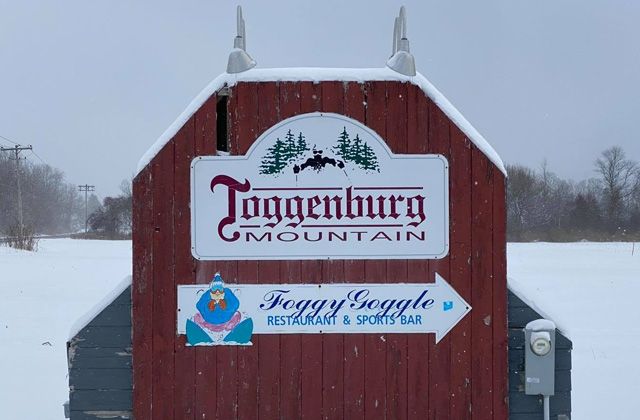
The roadside sign that used to greet people on their way to Togg. Image: Greek Peak on Facebook.
Moving right along, our next story this week is a big one for both the Central New York ski scene, as well as for me personally. If you’re a regular reader of Top Five Fridays, then there’s a chance you’re already familiar with the story of how I developed my first lifelong beef. If not, feel free to read about it here. For our purposes this week though, we’ll skip to the relevant part.
For a long time, the greater Syracuse area was home to three independently owned ski areas: Song Mountain, Labrador, and Toggenburg. Then, in 2014, the owner of Song Mountain (a man named Peter Harris) purchased Labrador, reducing ownership of the three ski areas to just two parties. This was okay for about 7 years, until Peter Harris then went on to purchase Toggenburg as well, putting all three ski areas under singular ownership. While this could have also been okay, the problem was that Harris immediately shut down Toggenburg, forcing all of the skiers in the area to ski at either Labrador or Song Mountain. Despite claiming that it was a necessary move to consolidate skier traffic as there weren't enough skiers in the area to support three mountains, New York’s attorney general sued Harris, claiming antitrust violations. Back in April of this year, roughly 4 years after the Toggenburg incident, a NY Supreme Court judge agreed with the attorney general, ruling that Harris was in fact guilty of the violation. At the time of the ruling however, the judge refrained from imposing penalties as he stated that more work was necessary to determine a proper resolution.
This week, we’re finally learning more about the potential outcome of this story, and for locals in the area, it’s incredible news: Harris is currently in negotiations to sell Toggenburg to a party that’s interested in reopening it. As is being reported by Syracuse.com, Harris sent a sales offer of $1.75 million to local businessman Douglas Wheeler, who had previously expressed interest in purchasing the resort. While a purchase hasn’t been made quite yet, there’s optimism surrounding the situation as $1.75 million offers a nearly $250,000 discount from the previously listed $1.995 million. Additionally, purchasing the property is a bit of a personal matter for Wheeler, whose great-grandfather initially sold the land to the Hickey family who turned it into a ski area back in the 1950’s. For Wheeler, there’s undoubtedly some aspect of “righting a wrong” involved in this business decision.
Perhaps more excitingly though, are Wheeler’s plans for the area. While we don’t know the full scope of recreation, we do know that Wheeler absolutely wants to reopen Toggenburg as a ski area, as well as turn it into a four seasons resort. Prior to its closing, Toggenburg operated solely as a ski area. Now, under Wheeler’s guidance, the sky’s the limit for summer activities at the resort as many other ski areas across the U.S. have shown that adding activities like hiking, mountain biking, disc golf, and live music can all soften the seasonality of ski areas. All told, while this deal isn’t done, it’s exciting news for a ski community that’s been uncomfortably forced to support a shady business owner for the past half decade. To learn more about this week’s news, check out the report from Syracuse.com.
#4: What’s Next Winter’s Weather Looking Like? No One Knows for Sure, But NOAA Has a Guess:
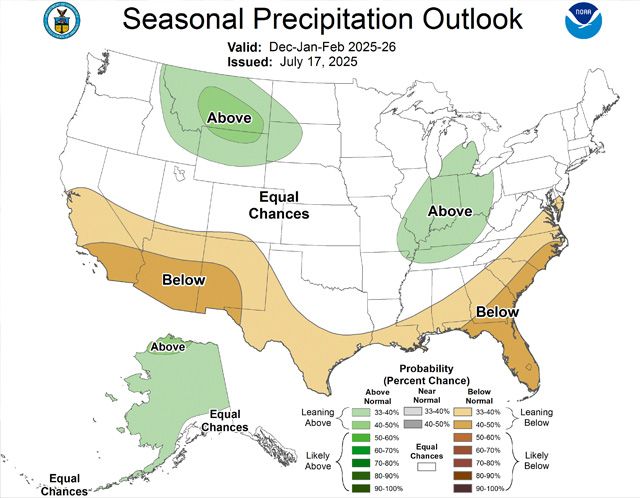
A look at the precipitation forecast from December - February. Courtesy of NOAA.
Finally, we’re rounding things out this week with our first long range forecast for the 2025/2026 winter. Now, as you know, NOAA and other weather services always tend to release their winter predictions this time of year, and while they’re always based in some form of meteorological science, they should also always be taken with a grain of salt. As we know, it can be hard to know what the weather will be one week from now, let alone in three months. Still, these forecasts are backed by science and can at least give us some ideas regarding whether we should expect La Niña or El Niño, both of which are strong enough patterns to at least set expectations. So, with that said, what does the National Oceanic and Atmospheric Administration think we have in store this winter?
As it turns out, not much for most of us. In their long range models, NOAA is showing conditions for mild winter across most of the U.S., consisting of “equal chances” of above or below normal temperatures for most of the country, with New England leaning slightly towards above average temperatures and the very tip of the Pacific Northwest leaning towards slightly below average temperatures. In the precipitation map, it’s a similar story, with nearly all of the skiing regions seeing equal chances of above and below average precipitation. The biggest anomaly on this map though is in the Northern Rocky Mountains region, with Wyoming, Montana, and part of Idaho showing predictions for above average precipitation.
So, what does it all mean? In this particular case, it means we’re likely looking at what we’re calling a “normal” winter, much like last season. Prior to last year, we saw a series of consecutive El Niño or La Niña winters, setting up seasons in which there were big winners and big losers. Last year though, was a “normal” winter, and at least for us here in New England, that was totally ok. For once in what felt like forever, we had consistent snow from December through March. As for what will actually happen this winter, who knows, but for now, we’re completely ok with this very normal forecast. To learn more about what NOAA thinks we can expect, check out the maps for yourself, right here.