


Top Five Fridays: December 8, 2023
Lead Image: After a tremendously slow start to the season due to a number of cancellations, the FIS Men’s Alpine circuit finally takes them to Beaver Creek this week for a series of speed races. The U.S. Men’s team appears poised to make a splash. Image: U.S. Ski and Snowboard Team on Facebook
#1: FIS World Cup Alpine Update: Shiffrin Continues Podium Streak in Tremblant, While the Men See More Cancellations:
Highlights from a wild weekend in Tremblant, where heavy snowfall put day two of racing into question.
Hello, and welcome to Top Five Fridays, the December 8, 2023 edition! This week we start with back to back FIS highlights before shifting into a couple of general interest pieces. Before getting to those though, let’s start with how we always start this time of year: by recapping the latest from the FIS World Cup alpine circuit!
When we left off last week, the women’s circuit had just wrapped up in Killington and was currently preparing to hold two giant slalom races in Mont Tremblant for the first time ever. Much to almost everyone’s delight, despite some challenging weather conditions on the second day, both races were successfully held and Tremblant proved to be an excellent addition to the calendar. For Team U.S.A. specifically, it was another successful weekend as Mikaela Shiffrin found herself on both podiums, finishing in third place in each race. In doing so, Shiffrin find herself on the precipice of another potential record. At present, she is currently tied with Ted Ligety for the most career giant slalom podiums, with 41 total. In addition to this news from Mikaela, while Sunday’s race was not a highlight for many racers who thought the deterioration of snow conditions by the conclusion of the second run were downright dangerous, it proved to be a fruitful race for A.J. hurt who finished in 9th, as well as Paula Moltzan who finished in 15th. For Hurt, this marks her best finish of the season so far, and for Moltzan it continues a string of solid performances as we await her inevitable breakout at some point this season. Looking ahead, the women’s circuit is scheduled to compete in two Super G’s and a Downhill this weekend in St. Moritz, Switzerland. The first of the two Super G’s has actually already been held, but we’ll wait to cover the trio of races in next week’s news. For now, you can view those results and preview the rest of the races right here.
On the men’s side of the schedule, frustration unfortunately continues as all three races scheduled to be held last weekend in Beaver Creek, CO were canceled due to inclement weather. If you’ve been following the men’s side of alpine racing this year, then you’re well aware that this is far from the first series of cancellations. In fact, to this point, the men have only been able to successfully hold one race so far this season, while the rest have been canceled due to weather. Still, the circuit will try again this weekend in Val-d'Isère, Italy for a Giant Slalom and Slalom race. You can preview those races here.
#2: The FIS World Cup Beijing Big Air Event Reveals a Shift in Freeski Judging This Season::
Highlights from the 2023 Beijing Big Air, where difficulty and technicality were awarded in a way that we haven't seen before.
In other FIS news, we’re particularly excited to bring you this next highlight, from the world of freeskiing. When we last checked in on competitive freeskiing, we were talking about the new requirement for all competitors to use poles. While that rule change ruffled some feathers, by and large the community seemed supportive of the move as it served to put all athletes on an even playing field. In other words, despite its history, the FIS did something good for the freeskiing community. This week, they appear to have hit another home run as the Big Air event held last weekend in Beijing resulted in some unexpected but welcomed judging.
If you follow freeskiing, then you likely know that the trend in recent years has been in favor of “more”. More spins, more flips, more grabs, etc. The concern of course, is that the sport would eventually (d)evolve into a spin to win competition, ultimately too closely resembling aerials. After last week’s results however, those concerns have taken a backseat to excitement as the FIS judges ruled heavily in favor of creativity, difficulty, and technicality at the Beijing event. Let us explain what happened.
Perhaps the easiest way to summarize the shift in judging is this: the highest score of the day went to Matej Svancer for his Tokyo drift style 270 bring back with a japan grab. Yes, you read that correctly: the highest score in a Big Air contest went to a trick that didn’t even rotate beyond 360 degrees. And while that may sound befuddling, if you watch the trick, you’ll instantly understand why. It’s the kind of thing that even a physicist would struggle to explain. While that’s the most blatant example of a change in judging philosophy, other examples were prevalent as well. Take for instance the fact that Alex Hall won the contest in his first two runs, with his third run being a victory lap. His first trick? A rightside double 1080, brought back to 900. Again, a trick that ultimately didn’t even rotate into a four digit number was rewarded well enough to help the athlete secure first place by the end of his second run. Ultimately, that’s the highlight here. Typically these recaps are a restatement of who finished in which place, but in this particular instance, the real highlight is a completely new, and very refreshing judging philosophy in FIS World Cup freeskiing. To learn more about this event, and who did what in every run, we recommend checking out the always thorough recap from Newschoolers.
#3: Reminder: onX Maps Introduced a New “Avalanche Terrain Exposure Scale” Layer to its Backcountry App This Year:
Just yesterday, onX released this explainer video, making it easy to understand how the layer works, and how it can be a beneficial part of expedition planning.
For our third highlight this week, we want to do something that’s a little atypical for us, as this highlight isn’t quite new news. Still, with mountains starting to receive some significant snow, we’re once again entering the time of year when a little avalanche awareness reminder feels in order. As such, we want to share with you a cool new feature that onX Maps introduced to their backcountry app last Spring. For those unaware of onX, it’s an app that allows you to view trail networks, topography, and 3D visualizations of terrain. It’s not unique in this - there are several other apps that offer backcountry navigation features. Where we’re pretty sure onX is unique though, is with their new Avalanche Terrain Exposure Scale.
Introduced last March, onX’s Avalanche Terrain Exposure Scale (ATES) is a layer that map users can turn on to quickly see a visualization of their exposure to avalanche paths. Now, we want to just clarify quickly here, that this is not a live-look at current avalanche danger, that’s the job of the North American Danger Rating Scale, which grades avalanche risk on a 1-5 scale based largely on snowpack and weather conditions. The ATE scale is more about the terrain itself, and helps to identify terrain traps and areas where an avalanche is likely to occur, based purely on the geography of the area. In the words of onX, the ATES is most powerful when used in combination with local avalanche forecasts, in particular when it comes to planning routes on any given day.
Ultimately, that’s the name of the game when it comes to avalanche safety. If you have plans to send it into the backcountry, please be sure to be equipped with an arsenal of tools to keep you safe. Have proper safety equipment, starting with at least a beacon, shovel, and probe. Be sure to have knowledge of these tools, so that you can use them when the time comes. Make sure the people in your group also have these tools, as well as the knowledge to use them. Have a good understanding of the avalanche conditions on the day you’re going out. Know what the weather will be like on that day, as well as what the recent weather has been. Dig a snowpit to test the snowpack before dropping in. And maybe, just maybe, consider using the new ATES feature from onX to help plan a safe route given that day’s conditions. Individually, each of these steps will help keep you safe. Piled on top of eachother, your safety will increase exponentially. Skiing and riding in the backcountry can be an amazing experience, and we encourage anyone who’s interested to give it a try. But, we also encourage you to do so safely.
Before we close this highlight out, we do want to just very quickly mention that this is not at all a paid advertisement. We simply think that onX has created a valuable tool that could prove to be useful when it comes to backcountry safety. To learn more about it, check out their press release.
#4: Japanese Investment Group Announces Intention to Spend $1.36 Billion Creatingthe Whistler of Japan:
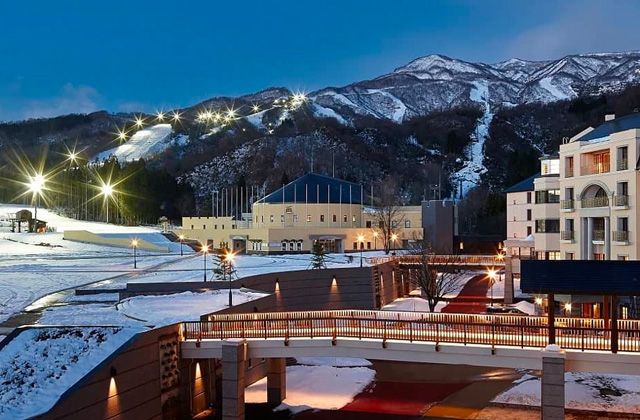
Located just 2.5 hours from Tokyo via train, and home to some of the best terrain in Japan, developers are hoping to turn what was once a bustling ski town into the Whistler of Japan. Image: Myoko Kogen on Facebook
Finally, let’s round out this week’s news with an interesting highlight out of Japan, skiing’s most confusing mecca. We phrase it that way because as North Americans and Europeans have come to find out over the last couple of decades, Japan is home to some of the deepest powder and most playful slopes on the planet. It appears to be a land custom built for tree skiing. But, oddly enough, the local population is far less interested in not just powder skiing, but skiing in general. This week, we learned a little bit about why that is in a story from Nikkei Asia, which focuses on a massive revitalization project being planned.
Before we get into the details of the planned project, we want to backtrack a bit as the article also comes with a bit of a history lesson. As it turns out, there are a couple of factors at play which explain the unexpectedly low interest in skiing amongst the Japanese. First, is the not at all surprising fact that it hasn’t always been this way. Back in the late 1980’s and early 1990’s, Japan was actually home to a vibrant ski community. Unfortunately, that came to an end in the mid 1990’s when the country’s economic bubble popped. Since then, there’s been an overall decline in ski participation in the country. To put it in perspective, a resort town called Myoko Kogen, which is located just 2.5 hours away from Tokyo via bullet train, saw approximately 16 million visitors at its peak in 1992. In 2022, that number decreased approximately 80%, all the way down to just 3.81 million visitors. In addition to the decline in participation due to the economy, there’s also a second half of this story: the population of those who were avid skiers in the 1980’s and 1990’s has obviously aged out. With the decrease in interest during the 90’s and 2000’s, a new generation of skiers and snowboarders was never born, so to speak. And thus, the world has a country, which is home to some of its best skiing, but in which the local population lacks interest.
All of this brings us to the real news this week: it’s just been announced that an investment group called Patience Capital Group (PCG) has announced plans to spend $1.36 billion developing Myoko Kogen in an effort to create a ski region similar to Whistler. Noting the incredible terrain and convenient location, the investment group believes it can draw international crowds to the mountain, and ultimately reignite local interest in winter sports as well. As part of their vision, PCG will start by building 2-3 hotels, residential buildings, and a commercial zone at the foot of the resort. In doing so, they’ll look to integrate the village with the resort as closely as possible, going as far as creating a unified payment and transportation system. If all goes to plan, the investment group hopes to have development completed by 2027. From the outside looking in, Japan appears to have a handful of preferred destinations, but doesn’t yet have a ski resort with a world renowned reputation on the same level as a Whistler, Aspen, or Vail. If PCG can pull this off, and create a ski village that’s synonymous with Japan, they could stand to be highly successful. For now, head over to Nikkei Asia to learn what we know about this exciting project.