


Top Five Fridays: November 17, 2023
Lead Image: Now 7 reindeers deep, Shiffrin appears to be actively challenging Santa for his throne. In this photo, he’s playing it cool, but if you zoom in you can probably see some sweat on his brow. Image: Mikaela Shiffrin on Facebook
#1: FIS World Cup Ski Racing Updates: Shiffrin Looking to Challenge Santa’s Reindeer Count:
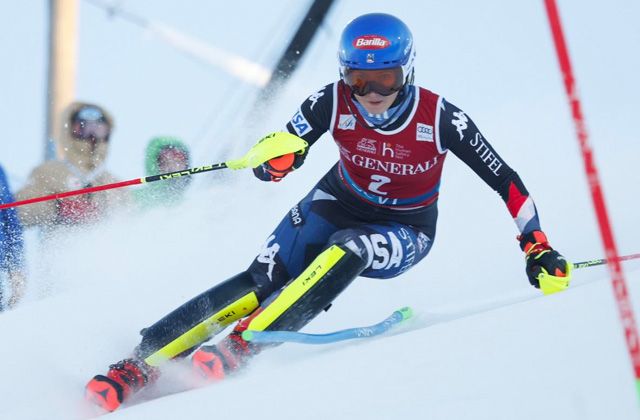
Mikaela Shiffrin, somehow simultaneously making eye contact with the camera lens and winning her 89th World Cup race. Image: FIS World Cup Alpine Racing on Facebook
Hello, and welcome to Top Five Fridays, the November 17, 2023 edition! This week we bring you a triple header of FIS news, as well as a follow up to one of the most academic articles we’ve shared in recent memory. We’ll explain ourselves a little later, but for now, let’s start with FIS World Cup action.
As you likely know, the first men’s race of the season was canceled just over two weeks ago, when heavy winds forced event organizers to shut down efforts to host a giant slalom race in Solden, Austria. Despite the disappointing start, things were still looking positive for the men’s circuit as they were set to debut the highly anticipated, brand new Zermatt - Cervinia Downhill course last weekend. Unfortunately, those races were also canceled due to weather. While this year’s start certainly feels a lot like last year’s start, it should be noted that this year’s cancellations are not due to an utter lack of snow. Instead, the men have simply been the victims of untimely inclement weather. While they have yet to race this season, things are looking better in the immediate future, as a slalom race in Gurgl, Austria is scheduled for tomorrow. For the moment, the weather looks to be calm enough that event coordinators should have no trouble running the race. To preview that event, click here.
Fortunately, unlike the men, the women’s circuit has had no trouble at all getting the season started as they’re a perfect 3 for 3 so far when it comes to running previously planned races. This past weekend, the women gathered in Levi, Finland for their annual slalom double header, where the winner of each race is symbolically gifted a reindeer. Historically speaking, this has also been a strong venue for Shiffrin as she entered the weekend with 6 Levi wins (and therefore 6 reindeer) to her name. So, how did she do? Well, in the first of two races, she just barely missed the podium, finishing in fourth place, with Slovakia’s Petra Vlhova finishing in first. Also notching points in this race for Team America was Paula Moltzan, who finished 15th. For those who might be starting to worry about Shiffrin - don’t. A day later, she proved that she’s still very much operating at a high level as she took home first in the second race of the weekend, earning her 7th Levi reindeer. To be honest we’re not exactly sure how many reindeer are required to overtake Santa’s herd, but at this point it’s becoming clear that Shiffrin is certainly trying to do just that. In addition to her reindeer count, we also want to briefly point out one other Shiffrin stat: while it’s extremely early in the season, Shiffrin is in fact on top of the standings with 2,388 points, compared to Lara Gut-Behrami’s 1,383. We point this out just to remind everyone that at this point in her career, one of Shiffrin’s biggest goals is to win the overall title each season. To do that, she doesn’t necessarily have to win every race. If she simply competes in most, and earns a respectable position, she’ll be in a great place to achieve her season long goal.
Looking ahead, the women’s circuit hopes to finally be the ones to debut the new Zermatt-Cervinia Downhill course this weekend as two races are scheduled. That said, two of the three training runs have already been canceled, so we’ll be holding our breaths to see if either of the two official races go ahead as planned. It’s also worth noting that Shiffrin’s name hasn’t appeared in any of the training start lists, so we’re guessing that she won’t be competing this weekend, even if the races are a go. To preview the planned schedule of events, click here.
#2: Killington World Cup Racing is a Go! Positive Snow Control Paves the Way for the 6th Annual Event:
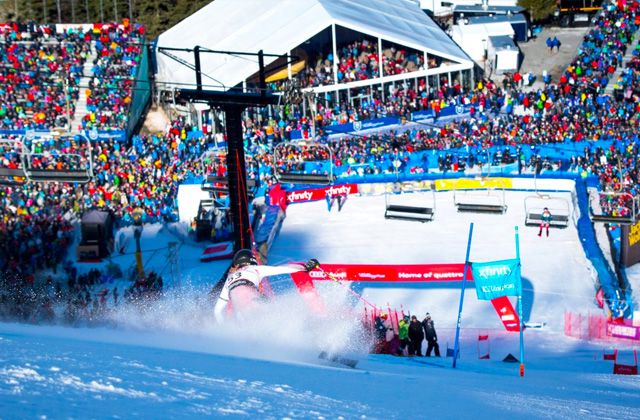
The FIS World Cup races at Killington are always a party. This year should prove to be no different, thanks to a strong snowpack and a positive snow control. Image: Killington Resort on Facebook
Speaking of FIS races, Killington received some positive news this week as the events set to be hosted there in a week were given the green light after a positive snow control was held. As you might recall, last year’s event caused maximum stress for organizers as cold weather didn’t return to the resort until just 5 days before the event. Fortunately, due to Killington’s significant investment in its snowmaking, the resort was still able to pull the event off. This year, things have been much easier for the resort as more seasonally cool air has hung around for most of the month of November, gifting snow makers plenty of time to prepare for the event. With the resort having opened to the public on November 3rd, preparations for this season’s event have been as smooth as it gets. As such, New England can once again look forward to playing host to a women’s giant slalom and slalom event in what’s become one of the annual highlights of winter in the region.
As per usual, our attention will be focused on Shiffrin next weekend, as Killington has proven to be one of her favorite venues. Keeping in mind that last weekend’s victory in Levi marked Shiffrin’s 89th victory, it sets the stage for her to win her 90th race right here in Vermont. While that anticipation is likely the highlight for many, the fanfare of the entire weekend should not be overlooked. In addition to the World Cup races, there will also be multiple concerts, crowds of skiers from around the world, and of course, plenty of skiing for the public on some of the best early season conditions in the region. To learn more about preparations for the event, click here. To find out how you can join the party, click here.
#3: New Rule Alert: FIS Now Requires Ski Poles to be Used in All Park & Pipe Freeski Competitions:
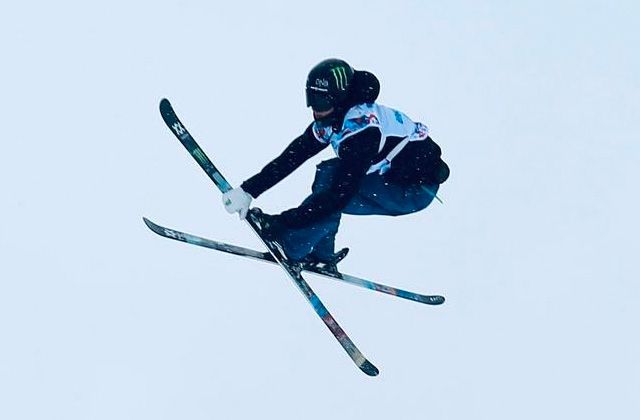
Last year, FIS World Cup freeski athletes were free to compete with or without poles without any impact on their score. This year, not so much. Image: FIS Freestyle Skiing on Facebook
Finally, for our third FIS highlight this week, we bring you an update that might be a touch niche, but is certainly significant to many. This year, poles will more or less be required for all level 1 FIS competitions. We say “more or less” because although a skier could technically compete without poles, judges are being instructed to score their run as if it were a crash. In other words, the athlete could score at most 30 points in their run. While the change itself was quietly announced a few weeks ago when the official 2023 FIS Freeski Park & Pipe Judges Handbook was released, it was primarily brought to everyone’s attention this week thanks to a really insightful and in depth article from Down Days. In his report, Ethan Stone does an excellent job of explaining why the change happened, and why it’s not an insignificant development for those who’ve followed freeskiing over the years. We’ll let his article be the beacon for our reporting here:
By and large, at the moment, it seems as though the freeskiing community is understanding and supportive of this change. For those who don’t support it, there’s an air of “this is freeskiing, let it be free and unrestricted.” That’s been a longstanding sentiment, ever since the FIS got involved in the sport, but in this particular case the decision is being backed by sound reasoning. In addition to the aforementioned sentiment, there’s another widely agreed upon notion: it’s a whole lot easier to grab without poles. As such, FIS judges have been grappling with comparing the runs of skiers competing with and without poles. The situation ultimately came to a head last winter at the World Championships Big Air event in Georgia. There, judges watched athletes in warmups drop into the jump without poles and their arms fully extended above their head, aerials style. Noting that this approach was giving these competitors an advantage, the judges decided to call a meeting with athletes. For obvious reasons, the judges couldn’t ask poled athletes to drop their poles, meaning the only reasonable solution was to ask non-poled athletes to use poles. At the meeting, the athletes all agreed to use poles for that specific contest. Now, that exception has become the rule thanks to the 2023 Judges Handbook. To be sure, it’s a pretty interesting development as the debate between poles vs. no poles has been a long lasting topic of discussion in the freeski community. While this likely won’t have an effect on non-competitive areas of the sport, it’s certainly a big change for those who do compete. To learn more about this update, we recommend reading the article from Down Days.
#4: The Storm Skiing Journal is Back With Another Comprehensive Industry Overview:
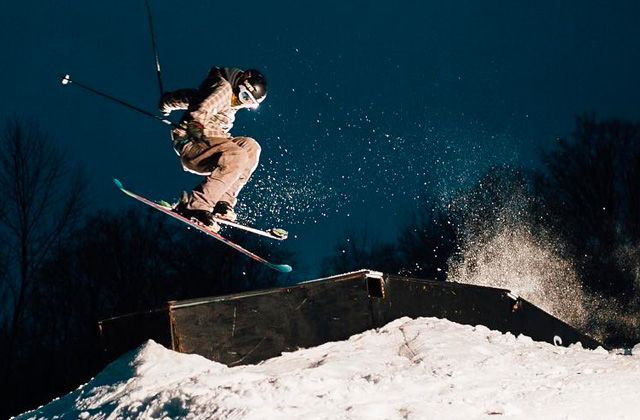
Snow Ridge GM Nick Mir having a little fun at his independently owned ski resort - one of 369 in the U.S. Image Snow Ridge on Facebook
Finally, we round out this week with some pretty academic reading. Remember a few weeks back when we shared an article from Storm Skiing that provided a comprehensive overview of which ski areas in the United States are a part of which multi-pass, if any? Well this week Storm Skiing has published an equally in depth follow up, this time examining a slightly different angle: which ski resorts are owned by a multi-mountain operator. If this distinction is a bit confusing, you’re forgiven- this world certainly isn’t simplistic anymore. To help clear it up, think about it this way: it’s possible for an independently owned ski area to be a part of the multi-pass. For example, New York’s Snow Ridge is owned by a family that owns just that one ski area, but is also a part of the Indy Pass, therefore it’s considered an independently owned multi-pass resort. With that in mind, this week’s article is focused on exploring ski area consolidation by taking a deep dive into how many multi-resort operators there are in the U.S., as well as how many resorts are owned by multi-resort owners. With constant talk of ski area consolidation, the results might surprise you.
Right off the bat, we found ourselves shocked by this statistic: roughly 73% of ski areas in the U.S. are either singularly or municipality owned. In other words, out of a total of 505 actively operating ski areas, 369 are owned by someone who owns just that one ski area, or by a municipality. On the flip side, just 136 or 27% of ski areas are owned by someone who owns multiple ski resorts. Now, at this point you might be looking for clarification: are we just talking about the Vail’s and Alterra’s of the world, as we talk about conglomerates owning more than one resort? The answer to that, is no. In this study, author Stuart Winchester took multi-resort ownership to its minimum meaning: owners operating at least two resorts. In his investigation, he found that there are a total of 24 conglomerates in the U.S., each operating at least two ski areas. Within that 24, 8 companies own 5 or more ski areas, 2 own 4, 6 own 3, and 8 own 2. In other words, somewhat shockingly, there truly are 369 independent ski areas in the United States. It’s an interesting revelation, to see the hard data unveil the fact that ski area conglomeration isn’t nearly as prevalent as many may have thought. It also, in its own way, reaffirms the importance of the Indy Pass as a means for independently owned ski areas to benefit from the multi-pass model. All in all, we just found ourselves fascinated by this research, and figured at least some of our readers might as well! To read the full report, and to see a comprehensive breakdown of every ski resort owned by a multi-resort owner, click here.