


Top Five Fridays: February 23, 2024
Lead Image: Last week, Minneapolis, Minnesota hosted the first World Cup XC races on U.S. soil in over two decades. Both the American fans and athletes rose to the occasion. More on that below! Image: U.S. Ski and Snowwboard Team on Facebook
#1: FIS World Cup Alpine Update - Men’s and Women’s Teams Continue to Show Consistency:

Can we just take a moment to appreciate how incredible this shot of Jacqueline Wiles is? Look at that balance, the composure, the focus! Image: U.S. Ski Team on Facebook
Hello, and welcome to Top Five Fridays, the February 23, 2024 edition! This week we’ve got a couple of World Cup highlights followed by two ski resort themed reports from around the world. Let’s kick things off this week as we always do this time of year: by diving into the latest round of World Cup Alpine racing results!
If you’ve been following ski racing this year, then you already know that Mikaela Shiffrin is currently sidelined with a knee injury that’s proven just bad enough to keep her off the hill. In her absence, the women’s circuit has done an admirable job of keeping up appearances, with Jacqueline Wiles and AJ Hurt both landing on the podium at the previous two venues. This week things slowed down a bit, as the women took to the slopes of Crans Montana, Switzerland for two downhill races and a super g. Still, despite a lack of podiums, there were still plenty of points earned. In the first of the two downhill races, Jacqueline Wiles set the bar for Team America with a 13th place finish, followed by Lauren Macuga in 20th. A day later, Jacqueline Wiles again took 13th place, while Macuga dropped to 23rd. Finally, in the super g, Isabella Wright took 17th, while Lauren Macuga took home 19th and Tricia Mangan earned 21st. Looking ahead, the women will be in Val di Fassa, Italy for a pair of super g races this weekend, which you can preview right here.
On the men’s side of things, remember the article we shared last week, about how the men’s team has been all about consistent, strong results this year, from a large number of athletes? Well, this past week’s races in Kvitfjell, Norway proved to be the perfect example of that, as numerous athletes showed up in the points in both the downhill and super g race. In the downhill, Bryce Bennet just missed the podium with a 4th place finish, followed by Ryan Cochran-Siegle who tied for 7th, Sam Morse in 10th, Jared Goldberg in 17th, and Wiley Maple and Kyle Negomir tied in 19th. Looked at statistically, that puts 6 Americans in the top 20 in that race, good for 30% of the field. In that particular race, that’s the highest percentage of top 20 finishers from any nation. As last week’s article pointed out, that’s the type of result that creates lasting success in a program. A day later, in the super g race, Team America fared nearly as well, placing 4 athletes in the points. In that race, RCS led the way, taking 11th, followed by Kyle Negomir in 12th, Sam Morse in 14th, and Jared Goldberg in 23rd. Looking ahead, the men’s circuit has some excellent chances to crack the podium as the World Cup circuit brings them to American soil in the coming weeks, starting with a giant slalom and slalom race schedule for Palisades, Tahoe this weekend, followed by a stop in Aspen the following week.
#2: 40,000 Spectators Travel to Minneapolis, Minnesota For the First U.S. World Cup XC Race in Over Two Decades. Diggins and Schumacher Make it Worth Their Time:
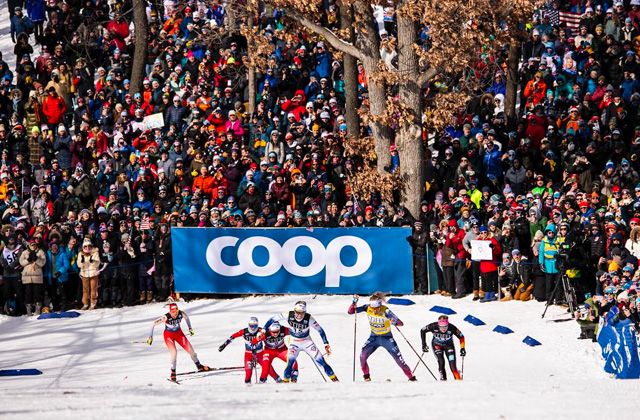
With a reported 40,000 spectators in attendance, athletes from around the world confirmed that they’d never been a part of a XC race quite like the one in Minnesota. Image: U.S. Ski Team on Facebook
In other World Cup news, this week provides the perfect chance to share an update from a different side of skiing: Cross Country ski racing. We admittedly don’t get to check in with the U.S. XC ski team as much as we’d like, but between a slightly slow week in ski news and a historic week for the team, there’s never been a more perfect time. Allow us to explain, starting with the headline.
American athletes Jessie Diggins and Gus Schumacher made history last week as the first World Cup XC races were held on American soil in over two decades in Minneapolis, Minnesota. There, both the Men’s and Women’s circuits competed in a Sprint Freestyle, and a 10km Freestyle race. Of the two, the 10km race proved to be the most fruitful for both Diggins and Schumacher as their results gave the home crowd something to celebrate. For Diggins, who grew up just 30 minutes away from the venue, a bronze medal at the event will go down as a definite career highlight. For Schumacher, his result was even stronger, as his gold medal was not only a career first, but also made him the youngest American to ever win a gold medal in a distance event, and the first American to win one since 1983. It was truly an amazing achievement, one made even more impressive by the fact that he was able to achieve the feat on home soil.
Perhaps the most important part of the events in Minneapolis though, were the events themselves. By all accounts, the races held last week were far from your average World Cup XC race. After years of effort to bring a World Cup XC race to American soil, it finally happened last week, and the fans who showed up in support made it clear that the decision was not a mistake. Enticed in part by Diggins’s local legend and in part by free tickets, approximately 40,000 people showed up to line the course and cheer on athletes. While the Americans saw it coming, international competitors who’d never competed in the midwest of the United States likely did not, and found themselves blown away by the cheering crowds. In the words of Norwegian XC skier and 5x Olympic gold medalist, Johannes Hoesflot Klaebo, “This was something special! What an amazing crowd and atmosphere it was. So much fun racing this weekend, goosebumps! … I hope it won't be 20 years until we are back in the US racing again.” To say the event was a massive success would be an understatement. From here, it seems to be just about everybody’s hope that the World Cup will return to Minneapolis again in years ahead, and with such a strong turnout from the locals, it’s hard to think it won’t be back as soon as next year. To learn more about last week’s success, check out the recap from the U.S. Ski and Snowboard Team.
#3: In Japan, Sky High Development Costs Deter Investors, Limiting Nation’s Ski Industry Potential:
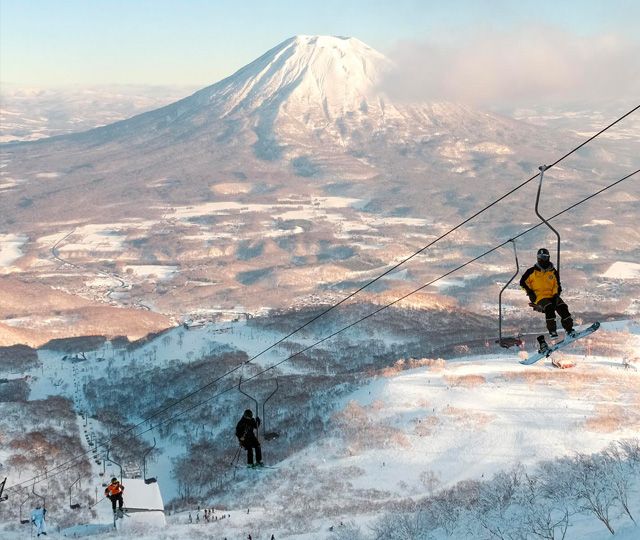
Despite becoming increasingly popular amongst international tourists, a myriad of economic factors are preventing investors from developing in Niseko, Japan. Image: The Luxe Nomad on Facebook
Moving on from competitive ski news, we bring you a story from Japan, where we continue to be fascinated by the country’s relationship with the ski industry. Afterall, as skiers, the nation has become something of a mecca where there seems to be limitless amounts of powder and culture. And yet, despite Japan being on die-hard skiers’ radar for well over a decade now, its ski industry doesn’t seem to be growing at the same rate as international interest. We touched on this topic somewhat recently, back in December, when we shared news of a massive resort being planned for a ski town known as Myoko Kogen, where developers hope to turn it into the “Whistler of Japan.” This week, we bring you a story from Bloomberg that’s in many ways the inverse: why investors are shying away from developing in Niseko, one of Japan’s most well known ski towns.
When we first came across this story this week, we were immediately intrigued as the message seems counterintuitive. At a time when it seems like the world is only increasingly interested in traveling to Japan to ski, why would one of its most popular areas be seeing a slowdown in development? Well, as you could probably guess, it’s a bit complicated due to a myriad of factors. The long and short of it is this: it’s become too expensive. Behind that simple statement though are complex economics that, when you run the numbers, make developing in Niseko simply a bad business decision. For starters, the cost for completing a project, whether it be a hotel, condos, apartments, or other type of development, have risen dramatically across the board. The cost of land, which used to account for approximately 10% of a project’s budget, now would account for 25%. The cost of construction expenses has jumped 20-30%. Perhaps most interestingly though, even if a developer were able to find the budget for the project, there’s a strong chance they wouldn’t be able to find workers to complete it. At the moment, the region is experiencing a shortage of construction workers as two massive, government backed projects are occupying the vast majority of the workforce: a high speed railway and a semiconductor plant, both in Hokkaido. In other words, in order to find laborers to build their developments, investors would have to pay high enough wages to entice these workers. Another massive expense.
At the end of the day, we simply find this story fascinating. Typical business sense would suggest that where there’s demand, there’s opportunity. At the moment, there’s most certainly demand in Japan for all things skiing. There isn’t, however, opportunity. Or at least not a very good one for developers. When it comes down to it, while some investors are forging ahead, recognizing the long term potential of their projects, a majority are simply putting their money into other opportunities with higher immediate returns and lower risk. As a result, Niseko’s skiing boom is on the back burner until further notice. If you’re a bit nerdy like us and want to learn more about the economic intricacies plaguing Niseko, check out this report from Bloomberg.
#4: In the Face of an Uncertain Season, Washington’s Loup Loup Ski Bowl Announces a $6,000 Lifetime Pass:
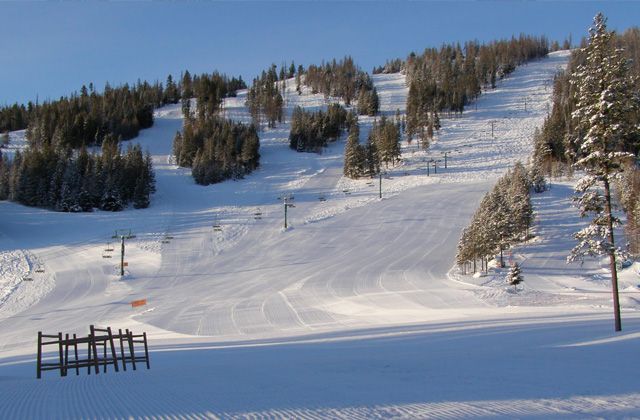
The slopes of Loup Loup Ski Bowl, where for $6,000, you can have unlimited skiing for the rest of your life. Image: Loup Loup Ski Area on Facebook
Finally, we end this week with a highlight coming out of Washington, where a small ski area called the Loup Loup Ski Bowl has just launched a sale for a lifetime ski pass. Coming in at the price of $6,000, purchasers of the Loup Loup Lifetime Pass will have unlimited access to the resort for the rest of their lives, so long as the resort is open. Additionally, that pass will include all of the perks and benefits of a normal season pass on any given year, including any reciprocal agreements with other ski areas in the region. Pretty cool, right?
It is, but here’s the catch: we get the idea that Loup Loup doesn’t necessarily want to be doing this. In the announcement made on their Facebook, it’s not hard to read between the lines to realize that this is an effort to raise money during what’s been a difficult year for the resort. In fact, the post itself outright says, “El Nino has taken its toll on the Loup as well…and we are in need of help.” In other words, the sale of lifetime passes is a somewhat desperate move from a ski resort that needs a little extra help making it through the season. Still, we don’t hate the idea. For locals and families in the area, a quick look at their current pricing shows an adult season pass going for $549/year. At that rate, the lifetime pass would pay itself off in 11 years. As the post for the passes points out though, the lifetime pass is inflation proof, making it an even better deal.
Now, us being us, we got to wondering: are lifetime passes the new season passes? Think about it: resorts have shifted to an “affordable season, expensive day” ticket model. Could “affordable lifetime, expensive season, really expensive day tickets” be the next model? Realistically, probably not, but what about a more affordable two year pass, so resorts can lock in customers for two years straight and find themselves with even more cash in hand to work with? We’re not sure about that either, but it’s at the very least an interesting thought. As always, we’d love to hear your opinions in the comments below, and if you’re interested in buying a Loup Loup lifetime pass, you can do so right here!