

Top Five Fridays: January 19, 2024
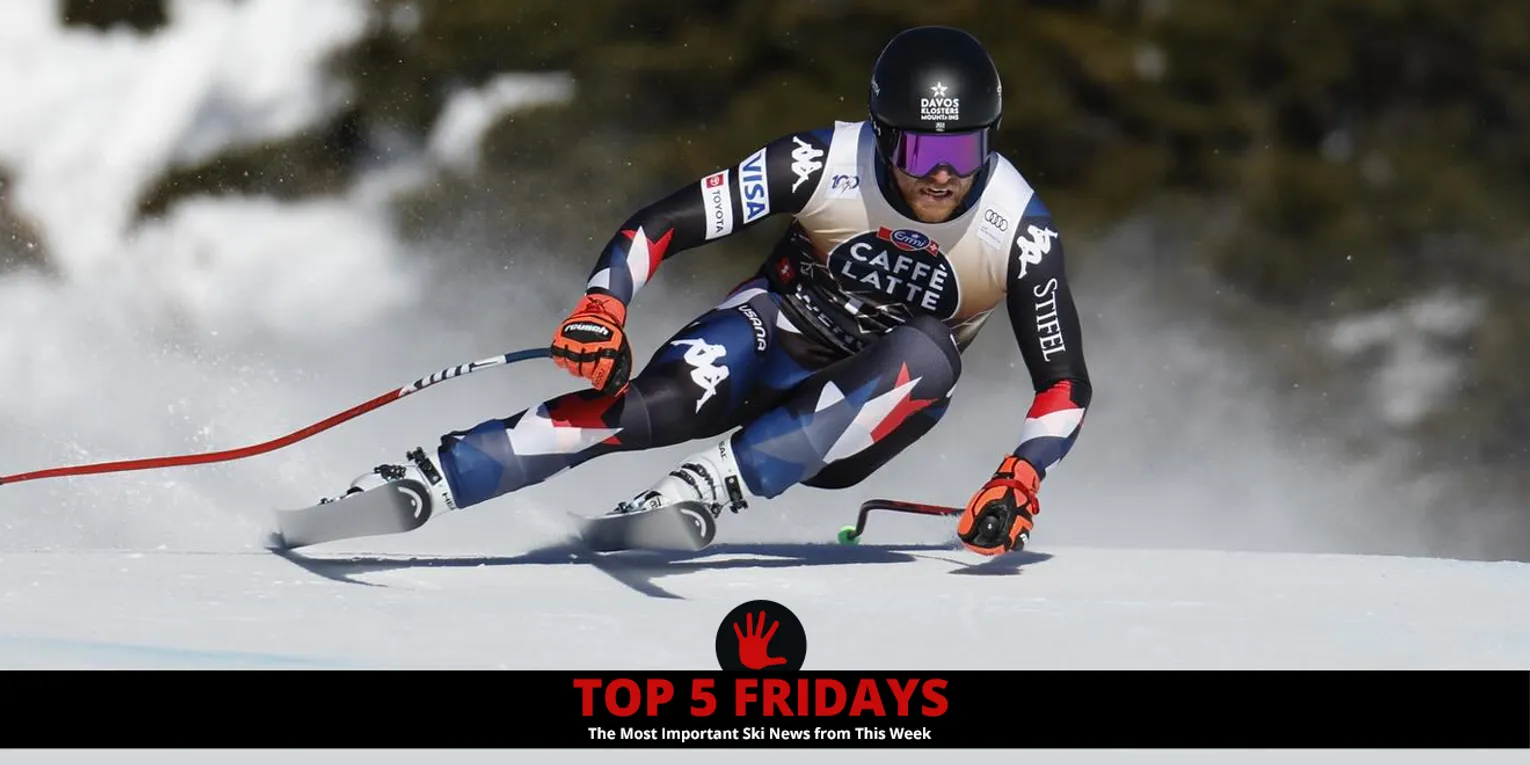
Lead Image: Ryan Cochran-Siegle leaning into a turn at a downhill race in Wengen last weekend. Over the course of the last week, he posted several notable results, which we’ll tell you all about directly below! Image: U.S. Ski and Snowboard Team on Facebook
#1: FIS World Cup Alpine Update - Ryan Cochran-Siegle Catches Fire in Austria, While Shiffrin Emerges Triumphant from a Tumultuous Week:
Hello, and welcome to Top Five Fridays, the January 19, 2024 edition! This week, for whatever reason, it’s unofficially “Colorado Week” as we have a trio of highlights coming out of the Rocky Mountain state. But first, before we dive into those stories, let’s check in with the latest from the FIS World Cup Alpine circuit.
Last week, as you might recall, things were pretty interesting on the women’s side of the sport as Mikaela Shiffrin found herself battling an illness that caused her to miss the podium in back to back races. Showing up for Team U.S.A. though, was AJ Hurt, who earned the first World Cup podium of her career. So, a week later, how did things go for the women’s team? All in all, pretty well! Last weekend, the circuit found itself in Altenmarkt-Zauchensee, Austria, for two super g races and a downhill. In light of her illness, as well as other events that we’ll get to in a second here, Shiffrin decided to sit this series of speed races out. Still, even without the team’s leader, these races were moderately successful for Team USA, with Isabella Wright finishing in 30th in the first super g race, Jacqueline Wiles finishing 14th and Isabella Wright taking 17th in the downhill, and Lauren Macuga taking 10th in the second super g. So while there weren’t any podiums to be had at this venue, there was still a smattering of solid results of the women’s team.
That’s not the real story from the women’s side of the circuit this week though. Shiffrin is, once again. As we mentioned, Shiffrin was battling what sounded like a pretty severe cold last week, and in all likelihood planned to sit out of the Altenmarkt-Zauchensee speed races last weekend in order to heal. Unfortunately, her week took a turn for the worst when her boyfriend, elite alpine racer Aleksander Kilde, crashed into the fencing during a downhill race in Wengen last Saturday, on 1/13/24. As a result of the crash, Kilde had to be airlifted to a hospital where he underwent surgery on his shoulder as well as a severe calf laceration that resulted in nerve damage. When that happened, Shiffrin rushed with her team to be at Kilde’s side. And then, it was Tuesday, 1/16/24, and Shiffrin was scheduled to compete in a slalom race in Flachau, Austria. Despite the illness, and despite the emotional exhaustion from Kilde’s accident, Shiffrin pulled herself together and made it to the race. Not only that, but she showed up and won, claiming her 94th FIS career victory. In doing so, Shiffrin once again showed us all an example of the type of character required to be the best in the world at any given discipline. When it comes to consistently being the best in any field, it comes down to more than just technical talent. It requires mastery of the mental game as well, and as Shiffrin proves time and time again, that her mentality is also world class. Looking ahead, the women’s circuit is currently in Jasna, Slovakia for a slalom and giant slalom race this weekend.
On the men’s side of the World Cup circuit, there may not have been such dramatic storylines this week, but the schedule did come with five races, each of which included results for the Americans. With so much to cover, let’s take it in chronological order. Kicking things off in Wengen last weekend, was the first of two downhill races, and one in which Aleksander Kilde finished third, for reference. In that race, Ryan Cochran-Siegle took home an impressive 6th place finish, Bryce Bennett took 16th, and Sam Morse rounded out the points with 30th. A day later, in the super g, Ryan Cochran-Siegle once again led the charge for the U.S. men, placing 21st, while Jared Goldbergtook home 27th, and Bryce Bennett grabbed 28th. Then, it was the 13th, the day of the downhill that took Kilde out for the season. In that race, the Americans showed up in force, once again led by RCS. In that race, he took 9th, while Bryce Bennett finished tied for 10th, Jared Goldberg finished 16th, and Sam Morse took 25th. Finally, after three days in a row of speed events, the fourth day of activities in Wengen brought a slalom race, allowing the aforementioned athletes to take a break. In their absence, U.S. slalom specialist Benjamin Ritchie showed up, taking 20th place.
After an action packed weekend, the men’s circuit quickly moved to Kitzbuhel, Austria, for two downhill races and a slalom race. While we’ll have to wait to cover the second downhill race and the slalom race next weekend, the results of the first downhill race are officially in, with that race having been completed just hours ago. In that event, Ryan Cochran-Siegle just missed the podium, finishing in 4th place, and just .01 seconds behind Switzerland’s Marco Odermatt. Also earning points in that race was Sam Morse in 19th and Bryce Bennett in 25th. All in all, it was yet another strong result for the men’s team, and another really strong result for RCS, who is evidently on an Austrian hot streak. With another downhill race scheduled for tomorrow, we’ll have our fingers crossed that we have a podium result to report next week. Until then, you can check out this weekend’s schedule, right here.
#2: Aspen Asking Employees to Report Rogue Ski Instructors:
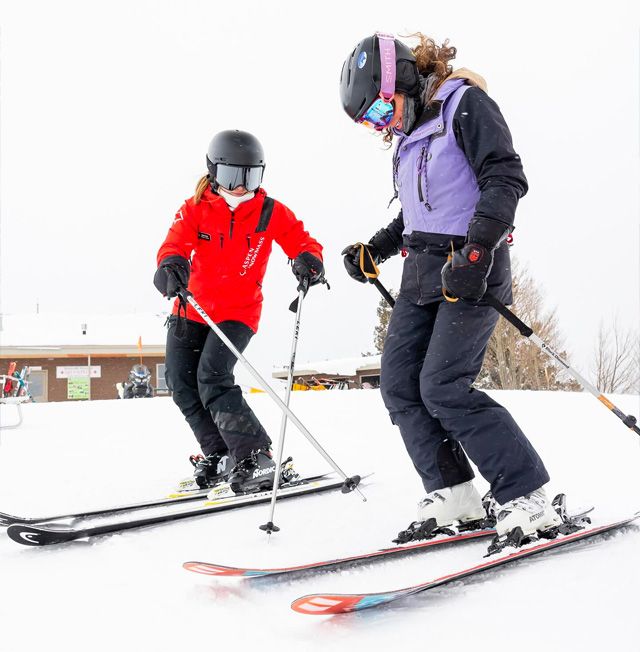
If you’re doing this at Aspen and you’re not wearing one of these red jackets, it could cost you your pass.Image: Aspen Snowmass on Facebook
Alright, with all of those exciting FIS World Cup results covered, let’s shift gears and get into “Colorado Week.” For our first of three Colorado stories this week, we’re bringing you an article from Aspen, where the resort is looking to crack down on black market ski instructing. As you might recall, we discussed this topic back in September, when we covered a very similar story coming out of New Zealand, where a skier had his pass revoked for allegedly giving ski lessons at Treble Cone and Cardona ski areas. In our coverage of that story, two things came to light: how hard it is to draw the line between someone teaching their friends to ski vs. giving illegal instruction, and also how the extreme prices of ski instruction at the resort resulted in the creation of this black market. This week’s story from Aspen mirrors those same two notions, while also adding an American twist.
First, let’s talk similarities. In our coverage of the Treble Cone incident, we reported that a private lesson for one adult, for one day, was approximately $475.00 USD. Now, keeping in mind that this is Aspen we’re talking about, arguably the wealthiest ski resort in America, here’s what a full day, private lesson would cost an adult there: $1,000. On the flipside, if you’re an average person trying to make it as a ski bum in the area, making even half of that would be considered a pretty good day’s worth of work. In other words, it’s incredibly easy to see how extremely expensive lessons can quickly create a black market opportunity for ski instructing, regardless of where you are in the world. The second similarity in these stories is that it’s equally difficult to detect black market ski instructors, or to prove that they were paid for their instruction. At the end of the day, resorts don’t want to tell skiers and snowboarders that they can’t help their friends learn how to ski or ride, and so it can be hard to spot black market instruction when you see it.
With that second point in mind, let’s hone in on the focus of this week’s story: earlier this week, Aspen’s Vice President of Mountain Sales and School, Jonathan Ballou, sent a letter out to employees asking them to essentially tell on underground ski instructors. In the newsletter, ski school employees were asked to report underground instruction to a “research team,” as well as to discreetly take photos of, “independent instructors, guides and ‘ski nannies’.” According to Ballou, the issue is, “not only a violation of our agreements with the Forest Service, it’s a disservice to our guests and our dedicated team of pros.” In other words, Ballou is aiming to place the bulk of the blame on the resort’s lease agreement with the Forest Service, which allows SkiCo (Aspen) to operate on the state Forest land throughout the winter, but no one else. As such, there’s a conflict when an independent operator makes money on land being leased by Aspen. To be clear, however, the second half of Ballou’s comments more likely highlight the actual issue: that Aspen loses money when black market ski instructors take on lessons. When Ballous says “a disservice to our dedicated team of pros,” what he’s really saying is, “the Aspen ski school makes less money, so it can’t afford to hire as many instructors.” This of course raises the question, “do the instructors care? Or would they make more money by partaking in the black market themselves?”
All in all, it’s a tricky topic with plenty of layers to it. For the anti-big ski resort crowd, there’s certainly a certain charm to people like Don Lemos, who famously offered black market ski instruction during the late ‘70s and ‘80s, even taking the resort to court over his rights to do so. On the other hand, the resort also has a case to make here. Not only do they have the exclusive rights to operate a business on the mountain, but they’re also liable for guest activities at the resort. Should one of these black market instruction sessions go wrong, it could become a disaster for them. Regardless of which side of the story you fall on, it’s an interesting debate to consider, and one that you can learn the details of in full from this report from Aspen Daily News.
#3: In Colorado Mountain Towns, Demand For Real Estate is Down While Pricing Remains Up:
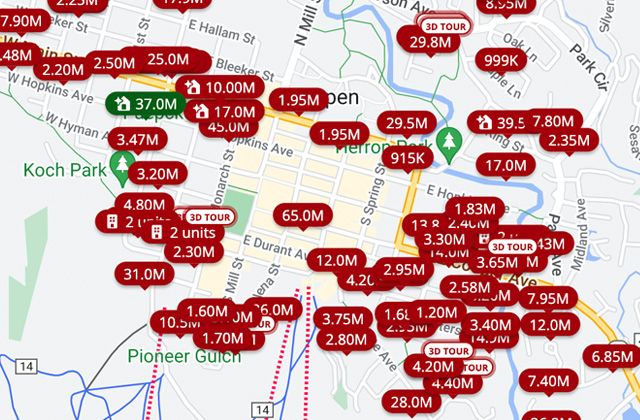
Just in case you were considering real estate in Aspen, here’s a quick look at what’s available downtown, courtesy of Zillow. Hope you’re prepared to spend m’s, not k’s! Image: Zillow
Next up in Colorado Week news: an update on real estate pricing in the state’s mountain towns. In an article from the Colorado Sun this week, ski industry guru Jason Blevins shares some confounding insights into the current state of real estate. First, the seemingly good news: mountain towns saw a 20-30% decrease in real estate sales last year, marking the first decrease since the pandemic spurred a buying frenzy. The reason why this is generally good news, is because it means the housing market is starting to cool off finally. Mountain towns are famously tough places to find budget friendly housing, so the fact that the buying frenzy has slowed down signals that the steeply rising home values could be plateauing or even falling soon.
Unfortunately however, that’s not exactly the case. At least not yet anyways. Despite a decrease in buyers, home prices in mountain towns across Colorado remain staggeringly high. In Steamboat, the average price for a single family home in 2023 was $1.73 million. For comparison’s sake, the pre-pandemic average was $935,000. In other words, despite a decrease in sales volume, home values are still 85% higher. While that region is particularly high, on average, values in mountain towns remain 20-30% above their 2019 pricing. So why exactly is this happening, if demand is down? It turns out that it comes down to very simple supply and demand economics. While demand is lower, it turns out that supply is too. In the words of Jon Wade, a realtor in Steamboat Springs who estimates that he helped 500 people buy homes in the area since the pandemic started, “I can think of only two who have left town.” What this tells us is simple: most of the people who bought homes during the pandemic have decided to stick around. Without new properties being built to match the rate of demand, inventory remains low, and prices remain high.
With all of this in mind, what’s the takeaway here? Well, the good news is that demand is starting to slow. With that happening, it’s possible that developers will have a chance to catch up, so to speak, creating new properties to meet the demand in the area. The bad news though, is that as it stands, becoming a homeowner in a Colorado mountain town is still wildly unfeasible for the vast majority of us. Furthermore, in order for that to change, development would need to happen, which is always a difficult decision to make. Afterall, what makes these mountain towns so unique and wonderful is the fact that they aren’t cities. They exist as escapes. To develop a mountain town in an effort to decrease home prices would be to run the risk of creating yet another urban landscape. All in all, it’s a difficult dynamic, but one that we’ll certainly continue to watch. To learn more, check out the latest from the Colorado Sun.
#4: Cuchara Mountain Park Offering $200 Cat Skiing Season Tickets:
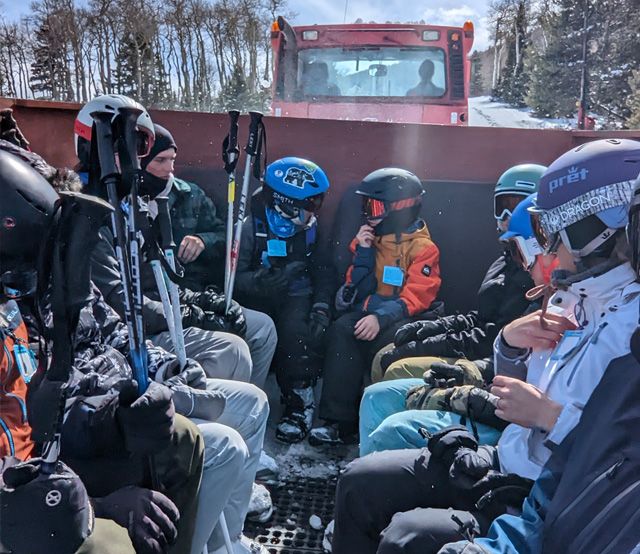
A shot of Cuchara’s “ski bus”, which is quite literally a trailer that’s outfitted with old schoolbus seats. Image: Cuchara Mountain Park on Facebook
Finally, we round out this week with a third Colorado highlight that feels drastically different from the two we just discussed. This week, we learned about a really cool, unique skiing experience being offered by Cuchara Mountain Park, a “small” ski area located in southern Colorado. Before we get into the story itself, let’s quickly review the recent history of Cuchara. Formerly, Panadero Ski Area, the mountain closed back in 2000. When it did, the land was parceled out and sold off, one piece at a time. The writing was seemingly on the wall for the former ski area, until 2017, when the local community and county joined forces to ultimately buy back the 48 acres that made up the ski hill’s base area. Ultimately the goal of that move was to reopen the lodge, rental shop, and primary ski lift. Unfortunately, due to the amount of both hands on and legal work required to get the mountain fully operational again, lifts at the resort continue to go unused six years later.
So far, kind of bleak, right? Here’s the thing: last March, over the course of five days, the ski area piloted a novel idea. In short, they outfitted a trailer with old school bus seats that could be towed behind a snowcat. With room for 22 people, the ski area began selling tickets that would bring skiers to the top of the hill, where they could either access 9 runs, or continue their vertical adventure on skins. The concept was a hit. Now, this year, the resort is offering an expanded, and incredibly affordable, version of the service. While the ski area doesn’t have any operating lifts, they do offer $40 rides on their “ski bus”, as well as an insanely affordable $200 season ticket. In other words, for $200, you can get unlimited rides to the top of a secluded mountain in Colorado, where ski trails are cut and competition is limited. For those in the area, it’s an incredible offering.
Now, typically when we cover something like this, our next question is, “that’s an amazing idea, will it catch on?” In this case, we’re not so sure. The idea of a ski resort offering rudimentary rides to the top of its slopes in a trailer being towed by a groomer doesn’t seem like something that mainstream ski resorts would be up for. On the other hand, it does make a lot of sense for a place like Cuchara, which has the feel of a feeder hill but the location of a ski area in the Rockies. With that in mind, our take is that small, overlooked ski areas that receive plenty of snow might benefit from this model, while the more “corporate” resorts likely wouldn’t be inclined to waste their resources. So what’s our ultimate takeaway here? You’ve probably already guessed it: in the ever evolving world of ski resorts, this is yet another way for skiers and snowboarders to get out and enjoy the sport in the way that works best for them. To learn more, check out the report from Ski Mag.