

Top Five Fridays: July 3, 2026
A skier gets playful at an Epic Resort on one of its snowier days, reminding us that regardless of who owns the mountain, this is what it’s all about. Vail Resorts coverage continues in our first highlight this week. Image: Epic Pass on Facebook
Hello, and welcome to Top Five Fridays, the July 3, 2026 edition! This week, we’ve got what feels like a pretty classic summer episode for you, as some of the bigger, more thematic stories we’ve been covering in recent weeks have given way to quick hitting one off stories like new inventions and controversial social media posts. We’ll get to those stories shortly, but before we do, there are two bigger topics to discuss: worrisome wildfires in Utah and Colorado, and continuing coverage of Vail’s rebuttal to Matthew Prince’s advances. In fact, let’s start there.
#1: Vail Stock Shows Slight Recovery After an Appearance from Rob Katz on Vail’s “Epic By Nature” Podcast:
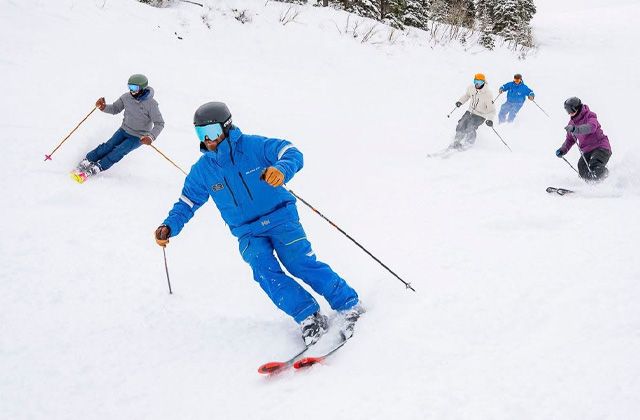
In an episode of Vail's Epic By Nature podcast last week, CEO Rob Katz outlined many ways in which ownership of resorts mattered. Creating a unified ski school experience was one of the more compelling arguments. Image: Park City Mountain on Facebook
At this point, we’re suspecting some of you are growing tired of hearing about Vail’s ongoing battles, and to be fair, we don’t blame you. That said, this showdown with Matthew Prince could prove to be pivotal in terms of whether the company continues operating as is, or if it’s forced into making some big changes. Keeping in mind the potential impact of this story, we bring you another week of mandatory updates.
Last week, we shared the news that Vail had hired a team of defense bankers to help them navigate the pressure being applied to them by Matthew Prince. At the time, we cited this as evidence that Vail is taking Prince’s threat seriously. What flew under our radar though, was a second acknowledgement: an episode of Vail’s “Epic By Nature” podcast in which Rob Katz spoke directly to why Vail’s current business model makes the most sense, as well as what he thinks of Matthew Prince’s takeover attempts.
Before diving into this one, we do want to take a real quick moment to give some background on this podcast as it’s something we’ve only just come across. Scrolling back through its history, it looks like the show ran somewhat regularly from 2018 until 2021, when Rob Katz left his post as CEO. During Kirsten Lynch’s tenure the podcast went dormant, but was revived again by Katz this past October, with episodes releasing 1-2 times per month ever since. In these episodes, Katz and other Vail Resorts higher ups discuss a myriad of issues, from labor, to weather, to recruiting new skiers and snowboarders, or, in last week’s case, a 30 minute defense of the resort ownership business model. Seeing as we’ve spent plenty of time in recent weeks sharing Prince’s side of the story, it feels only right to give Rob Katz the mic for at least one week. Here’s what he has to say:
First things first, it’s worth acknowledging that the core argument in this podcast remains the same: it’s Vail’s philosophy that ownership of the resorts on the Epic Pass is absolutely mandatory in order for them to implement their vision for a unified guest experience across all mountains. That’s more or less the company’s core mission: to create an unbeatable guest experience at every one of their resorts. While that concept is well known to us, it was enlightening to hear more about exactly how that’s being implemented at resorts.
One great example that Katz brings up is how they’re looking to innovate in the world of ski school. In the classic model, a skier or snowboarder hits the mountain, works with an instructor for a few hours or a day, presumably gets better, and then heads home. The lesson exists as a single occurrence, isolated from other lessons. What Vail is hoping to do is create some continuity between these experiences. Using the Epic app, as well as on hill photography and instructor notes, Vail imagines a world in which each lesson results in a report card of sorts, where you can view information about your performance and progress directly on the My Epic app. While this is a fun thing for guests, the real strength in the concept is that it allows your next instructor to pick up where you left off without needing to spend time getting to understand your skillset.
Beyond this, Katz also points to other benefits of having a united portfolio of resorts. Epic Gear for instance allows guests to demo any type of ski at any of the 12 Epic Resorts that offer the program. Now, it’s interesting to note that Vail owns 42 resorts, meaning the program is only available at about 28% of them, but the point remains - Vail could offer this across their entire portfolio as a result of owning each resort. Another point he makes is career growth: by owning each resort, Vail has a better ability to promote employees to leadership roles across resorts compared to single owner resorts where opportunities arise only when senior employees decide to move on. In the podcast, Katz argues all of these concepts are only doable if every resort is owned by one company, and would fall apart under a franchise model.
As for the sale of Park City? Well, Katz claims to love the enthusiasm from Vail shareholders, and encourages them to continue voicing their opinions and ideas for how to grow the company. Keeping that in mind, he argues that not only is Park City not for sale for the aforementioned reasons, but also that it cannot be sold as it’s currently operating on a 300 year land lease. Now, that seems like a bit of a stretch as lease agreements are reworked all the time, but for the moment, that’s the claim.
Interestingly enough, the combination of the defense bankers and this podcast episode does appear to have moved the needle ever so slightly in favor of Vail. Going back to last Thursday, Vail’s closing stock price was $133.34. At present, the price is $140.68, a roughly 6% increase over the week. While that may not sound like a lot, it’s a lot better than the $119.02 that it bottomed out at back on April 24th. In other words, while Matthew Prince is actively pushing for Vail to sell their resorts and citing stock prices as a core reason, the fact of the matter is that stocks are actually up 18% over the past 2 months. Ultimately that’s the trend worth watching here, as Katz’s counterargument regarding resort ownership really doesn’t matter. If stock prices bounce back, Prince’s argument falls apart and Vail survives the scare.
As always, we’ll continue to follow up with more on this as it progresses. For now, we’ll point you in the direction of the Epic By Nature podcast so you can learn more.
#2: A Low Snow Year is Turning into Devastating Fire Seasons in Colorado and Utah:
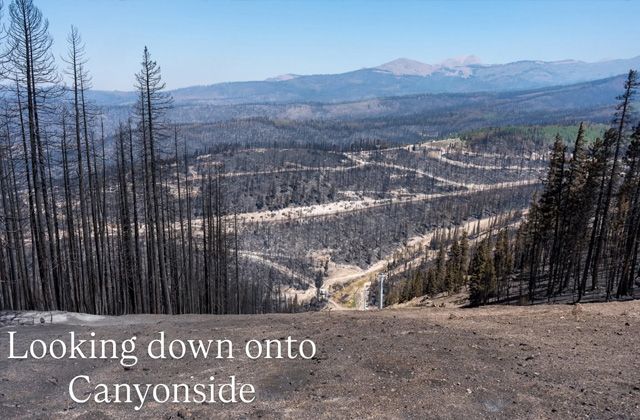
A view of an area that was highly impacted by wildfires at Utah's Eagle Point Resort. Image: Eagle Point Resort on Facebook
Next up this week is an unfortunately heavy topic that we feel compelled to share: the West is burning.
As we all know, it was a pretty tough winter for most of the West, and the Rocky Mountain region in particular, with snow totals coming in far below average. We’ve talked about this quite a bit here on Top 5, mostly with a lens focused on what it means for the economic results of the ski season. What we haven’t talked much about is how the impact of a low snow year extends far beyond that particular season’s statistics. While there are numerous outcomes from a low snow year, such as the wide ranging effects of water shortages, arguably the most destructive one is how a low snowpack can supercharge a wildfire season. It’s been known for a while now that a low snow year results in a longer wildfire season as the snowpack melts quicker and conditions become dry earlier. What’s new information though is that not only does the season lengthen, but the severity of the fires themselves increase as the lack of moisture throughout the landscape results in drier conditions that lead to worse fires.
With that in mind, it should come as no surprise that wildfire season is ramping up quickly in the West. Specifically, Colorado and Utah are currently experiencing the worst of it. In Colorado, there are currently six large wildfires underway, which have already burned roughly 200 square miles of land and are largely uncontained. In the words of the director of the state’s fire division, Mike Morgan, “I’ve been a firefighter in Colorado for 40 years and I have never seen conditions like we’re seeing out there right now.” From a historically bad snow year to a historically bad wildfire season, the connection seems clear.
At the moment, these fires have not impacted any ski areas, although there are a couple that are coming close. Roughly 20 miles outside of Aspen and just outside of Leadville, the Willow fire had already burned through 2,207 acres and was 0% contained as of Thursday. Thankfully, the fire does not appear to be heading in the resort’s direction. Elsewhere, just 10 miles from Telluride, the Gold Mountain fire had consumed 18,005 acres as of Thursday, threatening the nearby town of Ouray. Again, very fortunately, the fire’s current trajectory is taking it to the Northeast, away from both Telluride and Ouray. Still, the proximity and size of fires like this are strong reminders of the vulnerability of ski resorts in situations like this.
Unfortunately, we happen to have a perfect example of that as we share an update from Southern Utah’s Eagle Point Resort. There, the small family owned ski area wasn’t as lucky as Aspen or Telluride, as a fire tore through the resort a couple of weeks back. As it was happening, it was anyone’s guess as to whether or not any of the ski area would survive. This week, we finally learned the outcome.
As with most stories, there’s some good news and some bad news to be had. The good news is this: after assessing the property, Eagle Point owner Shane Gadbaw promised that the ski area will reopen. Considering that it found itself in the middle of what governor Spencer Cox called, “the most destructive fire in state history,” being able to reopen at all is a pretty substantial win. That said, Gadbaw has no current timeline for the reopening as a full assessment of the damage is still underway. What we do know about the damage is where the bad news comes in. While the resort itself will survive, it will do so after taking quite a hit. Lost or damaged in the fire were 4 out of the ski area’s 5 chairlifts, 300+ of the ski area’s 600 acres, the larger of Eagle Point’s two lodges, over 100 condos, 30 cabins, 5 snowmobiles, 3 vehicles, and 3 storage containers. In other words, the ski area got hit hard and is fortunate to be able to plan to reopen at all.
It’s our hope that this is how this story ends this summer. If it does, it’ll be yet another lesson in how interconnected the world of skiing is with the communities and environments around it. If it doesn’t, there will likely be more conversations regarding the impacts of climate change on our culture and communities. For now, we’ll turn you over to the Colorado Sun to learn more about the wildfires there, as well as this piece from the Salt Lake Tribune to learn more about the impact of the wildfire on Eagle Point Resort.
#3: This Week in Potentially Life Saving Technologies, We Present the “Tree Well Guardian”:
Moving right along, let’s get into some more fun topics. If you read along with us last week, you caught our coverage of a new avalanche beacon that’s hitting the market next season that hopes to reduce burial recovery times by about 30%. We were happy to share the news, as in our opinion, anything we can do to make skiing safer is a win in our book. Keeping with that theme this week, is another new safety product: the Tree Well Guardian.
Currently in development by a pair of college students at Oregon State University - Cascades, the Tree Well Guardian is a device that aims to prevent deaths that occur as a direct result of tree well entrapment. While not as notorious or as common as avalanches, tree well deaths still make up a significant portion of accidents each year, with BCA estimating that, “20 percent of fatalities in public ski areas are due to deep snow immersion.” Other sources put the number at 4-5 tree well deaths per year. In either case, it’s indisputable that this type of accident represents a real risk to powder skiers. It’s also a type of accident for which there is currently no safety device available to increase the odds of a rescue. “Currently” being the key word there.
If OSU-Cascades students Makani Hiltner and Hunter Erhard have their way, the Tree Well Guardian will be the first ever device to solve this unique issue. It works like this: the Guardian is a small, beacon size device that straps onto a user’s boot. Should that user find themselves trapped upside down, the Guardian gives them 10 seconds to deactivate it in the event of a false alarm. After those 10 seconds, the Guardian beeps. If it’s not deactivated within another 10 seconds, it will send an alert with GPS coordinates to your emergency contacts (presumably your riding party) as well as the mountain’s ski patrol.
As it stands, the device is very much in development, with early product discovery still ongoing. That said, the future is bright for the pair of students, who just won $7,500 for taking second place in Invent Oregon competition - a collegiate level product development contest. From here, the team will continue developing the product with plans to make their prototype smaller, add an accompanying app, and implement a working alert system. While we suspect the product is at least a couple of years away from hitting the market, we’ll be sure to let you know when and if it becomes available. For now, we’ll turn you over to reporting from TheInertia.com for more.
#4: California’s Donner Ski Ranch Put on Master Class in How to Go Viral For All the Wrong Reasons. But What if it Works?:
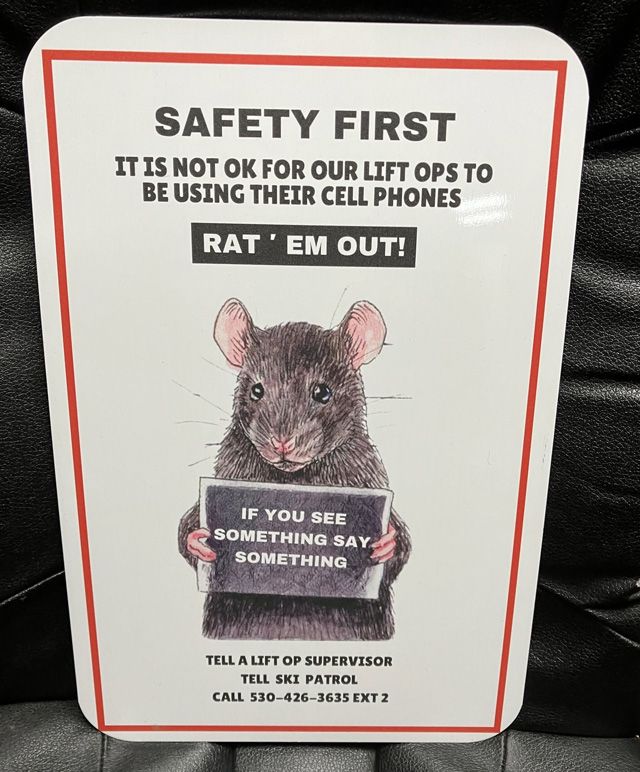
A screenshot of the sign posted not once, not twice, but thrice by Donner Ski Ranch on Facebook. Image: Donner Ski Ranch Post on Facebook
Finally, we’re rounding things out this week with coverage of a controversial social media post from a small ski area in California. There, Donner Ski Ranch, who is known for their irreverent ways both on the hill and on social media, has done the seemingly impossible: make a post that resulted in unanimous backlash. The premise? They’re asking guests to rat out their employees.
In a post made on June 24th, the ski area shared an image of new signage that they said would go up at the base of every lift. In that image, which accompanies this highlight, a rat is pictured holding a sign that says, “If you see something, say something.” Along with that is text that reads, “It’s not ok for our lift ops to be using their cell phones… Rat ‘em out!”. In other words, the ski area is leaning on its guests to keep a watchful eye on their employees, and to notify them if they’re being negligent.
Response to the post was swift and unified: it’s not the guest’s job to hold employees accountable while they’re on the job. Furthermore, guests appear to have the employees’ backs, pointing out how the sign just goes to alienate some of the most important people on the mountain. Many in the comments immediately called the post a mistake, and shamed the mountain for making it.
Now, to be fair, we didn’t expect this to be a story on Top Five Fridays. But then the ski area didn’t just double down, they tripled down in combative fashion this week, posting the image a third time, writing, “We are sorry that your moral standards are so high you will not mention an unsafe condition for your safety or the safety of others.” In addition to this statement, the resort also put out an offer: any guest that emails the resort a photo of an employee on their phone will receive a free lift ticket. In doing so, they’ve incentivized their entire customer base to police just a handful of employees.
As it stands, response to the campaign has been unanimous: no one thinks this is a good idea. Now, just to play devil’s advocate though, what if it works? Is there a scenario where, because these signs are posted, Donner Ski Ranch lift attendants actually are more attentive? And if that scenario plays out, does this mean this strategy of using your customers to monitor your employees is actually a good move? Truthfully we don’t know, but we’re curious to hear your thoughts on the matter, so be sure to leave a comment below!