

Top Five Fridays: June 26, 2026
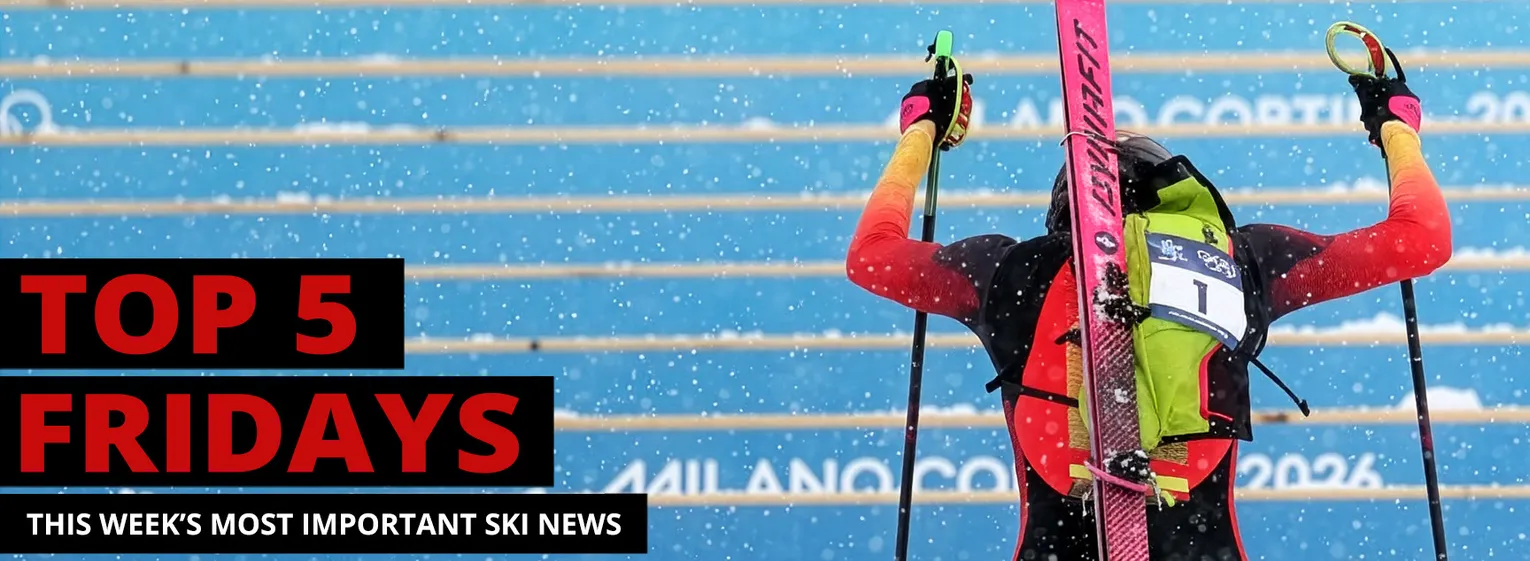
At the conclusion of this week’s IOC session it became official: Skimo is returning to the 2030 Olympics, with more events than ever before. More in highlight #1! Olympics on Facebook
Hello, and welcome to Top Five Fridays, the June 26, 2026 edition! As summer continues to heat up, ski news has begun to cool off after a hot stretch of its own throughout most of June. As such, we have a couple of stories featuring continuing coverage this week, as the IOC held their 146th session earlier this week while the Vail and. Matthew Prince continue to battle for Park City. In addition to those bigger stories, we’ll also share a couple of standalone highlights, letting you know about a potentially game changing new avalanche beacon that’s hitting the market next season, as well as results from this year’s annual ski battle on top of a power plant in Copenhagen. We’ll tell you everything you need to know regarding those stories in just a moment, but before we do, a quick announcement of our own:
#.5: Mark Your Calendar, The Fourth Annual SkiEssentials Warehouse Sale is Happening July 18-19th!

N For more information, check out the Fourth Annual SkiEssentials Warehouse Sale event page on Facebook.
If you know, you know: our annual warehouse sale has quickly become one of the absolute best ski sales in New England, possibly even North America. Pretty big claim right? Fortunately, you don’t have to take our word for it: you can read this Reddit thread and see the honest reactions.
For those of you who you don’t already know, here’s the deal: for the fourth year in a row, we’re opening our full warehouse to the general public for two days only, July 18th and 19th. Within our cavernous space, you’ll find what feels like endless sales on all types of gear. From 80% off skis, boots, and binding, to equal discounts on XC gear and snowboard gear, as well as over 50% off of apparel and accessories. With literally thousands of products on sale, it ends up being the type of sale where the deals are simply too good to pass on. So yes, it’s in the middle of July, but considering the fact that humans have been around for approximately 300,000 years and the universe is 13.8 billion years old, is the roughly 4-5 months wait until ski season really that long? Might as well stock up on new gear now. Plus, if you do go, you might just meet some SkiEssential celebrities like Jeff, Bob, and Matt. To learn more and catch up on all of the details, check out the official event page on Facebook.
#1: At This Week’s 146th International Olympic Committee Session, A Lot of Ground Was Covered:
First up this week, we’re going to attempt to share with you a broad number of highlights from this week’s 146th IOC Session. Before doing that, we want to quickly untangle a potential point of confusion. When it was initially scheduled, this week’s meeting was intended to be the time and place in which the program for the 2030 Winter Olympics would be finalized, including a complete roster of sports and athlete quotas per country. While we do have some updates there (more on that in a second), it was recently announced that those decisions would be pushed back by a few weeks so that the 146th session could be largely dedicated to one thing: the Fit for the Future Plan.
As you might imagine, there’s a lot of moving parts with a massive organization like the Olympics, and with a new round of global games happening every two years, it can be pretty easy to get caught up in the cycle without taking a moment to reassess the overall direction or goals of the organization. This week though, the IOC did just that as they finalized a new strategic plan for the group, called Fit for the Future. This newly announced framework is meant to shape all things Olympics, from overarching goals of the games such as sharing the “Olympic Values”, to more specific details, like how sports can become a part of the games, how hosts are selected, or how to best support athletes. There’s obviously far more to unpack here than we can handle in a single Top 5 Friday highlight, so for deep dives into these topics we recommend reading the respective articles on the Olympics website.
Before moving on though, we do want to quickly bring attention to one specific update: starting retroactively with the 2026 Winter Olympics, all Olympic athletes will receive a $10,000 “Fit for the Future Olympian Grant”. These grants are meant to help athletes continue to pursue their Olympic career, or transition out of sports. While that sum may be a drop in the bucket for the expenses associated with many of these sports, for some athletes, it could prove to be significant. You can learn more about this new program here.
In addition to looking towards the future, it’s worth mentioning that the IOC also spent some time looking into the recent past, examining the successes of this year’s Winter Olympics in Milano Cortina. While it can be hard to measure these things sometimes as there are countless metrics that can be used, there’s one number that was reported that says it all: 2.6 billion. That’s the number of people that the IOC reports “followed” the Olympics last year. For perspective, there are about 8.3 billion people in the world, meaning roughly 1 out of every 3 people in the world tuned into the games. Not bad. Beyond that singular massive data point, the games themselves are being seen as a success in several other ways, including through the lenses of sustainability, gender equality, broken records, and engagement. As such, the Milano Cortina games were touted as a “new model for future Olympic Winter Games.” More on that here.
Finally, the last storyline we want to include here is that, while the IOC has pushed back the deadline to finalize the 2030 Alpes program, one sport has been confirmed: Skimo. Just as we learned a few weeks ago, Skimo has been approved for a second round of Olympic inclusion, with an expansion of the discipline from 3 events to 5. Joining the Men’s Sprint, Women’s Sprint, and Mixed Team Relay, will be a Men’s Team Relay and a Women’s Team Relay. With that expansion confirmed well in advance, it’ll be interesting to see which new athletes emerge ahead of the 2030 games. We’ll find out in due time, but until then, you can learn more about this latest update here.
If you’d like to learn more about any of these stories, as well as several others that popped up this week, we’d recommend heading over to the Olympics.com and scrolling their news feed, where they’ve done an excellent job of covering each of these stories and several others from this week.
#2: As Pressures Mount, Vail Hires a Team of Defense Bankers to Assess Risks Facing the Company:
Continuing on with our continuing coverage, our next highlight this week is a new chapter in one of the more interesting stories that’s been unfolding over the past year, as a local Park City billionaire has been attempting to use the court of public opinion to strong arm Vail into selling him the ski resort. In case you haven’t heard the story yet, here’s the quick version:
Last May, CEO & Co-Founder of Cloudflare, roughly $6.3 billionaire, and Park City local Matthew Prince purchased the city’s Town Lift Plaza which provides lift access to the resort. At that time, he made it known that his long-term goals were to buy Park City and eventually connect it and the rest of the Wasatch resorts via lift, creating a massive unified ski area under a plan known as One Wasatch. When that news broke, it was so audacious that we were immediately skeptical. But, over the course of the year, a lot has happened to make this once wild pipedream seem just a little more realistic.
Two weeks ago, we shared a highlight that paired yet another round of disappointing earnings reports from Vail, with continued pressure from Prince. In his eyes, Vail stockholders should be demanding change as the company’s resort ownership model has led to an imbalance in the balance sheet. More specifically, the company’s assets have more value than the revenue that the company is generating, meaning that they should sell some of their assets to create value for investors. For shareholders in a company whose value has dropped from $372.51 back in November 2021, to $135.52 today, it’s a pretty compelling argument.
This week, we learned that the argument is actually so compelling that it’s at least partially responsible for Vail’s hiring of a team of takeover-defense bankers who are working with the company to assess its vulnerabilities. At present, the primary concern is the threat of an activist investor takeover led by Matthew Prince. It’s a concept that first popped up in this story back in August, and essentially means that Prince or a team of investors would buy such a large amount of stock in the company that they would have an outspoken say in what happens. In this scenario, it wouldn’t necessarily mean that Prince buys 51% of the shares, but it does mean that he and/or a group of similarly minded individuals buy enough shares that they can convince another portion of shareholders to join them. Purely to illustrate this scenario, pretend Prince and co. bought 26% of the shares. Then, they would only need to convince 25% of existing shareholders to join them in order to hold a majority.
While this all remains hypothetical at the moment, the hypothetical has grown in potential to a point where Vail is actively working with bankers to devise a defense plan. Alongside this activist investor scenario, Vail is also working with the team to address the myriad of other issues facing the company, from the PR nightmare that resulted from the Park City patrol strike back in early 2025, to how to mitigate the impact of a bad snow year on the company’s bottom line.
As industry observers here on Top 5 Fridays, we’ve witnessed trouble brewing at the company for a few years now as a seemingly neverending parade of issues have popped up. Now, with stock prices continuing to trend downward while existential threats trend upward, Vail has confirmed concerns in a circuitous manner by hiring what amounts to a crisis management team. With this latest development, you can be sure that we’ll be back with more as either Vail makes a move to change their trajectory, or the mounting pressure leads to further cracks in the facade. Until then, learn the latest by checking out the reports from TownLift.com or Semafor.com.
#3: There’s a New Avalanche Beacon Hitting the Market This Year, and it Might Be a Gamechanger:
Alright, now that we’ve got the big topics out of the way, let’s take on an easy one: there’s a new avalanche beacon entering the market next year, and it has the potential to be a game changer. Landing on our radar this week courtesy of SnowBrains.com, is word of the new Nivia 3D Finder avalanche beacon.
Now, to fully appreciate this new product, you need a quick understanding of how avalanche beacons currently work. If you’ve ever used one of these tools before, you know that not only are they quite literally not straightforward, but they also aren’t incredibly efficient. Because they work using electromagnetic signals, they tend to lead you on a curved path to your destination rather than a direct line. Then, once within a few meters, the search continues without directional guidance and only distance readings to let you know if you're still moving in the right direction. While experienced beacon users can be quite good at this technique, the process has a learning curve and in general is due for improvement. Afterall, finding a lost item using an Apple Airtag is currently an easier process than using an avalanche beacon. Historically speaking though, there’s been one simple problem: relying solely on satellite GPS isn’t an option due to how remote some backcountry locations can be. While this option might be viable in some areas, avalanche beacons need to be reliable everywhere, regardless of whether a GPS signal is available.
Enter: the Nivia 3D Finder. This new avalanche beacon solves the indirect search issue by giving users a GPS like experience, without the need for satellites. While we have yet to come across a specific breakdown of how the technology works, our understanding of it is this: every time the Nivia 3D Finder receives a signal from a buried transceiver, it places it on its own internal GPS map. After receiving a few of these signals, the Nivia transceiver begins triangulating the location of the signal based on its relation to previous ones. As a result, rather than leading searchers on a round about trajectory to the location, this algorithm allows the searching transceiver to very quickly pinpoint the exact location of the buried one. In doing so, it not only cuts out the circular approach path, but also the entire bracketing process that occurs when a conventional transceiver is within a few feet of the buried one. In a scenario where every second matters, this efficiency could prove to be hugely significant.
Now, while we are pretty excited about this new development, we’re compelled to pump the brakes briefly as it’s worth noting that the hardware side of these devices is just as important as the software. While the software seems to be pretty promising, and the products backwards compatibility with existing beacons is massive, it’s a moot point if the beacon itself doesn’t work well. As we saw a handful of years ago with BCA’s recall of their own transceivers, it’s absolutely crucial that the piece of equipment itself works flawlessly. Good battery life, no accidental mode switching, and reliable results - all must be absolutely dialed for this product to catch on. That said, if it does, it could prove to be lifesaving technology. For more on this or to learn how to preorder your own, check out the Nivia 3D Finder website.
#4: Team Norway Wins Arguably the Most Unique Event in Freeskiing: CopenHill’s Scandinavian Team Battle:
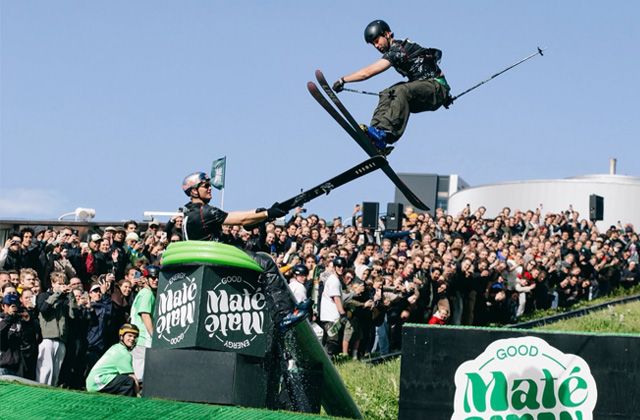
Team Canada’s Mark Hendrickson gets the assist from Max Moffat as he taps a ski during this year’s Scandinavian Team Battle. Image: CopenHill Urban Mountain on Facebook
Lastly this week, we want to bring you a quick recap of what is arguably the most unique event in freeskiing: the annual CopenHill Scandinavian Team Battle. Regular summertime readers may recognize this event as we’ve shared the replay edit from it the last couple of years, but we’ve never given it the full highlight treatment. This year though, it was reportedly the best event yet, and with a full breakdown available via Freeskier, we finally have the information we need to do it justice.
First things first, let’s address what makes this event truly unique, starting with the venue. CopenHill is a dryslope ski area in Copenhagen, integrated into the roof of a combined heat and power waste-to-energy plant. That alone is enough to make the event unique as the venue is the only ski area in the world that we’re aware of that exists on top of a power plant. But, the intrigue grew even further this year, as a qualification round gave two open-field skiers the chance to compete against the professional level talent that existed across the 6 international teams coming from Sweden, Norway, Denmark, Finland, the UK, and Canada. Amongst these teams were some notable names, such as Jesper Tjader, Max Moffat, and Mikkel BK. While the entire roster of 12 professional athletes wasn’t exactly a who’s who of Olympians, Olympic and Red Bull athlete level talent was present at a summertime dry slope competition on top of a power plant, in which anyone could sign up and enter for the chance to compete. Like we said, pretty unique.
While we don’t know the exact judging format for this competition, we do know that there are quite literally no rules, enabling athletes to get creative in an environment where features are modular and easy to rearrange. Based on previous years as well as the photos we’ve seen from this year’s event, that often means team members pair up to complete tandem style tricks. While we’ll have to sit tight for the edit to drop, we also know that it was team Norway who took home the win this year, as teammates Mikkel BK and Robert Ruud awed the judges, with Ruud’s creativity in particular standing out.
For more on this, and to see some pretty amazing photos from the event, check out the recap on Freeskier.com.