


Top Five Fridays: March 27, 2026
Does success ever taste less sweet? Only someone like Mikaela Shiffrin would know, but it sure doesn’t seem like it. Image: Mikaela Shiffrin on Facebook
Hello, and welcome to Top Five Fridays, the March 27, 2026 edition! This week, we’ve got an excellent lineup of news, with three deeply intriguing topics from around the world, plus the conclusion of the FIS World Cup Season. As it turns out, this season was a historic one in a number of ways. With plenty to get through, let’s dive right in!
#1: FIS Recap: The 2025-2026 World Cup Season is a Wrap, Concluding a Legendary Run for the U.S. Women:
When we left off last week, the regular FIS World Cup Alpine season had just concluded, and the top 25 athletes in each discipline were already gathered in Lillehammer, Norway for the final races of the season. While the overall winner of some disciplines had already been determined, such as women’s Slalom, there was still plenty to compete for as both the men’s and women’s overall cups remained up for grabs. Now, with those races having concluded on Wednesday, we finally have the answers to questions we’ve been having since the start of the season.
First things first, before we dive into this week’s results, we want to send a massive congratulations out to the U.S. Women’s Alpine Team for putting together a truly historic season. All throughout the year, we’ve found ourselves celebrating successes from multiple competitors across all disciplines. This year wasn’t just the year of Mikaela Shiffrin. It wasn’t just the year of Lindsey Vonn, or Paula Moltzan, or Breezy Johnson. This year, all four of those athletes podiumed multiple times, rewriting the story of their careers in the meantime. From the sheer dominance of Shiffrin in Slalom, to Lindsey Vonn’s incredible return to the top of the Downhill discipline - to Paula Moltzan’s steady rise as a regular on podiums and Breezy Johnson’s resurgence after being temporarily banned from competition, each one of these athletes put together a season well worth writing about. The fact that they did it all within the same season is nothing short of remarkable. It’s also a significant reason why the U.S. Women’s Team won the Nation’s Cup Title - the award for the most overall FIS points earned by a team - for the first time since 1982. Of course in saying that, we want to be sure to highlight other athletes such as Nina O’Brien, AJ Hurt, Keely Cashman, Jacqueline Wiles, and every other U.S. athlete who earned points this season. Winning the Nation’s Title is no small feat, and each and every athlete contributed to that success. A huge congratulations to all of you.
Now, with that massive triumph shared, let’s dive into some of this week’s more specific results. Taking things chronologically, finals week got started off in a big way for the Women’s team as Breezy Johnson took home second place in the Downhill. As we just mentioned, Lindsey Vonn returned this year and absolutely dominated the disciple. Then, she crashed in back to back weeks during the Olympic stretch, leaving us to wonder if any U.S. athletes would be able to fill her boots. It turns out, the answer to that question was an emphatic, “yes, Breezy Johnson.” Across her last four Downhill races of the season, Johnson finished in the top 5 in each of them, including a 3rd and 2nd place result. Throw in an Olympic gold for good measure, and it’s safe to say that this season officially marked a successful return to the circuit for Johnson.
A day later, things settled down a bit for the women’s team, with Keely Cashman’s 10th place finish in the Super G marking the best result in that race, while Breezy Johnson earned 14th. After a day off, the women returned to racing on Tuesday for what would be one of the most momentous races of the year: the final Slalom.
In that race, Shiffrin did what Shiffrin’s done just about all year: she went ahead and won. With that victory, Shiffrin broke the record for the most Slalom victories in a season, having won 9 out of 10 races. In addition to that feat, she also extended her record setting number of World Cup wins to 110 and officially secured her 9th Slalom crystal globe. Perhaps most importantly though, it put Shiffrin in position to win the season’s overall globe with only moderate pressure during the final race of the year: the Giant Slalom.
After the conclusion of the final Slalom, the math worked out so that there was only one competitor who could possibly take the overall globe away from Shiffrin: Emma Aicher. In order to do so though, Aicher would have to win the race and Shiffrin would have to finish outside of the top 15. In other words, while Aicher had a chance, Shiffrin was still in the driver's seat as a top 15 finish would award her the globe. And then, the race happened. After the initial run, Shiffrin sat in 17th while Aicher sat 4th. What once seemed farfetched now seemed reasonable: Aicher was within striking distance of 1st while Shiffrin was currently outside the top 15. And then - run two happened. Knowing what was on the line, Shiffrin locked in and skied an incredible run that moved her up 6 places, giving her an 11th place result, more than enough for her to secure her 6th overall globe. With that victory, Shiffrin is now tied with Austria’s Annemarie Moser-Pröll who earned her 6 overall globes back in the 1970’s. Ahead of her is only Marcel Hirscher, who won 8 consecutive globes from 2012-2019. While Shiffrin promises to return next season, only time will tell whether or not this 8 globe mark is one of the few remaining records she can match or beat.
As for the men, the best result of finals came in the Super G race, where Ryan Cochran-Siegle finished tied for 12th. Beyond that, the only other points-earning result came from River Radamus, who finished 14th in the Giant Slalom. While the men’s team wasn’t able to match the success of the women’s team this year (which, to be fair, no other team in the world was able to), there’s still plenty of positive momentum bringing them into the off season. Afterall, the season was filled with plenty of packed results sheets, while Ryan Cochran-Siegle seemed to find his rhythm in the second half of the year after winning another Olympic silver medal.
Looking ahead, there are no more races on the calendar for the season. Still, there will likely be plenty of off season updates in the weeks and months ahead, so be sure to stay tuned throughout the summer months! For now, we’ll turn you over to the U.S. Ski and Snowboard Team website for complete coverage of this year’s FIS World Cup Finals.
#2: The FIS Presidential Race Just Got Interesting, as Johan Eliasch Unexpectedly Faces New Competition in Upcoming Election:
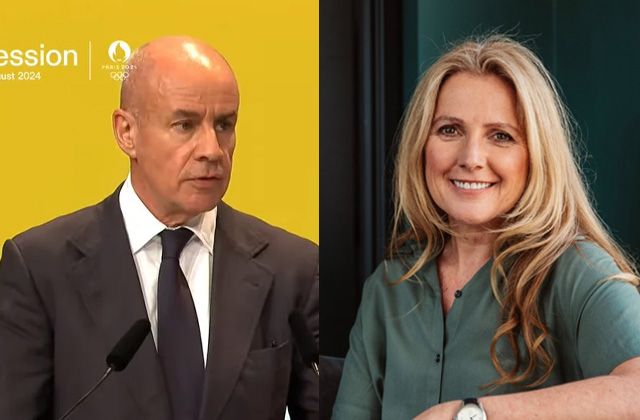
Image of Johan Eliasch via the FIS Official Website. Image of Victoria Gosling OBE via Instagram.
In other FIS related news, we have a relatively unexpected story breaking this week as it sounds like Johan Eliasch’s continued role as president of the FIS is not as certain as we once thought. Historically speaking, the FIS has always been one of the more consistent organizations in the world in regards to leadership, having only had 5 presidents in its 102 year existence, including Eliasch’s current 5 year term. That’s why it was a bit shocking for us to read a story this week in which it’s stated that Eliasch will face some opposition in the upcoming election this summer. Afterall, by many measures, Eliasch has done a terrific job implementing reforms and growing winter sports. As it turns out though, some of those reforms are exactly why some national governing bodies (NGB) would like to see him replaced.
Over the years, we’ve talked quite a bit about the FIS’s centralized media rights issue. While it remains a convoluted situation, the long and short of it is this: historically speaking, each nation has been in control of selling media rights for events taking place in its country. That’s why, for example, it can be challenging for you to find a livestream or a replay for events happening in say, Austria. For the purpose of this example, let’s say you live in the United States. In that situation, a company like NBC Sports would have to negotiate with Austria's NGB over broadcasting rights for that event. That’s all well and good - until it comes time for NBC Sports to negotiate with each and every event in each and every country. It’s a lot of work, and in many cases, it wasn’t happening.
That’s where Eliasch’s centralized rights movement came in. In order to grow the sport on a global level, he pushed for a centralization of these rights to streamline the process of providing livestreams and replays across the world. For sports fans, it's an amazing concept, and one that’s taken years to slowly bring to fruition. For “legacy” NGBs who hosted many events each year though, moving to centralized rights threatened their financial wellbeing, ultimately reducing their funding for their team. In other words, traditional powerhouses like Germany, Austria, and Switzerland have been adamantly against this plan, to the extent that they protested Eliasch’s 2022 election in the form of a walkout, and then followed it up with an appeal to the Court of Arbitration for Sport, claiming the election was illegitimate. From there, time went on, Eliasch began implementing his reforms, and we assumed all was well. As it turns out, that’s not the case.
This week, we learned that Great Britain has officially nominated Victoria Gosling OBE as a candidate for presidency at this summer’s election, taking place on June 10th - 11th. While Gosling is reportedly a solid choice for the role, the real story here isn’t necessarily that there will be a face off between Gosling and Eliasch this summer. Instead, it’s that the floodgates have likely opened now that an initial candidate has stepped up to challenge him. Now that it’s known that Eliasch will be challenged, it’s likely that several of the candidates who challenge him in 2022 will also come forth and announce their candidacy. Still, despite these challengers, it remains Eliasch’s role to lose. In a system where there are just 135 voting parties and majority wins, Eliasch has a massive headstart in terms of winning over the majority of smaller member associations who stand to benefit from the restructuring of the media rights.
All told, it’s a pretty juicy story if you’re into the strategic side of politics. If you are, we recommend giving this report from SnowSportsNews.com a read as it has plenty of additional details.
#3: A Lawsuit Has Been Filed Against Vail & Alterra Alleging Illegal Pricing Schemes and Antitrust Violations. What Happens Next Will Be Interesting:

Our third highlight this week is also arguably the biggest news of the week, and a story that many of you have likely heard already: four people have filed a lawsuit against Alterra and Vail, claiming that they are violating antitrust laws and are engaged in illegal pricing schemes. Specifically, the plaintiffs in this case argue that the two organizations are in violation of the law in two ways.
First, they argue that consolidation - to the extent that roughly 94% of “Extra Large” ski resorts are now owned by one of two companies - has harmed the consumer by steering a large segment of the skiing and snowboarding population into being customers of one of these two companies. In practice, what this argument is saying is that by owning as many destinations as they do, many locals “lose meaningful choice about where to ski.” Combined with bundling resorts on a multipass, it also prevents pass holders from visiting ski areas not covered by the same pass. That is, if the only choice in town is a Vail or Alterra resort, the locals are forced into buying an Epic or Ikon Pass. Then, when it comes time to vacation, they’re unlikely to consider going to a resort that’s not included with their pass - arguably unfairly reducing competition.
The second main argument in this lawsuit is pricing. At this point we all know: one of the primary pricing strategies employed by both the Epic and Ikon Pass is the use of exceptionally expensive daily lift tickets as a means for selling more season passes. While daily ticket prices vary per resort, we can confirm via the Colorado Sun that a single day ticket to Vail topped out at $356 this season, while Steamboat hit $339. For comparison, an Epic Pass with unlimited access to Vail is currently $1,089.00, while an Ikon Pass with unlimited access to Steamboat is $1,399.00. In either case, that’s the equivalent of 3-4 days of skiing. Optically, this is a good deal, however the lawsuit points out two potentially illegal issues. First, it harms casual skiers who may only want to ski for a day or two per year. If Ikon or Epic are the only options in town, this is predatory pricing. Second, it fuels the cycle laid out in the consolidation argument: by structuring pricing in this way, it all but forces locals into buying a bundled season pass product. In doing so, these customers are likely to never leave the Epic or Ikon ecosystem, bringing harm to independent ski areas. In other words, if your home mountain is Epic or Ikon, you have no choice but to buy the season pass. In that case, your vacation choices are likely to be informed by the pass product you purchased, not because you had a choice, but because circumstances all but forced you to.
What’s particularly interesting to us about this story is that none of these accusations come as a surprise. Since the Epic Passes inception in 2008, we’ve known about both the bundled resort and value-focused season pass offerings. We’ve known about the strategic use of expensive day tickets to sell season passes, and we’ve known about Vail’s strategy of buying feeder hills as a means to entice vacationers to visit their larger resorts. None of this is new. What is new though, is that a group of people are starting to question the legality of it all. While we certainly have no idea how this will end up, it’s certainly interesting to see, with many intriguing possible outcomes. Will new restrictions be placed on bundled access? Will daily lift tickets ultimately be capped at a certain percentage of the season’s pass? What other legal corrections could come as a result of this lawsuit? For now, it’s far too soon to tell, but as always, we’ll be sure to keep you updated as we learn more. Until then, check out the latest coverage from the Colorado Sun.
#4: After Massive Expectations, Saudi Arabia’s Futuristic Ski Area “Trojena” is Dead in the Water:
Finally, for our last highlight, we’re sharing what feels like an inevitable conclusion to what’s been one of the strangest sideplots in skiing over the last 4 years: Saudi Arabia’s futuristic ski destination, Trojena.
If this name doesn’t ring a bell, we’re truly sorry, as it’s been a highly entertaining ride watching the highs and lows of this project. First announced back in March of 2022, Trojena was just one of five ambitious developments planned within a larger project called, “NEOM”. While each of the five “regions” had their own sci-fi inspired focuses, Trojena is the one that hits closest to home for us as it promised to be the most unique ski area in the world. Built in Saudi Arabia’s high desert, Trojena was to be an entirely artificial ski resort, built in part upon a massive steel structure and heavily reliant on manmade snow. If you’re having trouble imagining this, we don’t blame you: the whole thing looks a bit otherworldly. Of course, in addition to the ski slopes themselves, Trojena also had plans to feature an extensive ski village, as well as a massive dam perched high up in the mountains.
For a while, as unrealistic and incredible as this project sounded, things seemed to be trending in the right direction. In October of 2022, Trojena was selected as the site for the 2029 Asian Winter Games. In the years since, plenty of major hospitality contracts were signed, ground was broken, and while lagging behind projected timelines, construction was underway. Then, the inevitable difficulties set in. Last August we reported that engineers were having far more trouble than expected when constructing the massive reservoir for the ski area. This week, we have a double dose of bad news.
On Wednesday of this week, we learned that the team behind Trojena has cancelled a massive steel contract, all but putting a halt to continued work on the project. When that news broke, it was positioned as a “pause” on the project as the Saudi’s looked to scale back their ambitions and refocus their efforts on a narrower version of the concept. Then, just earlier today, we learned that the Saudi’s have also cancelled a contract with the Italian construction company Webuild, who had been tasked with essentially building Trojena. In sum, those two cancellations mean that there’s no longer anyone actively building Trojena, and there are no new materials coming in. In effect, the project is dead.
While it is always possible that plans for this sci-fi inspired ski resort could be resurrected at some point in the future, at present it looks like it’ll go down as just another strange sideplot in the history of skiing, somewhat akin to the time that Walt Disney nearly built a ski resort in the 1960’s. To learn more about the end of Trojena, check out this article from CNBMe.com.
#5: And Now, Your Edits of the Week: Watch the Mental Process of Noah Gaffney as His Persistence Pays Off While Attempting a Massive Double Backflip:
Despite Being in the Game for ~20 Years, Phil Casabon Proves He’s Still One of the Most Stylish Skiers Around:
It’s SuperUnknown Season Once Again! Here’s Kyle Johnston’s Entry, But Be Sure to Head Over to Level 1’s YouTube Page to See Them All:
Click Here for Level 1’s SuperUnknown 23 Playlist