

Top Five Fridays: May 23, 2025
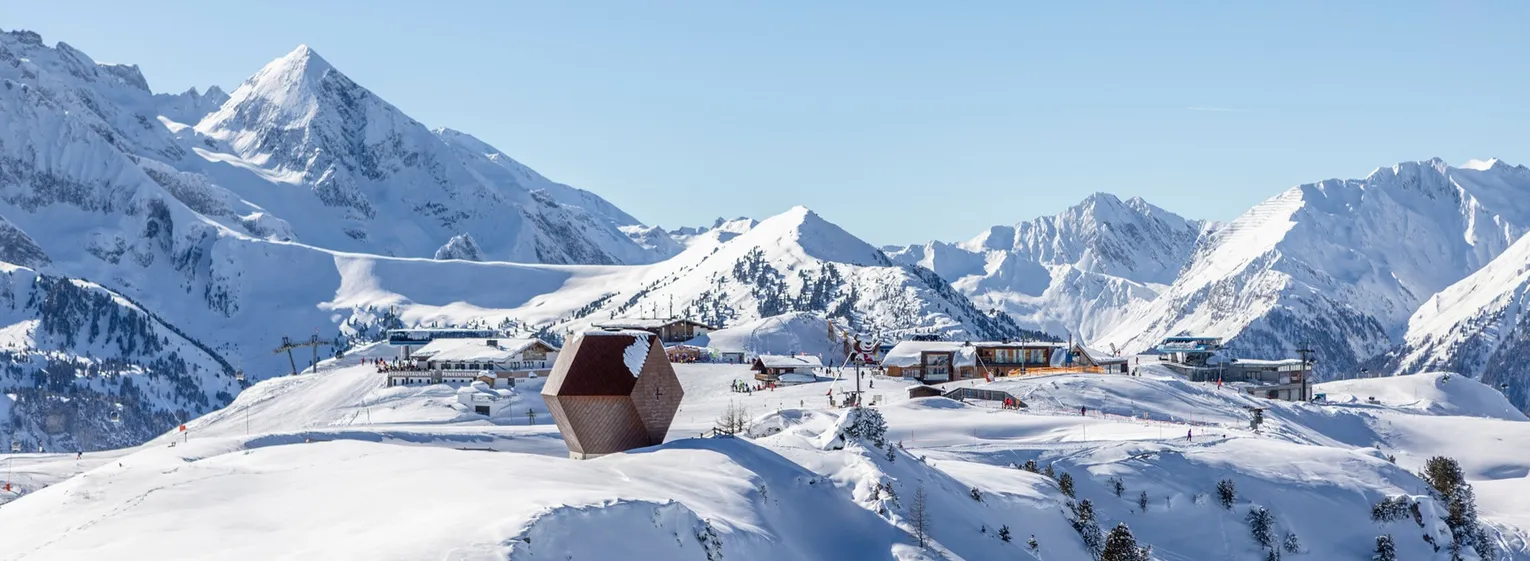
The view from the top of Hintertux, one of several Austrian additions to the Epic Pass that were announced this week. More on that in highlight #2! Image: Hintertux Glacier on Facebook
#1: Cloudflare CEO & Park City Local, Matthew Prince, Buys Park City’s Town Lift Plaza With Future Hopes of Buying the Resort and Connecting it to Alta:
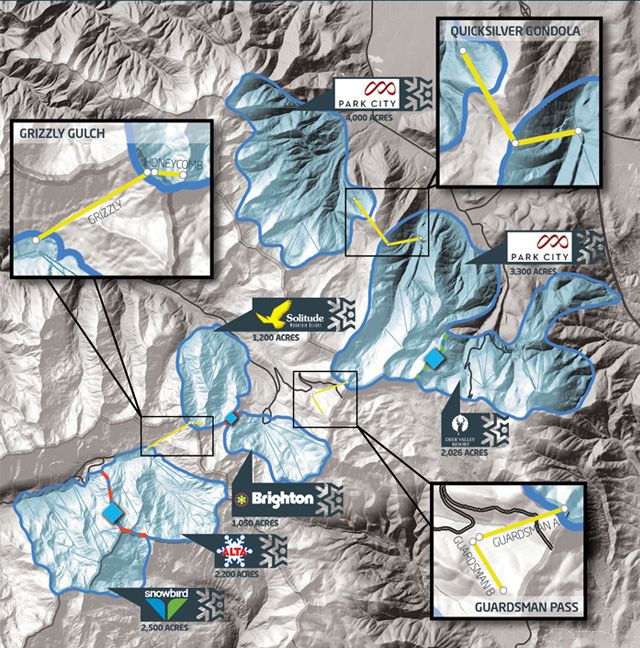
A look at the map outlining the One Wasatch concept, which would connect all six ski resorts in the Wasatch Mountains, from Deer Valley to Snowbird. To see a larger version, click here.
Hello, and welcome to Top Five Fridays, the May 23, 2025 edition! This week, we’ve got a classic summer hodgepodge for you as our highlights take us all over the world and into many genres of ski news. Case in point: our first highlight, which could either be filed under “resort development news” or “fantasy” depending on who you ask. Let’s jump right in.
On the surface, the news coming out of Park City this week is pretty straightforward: tech billionaire Matthew Prince has just purchased the Town Lift Plaza from the Sweeney family, who had owned it for decades. Located at the bottom of a lift that takes skiers and riders from - you guessed it - downtown Park City up to the ski area, the Town Lift Plaza is a prized piece of real estate that’s home to a suite of shops and eateries. Pretty straight forward, right? Well, not really, because Prince’s goals don’t start and end in the plaza.
To fully understand this story, we need to first turn back the hands of time to when Prince was just a kid, growing up in Park City in the 1980s. At that time, his family was very active in the community, with his mother owning several gift shops, his father owning a stock brokerage, and the family as a whole being involved with the construction of several local establishments, including Parlays Summit Ski Resort, the Stein Eriksen Lodge Deer Valley, and the Yarrow Hotel. In high school, Prince was also an instructor at Park City. All of this is to say, Matthew Prince grew up about as local as it gets in a town like Park City. Upon graduating high school, he went on to many years of higher education and business efforts, eventually cofounding Cloudflare, where he would make his fortunes. Now, Prince is the second wealthiest man in Utah, worth an estimated $4.2B.
“What does this have to do with skiing,” you might be wondering? Great question - let’s get back to the point. After establishing himself as a multibillionaire, Prince’s attention returned to Park City in 2023 when he purchased the Park Record newspaper (who we’ve cited many times over the years). This week, he purchased the Town Lift Plaza - one of the most sought after pieces of real estate in town. Where this story really gets interesting though, when we take into account what Prince hopes will happen next.
In the somewhat immediate future, Prince hopes to update the Town Lift, getting skiers and snowboarders on the mountain faster, and thereby giving people a better reason to venture into town to utilize this access point. What’s really interesting about this story though, are his comments surrounding that particular development. In his own words Prince wonders, “Why stop at Park City? You can, with a fairly clear right-of-way, go straight from Main Street Park City in the same length of time – 22 minutes – that it takes to ride the Town Lift today, all the way to Alta, with a stop at Solitude along the way. How amazing would that be? Could we make this like Europe?”
To us, that is the story here:
In Park City, Cloudflare CEO, multibillionaire, and local skier Matthew Prince is slowly staging a coup via acquisition. Unhappy with Vail’s ownership of the resort, Prince has now bought the local newspaper, a key piece of real estate, and hopes to upgrade one of the resort’s lifts. But that’s just the tip of the iceberg. Someday, he hopes to purchase the resort from Vail, returning the mountain to local ownership. Once acquired, he hopes to revive the One Wasatch concept, which lays out a vision for connecting nearly all of the ski areas in the Wasatch Range, creating a European-like experience where skiers can travel between multiple resorts via chairlifts (keep this concept in mind for our next highlight). While the One Wasatch idea has been around since at least 2012, it’s faced more than enough challenges to keep it at bay. Now, with a multibillionaire taking the first steps towards pursuing the dream, as well as continued drama surrounding congestion in the canyons, it’s only natural to wonder, “is this the start of something game changing?” Time will tell, and until it does, you can learn more about this particular story by checking out the report from KPCW.
#2: Vail Adds a Dozen Distinct Austrian Ski Areas to the Epic Pass, Including a Year Round Glacier:
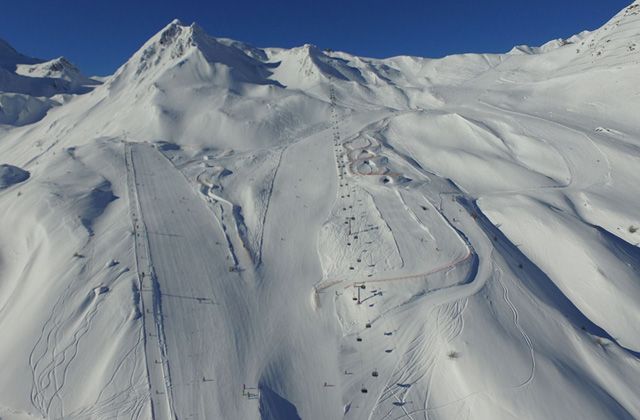
A look at the Hintertux Glacier, where Epic Pass holders have access to up to 5 days of skiing, any time of year. Image: Hintertux Glacier on Facebook
In other Vail related news this week, we’ve also got a pretty significant update from the Epic Pass in the form of European access. Over the course of Wednesday and Thursday of this week, Vail announced new Epic Pass partnerships with several Austrian ski areas, including Saalbach, Zell am See-Kaprun, Mayrhofen, Hintertux, and all of their associated snowfields.
While it’s always a little tricky to decipher, it’s our understanding that this introduces a total of 12 distinct ski areas across the four “parent mountains”. If it helps, think of these arrangements as being similar in a sense to Aspen, where there are actually four ski areas: Buttermilk, Highlands, Snowmass, and Aspen itself.
With the layout of these ski areas in mind, let’s take a look at some of the highlights of these newly announced partner resorts. First up, for FIS fans, you’ll likely recognize the name “Saalbach” as the location of last season’s World Championships. While the ski area isn’t on the schedule for this upcoming season, it’s all but guaranteed to return in the near future. The other ski area on this list that might ring a bell for some of you is Fieberbrunn, which has become a staple of the FWT in recent seasons. If fanfare and events aren’t exactly your idea of a ski vacation, don’t worry, there’s still plenty to like about these new additions. For example, at Mayrhofen, skiers can descend the steepest slope in Austria, with Harakiri measuring in at a ridiculous 78% gradient. If you’re still searching for the perfect reason to check out these new resorts, maybe Hintertux will be your answer. Home to the Hintertux glacier, this ski area operates year round. In other words, Epic Pass holders now have the ability to ski any day of the year without having to travel all the way to Europe. For some, this is surely a big deal.
Of course here on Top Five Fridays, one of the things we like to do is tie our weekly highlights into the bigger picture. In this case, it’s worth revisiting our coverage from August 30, 2024, and September 6, 2024, when we shared highlights in back to back weeks covering rumors of Vail and Alterra’s continued interests in Europe. While those stories focused primarily on Swiss ski resorts, they also shared plenty of insights into Vail and Alterra’s bigger picture goals in Europe, as well as details regarding the structure of the ski resort industry overseas. We recommend giving those a read for further information, as well as this week’s press release announcing the additions of Saalbach and Zell am See-Kaprun, as well as the additions of Mayrhofen and Hintertux.
#3: Whaleback Announces a Successful Fundraising Campaign, Thanks to a $10k Donation from Killington:
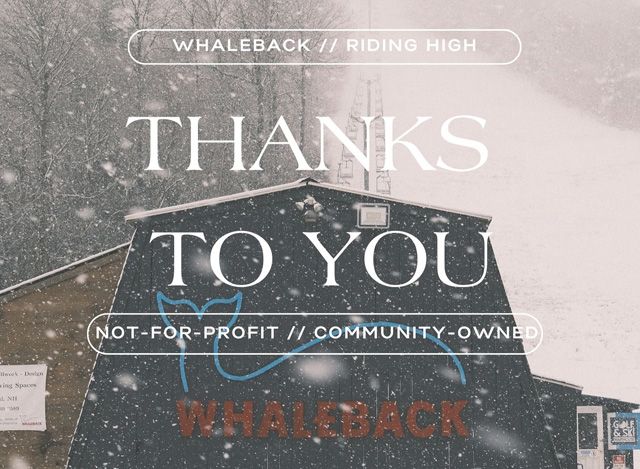
This Sunday, Whaleback Mountain officially thanked the public for their help in meeting their $250,000 fundraising goal. Image: Whaleback Mountain on Facebook
If at this point you’ve had just about all you can take of stories regarding the biggest ski resort enterprises on the planet doing what they can to consolidate the industry, well, this next highlight is for you. One of the many stories we didn’t have a chance to cover this past season was Whaleback Mountain’s unexpected hardships back at the end of February. At that time, the double chair that ran from the non-profit ski resort’s base area to the summit broke down, abruptly ending lift access for the season. Between the $100,000 bill to repair the lift, as well as projected losses from the abbreviated season, Whaleback had no choice but to launch a public fundraising campaign with a stated goal of $250,000. A daunting task to be sure, but a call that the community immediately began responding to, to the tune of $100,000 in donations in the weeks following the launch of the campaign. This week, we’ve learned more good news about Whaleback’s fundraising effort.
First things first, Whaleback has officially hit their fundraising goal. This past Sunday, the resort shared the news via their social media outlets that they’ve reached their $250,000 goal and that repair work will begin in July. As such, they fully expect to have not just the double chair open in time for next year, but a new surface lift as well.
In addition to that news, we also learned that Killington helped make this announcement possible by donating $10,000 to the effort. That sum of money reflects the mountain’s proceeds from their closing day. While $10,000 didn’t exactly make or break Whaleback’s fundraising effort, it’s worth noting that the donation was entirely optional. With significant upgrades of their own already underway, Killington most certainly didn’t have to donate the funds to Whaleback. But, they did. And as a result, they’ve contributed to the ongoing operations of a community oriented, non-profit ski area that services a certain region of New England that’s not particularly close to any significantly sized resorts. While you could argue that this is nothing more than a marketing effort by Killington’s part to try and tap into a new customer base by showcasing goodwill, the bottom line remains the same: the resort has made a not insignificant contribution to the ongoing health of community ski areas. For that, we applaud them. To learn more about Killington’s contribution, check out the report from Powder. To learn more about Whaleback’s lift problems and fundraising efforts, check out their website.
#4: After Escaping the Nazis on Skis, Klaus Obermeyer Went on to Become One of the Most Influential People in Skiing. Here Are His Flowers:
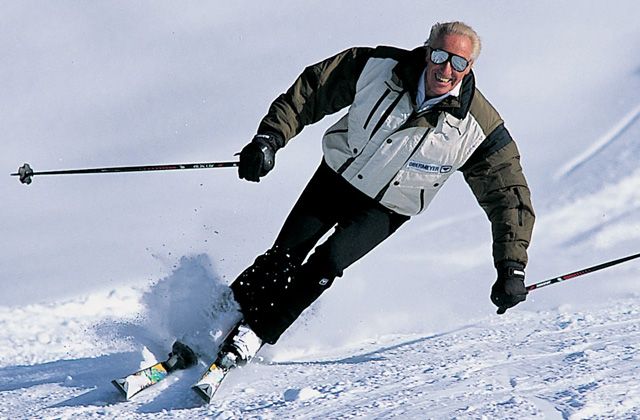
Klaus Obermeyer: a Legend. Learn more about his secrets to longevity, here.
Finally, we end this week’s highlight reel with something a little bit different. You know that saying, “give a person their flowers before it’s too late?” The one that suggests that all too often, people only pay homage to others once they’ve unfortunately passed away? Well, this week we’re taking a moment to give a certain person their flowers before it’s too late. That person is Klaus Obermeyer.
Now, you probably recognize the name as Klaus is the founder of Oberymeyer, an outerwear company launched in Aspen, CO in 1947 that has since exploded in global popularity. What you might not realize though is just how influential this man has been throughout his 105 years on earth. Take for example this non-exhaustive list of innovations credited to Klaus: the first down jacket. The first modern ski boot, meaning a hard outer shell paired with a warm liner. The first mirrored lenses on sunglasses. Ski brakes. The list goes on, but the point remains the same: Klaus Obermeyer is without a doubt one of, if not the most, influential people in skiing.
While his list of accomplishments alone would be more than enough reason to pay tribute, it turns out who he is as a person is quite legendary as well. There’s perhaps no better way to exemplify that than the impetus for this week’s highlight: the story he recently shared with The Powell Movement, regarding the time he escaped a pack soldiers of Nazis on skis, getting shot at the entire time. It’s truly the type of story you should hear for yourself, but the long and short of it is this: towards the end of World War II, Klaus was out skiing in the mountains along the border of Switzerland and Austria. It was a well known region to Klaus, and throughout the war he’d seen Nazi soldiers patrolling the border, so he knew to be careful and to check for their presence before skiing there. One day while Klaus was out for a ski, he approached a typical vantage point where he could check the border for troops and didn’t see any. So, he decided to drop into a route that took him across the border into Austria as he’d presumably done many times before. This time though, he turned a corner, only to discover a group of Nazis. Without many options, Klaus simply dropped in and skied the route as quickly as he could, all while Nazis opened fire on him. Luckily for Klaus, as well as the future of skiing, the closest they came was hitting one of the metal poles in his rucksack. After his escape, Klaus checked into a hospital to make sure he was all good, narrowly evaded more Nazies, and then continued on with his life.
And what a life it’s been. After the war, Klaus was asked to work for the U.S. Counter Intelligence Corp (CIC). After that, he relocated to Aspen where he was able to live his preferred ski-centric lifestyle. Beyond founding and growing Obermeyer into the brand it is today, Klaus also continued to embrace an active lifestyle centered around mountain culture. Today, Klaus is 105 years old, and while not as active as he was in his youth, he remains an avid skier and swimmer, citing exercise as his number one method to combat aging.
All told, none of this is exactly new news. Here on Top Five Fridays though, we do plenty of that already though, so this week we wanted to mix things up and take a moment to pay homage to an absolute legend of the sport. This one’s for you Klaus - congratulations on escaping the Nazis, developing countless innovations in the world of skiing, and remaining young at the spry age of 105. We can all only hope to achieve a small percentage of what you have with our time in this world.
To learn more about Klaus and to hear more stories, we highly recommend listening to this two part Powell Movement series.