

Top Five Fridays: November 24, 2023
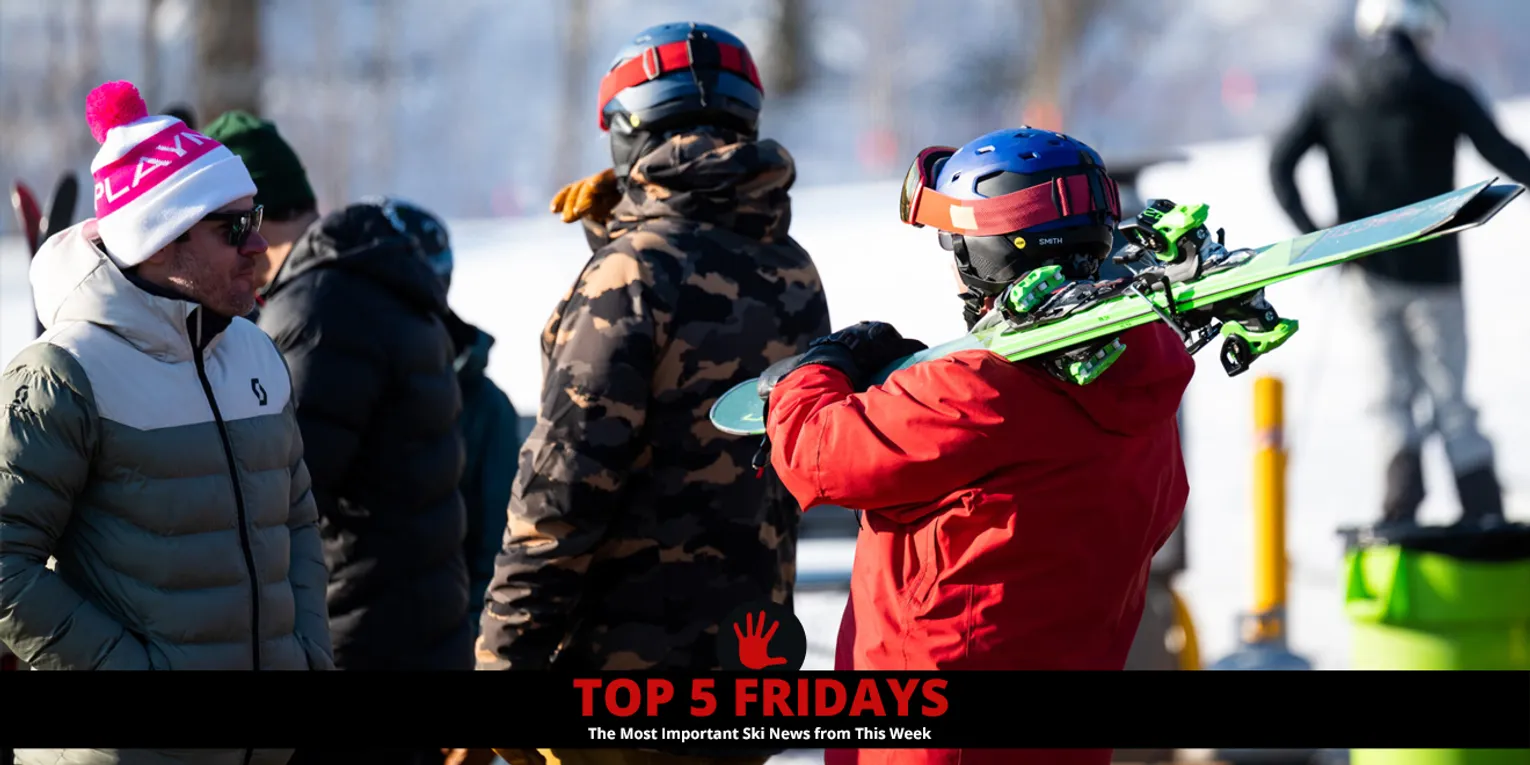
Lead Image: Last year, we learned just how big the outdoor industry has become. This year, we learned that it’s still growing rapidly. More on that in highlight #3! Image shot at our ski test last year by our very own Chris McClelland!
#1: FIS World Cup Update: More Cancellations in Zermatt-Cervinia:
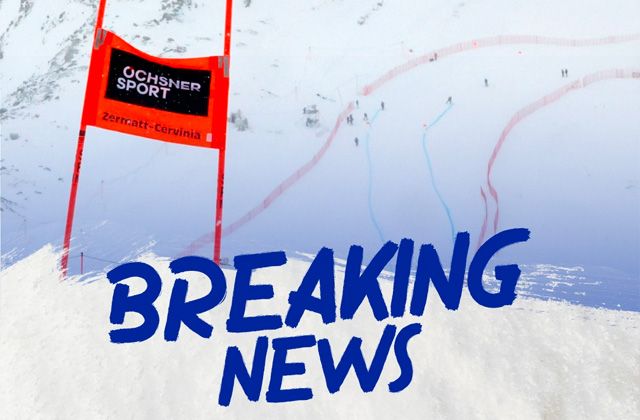
Disappointment continues on the border of Switzerland and Italy, as the highly anticipated Zermatt-Cervinia Downhill races have been completely canceled for a second straight year. Image: FIS World Cup Tour on Facebook
Hello, and welcome to Top Five Fridays, the November 24, 2023 edition! This week we’ve got a post-holiday round up that in some ways feels very similar to the recap we brought you one year ago. We’ll get into an explanation of that a little later, but for now, let’s start with a quick recap of last week’s FIS action.
We say quick because, as it turns out, there unfortunately wasn’t very much action at all. In fact, the real news coming out of the FIS Alpine world this week is the exact opposite: for the second week, as well as second year in a row, all of the races scheduled to occur in Zermatt-Cervinia have been canceled. As you’ll recall, we shared the disappointing news last week that after receiving a positive snow control, the two men’s downhill races scheduled for the weekend of 11/11 - 11/12 were called off due to high winds. Then, last weekend, the weather pattern persisted and the women’s circuit was only able to successfully complete one of the three planned training runs, and neither of the two actual races. Once again, the cancellation was due to high winds that would’ve resulted in dangerous racing conditions, particularly on the jumps. The net outcome of this news is that across the previous two years, all 8 scheduled races have been canceled due to weather - either caused by a lack of snow or significant winds.
As you’ll recall, the plot only thickens when we think back to just a few weeks ago when the FIS came under fire for pushing to host the races so early in the season, causing event organizers to engage in questionable environmental practices. In other words, the story of the Zermatt-Cervinia races is becoming this: the FIS and event hosts are trying as hard as they possibility can to host what could become an iconic race to start the season, but weather patterns are pushing back just as hard, potentially proving the race to be unfeasible. Critics of the race are calling for the FIS to simply push it later into the season, when weather will likely be more reliable. Either way, after two years of cancellations, the race is currently a universal disappointment for everyone involved, from the organizers, to the competitors, to the fans, as weeks and months of anticipation and hard work have ultimately been nullified by weather conditions. To learn more about the canceled race, check in with the FIS here, or SkiRacing.com.
On the men’s side of things, we have a glimmer of good news for the circuit as a whole, although not as much for the U.S. Team. The good news is this: the men’s season finally got underway, with a singular slalom event being successfully held in Gurgl, Austria. The bad news for us yankees, is that all of our athletes either didn’t finish their first run, or didn’t qualify. It’s been a tough start to the season for the men’s squad, as a string of cancellations have now culminated in a disappointing initial race. The good news though is, they’ll all have a chance to bounce back in a series of races next week on home soil, as Beaver Creek, CO is set to host two Downhills and a Super G race from 12/1 - 12/3. Speaking of looking ahead, it’d be downright irresponsible of us not to remind everyone that this weekend, in Killington, the women’s circuit will compete in a giant slalom and a slalom race in what’s proven to be a fruitful venue for Team America. You can preview those races right here.
#2: The Stifel U.S. Ski Team Announces 30% Increase in Prize Money, Making U.S. Alpine Races Most Valuable Contests on the Calendar:
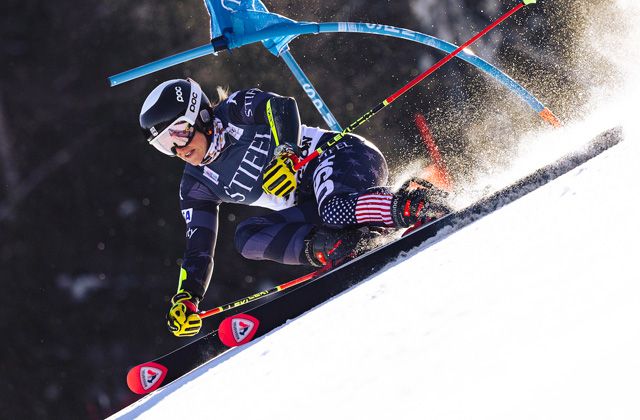
Paula Moltzan on course at Killington - one of four U.S. World Cup alpine race venues this year, where athletes from around the world will compete for the highest cash prizes on the circuit. Image: U.S. Ski and Snowboard Team Official Website
Next up in ski news is a tangential highlight that’s a big enough deal that we think it deserves its own writeup: it’s just been announced that the Stifel U.S. Ski Team has increased the prize money at all U.S. based Alpine World Cup Races. The development comes by way of title sponsor Stifel, who has agreed to pitch in to up the ante. Effective immediately, and just in time for the Killington races, the prize money for U.S. alpine races will see a 30% increase. As a result, first place finishers will now be awarded $64,300, second place will receive $30,000, and third place will receive $16,600. What makes this development even more interesting is a comparison to the prize money available at other events. In reviewing this publicly available information, we can quickly see that nearly every U.S. event for the men’s and women’s team has a first place prize of CHF 58,000 (Swiss Francs). Compared to other events, only the Zermatt-Cervinia race would’ve offered a higher purse, with CHF 60,000 awarded to first place. In other words, acknowledging the cancellation of the Zermatt-Cervinia races, the U.S. races will offer the highest cash prizes this season, besting most other races by about CHF 11,000. Pretty cool right? Well, here’s the thing: it also really matters.
Remember last Summer, when we talked about the U.S. skiing pipeline, and how crucial it is for the team to have a system in place to develop talent? Well, one of the many ideas discussed in that series was the concept of hosting World Cup events on home soil as a way of exposing young ski racers to that level of competition. By giving young ski racers first hand experience with World Cup events, it stands to inspire them to commit to the sport and to make the dream of competing at a higher level feel more attainable. In order to create these types of experiences and dreams for American youths, it’s important for the U.S. Ski Team to continue to convince the FIS that it’s important to keep hosting races here. While there’s a lot that goes into those conversations, the ability to offer the largest cash prizes to competitors has to be seen as a strong argument to continue growing the sport in America. Afterall, consider the flipside: what if the U.S. Ski Team offered a significantly smaller cash purse? What if instead of at least matching the standard CHF 47,000 first place prize money, the U.S. only awarded, say, CHF 30,000? It would make hosting races in America much less attractive, right? Ultimately for us, that’s the big news here. It’s not just a cool anecdote about the U.S. Team having a strong cash prize, but more so about the strength of the partnership between the U.S. Ski Team and Stifel Investment Bank, and how Stifel’s strong financial support could very realistically result in an influx in talent to the team for years to come. All in all, it’s a pretty exciting update, and one that you can read more about right here.
#3: The Outdoor Recreation Industry is Now Valued at Over $1.1 Trillion:
If you’re interested in learning more about this report, this 20 minute webinar from the Outdoor Recreation Roundtable shares all of the highlights.
Alright, let’s circle back here and share an update to a piece of news that we first discussed exactly one year ago: the financial power of the outdoor industry. At exactly this time last year, the U.S. Department of Commerce’s Bureau of Economic Analysis released a report that studied the economic impact of the Outdoor Industry in America. Now, just like last year, we want to clarify that this covers all outdoor sports, extending well beyond skiing. In this report, we’re considering everything from hiking and biking, to RVing and boating, and everything in between to be a part of the outdoor industry. That said, when the report was released last year, the findings were staggering: all combined, the outdoor industry contributed $862 billion a year to the U.S. economy.
This year, we’ve got our second report, and the results are even more astounding: in 2022, the outdoor industry contributed $1.1 trillion to the economy - an increase of roughly $300 billion in one year. In addition to the sheer volume, another way to look at the importance of the industry is in its contribution to Gross Domestic Product, where it’s responsible for 2.2%. In terms of employment, the industry provided jobs for five million people, or about 3.2% of the total national employment. All pretty impressive, right? Well get this: the economic value of the outdoor industry in America is more than oil and gas extraction, as well as mining, combined.
In recent years, we’ve unfortunately had to talk quite a bit about climate change, and the direct negative impacts it's having on the ski industry. We put it in that lens primarily because that’s who we are: skiers and snowboarders. But the thing is, climate change is having a significant impact on a wide swath of the outdoor industry. While the general notion is that our voice is relatively small in comparison to massive corporations who rely on fossil fuels, the truth of the matter is, as a whole, the outdoor industry actually stands to have a particularly loud voice. Afterall, we’re proving to have a significant impact on the economy, and it’s starting to get to the point where prioritizing the health of the industry and the planet could have significant financial benefits. For better or worse, it’s like they say, “money talks.” Well, if that’s the case, then this news isn’t just a feel good piece about how much people like recreating outside - it’s also a sign that our industry has the power to advocate for real environmental change. To learn more about this report, we’ll turn you over to Outside Online. To learn more about what this news means for our political bargaining power, we’ll turn you over to RecreationRoundTable.org.
#4: Utah Court Decision Could Pull Back the Curtain on Ski Resorts’ Secretive “Comfortable Carrying Capacity” Formula:
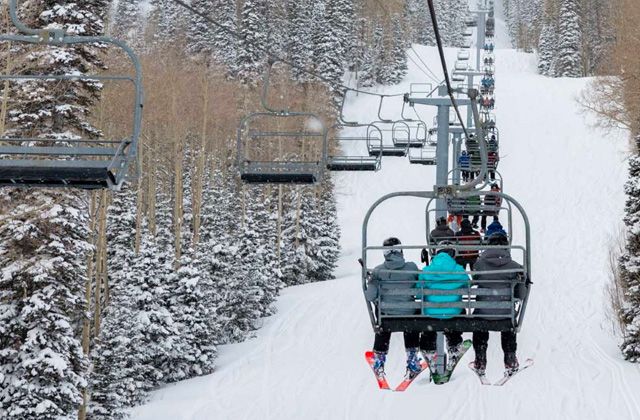
Skiers ride the lift at Park City, where the resort hopes to add another lift to reduce crowding, while locals have concerns over the impact on their community. All of this has called into question the concept of a resort’s “comfortable carrying capacity.” Image: Park City on Facebook
Finally, we round out this week with a highlight that also revisits a discussion we had about a year ago: the concept of a resort’s Comfortable Carrying Capacity. As a quick review, this concept was brought to our attention last July, when four Park City residents filed an appeal with the Park City planning commission to put a halt on Park City’s plans to build a new chairlift. At the center of their appeal was a challenge to how the new chairlift would impact the resort’s agreed upon Comfortable Carrying Capacity (CCC). In filing this suit, the group of four put a spotlight directly on a murky concept that’s at the heart of ski resort development in America. While you’d be justified in assuming that a resort’s CCC is akin to its maximum occupancy, the truth of the matter is that it’s a much more complex, and much more secretive figure than any of us ever really knew.
At the center of this appeal to the Park City planning commission, the four residents argued that the installation of the new lift would result in an increase of traffic that goes well beyond the resort’s agreed upon CCC. In doing so, they ultimately called into question the CCC figure, as well as how it was determined. In short, they wanted to know how it was determined, so that there could be a clear understanding about how the new chairlift would affect it. As a result of this action, Park City filed an appeal, arguing that their CCC formula contains proprietary information, and that revealing the details of how its derived could compromise their business. In other words, on one hand you have local residents concerned with the overpopulation of their city, and specific concerns of the resort drawing a larger crowd than was previously agreed upon. On the other, you have a resort saying they can’t discuss their agreed upon capacity because doing so would make proprietary information public. In a sense, the two parties were in a bit of a standoff. That is, until now.
This week, a Utah court shot down Park City’s appeal which in effect aimed to keep their CCC formula secretive. As a result, there’s a real chance that the resort will now have to reveal their exact CCC formula if they hope to move forward with building their new chairlift as it seems the only way for them to move forward is by having an open dialogue about their CCC number, and how they expect the new chairlift to impact it. What makes this even more interesting though, is that the conversation extends well beyond Park City. As you might’ve guessed, a CCC number is a number that every ski resort has, and is almost always used in creating master plans in conjunction with local communities. With this ruling, we’re seeing a precedent set in which ski resorts may have to be more forthcoming with their calculation of this number as it works with communities to ensure a harmonious relationship as they continue to develop.
Somewhat amazingly, we’ve only really started to scratch the surface of this issue in our coverage here. In the writeup from the Colorado Sun, we learn a lot more about what goes into this number, and why it matters so much to resorts looking to keep it secret. Without giving away too much, we’ll just say that if you wanted to, you could draw an indirect connection between the amount of time guests spend in the lodge at a ski area, and how much they pay the national forest service to lease the land. To wrap your head around that crazy connection, we recommend giving the full article a read.