
TOP FIVE FRIDAYS: OCTOBER 2, 2020
#1: Austrian Ski Town’s Role in Spread of Covid-19 Under Examination:
Known equally for its skiing and its partying, Austria’s Ischgl Resort has found itself facing international scrutiny for its role in the spread of Covid-19 at the start of the pandemic. Image: Ischgl Resort on Facebook
Before diving into this week’s news, we’d like to start with a moment of transparency. While we suspect the weeks and months ahead will be chock full of exciting news as the ski industry begins its journey on its first full pandemic winter, this week felt a bit more like the calm before the storm. There was news of course, but as dedicated skiers who’ve been following the ebbs and flows of expectations for the upcoming ski season all summer long, much of it consisted of topics that we’ve previously covered here, but that the mainstream media has yet to discuss. As such, some of the news this week may feel like a rehashing of events. We’ve tried to find articles that approach the news from new angles, but ultimately we expect more exciting news to roll in more consistently in the weeks ahead. Of course, that being said, this week’s news is still new and noteworthy, providing fresh insights that we have yet to share. If you’re someone who’s keen on keeping their finger on the pulse of the industry, we highly recommend that you keep reading!
First up on this week’s list is a story that’s been out there for a while now, but has continued to grow in exposure and importance in recent weeks. As we first shared all the way back at the end of March, the Austrian ski town of Ischgl quickly became the focus of international scrutiny for its role in enabling Covid-19 to spread. At that time, the resort town was already being accused of covering up knowledge of the coronavirus, and allowing its “party mountain” culture to continue, despite being aware of the growing spread and danger of the virus. In the months since then, the picture’s only become darke. Back in June, an international cohort of over 1,000 skiers who became sick in Ischgl filed a class action lawsuit accusing leaders at the federal level of the Austrian government for not shutting down businesses, despite knowing the risks. This week, another lawsuit was announced that specifically targets four members of Ischgl’s government, including its mayor. Again, the claim is that they were aware of the dangers of the virus, but refused to close businesses when they should have, in favor of maintaining the area’s economic status quo.
In addition to the newly announced lawsuit, we also caught a quality article from the New York Times that does an excellent job of putting the entire Ischgl incident into both global and historical context. On the historical side of things, the article reveals insights that help explain why Ischgl officials may have been led to believe that concerns regarding the spread of the coronavirus were overblown. One key reference made in the report are details surrounding a plague outbreak in India back in 1994. There, in the port city of Surat, fear spiked surrounding a potential outbreak, resulting in a global panic that included travel bans and a complete drop-off in tourism. When all was said and done, the area lost an estimated $3 Billion in business. As for the plague, it turned out to be overblown, with only 50 reported deaths- far lower than most health experts expected. Since then, there’s been a back and forth debate between politicians and health leaders between the importance of the physical health and economic health of a country. If you’re at all tuned into current events, and we suspect that you are, then this argument should sound tragically familiar. Of course, as is the case with all of our favorite articles, we can’t even begin to do the full piece justice, so we highly recommend giving it a read in full, which you can do here. As for the skiing side of things, just keep the story of Ischgl in mind this season if you find yourself wondering whether or not all of the safety precautions at your local mountain are overkill.
#2: Why the Pandemic Has Boosted the Real Estate Market in Ski Towns, a Wall Street Perspective:

How long would you expect it to take a multi-million dollar home in a ski town, such as this one in Jackson, WY? If you said, "just a matter of days," then you'd be absolutely right. Image: Zillow.com
Next up this week is another topic that we’ve touched on multiple times in recent months: the staggeringly hot real estate markets in ski towns. We first touched on this topic back in August, when we caught an article from local news outlet VTDigger that gave us some insight into the real estate markets here in Vermont, focusing on Dover, home to Mount Snow. There, home prices were up 20% and school enrollment was expected to be up 25% at the time of our reporting. Then, about a month later, we caught an update from Colorado Public Radio sharing a similar outlook for a number of Colorado mountain towns. This week, we caught yet another perspective on the topic, albeit this time from a decidedly different angle: the Wall Street Journal.
In our previous discussions on the topic, we found ourselves learning about the issue from the perspective of the local communities, including health care workers, real estate brokers, or those with insights into local education systems. In the article from the Wall Street Journal however, we’re treated to a completely different view of the issue: those doing the buying. As a result, we get the chance to either confirm or reshape our assumptions about why home sales are spiking in resort towns. While we’ll leave the opinion side of things to each individual reader, there are two particularly interesting takeaways from this article. First and foremost, while home sales on the whole are up in mountain towns, it’s interesting to note that the hottest segment of the real estate market, at least in areas like Colorado and Utah, has been the high end. There are a number of jaw dropping stats within the article, such as the fact that in the Jackson, WY region, 21 homes over $10 million were sold this summer, compared to 5 last summer, but potentially the most powerful anecdote is the one in which a Park City home listed for $15 million sold for $350,000 over its listed price, days after it hit the market, and was paid for in all cash.
The other interesting element to this story is the way in which the concept of cause and effect once again transforms itself into a complex web of circumstances. Over the course of the article, one sentiment that gets repeated by recent mountain town home buyers is the idea that the coronavirus simply accelerated their plans to relocate to the mountains. Oftentimes these buyers had been visiting the resort towns they now call home for years, and had fallen in love with the area for its contrast to their daily environments. While that slowly developing passion for mountain towns led many to decide to move there one day, the coronavirus made them take action quicker than previously expected. So far, this storyline is pretty vanilla and unsurprising. Where it gets interesting though, is when the mentality surrounding real estate enters the picture. The first aspect of that is that these new buyers realized quickly that they weren’t the only ones thinking like this. As a result, the market in their desired location was likely to become quite competitive, so the smart move would be to act fast. That’s the mentality that’s resulted in not only an explosion in home sales, but also an uptick in all cash offers and homes being sold for well above their listed price. The second aspect of this scenario that’s interesting is in regards to the thought process of selling the homes that these new buyers would be leaving behind. Again, knowing that they weren’t alone in their desire to vacate the city, this demographic was also moved to act quickly as they forecasted a decrease in demand for high end properties in or around cities. In other words, while mountain town real estate is booming, these home buyers expect urban real estate to be busting, resulting in an urge to sell their homes while they still could. All told, the article from the Wall Street Journal does a great job of providing a different perspective on the issue, and helps us all form a more complete picture of what’s behind the sudden demand for high end mountain homes. If you happen to have a paid WSJ account, you can read the article here. If not, you can sign up for a free 30-day trial.
#3: Vail Announces Additional Reorganization, Further Financial Impact of Covid-19 Revealed:

Image: Vail Resort on Facebook
In other news this week, we’ve got a couple of updates from Vail, where the corporation has just made what’s sure to be a divisive announcement. Ever since the company began acquiring ski resorts to bring under the Epic umbrella, Vail’s been working to restructure its business to work more effectively and efficiently. For the most part, that’s meant that minor reorganization and consolidation occurred whenever a new resort was acquired by Vail. This week however, we caught news of a much more significant change: the company officially cut all marketing teams at each individual resort, instead opting to create 22 new jobs at their headquarters in Broomfield, CO. While employees who’ve been cut by the resort are encouraged to apply for one of the 22 new roles, doing so would obviously require relocating to the Broomfield region. As with all things, there are ultimately two sides to this story. For employees who’ve worked in marketing at any one of Vail’s resorts, it’s obviously heartbreaking news to learn that your job simply no longer exists and that you’re out of work. For mountain communities, it’s also the fruition of a harsh reality: while consolidation has typically been a boost for local economies, it also at times means the loss of industry jobs. From a business perspective however, it’s hard to fault Vail. With 34 resorts under their ownership in North America, the consolidation of their marketing department into one location not only enables the creation of a more unified team, capable of producing more tightly aligned messaging, but it also greatly reduces their overhead by reducing the number of employees necessary to do a comparable amount of work. This second point is underscored by the second article we caught this week pertaining to Vail.
Earlier this week, the Colorado Sun published an article that takes a closer look at the financial realities facing Vail in the wake of the pandemic. To set a baseline, let’s recap what CEO Rob Katz predicted this time last year: that Vail would earn between $778 million and $818 million this year, up from the $707 million that it had earned in the 2018-2019 season. Instead, in a meeting with investors on 9/24/20, Katz revealed that Vail had only earned $503.3 million, a decrease of 29%. In addition to losing business over the course of March and April as a result of having to close its resorts, Vail also earned $43 million less over the course of May, June, and July than it had a year before. Fortunately for the company though, it’s not all bad news. First and foremost, while the earnings dropped substantially, the business still turned a profit of $98.8 million. While it’s impossible for us to know (without a full review of their financial records) what their net profit was or how long that $98.8 million will be able to sustain their business moving forward, it’s at least positive news to know that the organization didn’t operate at a loss, which could have catastrophic implications for the ski industry. Additionally, despite uncertainty surrounding the upcoming season, pass sales are actually up 18% this season, indicating that the company should be able to survive at least another winter under current circumstances. For a much deeper dive into Vail’s financial situation, we recommend checking out this article from the Colorado Sun. To learn more about their consolidation of marketing jobs, check out this writeup from Ski Area Management.
#4: Mayflower Mountain Resort Continues its Expedition:
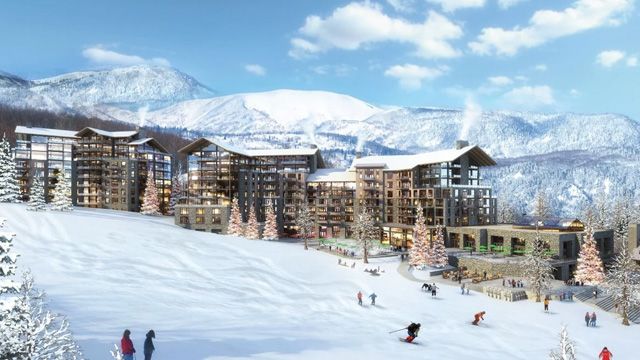
A rendering of the proposed Mayflower Ski Resort. Do take note of the real estate, which will certainly be state of the art on account of the project’s developer, Extell, known for their work in New York City. Image: Extell Utah Official Website
Finally, we’re rounding out this week’s recap with an update to a story we first shared back in August of last year, when plans for Mayflower Mountain Resort were initially announced. At that time, the news was that New York City developer, Extell, had publicly stated its intention to work with the Military Industrial Development Agency (MIDA) to develop the first large-scale ski resort and village in decades. In working with MIDA, the developers would offer members and former members of the military certain discount rates. In exchange, Extell would benefit from MIDA’s ability to bypass regulations that would typically slow the development process of a project of this scale. Just over a year later, we caught not just one, but two articles in the same week providing further insight into the project, as well as updates in regards to its current status.
First, let’s talk about where the project’s currently at. While locals in the area noticed a decline in activity coinciding with the start of Covid, an article from Park City’s Park Record newspaper informs us that the development of the resort is still on track, albeit just slightly delayed by the pandemic. As it turns out, those observant area residents were right: Covid-19 did delay development efforts on the ground level. But, the team at Extell doesn’t necessarily see that as a bad thing. As a result of being unable to work on their physical development efforts, they were forced to use the time to work on the administrative side, ultimately strengthening their foundation and plans moving forward. Now, they’re able to get back to work and have their sights set on a 2023-2024 initial opening date, at which point they expect to have one chairlift and one large-scale hotel open to the public. To read more about where Mayflower Mountain Resort is currently at, click here.
The other article we came across this week that features Mayflower Mountain Resort, is an excellent report from the Wall Street Journal that takes a look at the overarching effort behind the development plan. While the Park Record article focuses on the here and now of the endeavor, the Wall Street Journal article discusses the bigger picture, highlighting the substantial amount of risk that Gary Barnett, head of Extell, has decided to take on with this venture. While there are a number of details discussed in this article, including the substantial amount of money that Bartell’s already spent, and the $2 Billion in total that he expects to spend, one risk in particular stands out the most: Bartell’s hope that Mayflower Mountain will one day be connected with Deer Valley. While geographically the idea makes plenty of sense, as Mayflower Mountain will share the same mountain as Deer Valley, simply occupying a different face, the difficulty lies in convincing Deer Valley to open up its country club-esque culture to larger crowds. Known as one of the most elite ski resorts in America, Deer Valley skiers have already voiced concerns with joining the mountains, indicating that they’d prefer to retain their exclusivity. As a result, talks between the two businesses have rendered no results. While this isn’t necessarily a make or break factor for Mayflower Mountain, a successful agreement would do wonders for mitigating Extell’s risk. For more on this, check out the article from the Wall Street Journal.
#4.5: Don't Forget, Our 2021 Ski Test is Now Live!