

Top Five Fridays: October 6, 2023
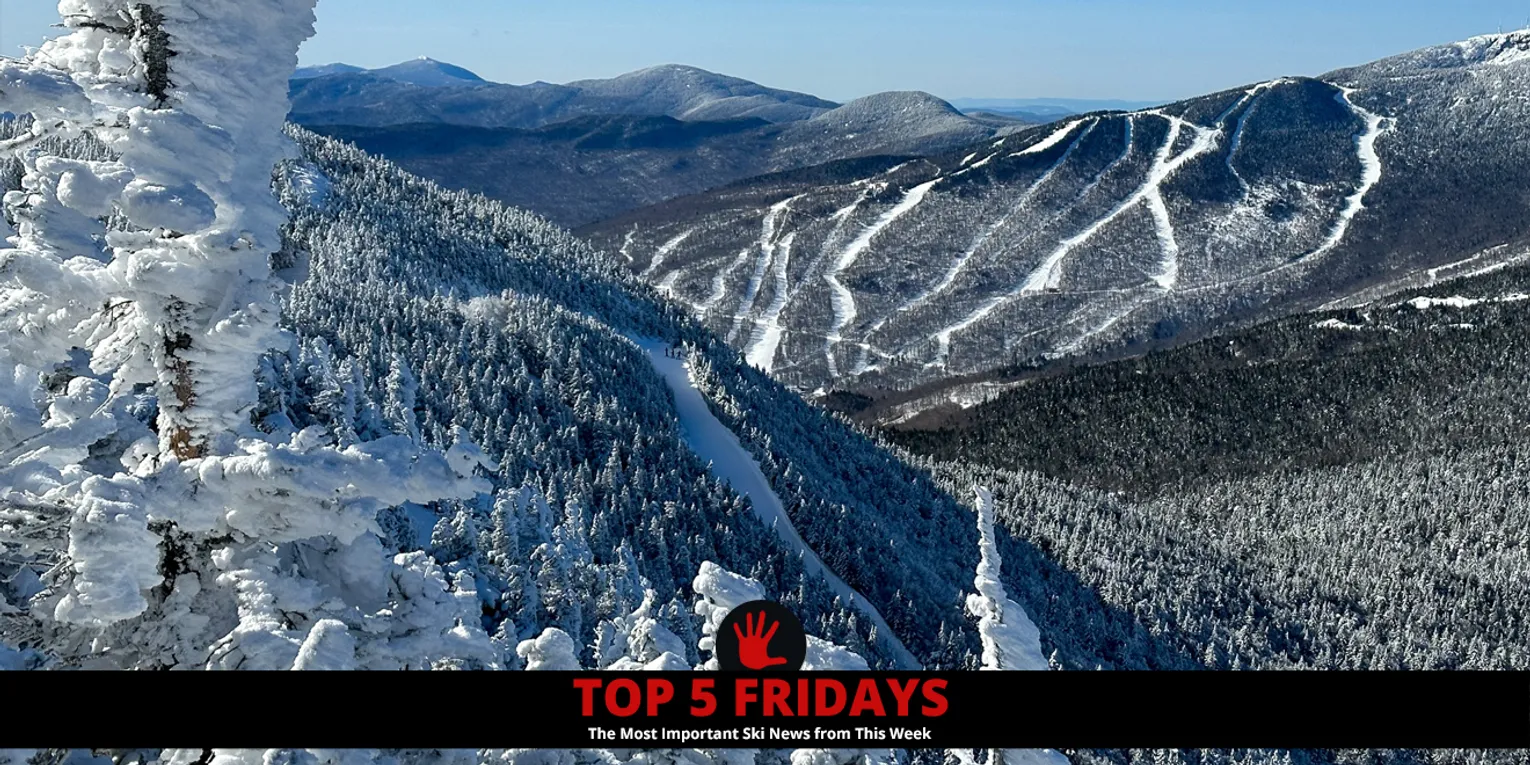
Lead Image: A view from Smugglers’ Notch, looking across to Stowe Mountain Resort. This week, hopes for a lift to connect the two resorts took a significant hit as the state affiliated committee tasked with researching the project unanimously announced their lack of support. More on this below. Image: Smugglers' Notch Resort on Facebook
#1: The Stowe - Smuggs Connector Lift Has Been Put on Hold Indefinitely:
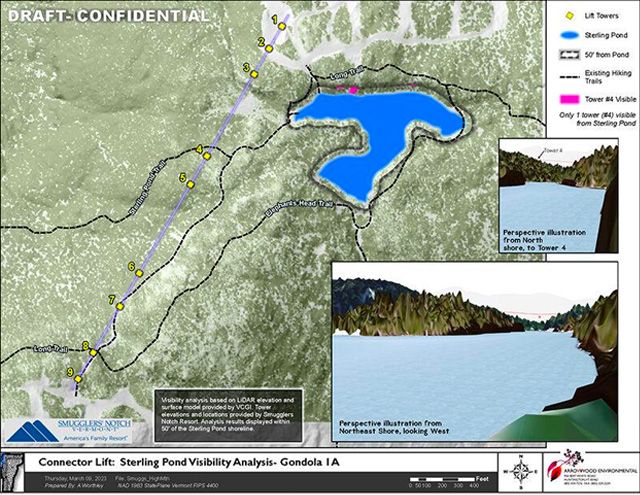
Diagram showing the proposed location of the connector lift. For a slightly larger version, click here.
Hello, and welcome to Top Five Fridays, the October 6, 2023 edition! Hot on the heels of last week’s update, which was packed full of intriguing topics of discussion, we’re back with a second round of headlines that piqued our interest across a variety of themes. Some weeks the off-season ski news is boring. Other weeks it’s full of interesting stories that prompt bigger questions and debates. This week’s news is certainly the latter.
Kicking off this week’s highlight reel, we’ve got a headline from our own backyard: plans for the Stowe - Smuggs connector lift have been withdrawn indefinitely. As you’ll recall, news broke back in June that Smuggs and Stowe had been in secret discussions regarding the potential development of a lift to connect the two resorts. Response to this news was wide ranging, with some loving the idea of an East Coast mega resort, others fearing the idea of Smuggs eventually succumbing to Vail’s consolidation efforts, and just about everything in between. When this news broke, there was a lot to talk about. For many, at the top of the list of concerns was the potential environmental impact that the lift would have, as well as how it would change the skyline for one of the region's most popular summer hiking trails. This week, we learned that these concerns have trumped all others as the Agency of Natural Resources (ANR) committee tasked with researching this project has unanimously agreed that they won’t be supporting the project’s efforts moving forward.
In a memo published announcing their decision, ANR committee member Brad Greenough wrote, “the proposed project is located on a portion of state lands that are not compatible with the type of use proposed for the area… It is unlikely any strategies to avoid or minimize impacts associated with a project of this nature could result in it being compatible with an area of such high ecological sensitivity and social value.” In other words, in the eyes of the ANR, the land that would be used for this connector lift is simply too valuable of an ecosystem, and too widely used as a recreation area, for there to be any way in which the lift would make sense to develop. With their decision announced, ANR secretary Julie Moore voiced her support for the decision, and while not ruling out the possibility of a lift forever, said, “ I agree with the memo’s assessment, which is that this would be a really significant lift for anyone to pursue this sort of project and may, in the end, be insurmountable.” Recognizing that the lift would be built on state land, and that cooperation from the ANR would be necessary for its approval, Smuggs owner and GM Bill Stritzler has withdrawn the proposal indefinitely.
Keeping all of this in mind, it’s worth noting that Stritzler’s dreams for this project aren’t entirely dead yet. While he recognizes the environmental hurdles the project faces, he maintains two beliefs: one, that the committee didn’t give his environmental studies enough credit for their impact mitigation, and two: that the overwhelmingly positive economic impact that connecting the two resorts would have on the rural communities surrounding Smugglers’ Notch could be enough to convince the committee to change its mind. As such, Stritzler has decided to focus his future efforts on researching the potential economic impacts, with hopes that his findings will make his proposal persuasive enough to be reconsidered. Our guess is that that research will take a couple of years to come together, so we’ll circle June 13, 2025 as the day on which we’ll bring you the next update from this story. Until then, check out this report from the Vermont News and Citizen to learn more about where the project currently stands.
#2: Indy Pass Announces Addition of 50+ Partner Resorts, Details to Be Revealed on October 10th:
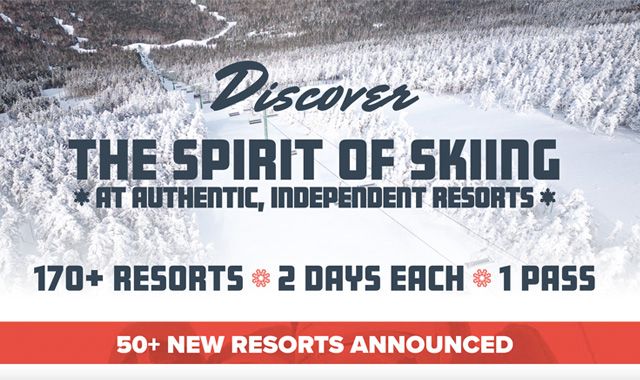
The homepage for the Indy Pass has been updated to reflect its new offering of access to 170+ partner resorts. Image: The Official Indy Pass Website
Next up in ski news this week, we have an update from the Indy Pass which continues to carve out a lane for itself as a powerful counter-offer to the Ikon and Epic Passes. For those of you living under a rock, the Indy Pass is a unique ski pass in which pass holders receive 2 lift tickets to well over a hundred resorts. It’s also wildly popular. When passes went on sale on April 1st, the company had to suspend sales just 10 days later out of fear of overselling and causing overcrowding issues at its partner resorts. This week, the company announced two updates that it hopes will alleviate that issue while continuing to provide its pass product to more skiers and riders.
In a brief blog post this week, the Indy Pass announced that it has added 50+ new partner resorts across three continents. That move brings their total number from the 120+ range, to 170+. While the full list of resorts has yet to be announced, the messaging suggests that there will be additional resorts added to their North American and Japanese rosters, with new European resorts as well, marking their first foray into the continent. With that move, the Indy Pass now has a presence in three continents, and depending on the locations of their European and Japanese resorts, may have just made themselves a viable option for those looking to go ski vacationing abroad.
The other part of this week’s update from the Indy Pass is that they’ll be reopening pass sales to those who’ve joined their waitlist, starting on October 10th. While we don’t know the details of how this will be rolled out, whether they’ll open sales incrementally or to the entire waitlist all at once, we do know that in order to be eligible to buy a ‘23/’24 Indy Pass, you’ll have to add your name to the list. If you’re interested, you can do so here.
#3: New York’s Windham Mountain Rebrands, Announces New Semi-Private Model. The Locals Are Not Pleased:
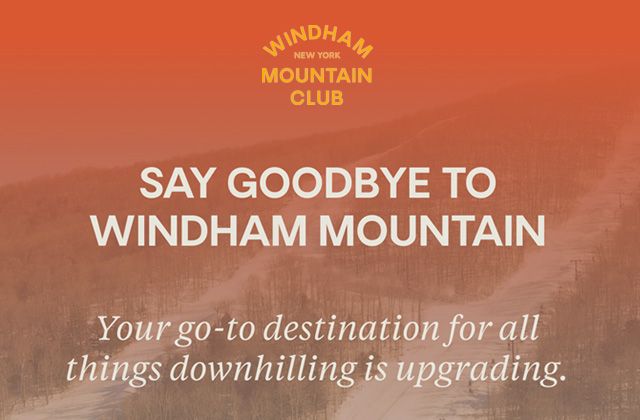
Along with its rebrand as “Windham Mountain Club” came a new brand voice and marketing campaign that many locals find offensive for the way it seemingly dismisses the mountain experience at Windham that they’ve come to love. Image: Windham Mountain Club website
For our third highlight this week, we’ve got a headline that we find downright fascinating. Not necessarily in a “good” or “bad” way, but in a, “huh, now that’s interesting,” kind of way. This week, New York’s Windham Mountain announced that it has now become the “Windham Mountain Club.” In making this change, the mountain is going through a complete overhaul. More than just a rebrand, the Windham Mountain Club is reflective of widespread change across the resort, as ownership looks to pivot the mountain into a semi-private, luxury experience. Prior to this week, Windham Mountain could be mentioned in the same breath as countless other mid-size ski areas, notable for their recreational and economic value to local communities.. Starting this week though, the Windham Mountain Club is seemingly aiming to be mentioned amongst the likes of the Yellowstone Club, Wasatch Peak, and other resorts looking to move to a private model, like Homewood Resort in Tahoe.
Alongside the new name, the resort has also announced a number of changes to the ski area, chief amongst which is a new membership model. While we don’t know the cost of membership as it hasn’t been made public, we do know that becoming a member of the club comes with a slew of exclusive benefits, for which we have to imagine a sizable cost is involved. Amongst the member benefits are things like exclusive member restaurants, concierge and valet services, private lockers, a private golf course, and much, much more. While it should be noted that the resort will continue to sell lift tickets and passes to the public, it’s clear that their goals are to become a more exclusive destination.
In addition to these experiential changes, the Windham Mountain Club has completely overhauled its marketing efforts. From the resort’s logo, to its website, its brand voice, and even marketing materials, it’s clear that the new owners of Windham Mountain are looking to present themselves as an upscale mountain experience, likely with the New York City market in mind. As you might guess, longtime locals of the resort are borderline furious with this development, and reasonably so. In announcing these changes on social media, Windham’s message has been along the lines of erasing history, replacing an old timey vibe with a new exclusive, luxury resort. Of course the bottom line for Windham’s new owners in regards to this gamble is not whether or not they keep longtime guests happy, but if the changes result in increased revenue for the resort. Ultimately, if the shift to a more exclusive resort increases their bottom line, then it will prove to be a successful business move, locals be damned.
For us, that’s what makes this story fascinating. Not good, not bad, but fascinating. As the ski resort industry continues to shift, with the ripples of consolidation requiring mid-sized resorts to find new ways to draw crowds, the idea of privatizing ski resorts has slowly grown in popularity. While this model is still youthful, it’s certainly one that we continue to see being tested and developed at ski resorts across North America. Whether this proves to be a positive development in terms of creating the ideal ski resort experience for everyone, or a negative one due to its reduction in community driven ski areas, remains to be seen. For now, we recommend checking out the new Windham Mountain Club website, as well as their Instagram, where their new marketing efforts are being met with relentless comments.
#4: Trollhaugen’s Snow Farming Efforts Prove to Be Wildly Successful:
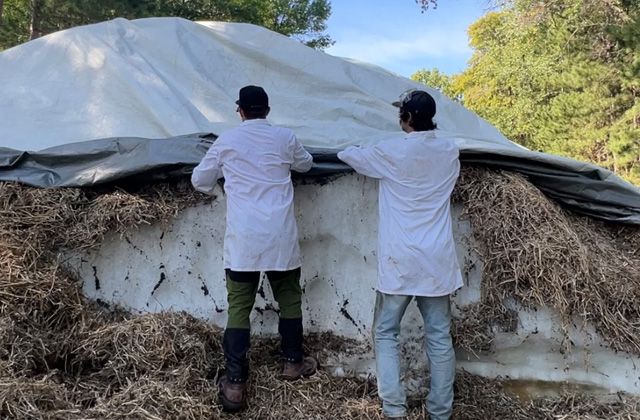
Trollhaugen’s “snow scientists” uncover the snowpile they successfully farmed over the duration of the summer. Image: Trollhaugen Troll on Facebook
Finally, we round out this week’s news with a cool story coming out of Wisconsin, where local ski resort Trollhaugen is set to host their annual Open Haugen Snow Fest this weekend. Amongst the preseason activities included at this event will be a Red Bull sponsored rail jam, constructed entirely with snow that’s been preserved since last season thanks to the resort’s snow farming efforts. It’s a concept we’ve discussed previously here on Top Five Fridays multiple times, but if it’s new to you, here’s the long and short of the technique: at the end of the season, a ski resort collects all of it’s leftover snow into a massive pile and then covers it with some form of insulation. The form of insulation varies, but in the case of Trollhaugen, it was a combination of an insulated tarp, and 2’ of hay. For the most part, snow farming has been used for things like ensuring early ski resort openings or pre-season rail jams such as this one, but what caught our attention about this week’s highlight is just how successful the technique has proven to be, and with such little effort to optimize the process in a large scale way. Allow us to explain.
In the article from MPR, we learn that when Trollhaugen built its snowpile at the end of last season, it was approximately 100’ long by 20’ tall. When they revisited it this Fall, it had shrunk to approximately 50’ long by 12’ tall. Since we don’t have a width to work with, let’s just base some math on the assumption of a 1’ width. With that assumption, the initial pile would’ve been 2,000 cubic feet, while the resulting pile would have been 600 cubic feet. That means the resort was able to preserve 30% of its snow. Now, let’s look again at how they did it: by pushing a big pile of snow into a shady area, and covering it with 2’ of hay and an insulated tarp. Again, while we don’t at all mean to take away from the success or the efforts of the team at Trollhaugen, our inquisitive minds can’t help but wonder what the implications could be if this technique were pushed further.
Consider this: Trollhaugen is a ski resort with 80 skiable acres and 280’ of vert. Park City, on the other hand, is a ski resort that closes well before its snow melts each year, and also happens to have a 3,200’ vertical with 7,300 skiable acres. Now, we know that not all of that terrain would be snow farmable, and there are obviously many, many other considerations such as how long it would take to farm that much snow, or the environmental impact of running groomers for that long, but the thought remains: imagine if a resort like Park City committed to snow farming? How much snow could they preserve? What if they optimized the effort and that 30% conservation rate hit 40 or even 50%? When early season comes along, would the preserved snow help them reopen without relying on man made snow? Would the reduced snowmaking effort ultimately lower the environmental footprint of the resort? Ultimately, these are the thoughts and the bigger conversation that makes this week’s news from Trollhaugen intriguing to us. If a small ski hill in Wisconsin is able to preserve a significant amount of snow with modest efforts, what could be achieved at a large ski resort with significant effort? While it’s amazing that Trollhaugen was able to preserve enough snow to host a rail jam, we’re ultimately even more impressed by what the team there may have stumbled upon in terms of providing a reliable skiing experience amidst an uncertain global climate. To learn more about Trollhaugen’s efforts and their upcoming event, click here.