

Top Five Fridays: September 12, 2025
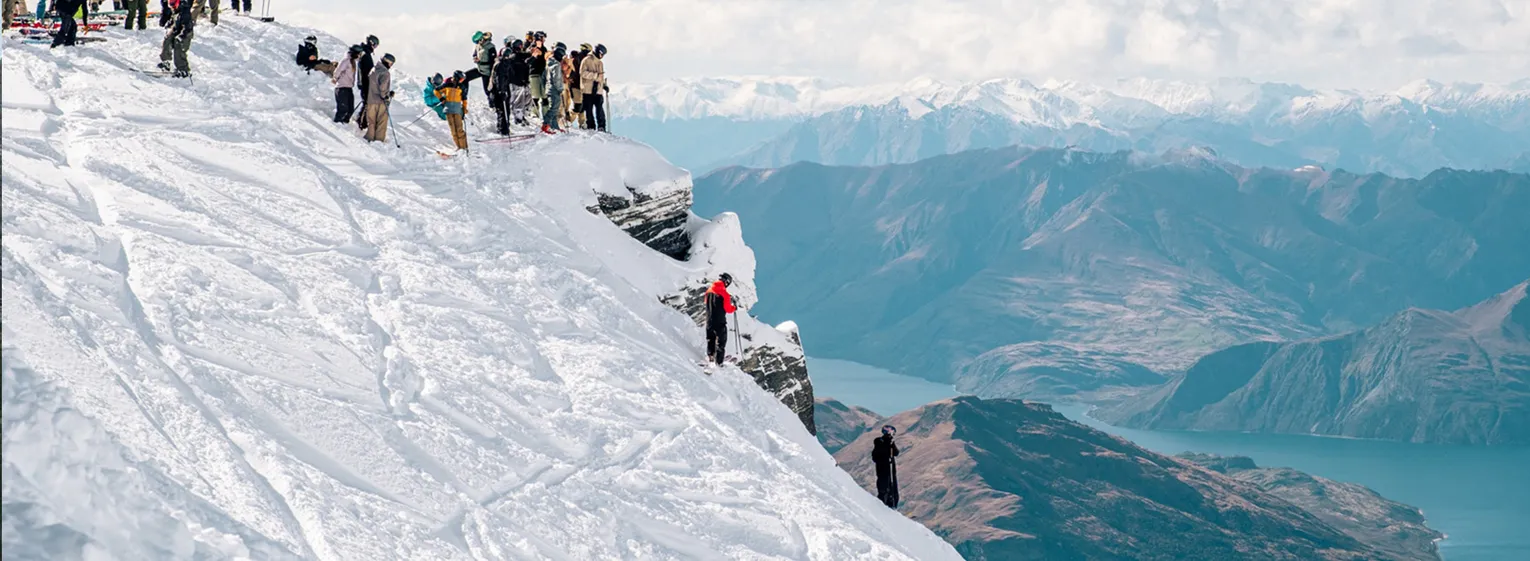
With fresh snow and plenty of freeride athletes in town for the Backcountry Invitational, Treble Cone, NZ appears to have been quite the scene last week. More on that below! Image: Treble Cone Ski Area on Facebook
#1: The Backcountry Invitational’s Second Test Event Was Just Held in Treble Cone, NZ. Here’s How it Went:
Hello, and welcome to Top Five Fridays, the September 12, 2025 edition! This week, our first two stories fall under what we’d consider continuing coverage, while the second half of our report shares two stories of the standalone variety. From exciting new competition formats, to AI ski training, college ski hills, and more lawsuit news, this week’s truly got something for everyone. So if you’re in the mood to learn, lean back, kick your feet up, and let the knowledge pour on in.
Kicking things off this week in our “continue coverage” section, is an update from Treble Cone, New Zealand, where the Backcountry Invitational has just held its second ever international test event. Just to quickly jog your memory, the Backcountry Invitational (BCI) is a new series currently being explored by the team behind the Nendaz Backcountry Invitational - an annual freeride event taking place at Switzerland’s Nendaz ski resort. In this particular competition format, athletes compete on what’s essentially a hand-built slopestyle course across natural terrain. With five editions of the Nendaz event under their belt, the team behind the BCI announced earlier this summer that they’re currently exploring the idea of turning the one off event into a full blown, worldwide series. Back in August, the first ever international test event of the Backcountry Invitational was held in Argentina. While the competition itself seemed to go smoothly, the conditions were much firmer than what we’re accustomed to seeing in Nendaz, leaving us unsure about the viability of extending the format to an international series.
Last weekend, the BCI held its second international test event, this time in Treble Cone, New Zealand. Unlike the Argentina event, the Treble Cone venue featured much better conditions, with fresh snow coating the mountain. While not a full on powder day, the handful of inches that did land prior to the event made for smooth transitions across a variety of landings. As a venue, the Treble Cone stop more or less followed a rolling gully, seemingly flanked by groomers. As such, there were a multitude of features, ranging from hip jumps, to cut outs, to straight up wedge style booters. Between the playfulness of the terrain and the quality snow conditions, the Treble Cone stop felt a lot more like the type of competition series that the team behind BCI imagines bringing to life.
Looking ahead, it’s still too soon to know what’s next for this potential series as organizers will likely need to debrief before settling upon their next move. Logistically speaking, it seems as though both test events went well, earning praise from the athletes involved. Had Argentina had better snow conditions, it would be a no-brainer for us outsiders to consider this test series a smashing success. Seeing those conditions though, we’re left wondering whether or not the weather could be the one factor that derails this concept. Still, we’re feeling quite optimistic that the team will figure it out and bring the BCI series to life in the near future. Afterall, it’s not as if the Freeride World Tour and FIS sports don’t occasionally see their own events cancelled due to conditions. With a few months to go before competition season really gets underway, we’re sure we’ll hear more about their plans soon. For now, check out the event coverage from DownDays.eu.
#2: With Oregon’s Ski Insurance Situation on the Precipice of Disaster, a New Lawsuit Has Been Filed Against Hoodoo Ski Area:
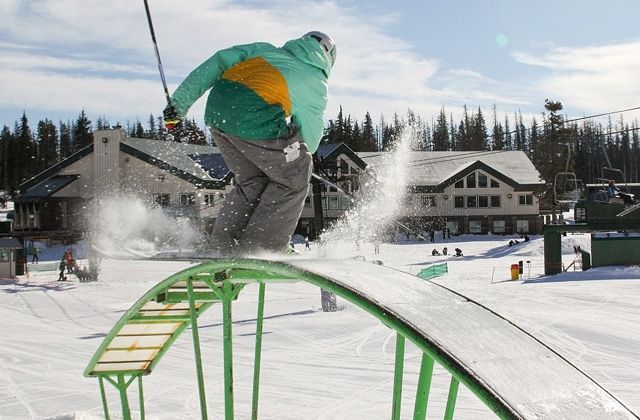
A shot from Hoodoo’s terrain park, just months before the incident in question occurred. Image: Hoodoo Ski & Recreation on Facebook
Next up this week is a story that, to be quite honest, we really tried our hardest not to share. Afterall, discussing lawsuits on a weekly basis isn’t exactly our idea of fun. But, the thing about it is, this story feels particularly important as it adds even more pressure to a situation that’s already nearing its breaking point. Allow us to explain:
This week, we learned that a new lawsuit has been filed against Oregon’s Hoodoo Ski Area as the result of an accident that occurred back in March of 2021. This time around, the plaintiff is a young girl who was just four years old on the day of the incident. On that fateful day, she was skiing through the terrain park which runs parallel to a beginner run, when she fell in the landing zone of a jump. Moments later, another skier cut into the terrain park from the beginner run, hit the jump, and crashed into the girl on the landing. As a result, the plaintiff suffered multiple broken bones and a concussion. Now, her family is seeking $4.6 million in compensation to cover the cost of several surgeries and medical bills measuring into the hundreds of thousands of dollars.
For our part, we’re not going to get too much further into the details of this particular case as we’ve done quite a bit of legal examination over the summer and we’re feeling a little burnt out on it. After all, we’re skiers, not lawyers. Instead, we’re going to focus on the bigger picture here: Oregon’s precarious insurance situation.
If you joined us on June 20th of this year, then you might recall our coverage of the troubling situation unfolding in Oregon. At that time, we shared the story of just how difficult it’s becoming for ski areas in the state to find insurance companies willing to cover them. In fact, at that time, the second to last insurance company operating in the state had just announced its decision to leave, meaning there’s now just one insurance company left to cover all of the resorts. As we learned then, the specific issue in Oregon is that state laws give very little power to liability waivers, putting businesses like ski areas, gyms, rafting companies, and a myriad of other operations, at risk of losing lawsuits. Because of that, insurers have been facing financial losses in the state for years, forcing all but one to leave. In our coverage that week, we quoted the senior vice president of the last remaining insurance company as saying, “If we end up with very large verdicts or nuclear verdicts, it’s going to force our hand.” In other words, the last remaining insurer is barely hanging on, and now, there’s another lawsuit in the works. Making matters worse, the state legislature failed to act on a bill that would have given liability waivers more power prior to the ending of their last legislative session, which could have eased the situation. Now, revisiting the proposed bill likely won’t happen until the state’s 2027 session.
Again, we wish we didn’t have to share this news this week, but in the end, it could prove to be a significant development as this latest lawsuit is yet another piece of straw being added to an already overburdened camel’s back. For more on this week’s news, check in with OregonLive.com.
#3: At Colorado Mountain College, Their Students Are the Future Workforce of the Ski Industry. Now, They Have a New Surface Lift to Install and Operate at Their Ski Hill:
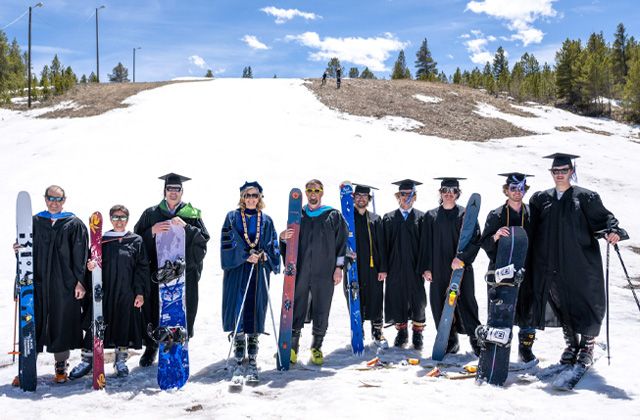
Colorado Mountain College graduates standing in front of Dutch Henry ski area, which they helped operate as a part of their coursework. Previously only ascendable on foot, Dutch Henry will soon be home to the school’s first surface lift. Image: Colorado Mountain College Leadville on Facebook
Moving onto our third topic this week, we’re breaking free of our thematic content and sharing a cool one-off story coming to us out of Leadville, Colorado. There, the small but mighty Colorado Mountain College (CMC) is continuing to grow its Ski Area Operations program thanks to a new surface lift that’s being installed on a ski hill owned and operated by the college and its students. As is commonplace for stories like this, it’s helpful to travel back in time just a little bit in order to grasp the full scope of the story, so let’s do exactly that.
While CMC first launched its Ski Area Operations program roughly 55 years ago, it was a 2023 overhaul of the program that transformed it into arguably the best in the nation. At that time, the small school partnered with Alterra to create a two year lift mechanic training program. For the first half of the course, students live on campus in Leadville, where they play a huge role in operating the small ski area known as “Dutch Henry.” Specifically, students in this program do everything, from managing and working as a part of ski patrol, being ski instructors, and even operating the groomers. Then, for the second portion of the course, students are paired up with an Alterra resort where they complete a year-long internship, focused on expanding upon their coursework while also learning the ins and outs of ski resort operations. One area that’s been slightly lacking over the early years of this program however, is lift operations. That’s not to say the students aren’t educated on how lifts operate at an electrical level using physical examples, but Dutch Henry simply doesn’t have a lift of its own to actually work with in real life. That is, until now.
This week, we learned from the Colorado Sun that Colorado Mountain College has come into possession of Steamboat’s old Rough Rider platter style surface lift. While currently existing as piles of equipment, the plan is for college students to eventually take on the task of not just operating the lift, but installing it as well. That means that when the time comes, it will be up to the students to operate the heavy equipment required for digging holes for the lift’s poles, filling them with concrete, and assembling the lift. In the course of doing so, they’ll get irreplaceable hands-on knowledge of the construction, assembly, mechanics, and even legal aspects of implementing a new lift at a ski hill. Once the lift is in place, the students will then continue operating it, finally bringing their small ski area full circle, with a scaled down version of every aspect of an actual ski resort.
As for the broader picture, this development isn’t just a cool story for the young adults choosing to enter a two year program at a college in Colorado. In addition to creating an interesting career path, the program is also helping meet a growing need for competent operations managers within the industry. While the article from the Colorado Sun doesn’t dive too deeply into details of the issue, the undertones of the piece indicate that finding qualified lift mechanics is increasingly difficult, particularly in mountain towns. For that reason, companies like Alterra, Vail, and POWDR are showing interest and support for the program, recognizing its importance for the long term health of the industry. It’s something that CMC’s Leadville and Salida campus dean Ben Cairns also recognizes, as he’s actively promoting and sharing his curriculum with colleges around the U.S. in hopes of fostering similar programs at other small colleges.
All in all, we just found this to be a pretty cool story about how one small Colorado college is playing an interesting role in connecting passionate skiers with technical industry careers - many of which will undoubtedly fill high level positions in the future. To learn more about Dutch Henry’s newest lift, check out this story from the Colorado Sun.
#4: The Norwegian Alpine Ski Team is Training Indoors and in Front of AI. Is This the Future?
Finally, rounding things out this week is a quick, interesting story coming to us out of Norway, where indoor ski facility SNØ has just partnered with a new AI product called Snow Eye that focuses on filming training runs for ski racers. In short, Snow Eye is a system of cameras that are set up to film training lanes, recognizing individual athletes based on their gear. Using Snow Eye’s AI, the training runs are automatically filmed, trimmed, and saved according to individual athletes. The end result is that coaches are freed up to actually coach their athletes, spending less time not just holding and pointing the camera, but also streamlining the post production efforts. As Jeff, myself, and anyone else that’s ever spent time transitioning raw footage into deliverable content, it takes a considerable amount of time to simply sort through clips, trim them, and give them appropriate file names, such as the name of athletes. One of the main value adds of Snow Eye is that it automates this entire process.
What’s interesting to us, is that in addition to this technology, the Norwegian ski team is also using an indoor facility to train throughout the summer months. Here in North America, we know two things to be true. First, small ski areas have proven to be excellent training grounds, with athletes like Mikaela Shiffrin, Lindsey Vonn, and a whole series of Cochrans learning to race on some of the smallest ski hills in America. In other words, you don’t need a massive slope to train for alpine racing - a small indoor hill could do just fine. Likewise, summer ski operations in North America are dwindling due to climate change, with only Mt. Hood remaining as a reliable annual summer ski destination.
Taken in tandem, the story is this: The Norwegian ski team is on the forefront of training, using indoor facilities to stay on snow year round, and AI to streamline the film review process. While we don’t have the depth of knowledge to know for sure how significant of an impact these specific efforts have, we do know that the Norwegian men's team placed 2nd and 3rd overall in World Cup Slalom last year, so they must be doing something right. With that in mind, is it worth considering adding a slalom lane and AI technology to Big Snow American Dream down in New Jersey? Again, we don’t know, but it’s certainly a thought. For now, give this article from Powder a read to learn more about the techniques being employed by our opponents.