


Top Five Fridays: September 25, 2026
This summer, a bill moved through the House of Representatives with unusual ease thanks to bipartisan support. It seems as though everyone is ready to do away with Daylight Savings Time. Everyone that is, except for the ski industry. More on that in highlight #3! Image: Arapahoe Basin on Facebook
Hello, and welcome to Top Five Fridays, the September 25, 2026 edition! This week, we kick things off with back to back competitive highlights, although they may not be quite what you expect. The first half of that endeavor includes coverage from last weekend’s Snow League event, where the first ever World Challenge team format and 720 spin cap both went off without a hitch. After recapping that, we’ll bring you to the world of FIS, national governing bodies, un-retirements, and Gus Kenworthy, where the athlete who’s known to be a trail blazer has once again paved the way for future athletes. By the time you read highlight #2, you’ll know exactly what we mean.
From there, we have a pair of more topical stories, starting with the Colorado Sun, who has shared coverage of the ski industries resistances to the Sunshine Protection Act, which would do away with Daylight Savings time. From there, we’ll take on a story from Utah, where one man is pitching his idea for a new, publicly funded, affordable ski area. Both of these topics should make excellent conversation fodder at parties this weekend, so if you’re the type who’s always leading the conversation, an introvert who prefers to be well informed, or somewhere in between, read on to learn all the details you need to know from the biggest headlines in skiing this week!
#1: The First Snow League World Challenge is in the Books! Here’s What You Should Know:
First things first this week, is a recap of the first ever Snow League world challenge, and therefore the first ever halfpipe competition with a 720 degree spin cap. If you read along with us back on August 17th, then you already know that we’ve been anticipating this event for over a month now. Yes, part of that stems from the fact that it marks the first “major” ski competition of the season, but in addition to that, this particular iteration of the Snow League provided two additional storylines to watch: it was a team event featuring three continental teams and a challenger team, and it introduced the novel new concept of capping the rotations for a round. Because of those two additions, this wasn’t just another halfpipe competition in September - it was a compelling new competition format to watch.
Diving straight into our recap, the first takeaway here is that Team Challengers won the event. As a reminder, this stop of the Snow League was a unique event for the series as it featured four, four member teams. As you might expect, those teams included Team North America, Team Europe, and Team Asia Pacific - each consisting of proven athletes from their region. Then, for the fourth team, Team Challenger featured four up and coming athletes who were picked regardless of region (although, they did all happen to be from the Asia Pacific region). As such, the competition itself was compelling, as it was not only a battle between three regions, but also a battle between 12 highly experienced athletes and 4 rising stars. Ultimately, and interestingly enough, it was the 4 rising stars who won the event. Not only that, but they won in dominating fashion, with Challengers athletes winning 3 of the 4 divisions, and placing 2nd in the 4th division. All told, it was an excellent showing for the team consisting of men’s freeskier Fin Melville Ives (1st), women’s freeski athlete Mischa Thomas (1st), men’s snowboard athlete Ryusei Yamada (1st), and women’s snowboard athlete Sara Shimizu (2nd). Hats off to Team Challenger, and we’re excited to continue watching these names for years to come!
As for the 720 spin cap, that too proved to be a massive success in the eyes of the viewers. Regardless of whether you look at recaps from Powder Magazine, Freeskier, or even the Charlotte Observer, the spin cap round provided a breath of fresh air for those who’ve become accustomed to counting as many rotations as they can, as fast as they can. In the words of Powder writer Matt Lorelli, “To start, the 720 spin cap was awesome… It was entertaining, exciting, and, honestly, quite nice from a spectator’s perspective to not have to count four- and five-spin tricks.” Ultimately, it was the forced creativity that made this rule change so impactful. While Fin Melville Ives’s nose butter cork 7 was arguably the trick of the round, Hunter Hess’s unique, initially decked flair to 180 out might have won social media for the event as its creativity left internet audiences in awe.
All told, the event lived up to the hype, and it's safe to say that the Snow League’s season is off to an excellent start. We’ll have to see if the 720 cap makes a return or is a practice that’s adopted by other organizations - but for now, relive the excitement of the event by checking in with the Snow League’s website.
#2: Inspired By His 2026 Winter Olympic Results, Gus Kenworthy Heads Back to Team USA, Prompting an FIS Rule Change in the Process:
It was surprisingly hard to find recent, relevant competition runs from Gus. Thankfully, we did come across a recap of his heat against David Wise at the LAAX stop of last year’s tour.
In other competitive news this week, our second story is actually a story within a story. A real two-tier Matryoshka nesting doll of a story, if you will. Now, with a healthy amount of confusion already in play, let’s start at the lede: Gus Kenworthy has just announced that he’s returning to the U.S. Ski Team, effective immediately.
To fully appreciate this statement, it helps to quickly recap Kenworthy’s journey through freeskiing. Back in the early to mid 2010’s, Kenworthy was on top of his game, winning numerous medals at all levels of the sport. At the 2014 Winter Olympics, Kenworthy took home the silver in Slopestyle. In 2016, he won 4 medals across two different X Games events. Between 2012-2018, he won 6 different Dew Tour medals. The list goes on. In the mid 2010’s, Kenworthy was one of the biggest names in freeskiing, representing Team USA.
In 2019, Kenworthy made the surprising decision to switch from the U.S. Ski Team to the British Ski Team. While it may have been an unexpected move, Kenworthy was actually born in the U.K., and moved to Telluride, CO when he was just 2 years old. As such, transferring to the British team was his way of paying tribute to his biggest supporter: his mother, who was born and raised there. Once on the team, Kenworthy made a quick impact as he secured a gold medal for the country at a World Cup event in Calgary in 2020. From there, Kenworthy went on to compete for the nation at the 2022 Winter Olympics, saying at the time it would be his last one. Ultimately, he ended up walking away with an 8th place finish in the Halfpipe event, thus bringing his career to a close.
That is, until he made the surprise announcement in May 2025 that he was coming back, with hopes of competing once again for Team Britain in the Olympics. Over the course of the subsequent 9 months, Kenworthy returned to competition and pretty quickly proved to the world that he hadn’t missed a step. Ultimately, his efforts went well enough that he once again qualified for the Winter Olympics. At those game, Kenworthy improved upon his 2022 result, earning a 6th place finish. That result, after just 9 months of training, has convinced Gus to give it another go.
This week, it was announced that Gus Kenworthy has decided to return to Team USA as he looks to earn a spot on the roster for the 2030 Winter Olympics. As straightforward as that may sound, his return path was anything but. Initially, this story began at the conclusion of this past season, when Kenworthy met with Team Britain to discuss his future with them. At that time, the team couldn’t commit to financial support, leaving him with plenty of uncertainty. As a result, they did offer to grant him a release, should he want to return to Team USA. From there, Kenworthy chatted with U.S. Ski & Snowboard Chief of Sport Anouk Patty, who offered him a spot if he wanted it. There was only one problem though: a relatively new FIS rule that prevents athletes from changing teams more than once.
Passed back in May of 2025, the FIS added a provision to Article 203.5 which stated that athletes could only switch teams one time, explicitly saying, “a change back or a second change is not allowed.” While the rule was implemented to keep athletes from repeatedly transferring to nations where it would provide them with an easier path to the Olympics, in Gus’s case, it was also preventing an athlete from returning to his original home team. As a result, the U.S. Ski Team submitted an appeal on Kenworthy’s behalf, arguing two factors. First, they argued that this rule was implemented well after Kenworthy’s move to Team Britain, meaning he should be grandfathered into the previous rules. After all, had Kenworthy known he wouldn’t be able to return to Team USA, he may not have switched teams in the first place. Second, Kenworthy’s move wasn’t about chasing an Olympic pathway, but rather wanting to represent the nation where he’d started his career. It was a return to home for him, not a points chase.
Ultimately, the FIS agreed with these points and is allowing Kenworthy to return to Team USA, effective immediately. As such, Gus will be competing for the U.S. Team on the World Cup circuit this season, as well as in future seasons, as he attempts to make it to the Winter Olympics one last time.
And as for the official FIS rules? Well, that’s the Russian nesting doll aspect of this story: as a result of Kenworthy’s return, the FIS has decided to adjust the existing rule to allow athletes one exception: they’re allowed to return to their original country. In the words of FIS ad interim Secretary General Urs Lehmann, “Gus' case initiated a thought process and a change in thinking. This is now a rule change that will count for everybody moving forward.”
So there you have it. One of the largest trailblazers in skiing has once again paved the way for future athletes. To learn more about this story, check out the recap from ESPN.
#3: Ski Areas Nationwide Rally Against Daylight Savings Time Legislation:
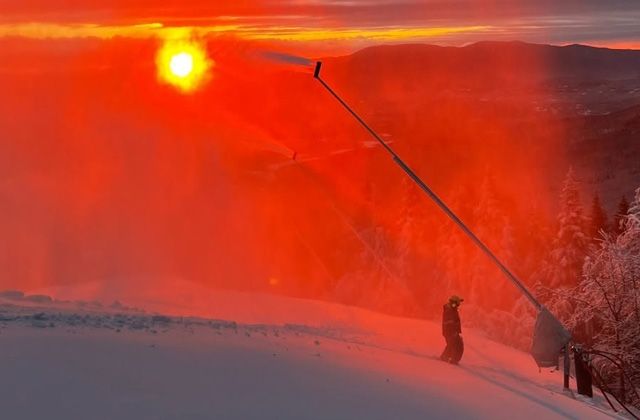
Snowmakers hard at work here at Stowe, using the early morning light to their advantage. Should the Sunshine Protection Act go through, even more of their work will have to be carried out in the dark. Image: Stowe Mountain Resort on Facebook
Moving on from competitive ski news this week, our next topic is a conversation that goes well beyond the ski world, but has very specific implications in our industry. That topic, is that of daylight savings time.
As you might know, the United States House of Representatives passed a bill back in July called the Sunshine Protection Act of 2026. That bill, if enacted, would put an end to the daylight savings time practice and instead shift those of us in the United States to permanent daylight savings time hours. In other words, we would keep the clock as it is in the summer months, doing away with the need to move it one hour earlier in the Fall and resetting it back to Summer time in the spring. The bill itself is a reaction to public sentiment, in which the clock-changing practice feels like more of a nuisance than a practical benefit, with some even claiming that doing away with the practice would “boost economic activity and improve public safety.” This week we learned, the ski industry feels exactly the opposite.
This week, the Colorado Sun published an article sharing the news that a letter was sent to 19 U.S. senators from a group made up of, “five resort trade groups and two resort companies representing 115 ski areas in 10 states.” In this letter, the ski industry urged the senators to vote against the Sunshine Protection Act as for them, the shift in daylight would dramatically alter both the safety and economic impact of their operations.
To understand the industry’s counter argument, we have to first wrap our heads around what the move to permanent daylight savings time would mean. As it stands, when we move our clocks back an hour in the fall, it’s meant to give us light earlier in the day at the cost of losing an hour of light at the end of the day. If it gets light at 8 am during daylight savings time, our current arrangement has us adjusting the clocks so that it becomes light at 7 am during the winter months. For ski resorts, that adjustment is crucial for pre-opening operations.
Under the Sunshine Protection Act, there would be several weeks during the winter in which the sun wouldn’t rise until after 8 AM in states like Vermont, Colorado, and Utah, while states further west in their time zones wouldn’t see a sunrise until after 9 AM. While that would only slightly impact the hour in which there’s enough light to let the lifts run, the real issue is that it would force all pre-opening operations to be conducted in the dark. For groomers, that doesn’t mean much, but for operations like ski patrol who are tasked with inspecting and closing unsafe terrain, it would delay their ability to assess the mountain in order to safely open it. After all, how can you tell if a trail is safe to ski if you can’t see it? Likewise, avalanche mitigation efforts would also be delayed as it’s not only unsafe, but also illegal to conduct any explosive-based mitigation without daylight. In other words, not moving the clocks back an hour would cause chaos for opening operations at a ski area.
That of course leads to an obvious question: why not just shift a ski area’s operations by an hour? According to the letter, resort operators suspect that skiers and snowboarders would head out at the same “time” of day regardless due to things like flat light and beating departure traffic. As such, the argument is that if the resort opens an hour later, they would essentially be losing an hour a day of engagement with their guests. That in turn, would lead to an economic impact. In the letter, it’s suggested that this trend would lead to the equivalent of approximately two less weeks of business per year.
Interestingly enough, the piece also spoke with a handful of ski patrollers in Colorado to hear their thoughts on the clock change. Their opinion? It’s not a big deal at all. In the words of Emil Sante, a 30-year patroller at Telluride, “We actually adjust the opening and closing times as the days grow longer and we have done this as long as I can remember.”
So, what do you think? Is the ski industry up in arms about nothing? Or would a post 8 or 9 am sunrise greatly affect vibes on the mountain? To learn more, give this story from the Colorado Sun a read. Then, let us know your thoughts in the comments below!
#4: In Utah, 31 Year Old Clint Richins is Dreaming Up a New, Publicly Owned Ski Resort:
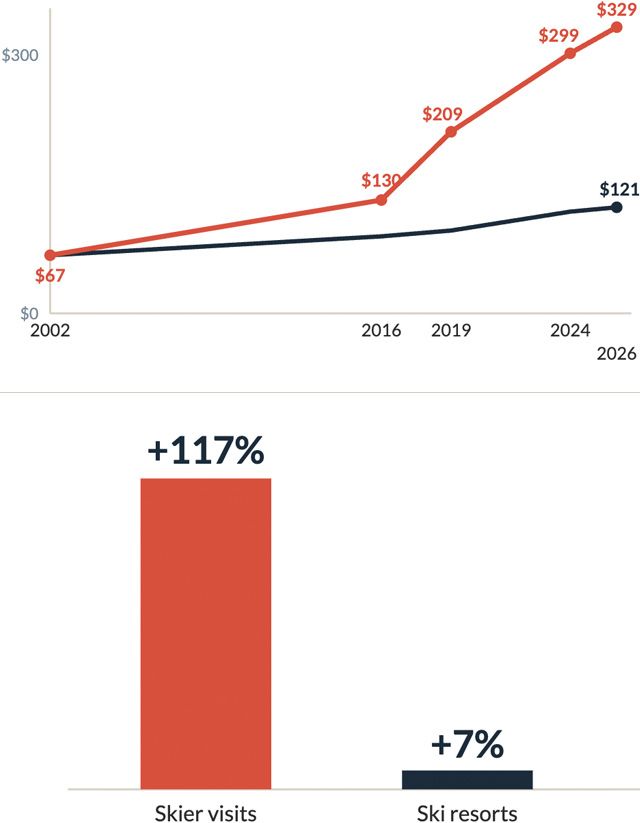
Top Chart: A look at the rise in cost for a daily lift ticket during peak season at Deer Valley over the last 24 years, as compared to inflation. Bottom Chart: A comparison between the increase in skier visits in Utah since 1990, compared to the increase in the number of ski resorts. Source: Utah Public Ski Area Coalition
Finally, rounding things out this week is a quick story about a big dream. Courtesy of a report from Powder Magazine, we’ve learned this week about a new organization that’s hoping to bring affordable skiing back to Utah. Initially debuting via Instagram back on September 3rd, the Utah Public Ski Area Coalition (UPSAC) is an organization helmed by Clint Richins. A 31 year old Utah native, Richins has a professional background in finance and economics, as well as experience in the outdoor and fitness industries, and is also a volunteer ski patroller. Now, he hopes to add “public ski area developer” to his resume.
In the debut post by Richins, he outlines an argument for the creation of a new publicly funded ski area in Utah. At the crux of his argument are a few verifiable facts. First, the cost of daily lift tickets have risen dramatically within the state over the past 24 years. While the UPSAC website specifically references the increase of a peak period lift ticket at Deer Valley, from $67 to $329, it’s safe to assume that similar increases have happened at a majority of Utah resorts. In other words, skiing is becoming more expensive for recreational skiers. Second, likely as a result of this price increase, the average age of Utah skiers has increased from 40 to 48 years old from the 2017/2018 season through the 2024/2025 season. Distilled, this means that the sport isn’t enticing new, younger, lifelong participants. Third, the UPSAC website also shows that Utah has seen a 117% increase in skier traffic since 1990, with just a 7% increase in the number of ski resorts. Now, that doesn’t speak to whether the capacity of each resort has increased during that time, but the point is undeniable: the state’s ski areas have become more crowded in recent years. Finally, the last point Richins makes is that with the 2034 Winter Olympics heading to the state, now is the perfect time to rally behind a new, affordable ski area for locals.
At the moment, the UPSAC is in its very early stages and is little more than a vision. That said, it’s a really well thought out vision. Already, Richins has built out a financial plan for the resort and considered specific requirements it would have to meet. In his mind, the resort would not rely on canyon roads, would be 2,500’ of vertical across 1,000 acres, serviced by 5 fixed grip lifts. The ski area would also be within 30-35 miles of Salt Lake City, ideally hosting 80,000 skier visits across a 110 day season. Perhaps most important to his core concern however, is a unique pricing structure that would give Utah residents affordable access to skiing. According to his model, Richins would look to sell day passes to Utah residents for just $59/day, while season passes would cost $750. For non-residents, those prices would be $139/day or $1,250/season.
Of course, as great as this all sounds, one of the biggest questions that the general public is sure to have is, “what will this cost me?”. Well, as it turns out, Richins is one step ahead, as he’s not only provided a full financial summary of what the phase 1 buildout of this resort would cost, but also where funding could come from. While the document does a great job of itemizing each development expense, as well as operational expenses, specific grant requests, and revenue, the number to know is that the initial development would cost roughly $83.9 million, all of which would be funded through existing government programs. All said and done, the bill for each of Utah’s 3.6 million tax payers would be $0.56 per year - although it should be noted that because this project would use existing grants, this is an amount already being paid by residents and does not represent an increase.
On the other side of the balance sheet, Richins projects the UPSAC ski area to generate $7.62 million in its first year, increasing to $16.53 million by year 10.
At the moment, this is all just one man’s dream - albeit a very well thought out one. From here, the next step in Richins’s plan is to fund a feasibility study that dives into more detail regarding what the business would actually look like. That starts with finding a specific location for the ski area. Once that’s dialed in, details regarding the financial picture can be brought into focus as things like on site development, actual visitation numbers, environmental considerations, and actual operation costs can all be moved from the conceptual phase, and into an actual forecast. Should that obstacle be cleared, Richin will be able to pursue further steps to make this public ski area a reality. If that happens, you can be sure that we’ll have plenty of coverage here. Until then, check out this report from Powder, the official UPSAC website, as well as their Instagram, where Richins posts regular updates.
#5: And Now, Your Edits of the Week: SLVSH is Back, This Time With a Series of Showdowns in Kicking Horse. First Up: Townsend Reed vs Ry Mann:
One of Our Favorite Skiers is Back, as Phil Casabon Puts His Urban Style on Full Display in “Track 12”:
*** Some bad words pop up in the soundtrack. A couple of f-bombs. If that’s a deal breaker, maybe just hit mute and put on your favorite song instead. ***
Finally, This One’s a Bit Risque, But With the Skiing as Good as it is, “Nubz 3” is a Must Share:
*** Ok, this one actually does have some pretty suspect language in the soundtrack. We wouldn’t normally even post it, but the skiing is absolutely phenomenal. Still, ot’s probably not an ideal watch for kids who wouldn’t be allowed to buy cd’s with a parental advisory, if those were still a thing. ***