

Top Five Fridays: April 24, 2026
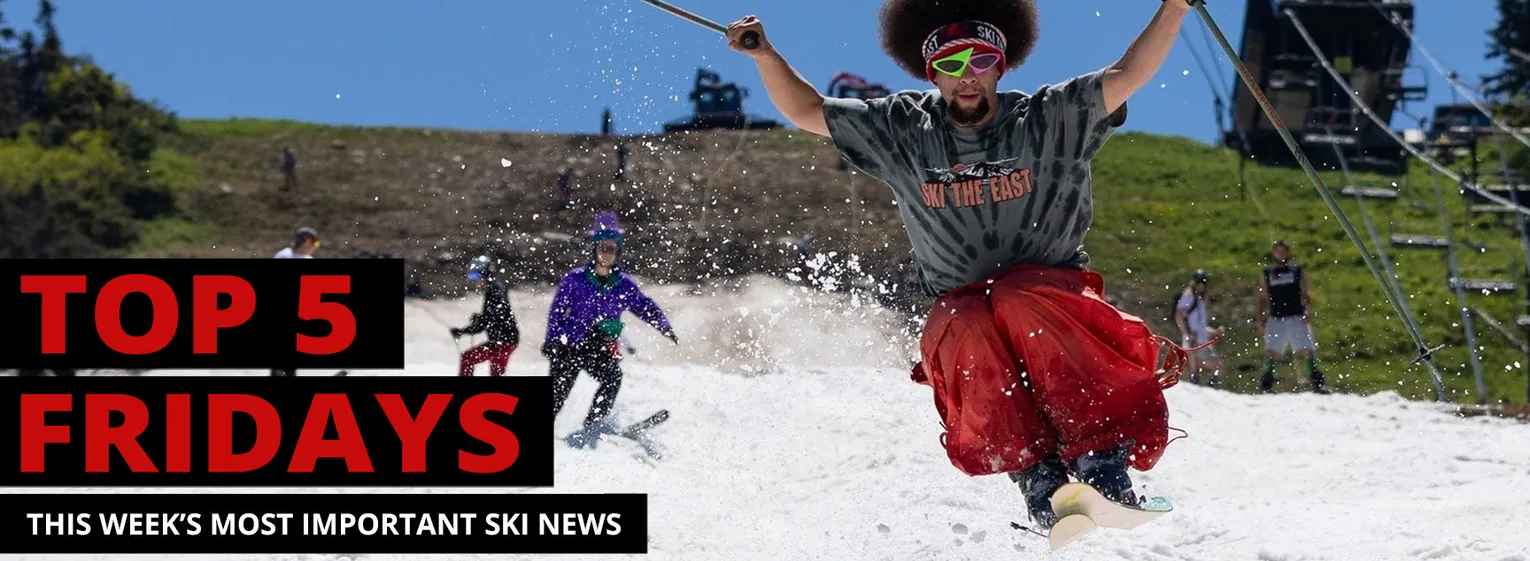
An enthusiastic skier airs it out at one of Killington’s legendary spring days on Superstar. This year, May 16th will be an even more legendary day for one skier or rider who records the most vert on the infamous bump run. More on that in highlight #4! Image: Ski the East on Facebook
Hello, and welcome to Top Five Fridays, the April 24, 2026 edition! We’ve got a wild one for you this week, with stories of political gamesmanship at the FIS, disappointing financial figures from Vail, snow farming, bump harvesting, and everything in between. If these vague phrases mean nothing to you, don’t worry, we’ll give you all the details in just a minute. All you have to do is keep reading!
#1: The FIS Presidential Plot Thickens as Johan Eliasch is Abandoned by His Two Home Countries, and is Instead Nominated by Georgia:

Despite making serious strides to increase the viewership of FIS sports, Johan Eliasch’s re-election is being heavily challenged by some of the organization’s strongest member nations. Image by Greg Martin, sourced via IOC Media on Flickr
First up in our highlight reel this week is continuing coverage of the upcoming FIS Presidential election. Now, as a quick reminder why you should care about this story, it all comes down to just two words: media rights. At present, the FIS is led by Johan Eliasch, the Swedish born, British-based billionaire owner of Head skis. Upon being first elected to the presidency back in 2021, Eliasch made it his goal to centralize broadcasting rights so that the FIS controlled global coverage of events rather than leaving it to each individual member nation. For us as spectators, that was tremendous news as it brought the promise of more access to more events. For some of the more periphery member nations, it was also good news as it meant they’d get a larger share of the media revenue which they could then put back into supporting their team. For the European nations that are the backbone of FIS sports though, this was bad news. For them, it meant a decline in media revenue, a decrease in funding for their team, and ultimately an opportunity for smaller countries to threaten their dominance. It’s with that backdrop that we learned back in March that Great Britain, the country that initially backed Eliasch’s presidential candidacy back in 2021, has dropped their support for him and has instead nominated Victoria Gosling as their candidate.
In the month since that news broke, there’s been plenty of behind the scenes action that we’re just now learning about. For starters, there are now a total of 5 candidates running for the position. In addition to Victoria Gosling from Great Britain, we also have Dexter Paine from the United States, Anna Harboe Falkenberg from Denmark, and Alexander Ospelt from Liechtenstein. As for Eliasch? He’s in the running too, but as a candidate representing a surprising country: Georgia. Making this plot even thicker, is the fact that nominees for presidency have to be nominated by a country to which they hold an active passport. Having been born in Sweden and a longtime citizen of Great Britain, it’s easy to see how either of these countries could have nominated him. With Georgia though, there are no known direct ties, and if he were a passport holder, it would be surprising.
At present, the list of candidates is going through a standard internal review, vetting each one to make sure they’re eligible. That process is expected to be completed on May 20th, just a few weeks ahead of the June 11th election. While there’s currently an air of confusion and doubt surrounding the legitimacy of Johan’s nomination, we’ll know for sure on 5/20 whether or not he makes the ballot. If he doesn’t, there’s a real chance that the past 5 years of effort spent making FIS more accessible on a global scale will be all for nought. To learn more about this, check out the report from the Associated Press.
#2: Another Year of Lackluster Statistics for Vail Adds Pressure to Katz’s Second Term as CEO:

Image: Epic Pass on Facebook
Moving right along, our next story this week isn’t one that we’d necessarily describe as new, surprising, or even exciting. Instead, it’s a story that demands our coverage as a way of keeping our finger on the pulse. That news is this: earlier this week, Vail Resorts shared a report with some of its key metrics from this past season. Considering the fact that it was a historically warm and dry season for much of the West, and several ski areas closed weeks earlier than expected, it should come as no surprise that numbers are quite a bit down compared to last year.
Taking it from the top, the most jarring statistic is the fact that overall skier visits were down 14.9% this season as compared to last. Of all the key metrics, that figure is likely the most “key” as it has a direct correlation to some of the second tier metrics. As a direct result of a decrease in traffic, lift revenue for instance, was down 5.6%. Ski school revenue was down 12%. Dining revenue was down 11.7%, and retail / rental revenue was down 6.6%. Finally, while regionally specific, the largest drop we saw in any metric was a 25% decrease in skier visits in the Rocky Mountain region. All in all, not good.
While the kneejerk reaction would be to chock these figures up to the historically bad winter for much of North America, it’s hard to ignore the fact that they come on the heels of several other disappointing reports from Vail in recent years. Looking back just a year ago, Vail saw a 3.1% decline in skier visits, despite it being the second busiest ski season on record. While they managed to record modest increases in revenue across categories, observers were quick to note that this came as a result of increased prices in the face of a decrease in customers. Over the last couple of years, it’s been hard to ignore the perilous direction that Vail is heading in.
At the moment, it’s hard to tell whether or not the return of Rob Katz will be the saving grace the company needs. While it’s true that pass sales were down last season, and it’s true that skier visits and revenue in several categories are also down this season, it could be argued that neither situation was something that Katz could control. What he can control however, are pass sales for next year. According to this week’s reports, Katz has said that there’s a “moderate decline” in unit sales of the Epic Pass so far this year as compared to last, as well as a “slight decline” in pass revenue. Still, he cites the price increase deadline in May as being a true test of this year’s early pass sales. Vail currently plans to update us with more information alongside their Q3 report, coming in June. For more on this week’s numbers, check out this report from the Park Record.
#3: Burke Mountain Receives Approval to Join the Snowfarming Movement in 2027 as it Looks to Extend its Ski Racing Season:
Just a little perspective on just how much snow can be farmed each year. Video from Snow Secure
Moving right along to our third topic this week, we have a story that continues on with the thread of climate change threatening the future of skiing. This story is a bit more positive though, as it shows us that there are ways to slow down on the effects of climate change while continuing to make skiing a viable business to be in.
This week, we learned that Burke Mountain, our neighbors to the north here in Vermont, has been given the go-ahead to engage in snowfarming starting in 2027.
At this point “snowfarming” has become a bit of an annual buzzword, so we suspect that most of you are likely familiar with the concept. For those of you who aren’t, it’s a pretty simple process: ski resorts make a big, big pile of snow and then cover it with insulation and a tarp for the duration of the summer. The intended result is a considerable amount of snow that can then be used to jumpstart operations in the Fall, regardless of whether or not snowmaking is an option. At Burke Mountain, home to the renowned Burke Mountain Academy whose alumni include Shane McConkey, Mikaela Shiffrin, and Nina O’Brien, the plan is to do just that.
Ahead of next summer, for the first time ever, Burke Mountain will be creating two, 300 foot long, 20 foot tall piles of snow in an effort to snowfarm. Inspired by research done by Vermont’s Craftsbury Outdoor Center in partnership with the University of Vermont, Burke’s new ownership team (Bear Den Partners) has taken the leap of faith and purchased insulation mats from Snow Secure, one of the leaders in snowfarming technology. These massive mats, which are essentially thick layers of dense styrofoam wrapped in white waterproof tarps, will aim to preserve approximately 60% of each snowpile throughout the course of the summer. Then, when November comes around, the mountain will unveil the piles and push them out, covering their respective trails with enough snow to make skiing possible. While a variety of mountains have used this technology for various reasons, the intention at Burke is to use the harvested snow to extend their ski racing season.
Reading between the lines a bit, and recalling that Bear Den Partners is in part owned by members of the Graham family who’ve invested significantly in Burke Mountain Academy, our guess is that this move is meant to lean into the mountain’s strength of having such a reputable race academy on hand, and play up the ski area’s connection to the ski racing world. While we won’t be privy to the results of this experiment until Fall 2027, it’s still an exciting and intriguing update from our neighbors up north. To learn more, check out the writeup from Vermont Public.
#4: Calling All Mogulers: Killington Event Offering $1,000 to the Skier or Rider Who Skis Superstar the Most in One Day:
Killington’s Superstar in all its springtime glory.
*** Warning: There is a naked skier in the first 15 seconds of this video ***
Finally, keeping things local (to us), our final highlight is more of an FYI to New England skiers than anything. That’s because this week, we learned that Killington Resort will be hosting a pretty unique contest on May 16th that it’s calling the “Superstar Showdown”. Hosted by professional ski-fluencers Madison Rose & Jim Ryan of the Jim & Mads show, the concept for this contest is simple: start at 8 am, ski until 4:30 pm, and whoever has logged the most vert by the end of the day wins $1,000 and a new set of skis or snowboard. Sounds easy, right? Here’s the thing: in order to win this event, you’re probably going to have to ski a black diamond bump run for 8.5 hours straight.
While the rules technically don’t require participants to ski Superstar, there’s plenty of reason to believe that that’s what will be required of the winner. For starters, the event takes place just over three weeks from now, on May 16th. At present, Killington has Superstar open, as well as a handful of adjacent connecting trails. In other words, even at present, Superstar is the steepest, most direct route to the bottom of the hill. In three weeks, it might be the only way down. So, while it’s not explicitly stated, it’s heavily implied that this event is essentially a contest to see who can survive Superstar the most times in one day.
If you’re the type of person that this form of torture appeals to, you can head over to the Killington website to claim your spot in the event for just $10. If you choose to do so, godspeed, and good luck.
#5: And Now, Your Edits of the Week: Armada’s Newest Pros, Ben Richards and Toby Rafford, Are Back With More Top Notch Skiing & Antics in “NUB TV EPISODE 2: SUPER CANCELLED NUBZ”:
*** Another Warning: There’s nothing overtly obscene in this one, but there is a general air of debauchery. Viewer discretion is advised for those under 13. ***