

Top Five Fridays: August 28, 2026
A skier enjoys powdery bliss at Aspen Mountain, the largest independent ski resort in the game. That matters for two reasons this week, as they’re definitively not involved in highlight #1, while their unique strategies are cause for highlight #2. Read on to learn more! Image: Aspen Snowmass on Facebook.
Hello, and welcome to Top Five Fridays, the August 28, 2026 edition! We’ve got a thick one for you this week, with three straight topics that dive into the depths of the ski business. Kicking that off is a brand new anti-trust lawsuit that’s just been filed against the biggest players in the ski resort game. If this sounds familiar, it should, because a nearly identical lawsuit was filed just three weeks ago. We’ll do a deep dive on that, before moving on to an illuminating conversation that was recently had amongst business leaders in Aspen, as well as a behind the scenes look at what’s happening at the private portion Powder Mountain, in an area known as Powder Haven. Finally, rounding things out, we’ll bring you the latest updates from the newest multipass in the game before sending you off with a handful of excellent edits. To find out all you need to know from this week in skiing, simply keep reading!
#1: Another Week, Another Anti-Trust Lawsuit Against the Ski Industry’s Biggest Players:
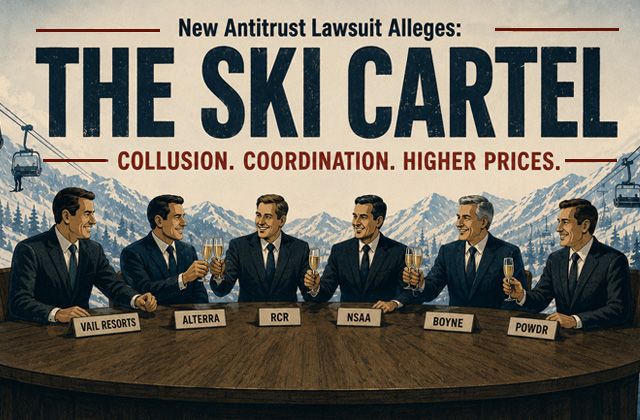
Another image made by ChatGPT. Not because we love ai, but because churning out a graphic as entertaining as this took just 3 well crafted prompts away. And also because we don’t have an illustrator on staff.
First up this week is yet another lawsuit that’s just been filed alleging price fixing amongst some of skiing’s biggest ski resort operators. As we get into this story, you might start getting a feeling of déjà vu, or even begin to wonder whether or not we’re accidentally covering the same story twice. We assure you, we’re not - this is simply the third active class action lawsuit alleging practices that violate anti-trust laws amongst North American ski resort operators, with the first being filed in late March and the second coming just three weeks ago.
Of the two previously filed lawsuits, this week’s lawsuit very closely resembles the second one, which came earlier this month. That is, it also alleges that Vail Resorts, Alterra, Boyne, and Powdr have participated in the sharing of confidential information as a means to collaboratively raise prices in the ski industry. In this most recent lawsuit, their conduit for doing so is also in-person conversations at trade meetings, as well as the sharing of information with RCR for the purposes of collecting industry wide data, compiling a report, and disseminating that information back to these resort operators. In these lawsuits, the accusation being made is that the act of compiling and redistributing financial information amounts to collusion. All of that is consistent between the two lawsuits filed this month.
With that said, there are some differences in this week’s lawsuit which ultimately add additional layers of intrigue to the situation. For starters, this particular lawsuit was filed by one of Vail’s own shareholders, a man named Gary Peterson. That’s notable as Vail’s primary obligation as a public company is to its shareholders. That is, to earn a return for them on their investment. With that in mind, it’s a bit counterintuitive for a shareholder to sue a company they’re invested in, alleging that collusion has led to higher prices, but there’s an additional aspect to Peterson’s complaint that may justify the filing.
In his lawsuit, Peterson calls to attention Vail’s own Code of Ethics. In that document, there is an entire page dedicated to Vail’s stance on “Antitrust and Fair Competition”. After reviewing that page ourselves, we have to say, it’s pretty interesting how strongly worded the document is against the practices being alleged in these lawsuits. For instance, it reads, “Certain kinds of information, such as pricing, marketing plans, and bids on Requests For Proposals (RFP) or government contracts (including National Park Service concession contracts), cannot be exchanged or discussed with competitors, no matter how innocent or casual the exchange may be and regardless of the setting, whether business or social.”
In another section, there is a fictional Q&A scenario, with the question being, “I am friends with a salesperson for a competing resort. We occasionally talk about marketing plans. Should I be concerned?” The reply reads, “Yes. You are revealing confidential information that we have invested time and money to develop. You may also be violating the competition laws that ban discussions of marketing and pricing among competitors.” Finally, that page also states, “The Company and its team members could incur significant criminal and/or civil penalties for antitrust violations.”
It’s a pretty interesting situation. The reality of it is, trade organization meetings are incredibly common in every single industry. The purpose of these meetings is to share knowledge of the industry to help all businesses involved. That said, in this instance, Vail’s own code of ethics seems very strict on concepts regarding not only pricing, but also marketing. That begs the question, if marketing and pricing are off limits at these meetings, what is up for discussion? Here at Top Five Fridays, we may never know the answer to that question. What we do know though, is that with pressure continuing to mount for not just Vail, but a majority of multi-resort owners, there’s likely more to this story that’s yet to come. As it does, we’ll keep you posted. For now, check in with The Colorado Sun for more.
Editor’s note: emphasis in this highlight is our own.
#2: In Aspen, Business Leaders See a Risk of a Declining Ski Population and Begin Exploring Ways to Diversify Their Community’s Income Streams:
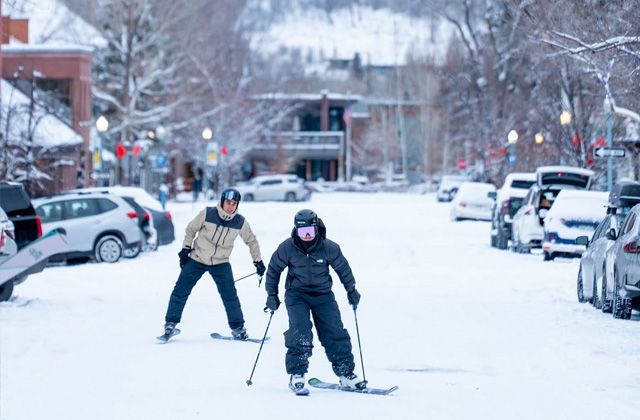
Skiers navigate downtown Aspen. Despite being at the heart of its economy, business leaders are already enacting efforts to make the municipality less reliant on one specific form of recreation. Image: Aspen Snowmass on Facebook
In other big ski business news, our next story this week comes to us from Aspen, another one of the biggest names in skiing. Before diving into this one, now feels like a good time to highlight Aspen’s unique position in the ski industry as being both one of the most well known names in the sport, as well as an independent business. While it’s true that the Aspen Skiing Co has partnerships with Alterra’s Ikon Pass and the Mountain Collective pass, the mountains themselves are more or less independently owned. Now, we say “more or less” because in actuality the four mountains that make up Aspen Snowmass (Aspen, Aspen Highlands, Snowmass, and Buttermilk) are actually operated by the Aspen Skiing Co., which is owned by Aspen One. Aspen One in turn, owns and operates the resorts, as well as a line of Aspen-centric apparel and outerwear called the Aspen Collection, and multiple lodging establishments through its hospitality arm. In other words, while it’s indisputably one of the biggest names in skiing, Aspen has found a way to carve a unique business model that leverages its reputation as a top destination into a unique level of independence amongst its peers - without being owned and operated by a larger corporation.
First things first, to understand this story we have to start with the root of the conversation: the possibility that skiing alone may not drive tourism in the town forever. While there are a number of factors at play there, one of the key metrics according to Aspen Skiing Co. CEO (and a man who once told me the best part about Colorado is that it’s not Vermont) Geoff Buchheister, is that the baby boomer population that was once the foundation of the resort is beginning to age out. In his words, “There was a commitment level there that we’re just not seeing from the younger generations.” Echoing that sentiment was ACRA board member Donnie Lee, who said, “We were all addicts when I moved here... It’s not the same fever, it’s not the same commitment. We do notice it.” Finally a third voice sharing that opinion came from Aspen One president and CEO Dave Tanner, who said skiing is, “a no-growth industry.” In other words, it’s firmly the opinion of those tasked with managing and growing Aspen’s economy that it’s increasingly likely that skiing won’t be the sole economic driver of the region forever.
From there, the conversation gets into a variety of challenges facing the area that we’ve heard echoed time and time again. Housing is an issue, of course, with 65% of those working in the Aspen Valley commuting from outside of it, and 25% traveling more than 50 miles for work. That issue is in turn exacerbated by rising development costs. As an anecdotal comparison, Tanner cites the fact that building Snowmass’s Elk Camp cost an estimated $12 million, while a new similar project, the rebuilding of the on mountain restaurant, the Ullrhof, is estimated to cost $42 million. In other words, the cost of re-investing in infrastructure is skyrocketing.
So, what is an end of the road mountain town to do when interest in skiing looks to be declining while costs of infrastructure increase? Well, here’s where the story gets interesting.
While there are a number of planned and proposed solutions within the valley, we were also fascinated to learn that part of Aspen One’s strategy is to continue business efforts outside the valley as a means of not only creating a more widespread customer base, but also for channeling funds from outside of Pitkin County back into their infrastructure. While the Aspen Collection line of apparel accomplishes this, the more intriguing aspect is what Aspen One is doing with their Limelight Hotels. Looking at the Limelight Hotels website, there are currently 6 locations listed, with just two of those being in or around Aspen. In addition, there are also locations in Denver and Boulder, which makes sense for traveling purposes, but even more intriguing are their locations in Mammoth, CA and Ketchum, ID - two skiing hotspots well beyond Colorado’s border. In other words, Aspen is planting its hotels in other ski destinations. The impact there is obvious: not only are they generating funding from outside their region, but they’re also making additional points of contact with their target market.
All in all, it’s a very interesting strategy, and just one of many fascinating anecdotes from the article which does a great job of highlighting how Aspen has managed to stay fiercely independent during the consolidation era of skiing. To learn much more, check out the story from the Aspen Times.
#3: As Reed Hasting’s Ownership of Powder Mountain Evolves, it’s Worth Learning About His Unique Approach to Creating a Hybrid Public/Private Ski Resort:
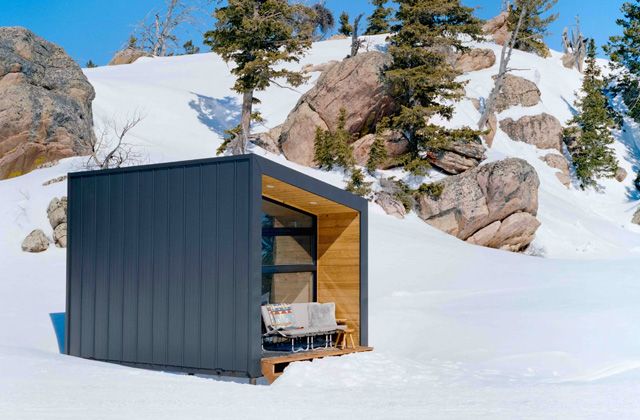
One of the public benefits from the semi-privatization of Powder Mountain? Well, they have to apply a “private resort” level of quality across the entire ski area, which means everyone benefits from Reed Hasting’s desire to implement art installations and cool structures across the mountain. Image: Powder Haven Website
Speaking of wealth in skiing and unique new business models, our next highlight this week does just that, even if this particular business model is one that’s sure to ruffle countless feathers. This time, we’re shining a spotlight on the private section of Powder Mountain, an area that’s come to be known as Powder Haven.
As you likely know, Utah’s Powder Mountain was more or less purchased by former Netflix CEO Reed Hastings back in 2023 when he bought a majority stake in the business. Since then, the mountain has slowly moved towards a semi-private business model, with a portion of the mountain being reserved solely for use by members of the mountain. While we’ve covered the evolution of this story several times over the years, we caught a story from TownLift.com this week that highlights a bit of the unique business strategy behind the decisions. Noting that privatization of ski areas is a pretty loaded topic, we’ll do our best to tread lightly here and only share the factual information regarding the ownership’s business strategy. That said, please feel free to leave your reactions in the comments!
At the core of the article that was published this week is the fact that Powder Mountain is operating as a hybrid public/private ski area. While other private resorts like the Yellowstone Club and Wasatch Peaks Ranch were built from the ground up entirely for private purposes, Powder Mountain is unique in that it’s added a private arm to a public resort. More specifically, Powder Mountain has created Powder Haven, a private mountain community that exists alongside the public.
Occupying approximately 3,000 acres of terrain out of Powder Mountain’s 8,000 total skiable acres (in other words, 5,000 are public), Powder Haven is essentially a resort within a resort. That is, there are currently 4 chairlifts that are only accessible to residents of Powder Haven, who have paid handsomely for membership and their homes there. Those lifts access several zones that would be far more effort than it’s worth to access via other lifts, making the terrain essentially resident only. So far, this is all pretty normal.
What makes this model interesting though is that the private residents also have access to the public resort. That, as it turns out, is a hugely advantageous selling point as it makes it far easier for Powder Mountain to provide Powder Haven residents with amenities like earlier seasonal openings, snowmaking, base area restaurants and lodges, services, and more. But, the real vision for Reed Hastings isn’t just the establishment of a private ski area. Instead, he imagines a more symbiotic relationship.
By leveraging the higher price point of the private ski area, Hastings believes he’ll be able to generate revenue to put back into both the private and public sides of the mountain. In that case, he would have found a way to strengthen the financial foundation of what’s historically been a treasured community ski resort by embracing the growth of privatization.
Of course, you may be feeling a well warranted amount of skepticism about these concepts, for which we wouldn’t blame you. Still, we found this article from TownLift.com insightful as it provides a look into some of the concepts driving the project, and concepts that we wouldn’t at all be surprised to see repeated in other locations in coming years. To learn more, give it a read yourself.
#4: A New Multi Pass is Here: With the New Snow Pass Now On Sale, There’s Plenty of Details to Share:
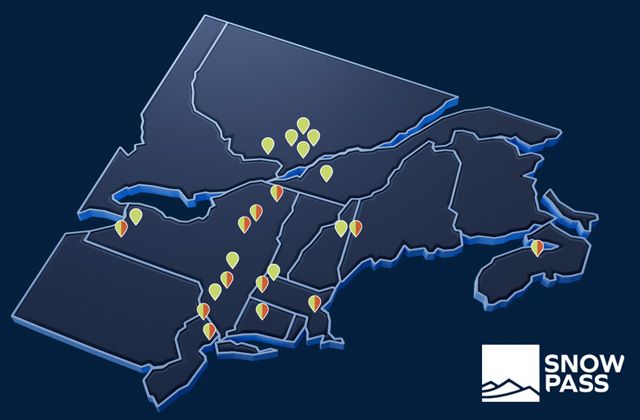
In this screenshot pulled from the Snow Pass website, you can see the locations included in their passes. Lime represents inclusion on the Triple Play, while orange represents the Snow Pass.
Finally, rounding things out this week, we want to share with you an update to a story that we first brought you back in May. At that time, the makers of the Snow Triple Play Pass had announced plans for a new multipass product that operates in very similar fashion to the Indy Pass. Just to jog your memory, the Snow Triple Play Pass launched at just about this time last year, and represented SnowPartners’ first foray into the multipass world. That pass, aimed exclusively at the Northeast, offered purchasers what amounted to a bundle of 3 lift tickets, valid at 15 different resorts, for $199.00, or $66.33 each. It was a solid, simple offering for recreational skiers who weren’t necessarily looking to spend 10+ days on the hill.
Then, back in May, we learned that SnowPartners was planning to debut a second pass product ahead of this coming winter. At that time, we knew that the general model of the pass would follow the Indy Pass’s model, offering 2 days at what was expected to be 15 resorts across the Northeastern region. This week, the SnowPartners officially unveiled the new pass product, as well as details regarding season 2 of their Snow Triple Play Pass.
On the Snow Pass side of things, the new pass offering is officially valid for 2 days at each of their 14 partner resorts (to clarify, yes, they are one short of the previously announced 15 partner resorts). Of the 14 resorts, 11 are based in New York, New Jersey, Connecticut, Massachusetts, and Maine. Additionally, Ski Martock in Nova Scotia made the list, as well as Monarch Mountain in Colorado and Snow King in Wyoming. In total, that gives skiers 28 days of skiing at an introductory price of $339.00.
Now, for those of you shopping around, there are a couple of things to consider here. First, the Snow Pass partner resorts are almost exclusively small to mid sized, local ski areas. The biggest exceptions to that rule are New York’s Whiteface and Gore mountains. Second, compared to the Indy Pass, there’s significantly less value as the Indy Pass offers 2 days of skiing at 300+ ski areas all over the world for a comparable price. That said, the Snow Pass has the upper hand in one very meaningful way: it’s still available. As of the time of this writing, the Indy Pass is currently sold out, and it’s unknown whether or not it will be available again before winter arrives. If you’re interested in this type of pass product, then the Snow Pass might be your best bet afterall.
As for the Snow Triple Play Pass, the core offering remains the same, but there are now 26 ski resorts involved compared to 16 last year. In additional SnowPartners news, we also learned via Ski Area Management that the group is expected to add a Midwest version of the pass ahead of next season. Should that happen, it’ll be an interesting progression of yet another new multipass model.
To learn more about this week’s news, head over to MySnowPass.com.
#5: And Now, Your Edits of the Week: It’s Just About Trailer Time! Get Started With “Actually, it is Rocket Science” from TGR:
We’ve Been Talking Quite a Bit About Skiing in South America This Summer, But What’s it Actually Like? Check it Out, With Rise & Alpine:
Warning: Some Excitement Induced & Conversational Swearing Occurs