

Top Five Fridays: May 8, 2026
What would you guess is the number one factor when it comes to attracting guests to ski slopes each winter? Don’t overthink this one, it’s easy: snow. Skier: Ryder Anderson. Image: Jay Peak on Facebook.
Hello, and welcome to Top Five Fridays, the May 8, 2026 edition! The ski news kept on coming this week, as we have a ton of news to share from the world of World Cup Alpine ski racing, from provisional schedules to U.S. Ski Team nominations. Plus, we’ve got official skier visit numbers from this past season, news of a new multipass offering, and a futuristic update coming to us out of Sweden. To find out everything you need to know from this week in skiing, keep reading!
#1: The U.S. Ski Teams Have Been Nominated: Here’s Who Made the Cut. Plus, the FIS Has Released its Provisional Race Schedule for Next Season:

First up on our list this week is a plethora of FIS news. If you read along with us last week, then you already knew that ski team nominations were imminent. What you probably didn’t know, and what we didn’t realize, is that ski team nominations would be announced this week. As such, there is plenty to discuss regarding the new rosters.
For our purposes here today, we’re going to stick with only giving the deep dive treatment to the U.S. Alpine Team. While we’d love to dive into each and every U.S. Ski and Snowboard Team roster, we simply don’t have the time or space to do so here. Instead, you can use these links to check out the Cross Country Ski Team Nominations, Freeski Team Nominations, Freestyle Ski Team Nominations, Ski Jumping Team Nominations, Nordic Combined Team Nominations, and Para Alpine Team Nominations. With that said, let’s check out the Alpine Team.
First things first, what immediately jumps out to us is the discrepancy in the number of athletes nominated to the men’s and women’s A teams. One of the interesting aspects of using the criteria that we shared last week is that it’s all results based. As such, there’s no opinion involved in these nominations - they’re based purely on results. Because of that, there’s also no minimum or maximum number of athletes on each team. Keeping that in mind, it’s interesting to note that this year’s Women’s team has a total of twelve athletes while the Men’s A Team only has five. Now, for some context here, last year those totals were 9 women and 6 men, and of the 6 men, one retired (Jared Goldberg). So, while it may seem like it was a tough season for the men’s team, they more or less maintained their status quo, with the only real adjustment being the promotion of Kyle Negomir from the B to A team, and the demotion of Ben Ritchie to the B team. Beyond that adjustment, it’s business as usual for the men’s A team.
What’s more intriguing about this discrepancy is the growth of the women’s team. Again, noting that these nominations are based on results, the growth of 9 A-Teamers to 12 is significant as it suggests that not only are the best U.S. athletes maintaining or bettering their global competitiveness, but members of the B and C team are also becoming more competitive globally. Getting back to the concept of promotion/demotion, it’s noteworthy that none of last year’s A-Team athletes were demoted. Instead, Keely Cashman and Allison Mollin were both promoted from the B-Team, while Mary Bocock jumped from the C-Team to the A-Team - a wildly impressive feat.
Now, as it stands, there are 12 athletes nominated to the women’s A-Team based on their performance last season. That said, one of those athletes is Lindsey Vonn, who is working through serious injuries sustained last season. Keeping that in mind, it should be noted that this nomination is just that: a nomination. It’s not confirmation of her inclusion on the team, or her intention to compete next season. For that news, we may have to wait all the way until next October when each of the teams are finalized and officially announced.
Finally, before wrapping up our coverage of FIS World Cup alpine racing news, we want to quickly let you know that the provisional schedule for next year’s races has been released. While these dates, locations, and events aren’t set in stone, a vast majority - if not all - will be locked in ahead of next season. As such, we have a pretty good idea of what we can expect next year to look like. For us here in Vermont, the biggest highlight on the calendar is the return of Women’s Giant Slalom and Slalom to Killington after a one year hiatus. From there, the women’s calendar will head north to Tremblant the following week, and then west to Beaver Creek the weekend after that. On the Men’s side, it’ll be a two week stretch in Colorado, with events scheduled at Copper Mountain the weekend after Thanksgiving, followed by races in Beaver Creek. Perhaps usurping all of these dates however, is the news that the World Cup Finals will once again be held in Sun Valley, Idaho after a very successful showing back in 2024. All in all, it’s a good time to be a ski racing fan in the United States. To see the full men’s schedule, click here. For the women’s schedule, click here.
#2: We All Knew It and Now It’s Official: Skier Visits Were Way Down This Year:
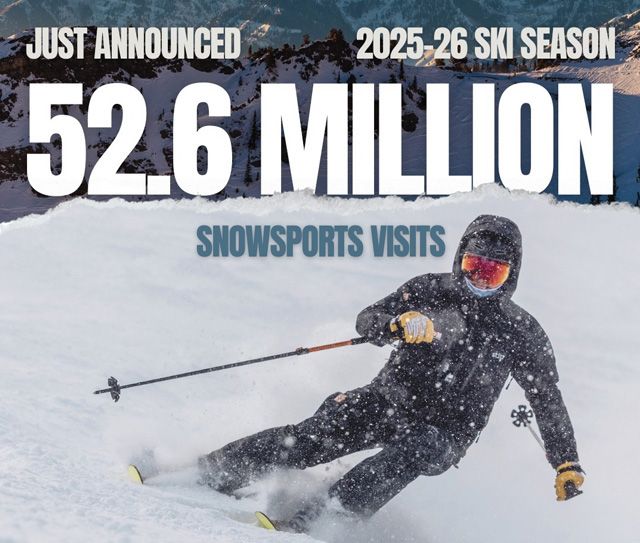
Image: NSAA on Facebook
Speaking of annual updates, our second story this week is also of the yearly variety, as the National Ski Areas Association (NSAA) has just released their skier visit statistics from the 2025-2026 season. Spoiler alert: they’re not good.
Before diving into this year’s numbers, allow us to take a moment to set some context by way of recent years. First and foremost, it’s worth noting that things have been looking pretty good for the ski industry ever since Covid. Last year, for example, was the second busiest season on record (since 1978/1979), with 61.65 million skier visits. For the busiest season on record, you’d only have to go back to 2022/2023, when there were a staggering 65.39 million skier visits. In fact, the four years after covid represents the busiest 4 year stretch on record, with the top 3 busiest years occurring during that span, and each season having 60 million or more skier visits. This year, unfortunately, weather patterns out west prevented the extension of that streak.
This week, the NSAA shared the results of their annual ski area visit survey which reported a year to date total of 52.6 million skier visits - a roughly 9 million decrease from last season and a roughly 15% drop. Again, for historical context, you’d have to go back a full decade to the 2015/2016 season to find a comparable season (excluding the Covid year, in which there were 51.8 million visits). For further context, this season ranks 32nd out of the 48 seasons on record. From 2nd to 32nd, just like that.
There is, of course, a very obvious reason for this sharp decline: the weather. As our Western readers know, in most regions west of the Mississippi, this season is already being called the “winter that never was”. While there were a couple of large storms that hit the Wasatch and Sierra ranges, this season lacked the consistent snowfall that’s expected at higher elevations. As a result, vacations plummeted. According to the report, by way of the Colorado Sun, the Rocky Mountain region measured just 20.1 million skier visits this year. For comparison, last year that number was 26.5 million, good for a 24% decrease in traffic this season.
If there’s any silver lining to this year’s report, it’s this: in both the Northeast and Southeast, where snow conditions were good this season, skier traffic was up by about .4 million in each region. The good news there is that it means this season’s numbers likely don’t reflect a widespread loss of interest in skiing as a winter activity. The bad news though, is that it does clearly illustrate that skiing’s success is directly linked to natural snowfall, which, as we all know, is becoming less certain each and every year. As such, it truly is the Earth’s world and we’re all just living in it. For more on this year’s numbers, check out the coverage from the Colorado Sun.
#3: New “Snow Pass” Looks to Compete With Indy Pass for Market Share of Casual Skiers:
In somewhat related news this week, we’re excited to share word of a new multipass option coming next year that aims to create yet another option for casual skiers. Alongside conversations regarding skier visits and the popularity of the sport, there’s almost always a discussion about how accessible or inaccessible it is for newcomers. That is, there’s generally a perception that skiing is extremely expensive for beginners, with the cost of rentals, lift tickets, and lessons rapidly climbing into the “hundreds of dollars per day” category. While we could argue either side of that endlessly, there’s still an underlying truth: skiers want affordable access to ski areas. Compounding that comment, is a second truth: not every skier is a 50 day a year skier. In fact, according to another NSAA study, roughly 70% of skiers hit the mountain 5 days or less per season. For this massive chunk of the market, spending roughly $1,000 on an Epic or an Ikon Pass hardly makes sense. For them, something like the Indy Pass is a better option, as it enables access to hundreds of ski areas for more than half the price. Now, coming next season, that same market will have a new option: the Snow Pass.
Last August, we shared with you a new pass product called the Snow Triple Play pass. That product offered pass holders a total of 3 days of access across 15 New England resorts for a total cost of $199.00. This week, we’re learning that the team behind that pass product is looking to take things a step further next year with the introduction of the “Snow Pass”, which is expected to go on sale next September. While we don’t know all of the details of this pass yet, what we do know is pretty intriguing.
Building off the success of the Triple Play Pass as well as some experiential learning, Snow Partners (the team behind these passes) has decided to launch a pass product that’s more or less directly inline with the Indy Pass’s offering. That is, while the Triple Play Pass offers 3 days of skiing total, the Snow Pass is expected to offer two days of skiing at each of its partner resorts for a sub $400 pricepoint.
At present, the list of partner resorts has yet to be announced, but we suspect that it will include at least the same resorts that are on its Triple Play Pass, as well as new additions in the midwest. We also wouldn’t be surprised if the roster grows considerably as the payment model behind the Snow Pass is pretty unique: it’s a co-op, where the partner resorts are members that are set to split 80% of the profits from the sales of the pass.
Currently, the traditional partnership based multipass model works on more of a usage based model. In other words, if an Ikon Pass holder visits a resort that’s on the Ikon Pass, then the resort receives a payment for that guest. For example, and while these surely aren’t accurate numbers, let’s say 1,000 Ikon Pass holders visited Sugarbush this past year, and that Ikon pays $50 per pass holder visits. Sugarbush would get a $50,000 payout from Ikon. That’s the traditional model. In this new co-op model being presented by the Snow Pass, ski resorts are set to get a slice of the pie regardless of whether anyone visits their ski area at all. Again, purely as an example, say there’s 10 partner resorts and the Snow Pass generates $100,000 in sales in its first year. The plan as we understand it, is for the Snow Pass to then take $80,000 and split it up amongst its 10 partner resorts, with three payouts given throughout the course of the year. It’s a decision that came as a result of seeing skier traffic through its Triple Play Pass last season, and one that Snow Partners hopes will further help resorts as it gives them guaranteed payouts at predetermined times. It takes some of the guesswork out of budgeting.
While there’s still much to learn about this new multipass, it’s at the very least an exciting addition to the industry as it can only help consumers when it comes time to finding the right pass product for them. Additionally, it has an extremely beneficial business model for resort partners, and we wouldn’t be surprised to see several more resorts jump onboard ahead of Fall sales. To learn more about what we know as of today, check out the writeup from Ski Area Management.
#4: Swedish Ski Area Sälen and Electric Bus Manufacturer, Karsan, Debuted an Autonomous Ski Bus This Year:
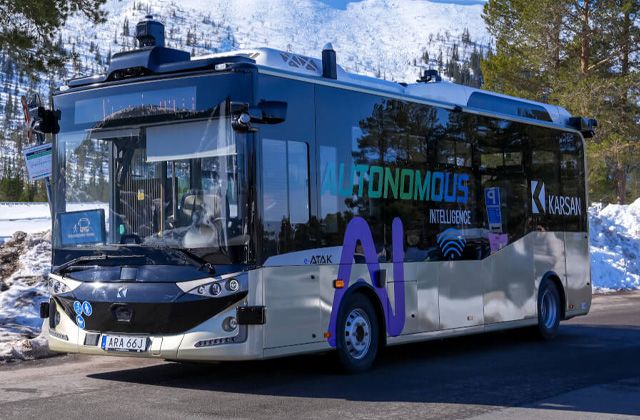
The Karsen Autonomous e-ATAK bus. It’s like any other ski bus, except it doesn’t have a driver. Image: Karsan Official Website
Finally, rounding out our conversation this week is something of a “welcome to the future” story. Over the years, we’ve talked quite a bit about travel issues surrounding ski areas. From possible gondola’s up Utah’s Little Cottonwood Canyon, to ski trains in Colorado, and paid parking situations at resorts everywhere. At one point we even found ourselves talking about how in Utah, even though there’s plenty of demand for more ski buses, there’s a shortage of drivers who are qualified and willing to take on the windy mountain roads. This week, we’ve learned about a company called Karsan who hopes to help solve some of these issues.
Thanks to an article from SnowSportsNews.com, we’ve learned that back in March, one of the first ever autonomous ski buses was put into use in a real world setting in Sweden. A collaborative effort between the municipality of Malung-Sälen, Dalarna University, the region’s transportation department, and electric vehicle manufacturer Karsan, the process of developing the autonomous vehicle was a lengthy one. As you can imagine, not only did this bus, known as the “Autonomous e-ATAK”, have to pass the typical test of identifying shared-road hazards such as other cars, unexpected accidents, wildlife, and pedestrians, but it also needed to prove that it could handle winter weather such as heavy snowfall, ice, and changing conditions. Ultimately, all of those tests were cleared and on March 9, 2026, the Swedish Transport Agency approved the e-ATAK for commercial use.
Upon receiving clearance, Karsan rolled out its first test of the bus, assigning it a 4.8km route that brought skiers in the area between the ski area and a number of accommodation points. In other words, the bus essentially ran a route around the base village of the ski area, helping skiers and snowboarders make the short trip from their accommodations to the base area. By all accounts, the pilot program was a success.
Looking ahead, as we’re known to do, we can’t help but consider what this might mean for the future of transportation in ski towns. On the positive side, should these autonomous buses prove to be safe and effective, it could be a huge help in places like Utah, who would love to provide more public transportation but simply can’t find enough qualified drivers. On the other side, the obvious elephant in the room is safety. It’s no secret that some of the best and busiest days on the mountain also feature some of the most perilous driving conditions. Will an autonomous vehicle be able to handle near white out conditions on mountain roads? Or, perhaps counterintuitively, will they actually prove to be better at handling these conditions by using tools like LiDAR to detect where the edges of the road are? Only time will tell of course, but if there’s one thing we can say for sure about this story, it’s that the future is most certainly coming soon. To learn more, check out the report from SnowSportNews.com.