

Top Five Fridays: August 7, 2026
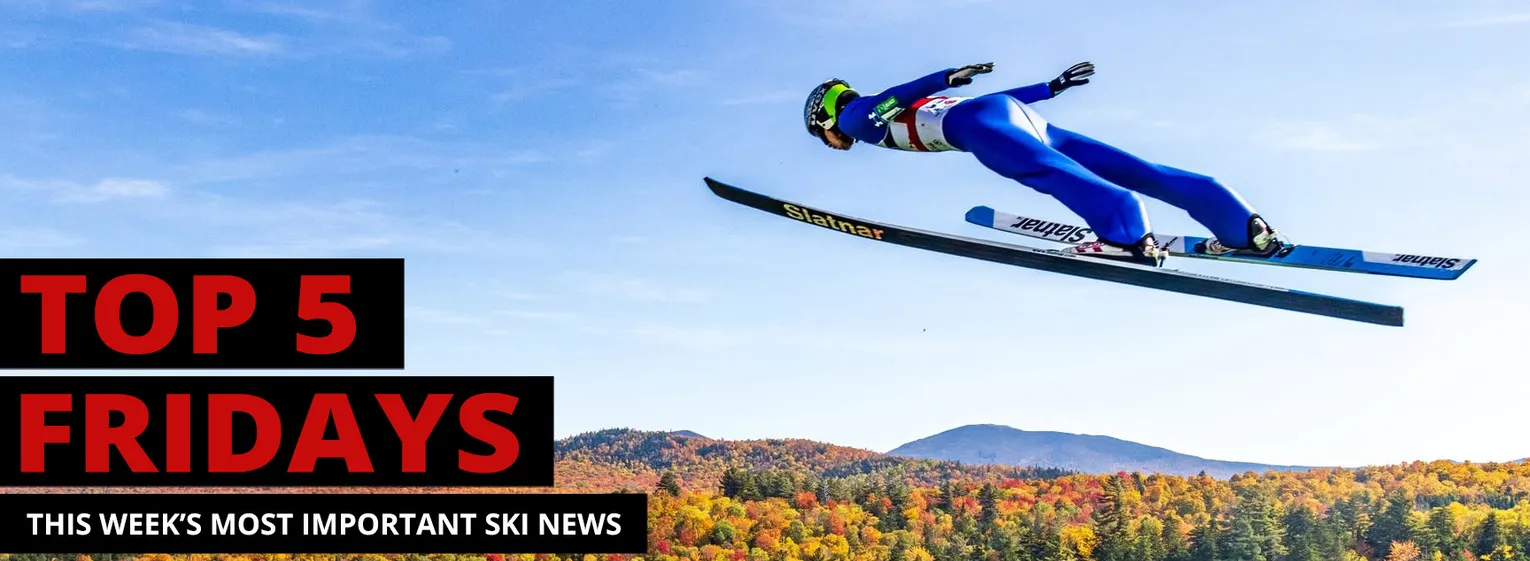
One of the biggest benefits for a sport being included in the Olympics? The support of its National Governing Body, and therefore opportunities like summer development camps for top tier junior athletes. More on that in highlight number 3! Image: Lake Placid Olympic Jumping Complex on Facebook
Hello, and welcome to Top Five Fridays, the August 7, 2026 edition! This week, we kick things off with back to back topics that highlight some maybe not-so-good news for the ski industry, as a massive class action lawsuit has just been filed against not one, not two, not three, not… ok let’s skip ahead a bit… but six of the biggest ski resort related businesses in North America. We’ll do our best to untangle that mess before bringing you up to speed with more wildfire news from the Pacific Northwest. Finally, once we wrap those two heavier topics up, we’ll shift gears and share a tandem of highlights that focus on the junior level of alpine sports as we continue to expand our knowledge of how Olympic pipelines develop. If that all works for you, forge ahead with us as we take a journey through this week’s news!
#1: A Far-Reaching Class Action Lawsuit Has Just Been Filed, Accusing 6 Major Players Within the Ski Industry of Collusion:

Big shout out to Always Sunny in Philadelphia and Pepe Silvia for the inspiration behind today’s ChatGPT illustration. On that note, yes the image is AI, and yes "Charlie" only has 4 fingers. But, we thought it was a pretty funny graphic, especially if you know the scene. That said, hate the use of AI? Let us know in the comments!
Getting things underway this week, is a surprisingly interesting price fixing lawsuit that’s been filed against several of the biggest names in skiing. Now, we say surprisingly interesting because we covered a similar story back in March in which Vail and Alterra were being sued for antitrust violations, alleging that the two companies owned such a significant share of major ski resorts that they’re able to raise prices at will. While there’s certainly an argument to be made there, the allegation and discussion is pretty straight forward - especially compared to this week’s news.
In a lawsuit filed on Wednesday in federal court in Colorado, three plaintiffs alleged that Vail Resorts, Alterra, Boyne Resorts, Powdr Corp, the National Ski Areas Association, and a data firm called RRC Associates all colluded in a way that allowed the resort owners to raise prices at their resorts. According to the lawsuit, there are only 32 “destination resorts” in the United States, of which the four corporations own or control access to 30, in addition to owning several other ski areas. With control of these resorts, the four companies collectively raised their season passes by 40-45% and daily lift tickets at destination resorts by as much as 55% since 2020. Now at this point, the argument feels a bit soft still, as increasing prices across an industry doesn’t necessarily equate to collusion or price fixing. But, there’s another layer to this lawsuit.
Enter RRC Associates, a “strategic market research, data analysis & consumer intelligence for tourism and outdoor recreation industries” company based out of Boulder, CO. In other words, it’s a company that organizations can hire to perform industry type research. There’s a lot that could be unpacked here in terms of how an organization like this can help steer industries for better or worse, but for this week’s purposes, we’re going to focus on its role in this particular lawsuit.
As you might guess, collusion and price fixing typically doesn’t mean that all four CEO’s were in a group chat asking each other, “what should our price be this year?”. Instead, it happens much more subtly, which is where RRC comes into play. In this lawsuit, it’s alleged that Alterra, Vail, Boyne, and Powdr all shared sensitive information regarding their costs, pricing, and revenue with RRC. RRC then collected that data in the form of a report that was prepared for the NSAA. That report in turn was then available to members of the organization such as Alterra, Vail, Boyne, and Powdr. In other words, the four companies provided their info, RRC collected it, made recommendations, and then provided a report to the NSAA which was then accessible by the businesses. In doing so, the four competitors were able to pool what should have been confidential information into a singular report that enabled them to better understand not only what their competitors were doing, but also their customer’s options and price tolerances. The lawsuit argues that this amounts to collusion.
In addition to this main storyline, there is an additional claim made in the lawsuit that Alterra, Boyne, and Powdr took their collusion a step further by all using an Alterra owned piece of software called “Aspenware Commerce”. This software is a platform in which operators of each ski resort owned by the three companies input key data points throughout the season in an effort to streamline reporting. Additionally, this software is also responsible for setting dynamic pricing at the resorts throughout the season. Importantly, it’s worth noting that the reason these three businesses use this platform is because many Boyne and Powdr ski areas are partners of the Alterra owned Ikon Pass.
All said and done, this is a pretty fascinating one. As presented in the lawsuit, and therefore in our recap, there’s a clear pattern of collaboration in an effort to set resort prices, which have undeniably been rising in recent years. There is also a counter argument though: trade organizations are commonplace in every single industry, and the purpose of these organizations is to share knowledge so that businesses can prosper. That’s the entire point. But, collusion and price fixing are also illegal. The question then becomes, as it so often does in legal cases, “where do we draw the line?”. At what point does providing data to a research firm who collects it into a report which is then distributed via a trade organization - at what point does that stop becoming the normal operation of a trade organization, and start to become collusion? That’s not an answer that we have yet, but eventually this story will progress and we’ll have a better understanding. When we do, we’ll be sure to report back. Until then, check out this report from Reuters, or the lawsuit itself.
#2: A Challenging Wildfire Season Continues as Mt. Hood Ski Areas Threatened by Grasshopper Fire. Meanwhile, Eagle Point Announces Outlook For the Coming Season:
While wildly popular in Europe, Biathlon has struggled to catch on here in North America. So, in case it’s something you haven’t seen before, here’s some Olympic coverage to get familiar with.
Next up this week is some difficult news coming out of Oregon, where a wildfire started dangerously close to Mt. Hood back on July 23rd. Initiated as a result of a lightning strike, the Grasshopper Fire began just 15 miles to the Southeast of Mt. Hood Meadows and neighboring Timberline Lodge. Since then, it has spread to cover 43,244 acres, marching in a problematic direction, although it’s currently blocked by Route 35.
On Tuesday of this week, the situation became dire as Mt. Hood Meadows was put under a Level 3, “Go Now” evacuation - the most urgent level available. As a result, the resort was obviously closed and guests were asked to stay away in order to allow firefighters to take preventative measures. At nearby Timberline Lodge, which is roughly 35° around the bend of the circular Mt. Hood volcano, the evacuation notice got as high as a Level 1, meaning “be ready to go.” For the better part of this past week, those in the area have been holding their breath, hoping the fire didn’t jump Route 35.
Fortunately, there’s beginning to be an air of optimism in the area as winds are beginning to shift, now coming from the Northwest. In the world of wildfires, wind is an enormous factor in terms of the direction the fire moves. With Northwest winds now in effect, both Timberline and Mt. Hood Meadows are cautiously optimistic that they’ll dodge the bullet and be able to resume operations within the coming days. While hopes are high that the two resorts will emerge from this near disaster unscathed, it’s yet another reminder that climate change and dry winters don’t just mean less powder days: they often mean worse wildfires too. To stay up to date on this, follow along with the Grasshopper Fire Facebook page which has been posting regular updates.
Before rounding this lowlight out, we want to quickly share an update from Eagle Point Resort in Utah, who we covered back in July. There, the resort wasn’t as lucky as those on Mt. Hood, as a devastating fire ripped through its property back in June, leaving behind an incredible amount of damage. Unfortunately, we learned this week that the damage was so severe that multiple lifts will require new haul ropes and repairs, a process which can take several months to complete. As a result, Eagle Point Resort will not be opening for the upcoming winter season. To learn more about this, check out the report from SkiMag.com.
#3: Team Summit Colorado’s Continued Success Highlights the Value in Development Camps Like the U.S. Ski Team’s Project Gold:
Image: U.S. Ski and Snowboard Team
Moving on from those heaving topics, we’re going to shift gears here and talk about junior skiing for the back half of this week’s newsreel. This week, we caught a story from Colorado’s Summit Daily that shares the successes of a few of its junior athletes. While we’re excited to highlight them, we also found this story to be a great way to highlight one aspect of the U.S. Ski Team’s development pipeline at the very early levels. Let’s jump in.
First and foremost, a massive congratulations to Team Summit Colorado mogul athletes Easton Dean (13 years old), Georgia Kirchner (15), and Micah Rubinstein (15) for being invited to represent the Rocky Mountain region at this year’s Freestyle Project Gold Camp - a U.S. Ski and Snowboard Team development camp. In order to be invited to this camp, athletes had to be ranked in the top-10 within their region and gender this past season. Receiving an invite to the camp marks one of the first major milestones in a young athlete’s career as it recognizes them for their accomplishments while also giving them exposure to the next level of the sport.
While these camps take place in the Western, Rocky / Central, and Eastern Regions each year, and are offered to freestyle, freeski, and snowboarding, the specific camp that these three athletes attended was held at Park City’s Center of Excellence. There, athletes were given access to world class training facilities and were able to meet with U.S. Ski Team sport coaches, nutritionists, and strength coaches. Throughout the weeklong camp, athletes learned more about workout routines specifically meant to improve their abilities on the hill, as well as nutrition to help ensure that their diet is properly fueling their training. In addition to these educational aspects, athletes were also able to hit the water ramps at the facility, helping them dial in new tricks before taking them to snow. All of this, one would assume, will give these athletes an added edge heading into next season, where hopefully they’ll qualify for a Project Gold camp again, ultimately benefiting from compounding experiences.
While this week’s story focuses on a trio of junior athletes from Colorado, we can’t help but to think about how powerful an experience like this can be for junior athletes in any sport. At risk of preaching to an empty room, we want to quickly connect this concept to the sport of Freeride.
As you know, Freeride was just included in the 2030 Winter Olympic program, to the excitement of some and chagrin of others. While Team Chagrin laments the possible impact that the FIS and IOC will have on the spirit of Freeride skiing, Team Excitement points in part to the immense opportunities that will emerge from the inclusion. While the top goal for any elite athlete would be to make it to the Olympics, it’s worth noting the impact that camps like Project Gold can have on a much wider range of people. This year, Project Gold invited 10 athletes from 3 regions for mogul skiing - 30 kids. Multiply that by all of the disciplines that get invited to camps like this and suddenly the impact of Olympic inclusion isn’t just the opportunity to stand on arguably the most important podium in sports or to earn big name sponsors. Instead, the impact is a scenario in which hundreds of kids each year have their confidence and abilities affirmed by way of being invited to an exclusive camp, only to go on and learn far more in the worlds of health, fitness, competitive psychology, and much more. These kinds of experiences can be life changing for a teenage athlete, who can carry lessons with them regardless of whether or not they pursue the sport to a professional level. So yes, while Olympic inclusion also inherently requires playing by the rules of an organization that may not have had its finger on the pulse of a sport since day 1, it also leads to the sport providing far more formative opportunities for junior athletes. Just some food for thought!
To learn more about the Team Summit athletes who attended Project Gold this summer, click here. To learn more about Project Gold qualification requirements, click here for freestyle, here for snowboarding, or here for freeskiing.
#4: The 2026-2027 IFSA Freeride Season is Underway as Competitions Kick Off in South America!:
Finally, rounding out this week we want to quickly share with you the latest news from the world of Freeride skiing, where the IFSA competition season has just kicked off in South America! Now, if you’ve been reading along with us, you may have heard us mention the IFSA before, but we know that all of these acronyms can be hard to keep straight, so here’s a quick overview of how the sport of Freeride is structured. The global circuit that professional Freeriders compete in is called the Freeride World Tour. The FWT also operates a junior circuit and the adult circuit for everywhere in the world except North and South America. Here, the International Freeskiers & Snowboarders Association (IFSA), which was founded by Shane McConkey in 1996, organizes and hosts events for junior and adult athletes. For juniors, the ultimate achievement is qualifying for the annual world’s event (hosted by the FWT in Austria every January), while adults compete in an effort to qualify for the 3 stop IFSA Challengers Series. Should they do well in Challengers, they qualify for the Freeride World Tour.
All make sense? Good. Just one last thing to keep in mind: within the junior and adult qualifying series, there are 2* events which are generally easier to get into and worth a modest amount of points, 3* events which require a higher seeding to get into, are worth more points, and for junior athletes, include a qualification day and a finals day (the only time this happens in Freeride). At the adult level, there are also 4* events that are worth even more points at the adult level, while events like the Junior Freeride Championships offer similar point structure at the junior level.
All of this is to say that the IFSA 2026-2027 season has just gotten underway with a week full of events down in South America, signifying the start of another season in which a select few athletes will inevitably achieve their goal of qualifying for either the Freeride World Tour or Junior Worlds.
Kicking things off last weekend, Argentina’s Cerro Perito Moreno held both an adult 2* and a junior 2*, easing athletes into the season. From there, things quickly escalated as El Colorado played host to what’s known as Andes Week - a celebration of freeskiing with several events happening concurrently over the course of the week. While Andes Week is only a few years old, it’s already growing tremendously in popularity with more and more North American teams making the trek down South, not only to get some skiing in and compete, but also to continue growing the sport of Freeride in South America.
This time around, Andes Week featured a U12 junior event, an adult 2* event, and a two day junior 3* event. Making it even more exciting, all of these events were streamed live, giving us the opportunity to build some excitement for the season ahead by watching athletes take on what proved to be an interesting and playful venue at El Colorado. While we don’t want to spend too much time diving into highlights or results, we do just want to quickly mention that cork 7’s on natural terrain appear to be the new standard at the junior level, as multiple were thrown in events this week. That’s all we’ll say for now, but if you’re looking for something to watch as you wait for Winter, we recommend checking out the full replay of the Junior 3* finals accompanying this highlight, or the adult 2* replay in this week’s edits of the week! To check out results, head over to LiveHeats.com and do a search for “El Colorado.”