

Top Five Fridays: December 15, 2023
Lead Image: After a tremendously slow start to the season due to a number of cancellations, the FIS Men’s Alpine circuit finally takes them to Beaver Creek this week for a series of speed races. The U.S. Men’s team appears poised to make a splash. Image: U.S. Ski and Snowboard Team on Facebook
#1: FIS Updates - Bryce Bennett and Mikaela Shiffrin Both Earn Huge Downhill Wins:
Replaying Bryce Bennett's winning downhill run in Val Gardena
Hello, and welcome to Top Five Fridays, the December 15, 2023 edition! This week we’ve got a triple header of FIS news highlights, although each underlying topic is decidedly different. To get that highlight reel underway, let’s start how we always do: by recapping last week’s alpine World Cup action.
After an exciting and fruitful stint in North America, the women’s circuit found itself back in Europe this past week for a series of speed races in St. Moritz, Switzerland. Last Friday, just as we were finishing our weekly recap, the first super-G race of the season was reaching its conclusion. Riding a recent podium streak, we had high hopes that Mikaela could keep her run going, despite it being her first speed race of the season. Unfortunately, our hopes for Mikaela were just .08 seconds too high as she ultimately finished the race in fourth place. Making matters even more frustrating for us, as fans, is the fact that just .13 seconds separated Mikaela’s fourth place finish with Cornelia Huetter’s 2nd place finish. In addition to Mikaela, U.S. athletes Keely Cashman and Lauren Macuga also earned points in the race, finishing in 24th and 30th place respectively. Unfortunately, Breezy Johnson, one of the best athletes on the U.S. Women’s speed team, was unable to compete for reasons that we’ll cover in highlight #2.
Fortunately for us Shiffrin fans, the disappointment resulting from our unrealistic expectations only lasted one day, as she did what she does best in the very next race: absolutely blow us away. The second race of the St. Moritz series was a downhill - an event that is not at all Shiffrin’s specialty, but a discipline that she seems to love and is constantly looking to become better at. Keeping that in mind, it’s with great excitement that we share the news that Mikaela Shiffrin won that race, notching just her fourth ever career downhill gold medal, and her 91st ever FIS gold medal. For Shiffrin to be able to win a downhill race, when her specialty is at the other end of the spectrum, is nothing short of remarkable. Of course the day wasn’t entirely about her. In addition to her gold medal, Isabella Wright earned a 12th place finish, while Alice Merryweather finished in 32nd in her return to snow. Unfortunately, after that race, the following day’s super-G was canceled due to inclement weather. Looking ahead, the women’s circuit is now in Val d'Isere, France, for another downhill and super-G race. You can preview that schedule here.
On the men’s side, we finally have the type of results to report that we’ve been waiting all year for. Not only have the men been able to compete in multiple races this week, but the U.S. team also earned some extremely positive results. Getting things started for the Men’s team this week was a top 10 finish from River Radamus in a slalom race at Val d'Isere, where he finished in exactly that: 10th place. From there, the circuit traveled to Val Gardena / Groeden, Italy for two downhills and a super-G. At the time of this writing, the first of the two downhill races has been held, as well as the super-G, with the second downhill scheduled for tomorrow. So, how did Team America do? Well, pretty darn good. In the downhill race, the U.S. team put three athletes in the top 20, led by an amazing victory from Bryce Bennett who stole first place from Aleksander Kilde - one of the top athletes on the men’s side of things. For Bennett, it’s a huge result, particularly coming as the first one of the year for him. Following his lead, Ryan Cochran-Siegle finished in a commendable 14th place, while Jared Goldberg earned 18th. A day later, in the super-G, the U.S. team continued to earn points, with Jared Goldberg finishing tied for 10th, followed by Bryce Bennett in 14th, Kyle Negomir in 24th, and Sam Morsing rounding out the points in 30th. All in all, it’s been a terrific weekend for the men’s team, who apparently is quite excited to be competing again. Looking ahead, they’ll compete in one more downhill in Val Gardena / Groeden tomorrow, before heading to Alta Badia for two giant slaloms on the 17th and 18th, and then onto Madonna di Campiglio on the 22nd for a slalom race. As always, we’ll be back next week with a full recap of results!
#2: Breezy Johnson Sidelined Due to Doping Rule Violations. In Actuality, the Story Highlights the Stringent Regulations Athletes Face:
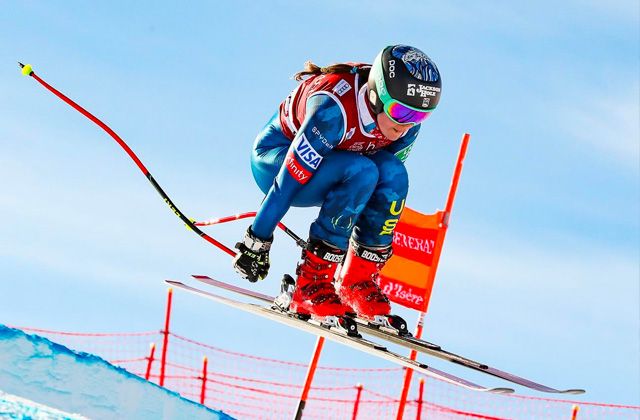
Breezy Johnson, one of the fastest speed racers on the U.S. Women’s Alpine Ski Team, is currently sidelined pending the results of an open case with the U.S. Anti-Doping Agency. Image: Breezy Johnson on Facebook
Unfortunately this next bit of FIS World Cup news is significantly less fun: Breezy Johnson has left the alpine circuit indefinitely. Last weekend, in St. Moritz, Johnson, who is one of the U.S. Ski Team’s top speed athletes, was unexpectedly missing from competition. The reason for her absence, as we found out on Saturday, is due to issues regarding her compliance with the U.S. Anti-Doping Agency’s (USADA) anti-doping regulations. Now, we know how that sounds, and the knee-jerk conclusion is to assume that this means Johnson has been using banned substances in her training. That’s actually not necessarily the issue here. Rather, Johnson has been found in violation of what’s called a “whereabouts” policy. Essentially, athletes representing U.S. national teams are required to give the USADA quarterly updates as to where they are so that the agency can issue a surprise drug test at any given time. Even more specifically, these filings require athletes to provide a 1-hour window stating where they’ll be on each day so that they can provide a sample with no advance notice. If an athlete fails to be available during this one hour window, it’s considered a “missed test” violation. Johnson, as it turns out, has three missed tests in the last calendar year. That volume has caused doubts regarding Johnson’s ability to pass a drug test, and so she has decided, in her words, to pull out of races until the matter is resolved out of respect for her fellow athletes. Historically, these situations have commonly resulted in 18 to 24 month long bans for athletes.
Now, we don’t want to pretend to know whether or not Johnson is clean, although she did publicly state that, “I am, and always have been, a clean athlete,” and we’re inclined to believe her. While missing random drug tests certainly doesn’t look great, take a second and put yourself in her shoes. If someone asked you to tell them exactly where they could find you for one hour every day for the next three months, or really your entire life for that matter, would you be able to do it? And even if you were to name that time and location, what are the odds you’d actually be there, for the same time, every single day? Of course it’s true that Johnson is a world class athlete, and along with such talent comes great responsibility, but in our eyes, this story is as much about the stringent lifestyles these athletes have to live as it is the fact that Johnson is currently on the sidelines over doping concerns. To read more about this, check out the write ups from SkiRacing.com and Jackson Hole News and Guide.
#3: What Happens When an FIS Race is Canceled? A Lot of People Lose a Lot of Money:
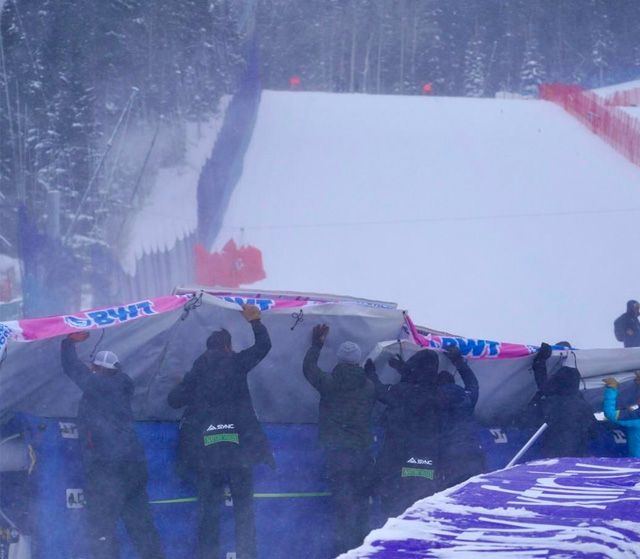
Birds of Prey volunteers do their best to pull off an FIS World Cup race, despite the challenging weather. Unfortunately, their efforts were futile and all three scheduled races had to be canceled, costing event organizers hundreds of thousands of dollars. Image: Birds of Prey World Cup on Facebook
Moving right along, for our third update this week, we caught an interesting article that shines a light on what happens behind the scenes at World Cup race venues. As you know, numerous races have been canceled this year, primarily on the men’s circuit. Amongst the cancellations, were all three races scheduled to occur in Beaver Creek over the course of the first weekend in December. Known as the “Birds of Prey” event, these races have long been a hallmark of the early World Cup season, and by and large, go off without a hitch each year. This year, unfortunately, was different, as the races were canceled due to weather. As per usual, when the news broke we reported on the disappointment felt by athletes, spectators, and event organizers alike. This week though, we caught an article from the Vail Daily that dives a little deeper, past “disappointment,” and into the financial implications felt by event organizers when a series of FIS races are canceled.
To tell the story, the first thing you need to know is that the Birds of Prey races are organized and hosted by the Vail Valley Foundation, a non-profit organization that operates as something of a tourism and e-commerce agency, looking to bring growth to Vail Valley. As part of their efforts to stimulate the local economy, the VVF puts on the Birds of Prey event, knowing that it brings guests to their region during what’s typically a slow time of year, and whose spending gives local restaurants, shops, hotels, and other services an economic boost. In doing so, the VVF expects to spend about $4 million each year, in order to create a $3.4 million local impact. Now, just to be clear, those are different figures - the $4 million is the VVF’s budget, while the $3.4 million is money that’s spent around town at local businesses. The VVF doesn’t recoup that $3.4 million. In terms of actual losses for the VVF, their President, Mike Imhof, estimates that they typically budget for about $200k in lost revenue each year. This year though, due to the cancellations, he’s expecting that number to double, or even triple. In other words, the VVF will likely have $200k - $400k less in their budget than they anticipated in the year ahead.
While we’re sure each and every venue is different in terms of who’s actually running the show and where the budget comes from, our guess is that these losses are at least similar across the board, no matter where a race is being held. Now that we have a rough idea of financial losses per FIS race cancellation, it’s something to keep in mind moving forward as we talk about not only race cancellations, but also the concept of moving the FIS schedule deeper into the season. While the FIS organization itself wants to capitalize on early season excitement, if event organizers find themselves losing hundreds of thousands of dollars when races are canceled every year, there may come a time when financial incentives pair up with environmental concerns in a way that forces the change to happen. We’ll continue to analyze that in years to come, but for now, we’d recommend checking out this writeup from the Vail Daily to learn more.
#4: Under Netflix CEO’s Ownership, Powder Mountain Announces Plans to Go Semi-Private, Creating “Members Only” Chairlifts:
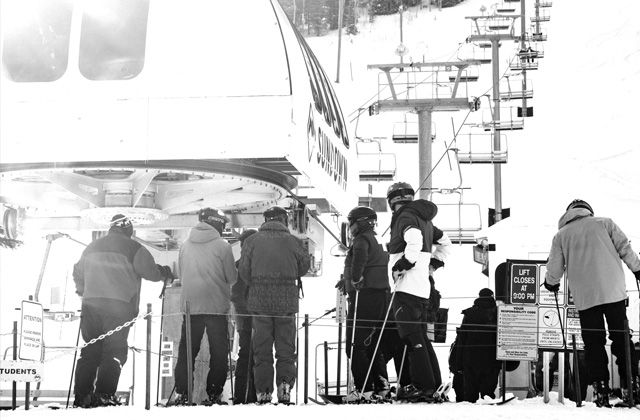
Looking up Powder Mountain’s Sundown lift - one of the lifts that is not affected by the resort’s privatization plans. Image: Powder Mountain on Facebook
Finally, we’re rounding out the news this week with a story that we think officially symbolizes a trend in the ski resort industry: privatization. In recent months, we’ve found ourselves talking more and more about ski areas becoming either completely or partially private. In Utah, we’ve covered the controversial development of Wasatch Ranch, which may actually never be allowed to open. In the Tahoe region, we’ve talked about Homewood Mountain Resort, whose attempts to semi-privatize have all but been dashed due to public backlash. In New York, we’ve talked about the rebranding and semi-privatization of Windham Mountain, now known as the Windham Mountain Club. Prior to these stories emerging within the last year or so, there was really just one private ski resort in the United States: the Yellowstone Club. Now, in the last year, three others had made headlines, with this week bringing a fourth: Powder Mountain, Utah.
If you’ll recall back in September we shared the news that Netflix CEO & Co-Founder, Reed Hastings, had bought into Powder Mountain’s ownership in such a substantial way that he immediately became the majority shareholder. As such, it’s more or less his mountain to have his way with. Ironically, in that report, we talked about how Reed’s vision was all about “access”. He hoped to open more terrain, increase backcountry access and interest, and even offer an incredibly affordable $19 night skiing ticket. In that moment, Hasting’s direction felt surprisingly refreshing. This week though, news broke that’s left the community feeling a bit less excited about what’s to come.
In a press release this week, Hastings broke the news that Powder Mountain will be moving to a semi-private model. In his version of what this means, certain areas of the mountain will only be accessible to homeowners in the area. In other words, there will be private portions of the mountain, inaccessible to the public. Starting next year, two lifts known as Village and Mary’s will become member-access only. A quick look at the trail map shows these lifts providing comprehensive access to two mostly beginner and intermediate trail networks in what’s called “Mary’s Bowl” and “Lefty’s Canyon”. In each of these secluded areas, their lifts bring skiers back to a shared peak, upon which there is also a small village and lodge. We imagine the general concept here is that these will become primarily used by this private skiing crowd. In addition to these lifts, there are also plans to add a lift to the Rain Tree area, which consists of a number of black diamond level glades runs. Judging by the map, this area seems to be currently accessible via either a long approach, starting at the top of Mary’s Bowl / Lefty’s Canyon, or via cat skiing services. Keeping that in mind, it feels like the play here is to create more convenient access to some of the steepest, most secluded glades on the mountain, exclusively for local homeowners.
Aside from the details of the story, what really caught our attention here is two things. First, it’s yet another scenario in which a ski area is moving to a semi-private model, which makes this concept feel more and more like a growing trend. Much like when ski resort consolidation really got underway back in the mid 2010’s, we’re starting to get a similar vibe with the concept of privatization as resorts look to leverage their real estate as a way to ensure long term independence and viability. Second, this concept of having portions of the mountain only accessible to members is a new one, and yet another way in which ski resorts are exploring the semi-private model. Noting the red tape and requirements that ski areas need to go through as they develop, it’ll be interesting to see if Powder Mountain is in fact able to create a new lift with the intention of only allowing private members to ride it. That’s a story we expect to hear more about down the road, so for now, we’ll turn you over to Powder.com to learn more.