


Top Five Fridays: July 31, 2026
A junior athlete competes in a rail jam held at Calgary’s WinSport multi-recreational facility. Originally built for the 1988 Winter Olympics, WinSport is one of many Canadian facilities set to get an influx of cash for renovations. Image: WinSport's Canada Olympic Park on Facebook
Hello, and welcome to Top 5 Fridays, the July 31, 2026 edition! This week, we’ve got three big stories about big business in the world of skiing. From the U.S. Ski Team’s continued expansion efforts, to massive investments being made by both the Canadian and Coloradan Governments, this week’s newsreel starts out with back to back to back stories featuring high dollar investments. Don’t worry though, once we’ve sufficiently melted your brain with dense financial details, we’ll cool things off by checking in with Chile, where the massive storm system we first learned about in mid-July has since delivered. To escape our vaguities and get into some details, keep on reading!
#1: U.S. Biathlon Votes to Postpone Merger With the U.S. Ski Team After Significant Pushback and Legal Concerns Arise::
While wildly popular in Europe, Biathlon has struggled to catch on here in North America. So, in case it’s something you haven’t seen before, here’s some Olympic coverage to get familiar with.
First up this week in our big business triple header, is a complicated and convoluted story coming to us from the world of U.S. based national governing bodies. If you’re a regular reader of Top 5, you should be pretty familiar with this term, but just in case you’re not, here’s your reminder: national governing bodies, or NGBs, are the official organizations that represent sports within a country for purposes of global competition. The U.S. Ski Team, for example, is the NGB that represents U.S. Alpine Ski Racing, Freeski, Snowboard, Ski Jumping, Cross Country, Aerials, Mogul, Ski Jumping, Nordic Combined, and all equivalent para sports. They also, as it turns out, are hoping to represent Biathlon athletes.
On Tuesday of this week, we began seeing reports that U.S. Biathlon (USBA), the current NGB for the sport, was set to hold a vote on Wednesday regarding whether or not they wanted to move forward with a merger with the U.S. Ski Team (USSS). While it was the first we were hearing of this concept, it turns out that it had actually been in motion since March, after the U.S. Biathlon Team failed to medal in the Winter Olympics - something that it still has never achieved. As it turns out, in the wake of yet another round of Olympic losses, the United States Olympic and Paralympic Committee decided to cut the organization’s funding by 22%, while sponsors simultaneously began reducing their support. As a result, U.S. Biathlon board members engaged in talks with Sophie Goldschmidt and the USSS to explore the possibility of having their organization absorb Biathlon athletes. The benefit of course, would be more funding, more training resources, and more opportunities for the Biathlon team. While there’s certainly a financial argument to be made here, the concept was met with swift backlash from the USBA community who wasn’t informed of the discussions until May.
Leading up to this week’s decisive vote, grumbles within the community grew to a roar. In addition to the voice of public opinion growing in volume across social media, townhalls, and full blown opposition websites, so too did legal arguments against the merger. Last Friday, sports lawyer Ed Williams and Olympian Joan Wilder filed a complaint with the USBA’s ethics committee. In that complaint, the two allege that USBA’s chairman, Bob Hall, unethically hosted meetings regarding the merger behind closed doors and without notifying members. Additionally, a second complaint points out a conflict of interest with USBA board member Dexter Paine, who also sits on the USSS board, suggesting that it’s in his own personal best interest to support the merger. Furthermore, there’s yet another concern about the merger: it may not be legally possible at all. According to the 1978 Ted Stevens Olympic and Amateur Sports Act, each NGB can only be a member of a one international governing body. As it stands, the U.S. Ski and Snowboard Team is a part of the FIS, while U.S. Biathlon is a part of the International Biathlon Union. In other words, there’s currently a federal law in place that would prevent the U.S. Ski Team from overseeing the Biathlon team as it competes under a different international entity.
Ultimately, after much back and forth and with the temperature within the community rising for months now, the board voted on Wednesday to postpone their decision until late August. Between then and now, the organization plans to form a working group to get a better understanding of both the legal viability of this move, as well as determining guardrails that they can include in the potential agreement to address concerns within the community about the future of the sport - such as the USSS reducing the USBA’s funding like they did for Ski Jumping in 2010 and Nordic Combined in 2014. So, while this week’s news made plenty of headlines, it sounds like this story might be just getting started. To learn more about it, check out this report from the Associated Press.
Before rounding this highlight out, we also want to bring some attention to a small anecdote that we picked up on in this story: Sophie Goldschmidt is currently in conversations with USA Skateboarding as well. As you’ll recall, last September we shared the news that Goldschmidt had been attempting to acquire the USA Surfing - an effort that has ultimately fallen through for the moment. This week, as we learned about the U.S. Biathlon hopes, we also learned about the USSS’s interest in acquiring USA Skateboarding (news of which actually broke at the end of January). In other words, within the last year or so, Goldschmidt has made efforts to absorb three additional NGB’s, two of which are summer Olympic sports. We don’t have the space to further explore this story here this week, but you can almost guarantee that at some point we’ll take a deeper dive into Goldschmidt’s efforts to create a unified action sports NGB. For now, we’ll defer you to Sportico’s coverage of USA Skateboarding acquisition efforts, first revealed back in January.
#2: Canadian Governments Promise Combined Contributions of Over $60 Million in Winter Sport Investments:

Amongst the many line items slated for improvement from the recent influx of funding, is the halfpipe at Calgary’s WinSport Olympic Park. Image: WinSport's Canada Olympic Park on Facebook
Moving right along, in other Olympic based sports news, our second story this week is the complete opposite of our first one in some ways. While the story surrounding the potential merging of the U.S. Biathlon and the U.S. SKi and Snowboard Team is rooted in a lack of funding, the news coming out of Canada this week is rooted in a massive influx of funding.
On Monday of this week, the Canadian government published a press release detailing plans to spend a combined $33.676 million on a slew of projects meant to support both its current winter Olympic athlete teams, as well as support its pipeline by continuing to provide world class training facilities and recreational opportunities.
The cornerstone of this package deal is a $26 million investment in the University of Calgary’s Olympic Oval skating arena, which hosted the 1988 Winter Olympic Games. In addition to the $26 million in federal funding, the Province of Alberta is matching the contribution and adding another $26 million, bringing the renovation project to a total of $52 million in funding.
“Ok, but what about the ski and snowboard teams?” you ask. Fear not: neither have been neglected. In addition to this massive cornerstone project, the federal government will be investing in several other infrastructure projects that should boost the facilities for a variety of disciplines. At Calgary’s WinSport multipurpose Olympic Venue, upgrades will be made to the halfpipe in order to support training as well as international events. Additionally, alpine training centers in Whistler and at Panorama Mountain will be receiving upgrades. In the world of Nordic Skiing, the Nakiska National Ski Cross Training Centre will receive funding for upgrades. The list continues, with each upgrade aimed at supporting both global competitions, as well as local clubs who support junior athletes on their journeys.
Speaking of which, the federal government made one additional pledge that’s athlete-centric: increasing the nation’s Athlete Assistance Program annual budget from $40 million a year, to $43 million a year, allowing them to provide more financial support to more athletes.
All in all, it’s a big investment in winter sports for a country who earned 21 medals at last year’s Winter Olympics - a slight dip from their average of 26 across the previous 5 iterations. While we’ll have to see if this investment pays off, it’s certainly worth noting the level of importance that both the U.S. and Canadian governments place on remaining globally competitive in winter sports. To learn more about this week’s announcements, check out the official press release here.
#3: The State of Colorado Offers a $4 Million Incentive Package, Hoping to Entice “Project Odysseus” to Stick Around:

Downtown Denver, CO, the focal point of this week’s news regarding efforts to retain Project Odysseus, probably aka Alterra. Image: Visit Denver on Facebook
For our third big business highlight this week, we’re transitioning out of the world of Olympics, but continuing our theme of government subsidies as we turn our attention to Denver, CO, where rumors are spreading that the state has pledged millions of dollars to keep one of the biggest companies in skiing in town. We say “rumors” here, because while highly likely, we can only say with 99.99% certainty that “Project Odysseus” is a code name for Alterra. Allow us to explain.
At 7 AM on Monday this week, members of the Colorado Economic Development Commission (CEDC) held an emergency meeting to approve a deal that would give roughly $4 million in combined incentives to a company using the code name Project Odysseus. In a weird legal quirk, the CEDC is allowed (and likely required) to cite details of the package they agreed upon, as well as previous deals given to the same company, but because the company might be actively seeking similar packages in other states, they’re allowed to have anonymity. As such, we don’t know with absolute certainty that Project Odysseus is Alterra, but several clues make it all but certain.
Here’s what we do know: on Monday morning an emergency meeting was held by the CEDC to approve an incentive package for the anonymous company. When asked about the emergency nature of the meeting, one of the commissioners of the CEDC said that the anonymous company was set to have a board meeting soon to vote on plans to relocate to Salt Lake City. As such, they needed to rush this offer through so that the company would consider relocating to Downtown Denver instead.
We also know the details of the package. Coming in at just under $4 million in value, the package included a $1 million interest free loan, $1.9 million in Job Growth Incentive Tax Credits for up to 106 jobs over the next 8 years, with an average salary of $131,000, as well as $1 million in grant money to be used by Project Odysseus in $250,000 increments to support recruitment projects specifically. All of this would be contingent on Project Odysseus signing a long-term lease in Denver’s metro area.
Now, based on those details alone, there’s nothing to prove that Project Odysseus and Alterra are one in the same. But, like we mentioned, the CEDC is also allowed to cite prior agreements with the business in question. As such, we also know that Project Odysseus has already secured a $7 million loan at 2% interest. That aligns quite well with an agreement made by the Denver Downtown Development Authority with Alterra just last week, when they agreed to lending the company $7 million if they moved their offices to the city’s upper downtown district. Additionally, commissioners mentioned that Project Odysseus had been awarded a job-growth tax incentive back in 2019 that it had successfully achieved. Likewise, Alterra received $1.7 million in 2019 to add 132 jobs. In other words, while it’s not being said out loud, there are a lot of unique details that point directly at Alterra.
Now, as per usual, we’re going to take a moment to zoom out on this story and consider the bigger picture. First and foremost, it’ll be interesting to see if Alterra continues to reside in Colorado, or if they jump ship to Salt Lake City. In recent years, there’s been a bit of a competition forming between these two states as the battle to retain big name events and businesses. Sundance Film Festival, for instance, will be relocating from Park City, Utah to Boulder, CO this year, marking the first time it will be held outside of Utah. Swinging the other direction, the Outdoor Retailer Show had been hosted in Denver for many years before moving over to Salt Lake City. Now, with this Project Odysseus situation, it’s yet another battle for a big name business. Interestingly, it’s also worth noting that the Vail Resorts headquarters is located just 30 minutes North of Denver, in Broomfield, CO. So, as it stands, the two largest ski resort operators in the world are located in the greater Denver area. Noting the combined $11 million in incentives being offered to Project Odysseus, it would seem as though retaining this claim to fame is of utmost importance to governments in Colorado.
To learn more about the latest in this story that most-likely pertains to Alterra, check out the report from the Denver Gazette.
#4: As Predicted, Historic Snowfall Has Come to Chile, With Ski Portillo Reporting Nearly 200” of Snow in the Last Two Weeks:
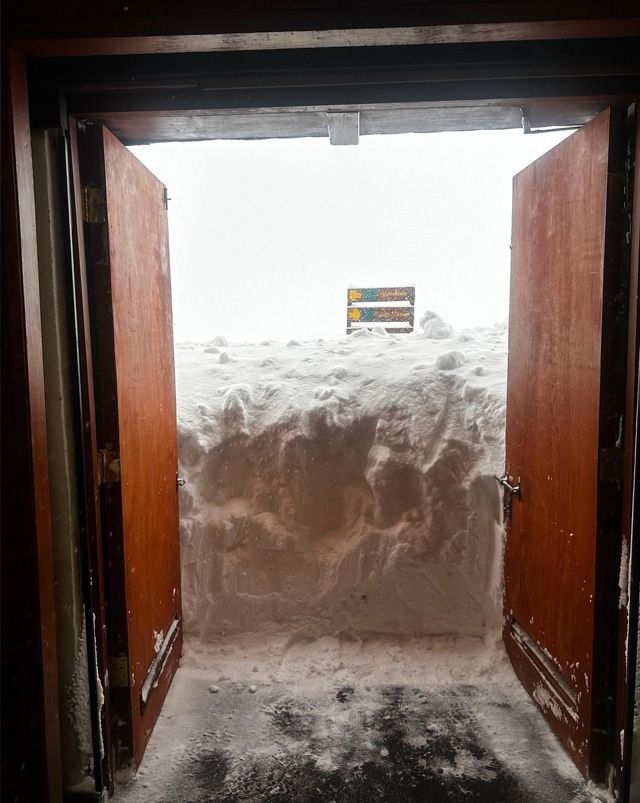
In this photo posted on July 20th, snow is already halfway up an open door at Ski Portillo. Since then, it’s only continued to accumulate in what’s become one of the largest storms on record. Image: Ski Portillo on Facebook
Finally, for our last highlight this week, we’re going to cool things down and take on a story that’s much less taxing on the brain: in Chile, winter conditions have changed dramatically over the last two weeks. The last time we checked in on this story was back on July 17th, just as snow was beginning to fall in the region and mountain passes closed in advance of what was predicted to be a multi-week, historic storm. Also at that time, South America was in desperate need for snow, with Ski Portillo in Chile operating at just 28% of their average snowpack before the storm. Of course, while snow had begun falling at that time and the forecast was promising, many wondered if this storm would actually produce the roughly 150” that was being predicted.
This week, we check back in on the situation down south to see if this historic storm has delivered, and as it turns out, it has. In a special weather update posted by Ski Portillo to their website, the resort reported total accumulations of over 6 feet (192”) as of July 23, 2026. For those of you not in tune with your calendars, that’s just over a week ago. Since then, the most recent report we could find comes from Outside Online, who has set the mark at 213 inches. Looking ahead, OnTheSnow has another 53” of snow coming to Portillo through next Wednesday, at which point things appear to finally slow down. Should that come to fruition, the resort would have received north of 265”, or 22 feet of snow, over the course of 3 weeks.
Now, while plentiful snowfall is certainly welcome at the resort, it’s not without issue. In our previous report, we shared the news that the road to Portillo had been closed indefinitely. As of the time of this writing, it remains closed. While 2-3 weeks of no business is a tough break for any ski area, Ski Portillo offers a unique business model. In addition to offering your standard daily lift access, Ski Portillo also offers all inclusive packages in either 3, 4, or 7 day increments. These packages include not only lift tickets, but also lodging and food. It’s a business model that has led many to compare Portillo to a cruise ship over the years, as guests ultimately find themselves sharing the secluded resort with a cruise ship sized group of people for the duration of their stay. While those packages make it quite easy to book a vacation to Portillo, it’s also easy to imagine how 2-3 weeks of cancellations creates quite the backlog of guests.
Of course with a storm this big it’s not just one mountain that benefits. Snow totals and base depths are up across the entire Andes range, rescuing what had started as a dry winter, quickly transforming it into one that’ll go down in the history books. With more snow on the way, now’s the time to book that flight you’ve been eyeing and get yourself down to South America. To get a read on which resorts have seen the most snow, and which have more on the way, check out the South American Snow Report page from OnTheSnow.com.