


Top Five Fridays: October 17, 2025
When she made her debut on the World Cup in 2022, Ava Sunshine became the first U.S. Women’s Alpine athlete to earn points in her first World Cup start after earning a 21st place finish. Now, after missing the last two seasons due to injury, Sunshine is back on the U.S. Alpine Team’s B-Team. More on that in highlight #1! Image: U.S. Ski and Snowboard Team on Facebook
#1: All U.S. Ski Teams Announced As Start of the World Cup Season Draws Near:

Hello, and welcome to Top Five Fridays, the October 17, 2025 edition! This week is yet another preseason mixed bag, as we have coverage coming from all over the world - ranging from wildly impressive first descents down Everest, to more international skier visit data, regional snowmaking concerns here in New England, and of course, U.S. Ski Team news. We’ll get into the details of all of those stories shortly, but first, we want to ease into winter by kicking things off with a familiar topic: updates from the world of World Cup Skiing.
This week, the U.S. Ski and Snowboard Team officially released their rosters for every ski discipline, including the Alpine Ski Team, Cross Country Ski Team, Freestyle Ski Team, Freeski Team, and Para Alpine Ski Team. As much as we’d love to dive into the nooks and crannies of all of these teams that would take a tremendously long time, and since we tend to find ourselves covering the Alpine Ski Team more than any other team here, we’ll constrict our coverage to just that discipline this week. Of course if you’d like to check out any of the other rosters, simply click the links above! With that said, let’s dive into some roster updates.
For both the Men’s and Women’s teams, the A-Teams look largely the same as last year, which is to be expected. On the Men’s side of things, Bryce Bennett, Ryan Cochran-Siegle, Tommy Ford, Jared Goldberg, and River Radamus are now joined by Ben Ritchie whose strong showing on the slalom circuit last year earned him the promotion. On the women’s team, it’s largely the same group on the A-Team, with seven names reappearing, plus Lindsey Vonn being officially on the introductory roster. As you’ll recall, Vonn took advantage of the new FIS wildcard rule to make her return after the initial roster announcements last season. As for additions, Katie Hensien received a promotion while Isabella Wright was moved to the B-Team.
Speaking of B-Teams, potentially the most exciting and intriguing name on the entirety of the Alpine roster is Ava Sunshine, who is back on the B-Team this year. While it’s been a couple of seasons since Sunshine has competed on the World Cup circuit, she quickly made a name for herself in the 2022-2023 season when the then 20 year old rookie finished in 21st and 27th in her first two slalom races. That following summer, she continued to raise expectations by taking home a first, second, and fourth place finish at the Australian New Zealand Cup. And then, she crashed in training, tearing her ACL ahead of the season. While she was added back to the C-Team last season, she hasn’t returned to racing since that trio of results in the Australian New Zealand Cup. Now, back on the B-Team with a new lease on racing, Ava’s return to World Cup action is chock full of intrigue. To learn more about her story, check out this writeup from SkiRacing.com.
Beyond these highlights, there are dozens of other names joining the B, C, and D teams. While some of these are names we’re all but certain we’ll mention this year - such as Luke Winters or Elisabeth Bocock - there are also sure to be plenty of other new names that we’ll be mentioning for the first time as these under the radar athletes make the most of their World Cup opportunities. To give the U.S. Alpine Ski Team’s roster a full review, you can head on over to the U.S. Ski Team’s official website.
#2: More Adverse Effects: Climate Change Threatens Availability of Water for Snowmaking in New England:
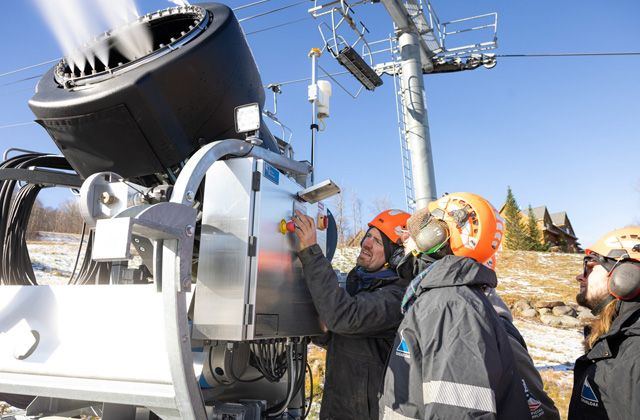
Sugarloaf’s mountain ops team has already started getting the guns ready for winter. Despite concerns surrounding their water supply, the mountain is confident that they’ll be able to create enough snow to have a successful winter. Image: Sugarloaf Mountain on Facebook
Next up this week is some troubling news coming out of New England, where climate change is rearing its head yet again, although this time it’s creating brand new concerns for the region. A couple of weeks back, we came across a story about how Sugarbush Resort’s snowmaking pond is quite a bit lower than usual this year, which could present problems as far as continuing to cover their trails throughout the early season. Still, there was a tone of optimism throughout the piece, and we couldn’t help but also recall some early season water shortages at the resort last season as well. With that all in mind, we didn’t consider the story worthy of full coverage - more just an attempt to fill the preseason ski news void. That is, until this week, when the story grew in scale.
What was a conversation about Sugarbush with a quick mention of Jay Peak just two weeks ago has quickly spread across the region as we’re seeing similar stories coming out of New Hampshire and Maine.
In a report from the New Hampshire Bulletin, we’ve now learned about an array of tactics being used at ski areas like Ragged Mountain and Gunstock, where snowmaking’s growing importance has resulted in an uptick in strategic thinking. At Gunstock for instance the stream that fed their snowmaking pond had run dry as a result of the late summer drought, putting water capacity at risk. As a result, Gunstock has moved on from a longstanding approach to snowmaking in which they would blow enough snow at the start of the year to last the entire season, to a more moderated effort that takes into account their available water supply as well as the fluctuating early season temperatures. With this new approach, they’re able to better manage their resources while also reducing the risk of a weather event eliminating freshly blown snow.
At Ragged Mountain, a bog supplies their snowmaking water, fortunately making the mountain much more resilient to droughts as bogs tend to retain water much better. As such, they focus less on rationing their resources throughout the season, and more on the machines that are using their resources. There, considerable money has been spent on upgrading the mountain’s snowmaking infrastructure in recent years, essentially allowing them to make more snow with less water and energy.
Of course, as we mentioned, it’s not just Sugarbush, Jay Peak, Ragged Mountain, and Gunstock that are facing snowmaking issues. To the north, in Maine, Sugarloaf is sharing a similar story: this year’s late summer drought has left their main water supply running low. While the mountain itself has a reservoir that it can use to blow snow, it relies on the Carrabassett River to keep it replenished. Unfortunately though, that river is also exceedingly low, raising concerns that Sugarloaf might also be at risk of running out of water this season.
While the broader story being told by these reports is certainly troubling, the entire region remains hopeful that water supplies can bounce back with a little bit of rain and some early season snowmelt. Whether or not that happens remains to be seen, but one way or another, each of the mountains covered in this week’s news have their own strategies that they feel confident will help them navigate the dryspell. So, for now, this news is akin to the oil light on your car’s dashboard coming on. We’re not in full blown panic mode yet - everything might be fine - but it’s a story worth keeping an eye on.
#3: New Report Shows Solid Growth in French Ski Industry, Underlining a Global Trend:
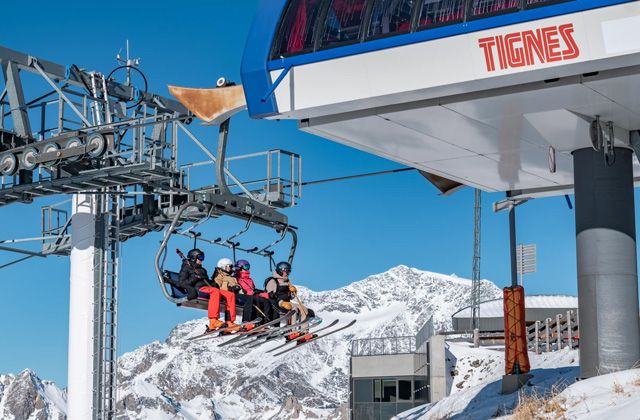
A shot from Tignes, one of several French ski resorts that’s drawing both domestic and international crowds, boosting the nation’s ski economy. Image: Val d'Isère on Facebook
For our third highlight this week, we want to share a story that slid across our screen that we suspect will please some of the bigger ski nerds amongst us. As regular readers know, each May we share a report that reveals the latest results from the prior ski season, often measuring success by the number of combined skier visits at American ski areas. This past year, the report stated that after a total of 61.5 million skier visits, it was the second busiest winter ever for U.S. ski areas, representing a 1.7% increase over the 2023-2024 season. While these are excellent numbers, and recent years have always given us reason to feel good about the status of the ski industry in North America, we rarely have a chance to look around the world to see whether or not the industry is growing on the whole.
A couple of weeks ago we did have that opportunity though, as a deluge of news from China forced us to take notice, sharing multiple articles from the country that indicate a surging ski scene. While skier visits weren’t the focus of that week’s coverage, we do have that information available to us via the China Ski Industry White Paper that we cited. On page 12 of that paper, we can see that the nation hosted just over 26 million skier visits last season, representing a 12.9% increase over the 2023-2024 season. Compared to the U.S.’s 1.7% growth, it’s clear to see that China is in the midst of a full on ski-boom.
This week, the story continued to grow, as we had the rare opportunity to peek inside of yet another country where skiing happens to be growing at a tremendous rate: France.
In a report published by TravelandTourWorld.com titled, “The United States, Germany, And Austria Face Stiff Competition As France’s Ski Industry Sees A Five Percent Growth And Breaks Record In 2024-2025,” we have a chance to learn about the European nations rising industry. In the interest of providing comparable facts, the report states that France hosted 54.8 million skier visits last season, representing a 5.5% increase over the previous season. The article also notes that this represents the world’s second largest ski market, trailing only the U.S. (again, at 61.5 million). Just behind France is Austria, with 52.6 million visits.
The article itself then dives into the details behind France’s season, covering which months and weather patterns led to upticks in skier traffic, as well as ratios regarding international vs domestic visitation. If you’re interested in learning the details, we definitely recommend giving the article a read.
For our part though, we want to zoom out a little bit and make note of one common theme: the ski industry is in the midst of a global growth spurt. While there may be snowmaking concerns here in New England, and China’s skier visitation numbers may be widely propped up by indoor ski visits, the common thread is quite simple: people all across the world are continuing to fall in love with the sport. For organizations like the FIS and the X Games, this is an encouraging sign as they both look to push their brands to new levels of global exposure, creating better career opportunities for their athletes. This take of course is a summation of multiple plotlines, so we can’t exactly defer you anywhere to learn more. Instead, we simply recommend continuing to tune into Top Five Fridays as we bring you all the ski news you could ever need and more!
#4: Jim Morrison Makes First Ski Descent Down Everest’s Hornbein Couloir in Tribute to His Late Partner, Hilaree Nelson:
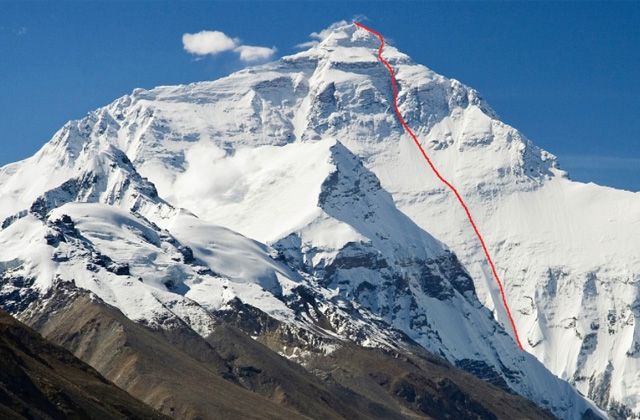
While we’re dying to see the media from Morrison’s descent down the Hornbein Couloir, we’ll have to wait until National Geographic releases their documentary about it. For now, this rough outline of Morrison’s route will have to suffice. Image: ExplorersWeb.com
Finally, rounding things out this week is quite arguably the biggest ski news of the week, if you were to measure that metric by the sheer magnitude of headlines it made. From Nat Geo, to Ski Mag, and even ABC News, one story popped up on our radar far more than any other this week: Jim Morrison has just become the first person to ever ski Everest’s Hornbein Couloir.
Before diving into this story, we want to quickly clarify the difference between this feat and news we shared from Andrzej Bargiel a few weeks back. In Bargiel’s story, he was the first person to summit and ski the mountain without the use of supplemental oxygen. In Morrison’s story, the notable feat wasn’t the lack of oxygen, but that he became the first person to ski down arguably the most harrowing route on earth: the Hornbein Couloir.
Located on the North Face of the mountain, the descent of the Hornbein Couloir has been called the “Most Audacious Ski Run in History.” Not only is it located off the peak of the world’s largest mountain, but the route itself has every terrifying element you could ask for. It’s long, with the entire descent through the Honrbein Couloir and the subsequent Japanese Couloir clocking in at a ridiculous 12,000’ of vertical. It’s steep, with an average pitch of 50°. It’s covered in rocks - at one point Morrison had to repel down 650’ of sheer rock. It’s tumultuous, with plentiful ice and windblown sastrugi that Morrison estimated measured 4’ in height. It’s exhausting, as the entire 12,000’ face took Morrison four hours and five minutes. And lastly, it’s dangerous. The last person to attempt this descent was a snowboarder named Marco Siffredi who tried in 2002. Siffredi died in his attempt, and his body was never found. In other words, accomplishing this feat is truly one of the most extreme things you can do in this world.
Keeping all of that in mind, you might wonder how Morrison found it within himself to conquer this challenge. The answer, as it turns out, is that he had some extra help. In addition to the 11 climbers who helped him summit and descend the peak as part of a documentary for National Geographic, there was a 12th member of the team whose presence mattered to Morrison more than anything: his late partner Hilaree Nelson.
Back in 2022, Nelson passed away while descending Manaslu, another Nepali high peak. Three years after the tragedy, Morrison took on the biggest, riskiest challenge of his career in her honor.
After a long, arduous climb to the summit, Morrison took a moment at the top of Everest to spread honor Nelson’s life, spreading her ashes and having a conversation with her. In speaking with her spirit, Morrison promised that he would ski the world’s most challenging run in her honor. From there, he stuck to his word, locked in with the laser focus and strength required, and accomplished the death-defying feat. While Morrison states that he felt her presence cheering him on throughout the run, it was at the bottom when the weight of the moment finally hit him and tears that represented an unfathomable range of emotions began to flood his face.
At the moment, there isn’t a tremendous amount of media to share from this feat as the entire story was captured by the legendary Jimmy Chin on behalf of National Geographic who plans to release a feature length documentary. When that drops, we’ll be sure to let you know. For now, a huge congratulations goes out to Jim Morrison. We can’t imagine how proud you’ve made Hilaree.
You can read more about this all over the internet, but we found this recap from Explorer’s Web to be one of the best ones.