

Top Five Fridays: October 2, 2026
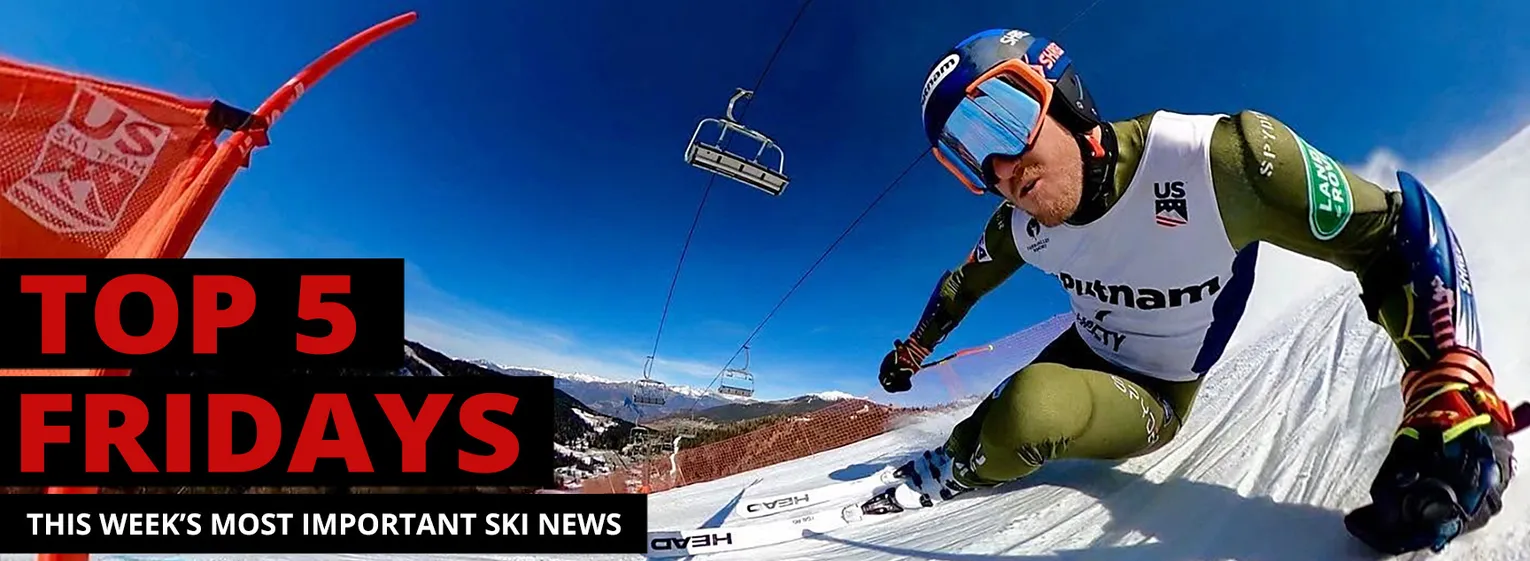
Ted Ligety, is that you? Yup! Despite retiring back in 2021, Ted Ligety is back in the news this week as he adds a massive achievement to his resume. More in highlight four! Image shot via GoPro, sourced from Ted Ligety on Facebook
Hello, and welcome to Top Five Fridays, the October 2, 2026 edition! This week, we’ve got a triple header of financial news as the FIS, Vail, and Nederland, CO have all made headlines due to some financial complications. Truthfully, while these aren’t the most positive stories we’ve covered here on Top 5, each of them contain reasons for hope, and in the case of the FIS, cause for excitement. Once you make your way through these three highlights, you’ll be rewarded with some more exciting news as we share with you the latest inductees into the U.S. National Ski Hall of Fame. While we don’t cover this story every year, the Class of 2026 caught our eye as it’s one of the most loaded classes yet. Curious to see who made the cut? Then keep reading!
#1: With Cash Reserves Rapidly Depleting, FIS President Alexander Ospelt Lays Off Staff While Eyeing an Expanded Competition Schedule:

Another look at the situation room, where big moves get made within the FIS. Image shot by Pierre Teyssot for FIS. Sourced via the Official FIS Website
First up in ski news this week is a pretty eye-opening article from the world of FIS, where new information regarding the organization’s financial situation has come to light that might help explain this summer’s dramatic presidential election.
Let’s cut right to the chase: the FIS is in precarious financial shape. As it stood until very recently, the FIS was on pace to burn through its cash reserves by 2028. That pace came about as a result of a spending spree by outgoing president Johan Eliasch, whose financial management cut cash reserves roughly in half, resulting in only $52 million remaining by the end of last year. As it stands, the FIS is currently operating at an annual loss of about $24 million - hence the roughly two year timeline.
As a result of this rapid depletion of cash reserves, newly elected FIS president Alexander Ospelt has announced two difficult decisions. First, he closed the FIS Munich office in order to reduce the number of FIS employees. Second, he will be ending the FIS’s subsidization of prize money, a practice that was started by Eliasch in the wake of the pandemic. While the first aspect of those two decisions is certainly bad, it’s not the one that’s set to have a ripple effect throughout the winter sports competition scene. Ultimately, it’s the inability to subsidize prize money that will result in noticeable changes.
If you’ll recall our coverage from the election back on June 19th, you’ll remember that prize money was a key consideration in the election. For Mikaela Shiffrin, there was concern that prize money for athletes would decrease, just as the organization claimed to be interested in growing in global visibility. Alongside those comments, we also had some insight from Ospelt, who suggested that he supported increasing prize money, “while emphasizing organizer involvement.” Suddenly, that whole situation makes much more sense. It was likely known by athletes that Eliasch was considering decreasing prize money, almost certainly as a result of the operational deficit. Ospelt, seeing the same challenge but realizing that reducing prize money for athletes wasn’t a realistic option, turned his attention to event organizers to reduce the FIS’s subsidization burden.
Now, here’s where the story becomes a bit more interesting. Just a few weeks ago, on September 11th, we reported that the FIS was considering adding more World Championships to the calendar, giving them an annual “big event” with which to generate significant broadcasting revenue and public interest. As it turns out, this budget deficit and need for an increase in prize money was the impetus for that move. By holding a world championship event every year, the FIS could potentially generate more revenue from its broadcasting agreements.
Taking the concept a step further, we also learned this week that Ospelt has his eye on adding more events to the calendar, saying, “I’m a strong believer that our calendar has more space. We have more interested parties than we have spots today.” For Ospelt, this would be a way to not only generate more broadcasting revenue, but also to generate more prize money by bringing more events into the fold in which organizers are responsible to cover the cash purse.
And as for the broadcasting rights, which were a major point of contention under the Eliasch terms? Well, those contracts are set to expire in 2030, meaning that for now, the FIS is locked in to the terms of their existing agreement. The hope now, is that they can make these calendar adjustments ahead of that contract renegotiation so that when the time comes, they’ll be able to show an increase in value and therefore secure even better agreements.
While subtle, this week’s article from ABC News is particularly interesting as it not only reveals the reasons for the ousting of Eliasch, but also provides some real insights into why the FIS is considering expansions to its calendar, as well as the promise that change may be happening sooner than you think. For more on this, give the full story a read.
#2: Another Earnings Report Reveals a Continued Downward Trend For Vail Resorts:

Image: Epic Pass on Facebook
Next up in the world of ski business is an update that we feel like we’ve shared countless times already, but one that’s a required share as we promise to report the top stories in skiing. This week, to no one’s surprise, Vail Resorts reported yet another round of disappointing sales results.
First things first, let’s take a look at the most recent numbers, shared as a result of Vail’s Q4 earnings report. As of September 18th, sales of Epic Pass products were down 12% as compared to last year. Perhaps even more notable though, is that revenue from passes was also down, 6%. For those of you who follow the Vail financial story, you’ll immediately notice the decrease in revenue as a major red flag here, as historically Vail has been able to increase pass revenue despite the volume of sales declining, by raising the price of their pass products. In June of 2024 for example, it was reported that pass sales were down in volume by 5%, while revenue was up 1%. This time around however, both are down significantly. Compounding that concern is another brutal statistic: net income decreased by about 48% this previous season, down to $147.5 million vs. $280 million the year before. While netting $147.5 million is a pretty impressive number for any business, it’s ultimately the type of trendline that investors watch, and as we know from the ongoing Matthew Prince story, Vail very much cannot afford to lose the support of its investors right now.
As for the concept of optimism, as the face of the brand, Rob Katz has plenty. The root of his optimism, of course, starts with an assessment of why the numbers are so dramatically down. For Katz, that blame lies on the historically bad season, paired with the recency bias of pass buyers. In other words, Katz believes that the significant decrease in sales can be directly linked to the lack of snow last winter. As such, he suspects that most people are in a “wait and see” state of mind, meaning that if it snows, they’ll return to the slopes. Should that happen, it would mean an uptick in day ticket sales, ideally followed by another uptick in Epic Pass sales in the off season. Of course, the cost of a day ticket may prove to be a deterrent as well, but that’s a consideration for a different day.
One additional consideration that should be made alongside this story, is that while this has become a bit of a recurring headline for Vail, that’s largely due to the fact that they’re the only publicly traded ski resort operator. As such, we don’t really know if this is a Vail problem, a multipass problem, or a ski popularity problem. One thing we do know is that Alterra has been experiencing some speed bumps of its own. Back in March, longtime CEO Jared Smith stepped down from his post, and the company is now being led by a committee while it searches for its next CEO. Then, in August, the company laid off an undisclosed number of employees at its corporate headquarters, just as it accepted roughly $11 million in tax incentives to stay in downtown Denver. Now, none of this is explicit proof that Alterra is incurring the same financial difficulties as Vail, but it’s certainly notable that the stories here are more inline with what would occur if revenue was declining rather than if it were increasing.
As always, what happens next remains to be seen. That said, a strong winter across North America would undoubtedly do wonders for both of these businesses, and would at the very least give us a better read on the status of the multipass industry come this time next year. Until then, we’ll defer you to The Aspen Times to learn more.
#3: In Nederland, CO Efforts to Purchase Eldora Are Becoming Increasingly Precarious:

A pair stare at a trail map currently belonging to Powdr Corp. While locals hope to one day own the map themselves, financial complications have arisen, putting the future owner of the resort back in question. Image: Eldora on Facebook
For our third businessy update this week, we bring you continuing coverage from the town of Nederland, CO, where the municipality's unique plan to acquire its local ski hill is becoming more doubtful by the day. As a quick refresher for those of you who may not have caught our previous coverage, the story goes like this: way back in November 2024, the town of Nederland, CO announced that it hoped to buy Eldora Mountain Resort from Powdr Corp. While we didn’t know it at the time, we’ve since come to learn that the purchase price for the ski area is roughly $120 million - an amount that the town initially planned to fund through the sale of bonds. Those bonds would then be repaid using profits from the ski area itself, creating a clean pathway for the town of approximately 1,500 residents to purchase the ski area without any significant increase in taxes. At first, the plan was extremely promising and all signs pointed to Nederland executing on a novel concept that could potentially be replicated across other ski town municipalities.
And then, the story dragged on. Earlier this summer, nearly 1.5 years after the story initially broke, we learned that the process was taking longer than expected. At that time, we reported on rising pre-purchase costs as the town worked with multiple experts to ensure that the planning and legal process for the acquisition and ongoing operation of the resort were all above board and executed flawlessly. While necessary steps, the price tag had grown to approximately $1.1 million - a sum of money that would mostly be recovered by the sale of bonds, but could potentially fall on the local taxpayers should the deal fall through.
Fast forward to this week, and we’re now learning both a bit more about why the entire process has been a bit delayed, as well as some last ditch efforts being attempted in order to save the plan.
First things first, the long-term delay ultimately boils down to the one part of this plan that was always the lynchpin holding the entire thing together: the sale of bonds. As it turns out, while selling $120 million in bonds would absolutely cover the cost of the acquisition, actually selling those bonds has been more challenging. Prior to making these bonds available for purchase, Nederland has been doing their due diligence of lining up buyers ahead of time to make sure they’ll meet their goal. In doing such, they’ve found a bit more resistance than expected as potential buyers have expressed concerns regarding the risk of their investment and ability for Nederland to pay them back. Now, this kind of consideration is par for the course for any savvy investor, but there’s one factor at play here that’s unique to skiing and impossible to ignore: Colorado’s historically bad 2025/2026 ski season. The timing of this past season alongside this project is impossible to deny as one of the requests being made by potential bond buyers is more aggressive financial forecasting during bad winters. In other words, they want to see what would happen if last winter repeated itself, potentially more than once. Before buying into the project, they want to make sure that the financials are airtight, even in a worst case scenario.
That’s all well and good, but it brings about some real issues for the planning committee. As it stands, Nederland’s purchase agreement with Powdr has expired. While the two organizations continue to work with each other in hopes of getting this deal across the finish line, Powdr has also voiced concerns with how long the process is taking, suggesting that they may begin searching for another buyer. That’s creating a sense of urgency for Nederland.
As a result, the town has begun pivoting, deciding to attempt to attract both philanthropic donations and/or grant money from the state of Colorado itself. On the philanthropic side, Nederland hopes they can convince a few individuals to make a non-repayable contribution in return for things like naming rights of trails or chairlifts. In terms of government contracts, the town of Nederland has been in direct contact with Colorado governor Jared Polis’s office. While they’re still waiting on a response, their hope is that the state and/or philanthropic donations will help them raise $20 million. If they’re able to do that, they can reduce the amount of bonds that they’ll need to sell, thereby also reducing the pressure on repaying the bonds, thus making the investment safer.
As it stands, the deal between Nederland, CO and Powdr remains a possibility, albeit one that’s declining in likelihood by the day. With Powdr growing anxious to sell the resort, an expired purchase agreement, and a last ditch effort to secure donations, there are a lot of variables at play here, casting a shadow of doubt upon a once promising story. As always, we’ll report back when new information emerges. For now, head over to the Denver Post to read the full story (although, you’ll need to buy a $1 account, which increases dramatically in price after a year). To learn more about the business risks being taken by Nederland, check out this op-ed from Ski Area Management.
#4: The U.S. National Ski & Snowboard Hall of Fame and Museum Has Just Announced it’s Class of 2026!:
In 1997, Brad Holmes released the film, “Natural Born Skier,” featuring himself and Glen Plake. Since then, the movie has become a cult classic and is just one of the many, many reasons Holmes has been inducted into the National Ski Hall of Fame.
For our final highlight of the week, let’s set our business caps aside and focus on a story that’s a bit more fun and lighthearted. This week, the U.S. National Ski & Snowboard Hall of Fame and Museum announced its Class of 2026, and this time around, they landed some big ones.
Going through the list, you’re sure to recognize several of the names - something that doesn’t happen in every class. Here on Chairlift Chat, myself (Matt McGinnis), Jeff, and Bob were all pretty tapped into what was happening with freestyle skiing back in the 90s and early 2000s. At that time, there were several freestyle skiers taking their rowdy and seemingly reckless approach to big mountain terrain. Glen Plake, Shane McConkey… Brad Holmes. This week, the Hall of Fame honored Brad Holmes by officially inducting him in its Class of 2026. Amongst his many accomplishments, the U.S. National Ski Hall of Fame lists the fact that he was the youngest person to ever join the U.S. Ski Team when he joined in 1984 at the age of 15. From there, he went on to win over 70 events, including a world championship. Of course for many of us, it wasn’t Holmes’s competition results that made him a core part of freeski culture, but his larger than life personality. In addition to his competitive success, Holmes went on to become one of the main faces in early Matchstick Productions films, eventually even being the star of a lesser known short flick called, “The People vs. Brad Holmes.” All told, Holmes was undeniably one of the most prominent faces of the pre-newschool ski movement, and a spot in the Hall of Fame seems fitting.
Of course in the early 2000’s, if you were an avid skier but weren’t involved in the freestyle scene, chances are you were locked in on the world of alpine racing, where the U.S. Ski Team was in the midst of a golden era - particularly on the Men’s side. Joining Brad Holmes in this year’s class is Ted Ligety, one of the most accomplished U.S. Men’s alpine racers of all time. While his list of accolades would far exceed our capacity here on Top 5, some highlights include Olympic gold medals in 2006 and 2014, 5 world championship gold medals, and 25 World Cup gold medals. You could certainly debate which of his many accomplishments are most impressive, however his appearance in the 2013 world championships at Schladming would absolutely have to be a frontrunner in the conversation. Afterall, he won the gold in three separate events, becoming just the fourth man to ever accomplish this, regardless of nationality.
In addition to these two great athletes, another legendary pair was also inducted this week: Jim Morrison and Hilaree Nelson. If you’re a regular reader of ours, you likely know both of these names as we’ve covered them various times throughout the years. Acting as both life partners and ski mountaineering partners, Morrison and Nelson became one of the most accomplished duos in the sport of high elevation ski mountaineering. Together, they bagged numerous high peaks throughout the late 2010’s, including the first ski descent of the Lhotse Couloir from the summit in 2018. That feat earned them National Geographic’s award for “Adventurers of the Year.” Unfortunately, their time together came to a terribly tragic end as Hilaree Nelson was caught in an avalanche while the pair was skiing down from the summit of Manaslu in Nepal. Nelson unfortunately lost her life in the accident. In the wake of her passing, Morrison continued his mountaineering efforts in her name, culminating in a successful summiting of Mount Everest in 2025, where he spread some of Nelson’s ashes before becoming the first to ever ski the mountain’s Hornbein Couloir - a feat he dedicated to her. This experience was captured by the legendary Jimmy Chin in a National Geographic film called, “Everest: The Other Side.” Now, the two are forever immortalized together in the Hall of Fame.
Beyond these three highlights, five additional and equally deserving people were inducted along with the 2026 class. Included in that group are the Hall of Fame’s founder, Dave Holli, legendary ski photographer Scott Markewitz, longtime and highly influential K2 CEO Tim Petrick, highly decorated paralympic athlete Stephani Victor, and CB Sports founder / one time speed record holder C.B. Vaughan Jr., who went 106.53 miles per hour on skis back in 1965.
And with that, we present to you the official U.S. National Ski & Snowboard Hall of Fame and Museum Class of 2026! Congrats to all inductees on the accomplishment! To learn more, check out the recap from Ski Area Management, or head straight to the Hall of Fame’s website.
#4.5: Beloved Freeride Athlete Juliette Willmann Has Passed Away as a Result of an Avalanche in Argentina:
Before moving onto the Edits of the Week portion of our weekly recap, we want to briefly share one tragic piece of news that came across our desk this week: former Freeride World Tour athlete, current Blizzard / Tecnica athlete, and by all accounts absolute gem of a human being, Juliette Willmann, has passed away in an avalanche in Argentina this week. As always, the absolute last thing we ever want to do here on Top 5 is mix human tragedy with marketing, and so we won’t dive any deeper into this story. Instead, we’ll simply share this edit from Juliette on YouTube, and point you over to Powder Magazine to learn more.
Rest in peace Juliette, and thank you for sharing your passion for skiing with the world.