


Top Five Fridays: September 18, 2026
This weekend, the Snow League season gets underway with its first ever World Challenge event, complete with an intriguing 720 spin cap in the semi-finals. Get a quick preview in bonus highlight #4.5! Image: Freeskier Magazine on Facebook.
Hello, and welcome to Top Five Fridays, the September 18, 2026 edition! We’ve got a fun one for you all this week, as a wide range of topics have fallen in our lap, meaning there’s sure to be something for everyone in this week’s round up! Kicking things off, we’ll start by recapping this week’s Winter XGL draft, which will go down in history as the year in which the X Games officially overhauled their business model. Speaking of business, our second highlight is a new chapter in the Vail vs its activist investors saga, as ski legend Picabo Street has just been nominated as a candidate for the board. From there, we’ll dip our toes into the world of science, as we talk chemistry and meteorology as it pertains to snow. Finally, we’ll complete a quick bonus highlight containing two stories we think should be on your radar before sending you off into the weekend with a series of excellent edits. If you feel like this is the right time and place to expand your knowledge of the ski world, simply continue on!
#1: The First Ever Winter XGL Draft is in the Books. Here’s How it Played Out:
Relive the excitement of the first ever Winter XGL Draft, with this full replay.
First up, as promised back on August 21st, is coverage from the first ever Winter X Games League draft! As you undoubtedly know by now, the X Games is transitioning to a league format this season, complete with multiple stops and four teams consisting of 10 athletes apiece. Being a brand new entity, this season kicked off on Wednesday with the first ever Winter XGL draft. Coming into this event, we had an idea of the structure the draft would follow, but with 198 free agent athletes competing for 40 roster spots, there was plenty of curiosity in terms of how things would actually play out. Now that it’s in the books, let’s recap some of the highlights!
First and foremost, it absolutely has to be acknowledged that Eileen Gu was the first ever Winter XGL athlete to be drafted, going to XC Golden State with the first pick of the first round. Say what you will about Gu’s decision to compete for China in the Olympics or to split her time between skiing and modeling - the fact remains, she’s undeniably one of the most consistent X Games athletes, regardless of gender or discipline. With her ability to compete in a number of events, she makes perfect sense as the top pick.
In addition to which athlete would be drafted first, one of the other big questions we had was how each team would weigh their roster. While we knew that the X Games required each team to select one male and one female athlete per round, nothing was implemented to ensure equality between disciplines. In other words, it would have been entirely possible for one team to only select skiers or to only select snowboarders. Without that guardrail in place, we were curious to see what would happen or if any unique strategies would emerge. As it turned out, each team chose to remain mostly balanced, either selecting an even mix of 5 skiers and 5 snowboarders, or straying ever so slightly into 60/40 territory.
Finally, the third element of this draft that we found particularly intriguing was the list of athletes who didn’t get drafted. Now, to be fair, one of the parts that leaves something to be desired about this new league is that a pool of 40 athletes, split equally between genders and roughly evenly between skiing and snowboarding, ultimately means that roughly only 10 athletes per specific category will go drafted. In other words, roughly 10 snowboard women, 10 ski women, 10 snowboard men, and 10 ski men were drafted. That leaves a ton of talent competing as free agents, meaning their success would earn the athlete medals and prizes, but would also rob the four teams of a point earning opportunity. As such, the list of undrafted athletes is just as intriguing as they could play the role of spoiler throughout the season. While the data here is pretty scattered, the team at Snow Brains has taken the time to comb through it and identified some of the best undrafted athletes. In addition to their effort, we also took not of names like Colby Stevenson, Nick Goepper, and Jesper Tjäder who shockingly didn’t make a team. Truthfully, we haven’t had time to go through the rosters with a fine tooth comb, so the list of potential spoilers is almost certainly even longer. If you’re interested in reviewing this dynamic, you can see the full list of eligible athletes here, as well as a comprehensive list of rosters here.
Beyond the draft itself, the X Games also released the official calendar for its three stop season. As expected and previously announced, the X Games will kick off in Buttermilk, Aspen, its longtime home, from January 29-31, 2027. From there, the event will head north to Calgary for its second stop, from February 19-21st at the city’s WinSport Olympic Park. Regular readers of ours might remember WinSport as one of the sports complexes set to receive a massive influx of government funding to support infrastructure projects. Events like this show exactly why that makes sense. Finally, the games will take a month off before heading far to the east, where Ruka, Finland will host the final stop from April 9-11th. At the conclusion of that event, we’ll know which team has won the first ever XGL Winter Season. All in all, it’s an exciting, or at the very least intriguing, time to be an X Games fan. To learn more, head over the X Games official website.
#2: As Vail Pledges to Retain Control Over its Resorts, Activists Investors See an in, Nominating Picabo Street as a Candidate For the Board of Directors Vacancy:
Picabo Street, the OG of the Women’s Alpine Team, has just been nominated as a candidate for Vail’s board of directors.
Next up this week, is a much denser topic that starts with a pretty exciting headline: ski racing legend Picabo Street has been nominated to the Vail Resorts board of directors. Now, as you can probably guess, there’s far more to this sentence than meets the eye, so let’s take it from the top.
Back on September 2, 2026, Vail announced that 11 year board member Sue Decker would be stepping down from her role. While there’s some legal complexity involved in what happens next, the long and short of it is that Decker’s departure clears the path for a new board member to step in in early 2027. As such, Vail has begun their search for a new board member to fill the role. That said, being a publicly traded company, decisions like this aren’t entirely at the sole discretion of Vail Resorts.
Enter: Oasis Management, a global investment manager who currently owns an estimated 6-8% of Vail’s stock. Last Friday afternoon, just as we clicked the publish button on last week’s Top 5 Fridays, Oasis announced that they had proposed the nominations of four different people to the Vail board: Robert A. Chapek and M. Ashton Hudson from Florida, as well as Bryce Roberts and Picabo Street from Park City. Now, no disrespect to Bryce, Robert, or M. Ashton, but for skiers everywhere, Picabo Street’s name sticks out the most.
While we’re not intimately familiar with the credentials of the three men who received nominations, we do know quite a bit about Picabo’s story. Way back in the mid 1990s Street put the U.S. Women’s Ski Team on the map, winning a silver at the 1994 Winter Olympics and gold at the 1998 games. While more recent legends like Lindsey Vonn and Mikaela Shiffrin have continued to carry that torch, it was Picabo Street who paved the way for their success. After her illustrious career, Picabo continued pushing the sport forward by starting her own ski academy in Park City, appropriately called the “Picabo Street Academy”. Now, with her city in the spotlight and an opportunity to join the board, Picabo is voicing excitement for the idea of using her potential role as a way of spreading her love of skiing to countless people. At the very least, it seems as though Street would add the voice of a devout skier to the board.
Of course, there’s a lot that has to happen before that becomes a reality, and it would seem as though Vail is uninterested in going in that direction. While investors are able to nominate candidates for the board of directors, as Oasis has just done, the next step is in the hands of Vail as it’s up to their current 9-member board of directors to approve nominations for the 10th member. Once that happens, the approved nominations will then be up for a vote amongst shareholders.
Taking a moment to zoom out, it’s important to realize how this story connects to previous reports of Matthew Prince’s efforts to force the sale of Vail assets like Park City via activist investors. In this case, Oasis is seen as an activist investor as they’re promoting their own candidate to the board. Doing so is crucial, as the goal of the activist investor takeover approach is to collect enough shareholders to force the board to vote on the direction of the company. A vote like that only makes sense if the board is stocked with members that are sympathetic to the cause of the activists. It’s our understanding that Oasis’s nominations hope to accomplish just that: placing a member on the board who could help sway a vote in favor of Vail offloading assets. While it’s an intriguing development, this story has a long ways to go before any significant changes occur. As always, we’ll stay tuned for more information regarding this story as it emerges. Until then, check out the latest report from ParkRecord.com.
#3: A New Type of Avalanche Control System is Gaining Momentum Thanks to a Mix of Hydrogen and Oxygen. Meet, the “Boom Woosh”:
The amount of niche, creative scientific applications being explored by the team behind Alpine Infrastructure is fascinating. Here, they team up with a college student who’s pursuing his masters to measure the power of different avalanche mitigation techniques using soundwaves.
Moving onto highlight number three this week, we bring you a story that we think is just downright cool. Over the summer, we’ve found ourselves discussing a mini-theme of skier safety in the backcountry. From new beacon technologies, to tree-well alert systems, and even avalanche drones, we’ve covered several topics now that share new, novel ways to improve your odds of survival while chasing powdery bliss. This week, we have yet another story on that subject, as The Colorado Sun has shared an article covering an increasingly popular avalanche mitigation system delightfully called the “Boom Woosh.”
Earlier this month, a company called Alpine Infrastructure used helicopters to drop off the supplies needed to install 5 new avalanche control systems at Crested Butte Mountain Resort. Based solely on appearances, these new avalanche control systems appear to be more or less the same as tried and true remote controlled mitigation systems from brands like Gazex and Wyssen. That is, the Boom Woosh towers also look like a pipe-based system meant to aim an explosion at a mountain slope, thereby triggering an avalanche. And, effectively, the systems are the same, but with one key difference: rather than being propane based, the Boom Woosh system uses a mix of hydrogen and oxygen.
For years, a man named Eric Bressler worked for companies servicing Gazex and Wyseen avalanche towers. In doing so, he spent countless hours accessing these remote installations, servicing and refueling them. As the story goes, sometime in 2021 as he was in the midst of yet another high-alpine service job, Bressler began contemplating ways that he could improve these systems to reduce the amount of high-risk work he was involved in. That, reportedly, is when he realized that refueling them was one of the most difficult aspects of their maintenance. As it stood, the most popular options required either supplying explosives directly to the towers via helicopter, or pushing propane uphill through a system of pipes - something that is particularly challenging in the cold. That’s when it hit him: instead of using propane, an explosive mix of hydrogen and oxygen could also be used to trigger an avalanche, and would be much, much easier to push uphill. In that case, refilling the mitigation devices could be accomplished from base elevations, greatly reducing the amount of on-mountain time required for maintenance. And arguably the best part? The only byproduct of the explosion would be water.
Armed with an idea, Bressler built an initial prototype using an old discarded lift tower from Jackson Hole resort and a bunch of valves he bought on Amazon. A couple quick test explosions later and by 2022 he was installing prototypes at Jackson Hole.
In the four years since those initial test explosions, Bressler’s idea has continued to take root. Last year, he capitalized on the idea by establishing Alpine Infrastructure, the business that sells the Boom Woosh systems. Since then, he’s been busy installing these new systems in locations like Park City, Wolf Creek, and now, Crested Butte. Looking ahead, Bressler already has more installations heading to Mammoth Mountain, while the Colorado Department of Transportation is in talks with him as they look to expand their fleet of avalanche mitigation systems. For CDOT, as well as all of Bresseler’s customers, the value proposition of the Boom Woosh system is a huge draw: being able to refuel the guns from base elevation, without needing to send workers to the tops of remote mountains, offers massive benefits from both a cost and safety perspective.
All in all, we love how effective the simplicity of this idea is. It’s a classic, “how did no one ever think about that?” scenario. Afterall, the mechanics of longstanding avalanche mitigation systems have worked just fine, it’s been the refueling side that’s been challenging. Meanwhile, the solution has been sitting in plain sight ever since the Hindenburg blew up in 1937. With its “lighter than air” and highly explosive characteristics, Hydrogen mixed with Oxygen has been an option this whole time. Now, one man has realized it and is turning it into a mechanism to make avalanche conditions safer for not only skiers and snowboarders, but for those who trigger the mitigation efforts as well. For more on this, check out the story from The Colorado Sun.
#4: $5.9 Million Grant Enables Three New England States to Modernize Their Snow Tracking Infrastructure:
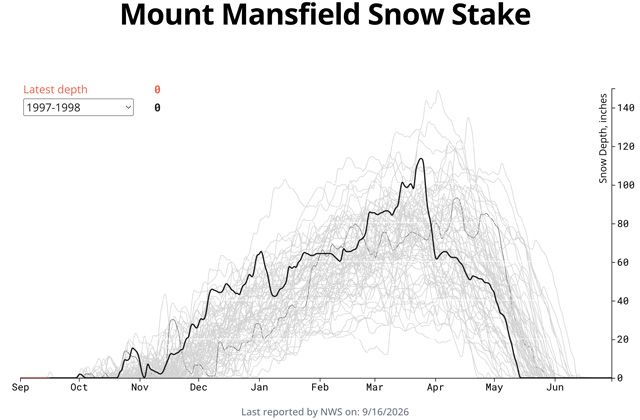
A quick look at the chart showing historic snowfall data at the Mount Mansfield snow stake. Here, we've selected data from the 1997-1998 season, which is the best equivalent to this season's El Niño conditions. Screenshot taken from MatthewParrilla.com
For our fourth highlight this week, we’re sticking with the science theme as we bring you news from our own neck of the woods. This week, we learned by way of Vermont Public that universities in three New England states are teaming up to bring some much needed meteorological updates to the region. In the report, it’s announced that the University of Vermont, as well as universities in Maine and New Hampshire, are co-recipients of a $5.9 million grant provided by the National Science Foundation meant to help the three states roll out comprehensive snowpack measurement devices, bringing long overdue modernization to New England.
As it stands, snow reports across the three states have historically required boots in the snow, hands on inspecting. In some cases that might mean the researcher is measuring the moisture content in the snowpack, while other stations are simple depth measurements. Here in Stowe, for instance, we have one of the most prolific snowpack measuring stations in the region, with the Mount Mansfield Snow Stake. That stake has, by nothing short of a miracle, been observed on nearly every relevant day since the 1954-1955 season. Think about that: one of the most reliable data centers for snowfall measurement in Vermont has required nearly daily winter visitation for over 70 years. While this week’s news likely won’t change the Mansfield snowstake itself, it does add some perspective regarding how badly needed this update is.
With that in mind, what type of new measuring systems should we expect to see from this project? Well, it sounds like there will be several different tools deployed, but the highlight is arguably the introduction of “snow pillows” to various ranges, locations, and elevations across the three states. These snow pillows are specialized pieces of equipment that measure the moisture content of snow that lands on it. While this measurement is helpful to skiers and snowboarders who are wondering if the recent snowfall is blower, or more akin to cement, the real value in it is that it gives weather forecasters information regarding how much liquid is being held in the mountains. As those of us in New England are unfortunately well aware, our winters aren’t always below freezing from start to finish, and a mid-winter rainstorm has the potential to cause rapid snowmelt and flooding. By having a better understanding of just how much moisture is locked up in the snowpack, meteorologists will have a better ability to forecast flood risks resulting from wet winter weather.
Of course, there are some specific ski industry tie-ins as well. As you know, this year is set to be the year of Super El Niño. While weather is unpredictable by nature, there are some strong historical indicators of what that might mean in different areas in the West. Here in New England though, it’s much more of a grab bag - especially with limited access to historical data. In fact, our current best guess is based on the Mansfield Snow Stake reports from 1997-1998, which is the closest recent equivalent we have. All of this is to say, the introduction of widespread snowfall measuring can help the New England ski industry get a better read on what to expect with specific weather patterns, as well as keeping an eye on longer term trends. While that is useful information for us as skiers, it’s also extremely important in regards to keeping the $1.6 billion Vermont industry as healthy as possible as we continue to trend towards less predictable winters and potentially less snowfall.
All told, we’re simply excited to know that we’ll soon have access to all the nerdy meteorological data we could ever want. To learn more about this project, check out the report from Vermont Public.
#4.5: Bonus Highlight - Olympic Alpine Venues Have Been Announced & The Snow League Kicks Off This Weekend:
Before wrapping things up this week, we want to very quickly share two additional stories with you that didn’t quite make the cut this week, but we think you might be interested in regardless. First, is a venue announcement from the 2030 Winter Olympics, as Courchevel and Val d’Isère have been named as the two host venues for alpine races. For plenty of additional details regarding that story, check out the report from SkiRacing.com.
Second, we want to remind you that this coming weekend is the first stop of this season’s Snow League, the halfpipe-only ski and snowboard competition. We briefly covered this about a month ago, sharing not only this particular stop’s unique “world challenge�� format, but also the intriguing 720 spin cap rule put in place for the semi-finals round. We’ll likely report back next week with a recap of results, but wanted to put out a reminder in case anyone wants to watch it live this weekend! If that sounds like you, check out the Snow League website for more information.